Children Skin Conditions That Need Pediatric Evaluation
A pediatrician can spot serious skin disease where parents see minor rashes.
Why childhood skin conditions don't behave like adult ones
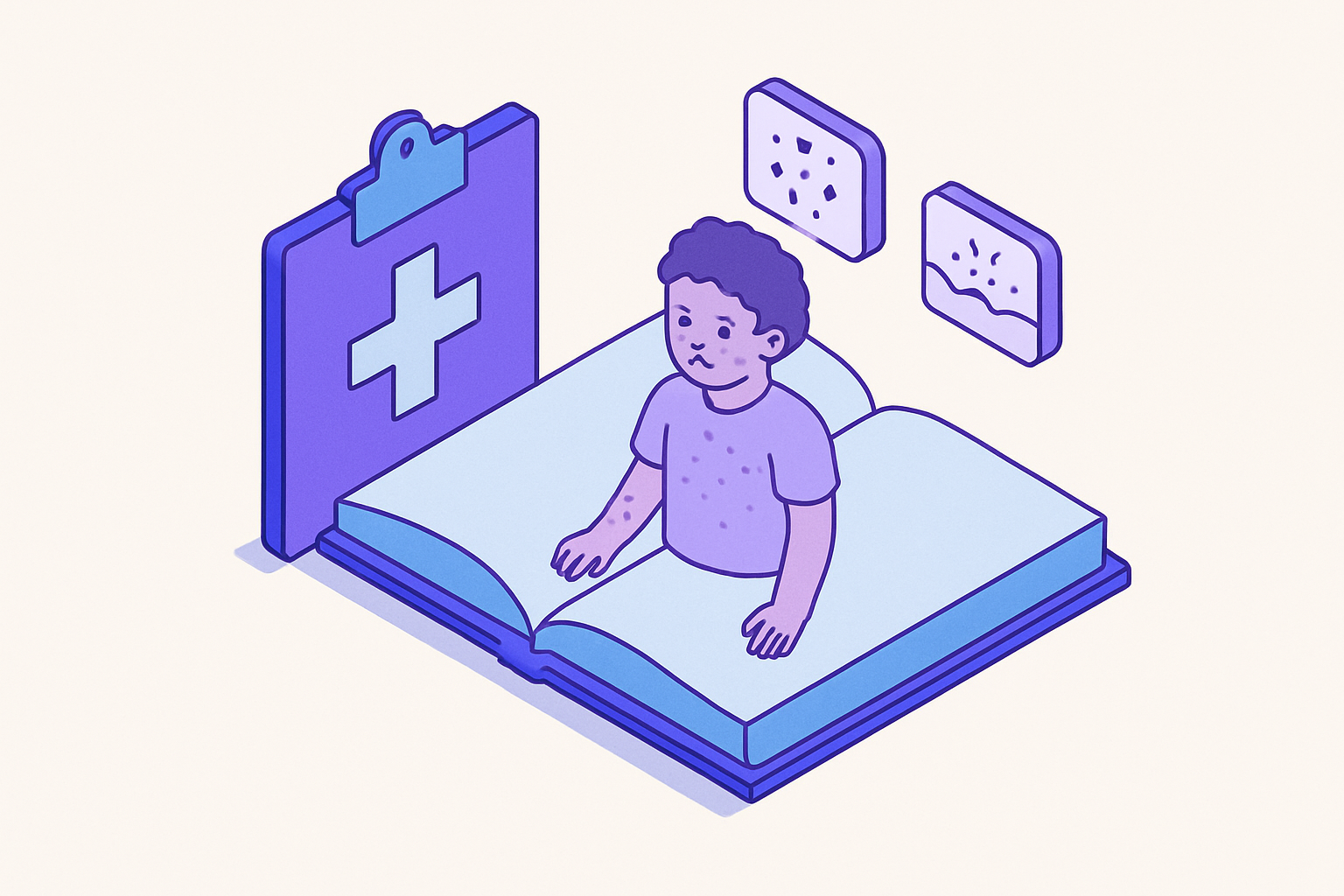
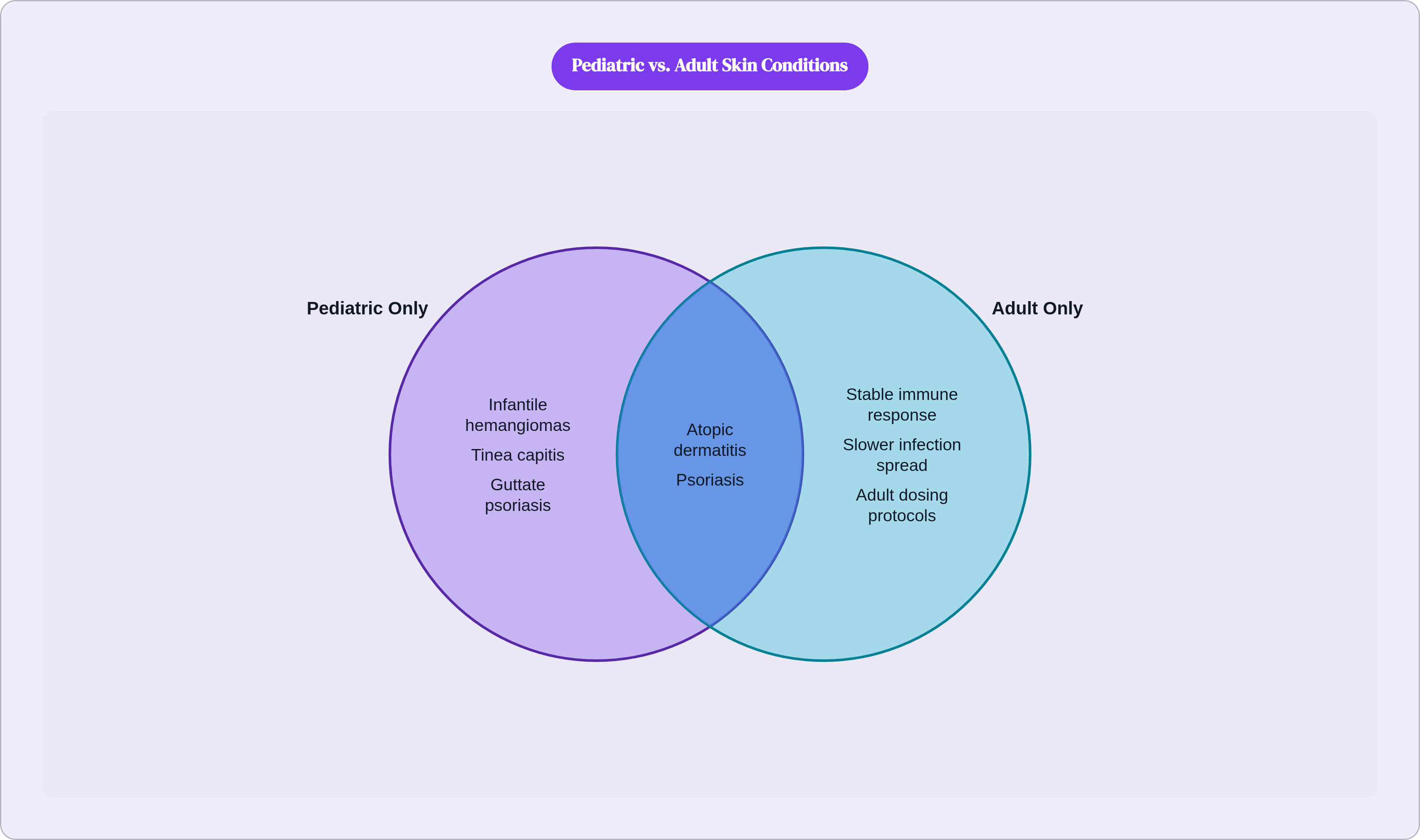
There's a shorthand people reach for: a rash is a rash. Pull up a symptom-checker image, match the picture, follow the advice. The problem is that pediatric skin disease doesn't map cleanly onto the adult version of the same condition. Some diseases are exclusive to childhood entirely. Others that exist in adults present so differently in young skin that comparing them is, at minimum, unreliable.
The immune system is the core reason. Children's immune systems are still under construction, which means infections spread faster, inflammatory responses run hotter, and a condition that smolders quietly in an adult can erupt aggressively in a six-year-old. Some things that look minor on the surface, a spot, a patch, a rash that doesn't quite resolve, can be the first visible signal of a deeper systemic or genetic issue. That's especially true in infants and toddlers, where the skin often speaks before other systems have had a chance to.
Skin tone matters here more than most general-audience articles acknowledge. Children with darker skin tones more frequently present with papular variants of conditions like atopic dermatitis. Pityriasis alba, tinea versicolor, and traction alopecia appear disproportionately in children of color, and misidentification is common enough that it constitutes a genuine clinical problem, not a footnote. Accurate diagnosis depends on clinicians trained to recognize these presentations, and on parents who know to push when a diagnosis doesn't feel right.
The American Academy of Dermatology's first pediatric-specific guidelines for atopic dermatitis made something formal that practitioners already knew: children need separate clinical guidance. Not a scaled-down version of adult protocols. Dosing, safety profiles, the reality that a parent is applying the treatment in a rushed morning routine. All of that requires its own framework.
Eczema: the most common condition, and the one most often mismanaged at home
Atopic dermatitis affects up to a quarter of children worldwide. Forty-five percent of cases develop by six months of age. Most parents encounter it before their child can articulate that something's wrong, which means the parents are doing the interpreting, and they're usually doing it without a lot of useful context.
Here's what home management typically looks like. The rash appears. Parents moisturize. The skin improves briefly, or appears to. Then it returns, sometimes worse. That cycle of flare and remission is intrinsic to the disease. It isn't a sign that the moisturizer wasn't good enough. The condition needs actual clinical management.
Recent guidance has been fairly blunt about this: moisturizers alone receive only a conditional recommendation for prevention in children six months to three years old. For active disease, the threshold is clearer. This needs medical attention, not a better cream.
The signs that should prompt a call to the pediatrician rather than another week of waiting: itching disrupting sleep or school, spreading or worsening rather than cycling, yellow or honey-colored crusting, pus, oozing, or clusters of small blisters. Each of those is the condition moving in a direction that self-management won't redirect.
There's also something that often goes unaddressed in the conversations families have with their doctors. Children with atopic dermatitis carry elevated risk for anxiety, depression, ADHD, and autism spectrum disorder, with sleep disruption identified as the most consistent mediating factor. The skin and the psychological downstream aren't two separate problems. They're causally linked. Treating the skin is part of treating the whole child, and framing it as just a rash does the family a real disservice.
Impetigo and ringworm: contagious infections that spread fast in school settings
Schools are, structurally, excellent environments for transmission. Close contact, shared surfaces, immune systems still building their defenses against common pathogens. Infectious skin conditions account for roughly a third of skin disorders in school-aged children. Spend twenty minutes in a kindergarten classroom and the proportion stops being surprising.
Impetigo, caused by Staphylococcus aureus or Streptococcus pyogenes, presents as red sores near the nose and mouth that crust into a honey-colored scab. It can resolve without treatment. But antibiotic therapy, topical or oral, prevents new lesions and cuts off the risk of more serious complications. Waiting it out risks spreading it to classmates and siblings, and secondary infections are a real possibility. The case for treatment is stronger than the case for patience.
Scalp ringworm is where the specific mistake gets made. Tinea capitis is among the most common culture-positive dermatophyte infections in children, concentrated in the six-to-ten age group. The error parents make, reliably, is treating it like body ringworm: applying an over-the-counter antifungal cream and expecting resolution. Topical treatments don't penetrate the hair follicle. Scalp ringworm requires oral antifungal medication, and two weeks of applying cream before finally coming in is just time lost.
Spreading sores, scalp patches with hair loss, a household contact who's also symptomatic: any of those should prompt evaluation rather than continued home management.
Scabies and molluscum contagiosum: two infestations parents frequently misread
Scabies carries stigma it hasn't earned. It's caused by a microscopic burrowing mite and spreads through prolonged skin-to-skin contact. It has nothing to do with hygiene, a point worth stating plainly because the assumption runs deep. Children and infants represent one of the largest affected populations.
The key signal is intense nighttime itching, particularly between the fingers or in skin folds. That nocturnal pattern distinguishes it from most other itchy conditions. The treatment trap is this: families treat only the child who's scratching. Scabies requires simultaneous treatment of all household members, regardless of whether anyone else is symptomatic yet. Treat one person while the mite continues cycling through the house, and the child you treated gets reinfested. The infestation doesn't end; it just restarts.
Molluscum contagiosum operates on a different timeline and a different logic. It's a poxvirus, spread by skin contact or shared surfaces. Young children are particularly susceptible because they haven't yet developed immunity. The lesions are pinkish-white bumps with a small central dimple, typically on the torso, arms, or legs. They're not dangerous. They're also slow to go; without treatment, they can persist for months or years.
Molluscum often resolves on its own, and treatment isn't always necessary. When lesions are spreading, causing distress, or appearing near the eye, evaluation makes sense. The misjudgment parents fall into is binary: either dismissing it entirely or treating it as urgent. It's neither. It needs an informed conversation with someone who can actually assess the situation.
Psoriasis and hives: conditions that look different in children than in textbooks
Up to one-third of people with psoriasis have their first episode before age twenty. This is not an adult disease with occasional pediatric exceptions. In children, it frequently presents as guttate psoriasis: small teardrop-shaped lesions distributed across the trunk and limbs, often triggered by a group A streptococcal throat infection. A sore throat followed days later by a sudden, widespread rash is a combination that should prompt evaluation — not simply continued strep treatment, not a wait-and-see approach.
Getting the diagnosis right matters beyond the skin itself. Pediatric psoriasis carries a higher risk of metabolic syndrome compared to the general pediatric population. Correct identification enables monitoring for those comorbidities and opens access to biologics and oral small molecules increasingly used in pediatric care. A misdiagnosed or undertreated child doesn't just suffer cosmetically; they miss interventions that could meaningfully change the disease's course.
Hives are the simpler case, until they aren't. Most urticaria in children responds to antihistamines and clears within days. The critical distinction is when hives arrive with difficulty breathing, facial swelling, or throat tightness. That combination is anaphylaxis. It requires emergency services immediately, not a next-day appointment.
Birthmarks, hemangiomas, and moles that need more than watchful waiting
The majority of birthmarks are benign. That's true, and it's also incomplete as a working framework, because certain features are reliable signals that primary-care monitoring isn't sufficient.
Congenital melanocytic nevi under 20 centimeters can generally be observed in primary care. Larger birthmarks, or children with multiple birthmarks, should be referred to a pediatric dermatologist because of elevated melanoma risk. Infantile hemangiomas can require systemic beta blocker treatment when they risk functional impairment, ulceration, scarring, or interference with critical structures: the eye, the airway, the lip. Location drives urgency here more than size does.
Six or more café-au-lait spots is a number worth knowing. That count warrants a workup for neurofibromatosis, a genetic condition that requires evaluation well beyond cosmetic reassurance. Port-wine stains on the face are associated with underlying vascular or neurological conditions. Dismissal isn't the right response.
The referral triggers that apply across all of these lesion types: growing, bleeding, ulcerating, changing color, or positioned near the eye, nose, lip, airway, forehead, or diaper area. Any one of those changes the calculus from observation to evaluation.
Alopecia areata, vitiligo, and the skin conditions that carry a psychological weight
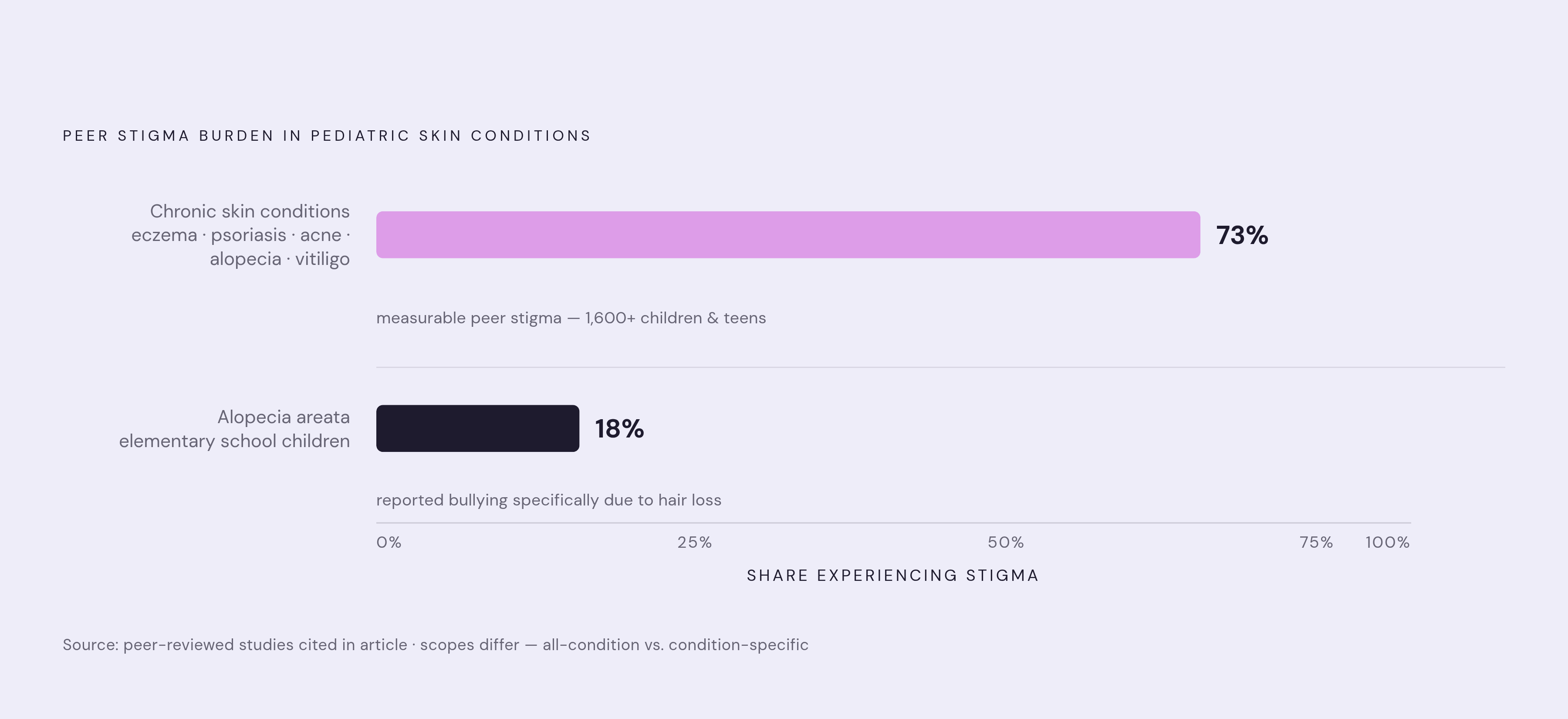
Alopecia areata and vitiligo are both autoimmune conditions. They are also routinely dismissed, by clinicians and the general public alike, as cosmetic concerns. That framing does specific harm to specific children, and the data is uncomfortable enough to be worth sitting with.
Roughly 18% of elementary school children with alopecia areata have been bullied because of it. A study drawing on more than 1,600 children found that 73% of children and teens with chronic skin diseases, including eczema, psoriasis, acne, alopecia areata, and vitiligo, had experienced measurable peer stigma, with strong associations to impaired quality of life. Depression, anxiety, damaged peer relationships. Several of these conditions, when emotional distress goes unaddressed, have been linked to elevated suicide risk. Dr. Amy Paller, chair of dermatology at Northwestern, has described these experiences as capable of shaping a child's personality into adulthood, eroding self-confidence in ways that don't simply resolve when the skin does.
A pediatric evaluation for alopecia areata or vitiligo isn't only about treating the lesion. It opens access to psychological support, school accommodations, and treatments that reduce the condition's visibility and, by extension, its social consequences. Labeling these conditions cosmetic deprioritizes children for whom the condition is actively shaping their development and their relationships with other people.
The red flags that mean go now, not next week
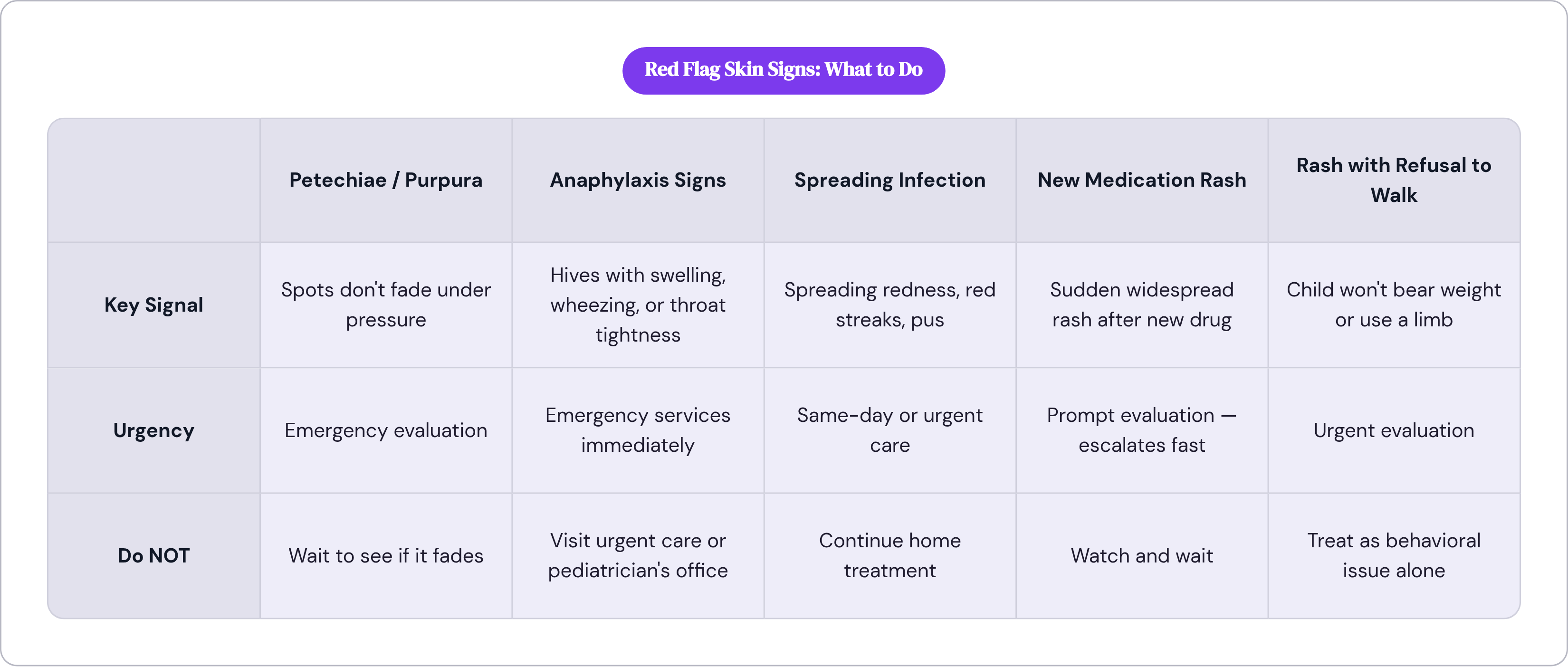
Some signs don't suggest scheduling an appointment. They suggest moving.
Petechiae or purpura, small red or purple spots that don't fade when you press on them, can signal a serious underlying condition and require emergency evaluation. The press test is simple: place a finger or glass on the spot and hold pressure. If the color remains, that's the relevant finding. Any rash in a child with high fever lasting more than three days, mucous membrane involvement, severe pain, or signs of hemodynamic instability is a red flag for something beyond the skin.
Spreading redness, warmth, red streaks extending from a wound, pus, swelling that's increasing rather than stabilizing: these suggest a bacterial infection that has moved beyond its original site. Same-day or urgent care, not continued home treatment.
A sudden widespread rash following a new medication warrants prompt evaluation. Drug reactions can escalate quickly, and the window for catching them early closes fast.
Difficulty breathing, wheezing, or swelling of the face, lips, or tongue alongside any skin reaction is anaphylaxis. Emergency services. Not urgent care, not the pediatrician's office.
A rash accompanied by your child refusing to walk, use a limb, or bear weight is a pain signal that demands urgent evaluation. Children often communicate pain through behavioral change before they can put it into words, and that shift in behavior is itself information.
When a skin symptom pairs with fever, behavioral change, or signs of systemic illness, the skin is functioning as a window into something deeper. A spot that fades when you press it is different from one that doesn't. For skin concerns that fall short of an emergency but still feel unclear, services like Nolla, an AI-guided skincare telehealth platform where licensed US clinicians review symptoms and can issue prescriptions in about 10 minutes, offer a faster first step than waiting weeks for a specialist slot. That difference is worth knowing.