Persistent Rashes That Are Not Self-Resolving
Atopic dermatitis and psoriasis persist because immune dysregulation doesn't switch off.
Eczema and Psoriasis: The Two Most Stubborn Chronic Inflammatory Rashes
Start with the most prevalent. Atopic dermatitis, the most severe and longest-lasting form of eczema, affects roughly 7.6% of adults and 12.7% of children in the United States, according to National Health Interview Survey data published in the Journal of the American Academy of Dermatology in 2025. By the metric of disability-adjusted life-years, it ranks first among all cutaneous diseases. That is not a trivial distinction, and the ranking earns its weight when you understand what it actually measures: how thoroughly a skin condition can erode a life when it fails to fully resolve.
In some patients, atopic dermatitis traces back to a gene variation that compromises the skin barrier's ability to retain moisture and block irritants. The result is a surface that cannot protect itself: an itchy, red rash concentrated on the arms, legs, and face. The itch accumulates. It costs you sleep. It sits with you during a meeting you cannot leave, a dinner you cannot enjoy. The experience is relentless in ways that pure clinical description understates.
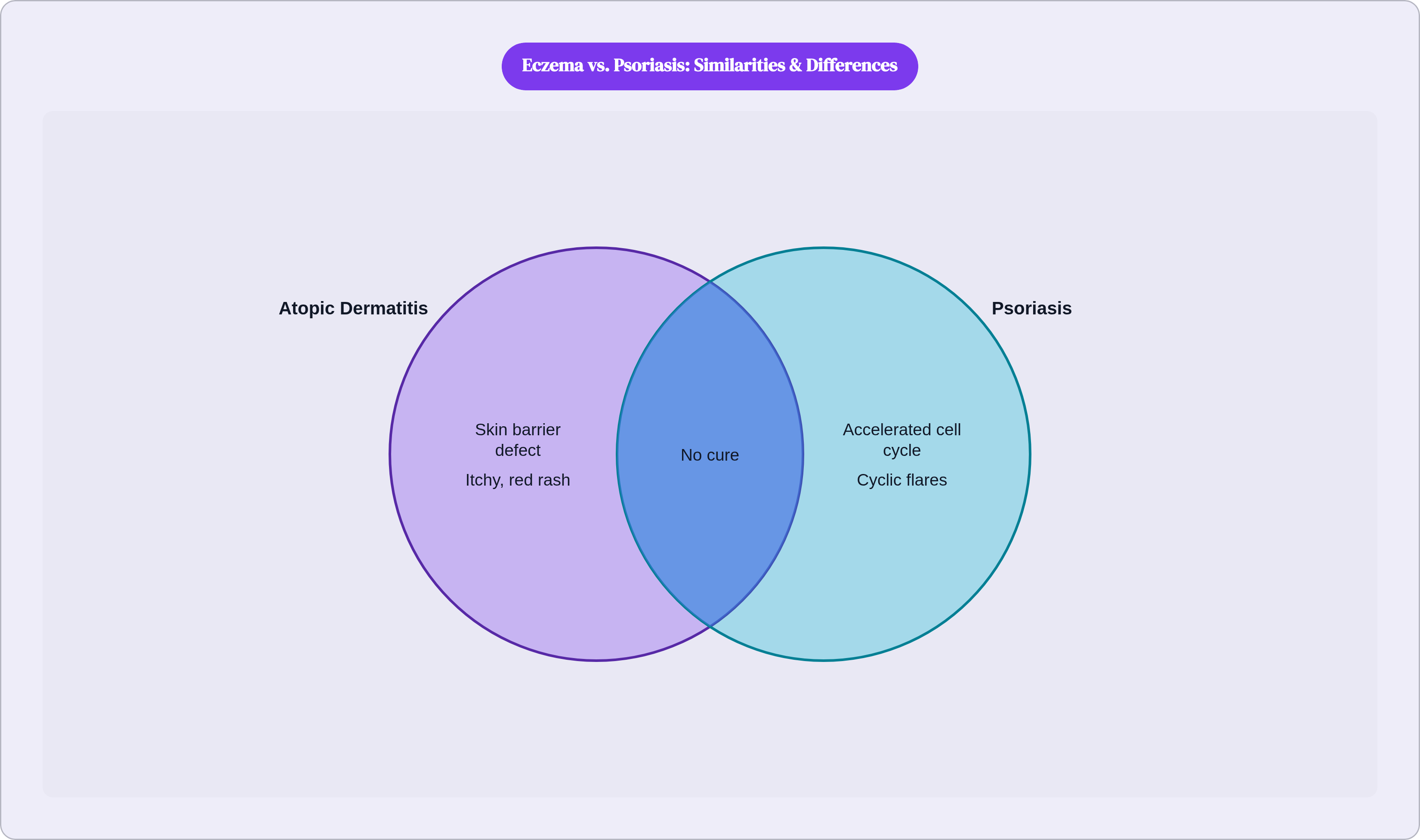
Psoriasis works differently. An overactive immune system accelerates the normal skin cell cycle dramatically, producing thick, raised, silvery-scaled plaques that flare in cycles rather than clearing. Global prevalence grew from roughly 23 million cases to nearly 43 million between 1990 and 2021, an 86% increase per Global Burden of Disease 2021 data. The World Health Organization classified it as a serious noncommunicable disease with no cure over a decade ago. That classification sets an accurate expectation: management, not resolution.
What psoriasis and atopic dermatitis share is immune dysregulation that does not switch off when a trigger is removed. They are not contact rashes that clear once you stop touching the offending substance. But why exactly does this happen? Despite surface similarities, the two respond to distinct therapies because the underlying immune mechanisms diverge. Both involve dysregulation; the specific pathways differ, and those differences determine what will actually help.
Contact Dermatitis: When the Rash Keeps Returning Because the Trigger Is Still Present
Contact dermatitis is more tractable than eczema or psoriasis, in that real resolution is achievable. The catch is that resolution depends entirely on identifying and consistently avoiding the trigger. Without that step, topical treatment is indefinitely symptomatic, and you end up applying cream to a fire you are still feeding.
Two forms exist. Irritant contact dermatitis results from repeated direct damage to the skin surface, no immune sensitization required. Allergic contact dermatitis is different: the immune system has identified a harmless substance as a threat and mounts a response every time exposure recurs. Both persist as long as exposure continues.
The anatomical pattern is often the first real clue. Rashes concentrated on the hands, face, eyelids, ears, or underarms frequently reflect contact dermatitis because distribution maps onto what touched the skin and where. A persistent rash on the earlobes often implicates nickel. One concentrated on the eyelids can trace back to nail products transferred by touch. The skin records contact; where something touched is where the reaction appears. It is also worth considering what that pattern actually tells you: the rash is not random. It is a map.
When the pattern does not obviously map to a single source, patch testing is typically the next necessary step. A dermatologist applies controlled concentrations of common allergens to the skin and reads the results over several days. It is methodical and, frankly, underutilized relative to how often contact dermatitis goes unresolved simply because the trigger was never formally identified. If you are still cycling through treatments that provide temporary relief and nothing more, patch testing is often the route out.
Chronic Hives, Seborrheic Dermatitis, and Lichen Planus: Three Conditions That Persist for Entirely Different Reasons
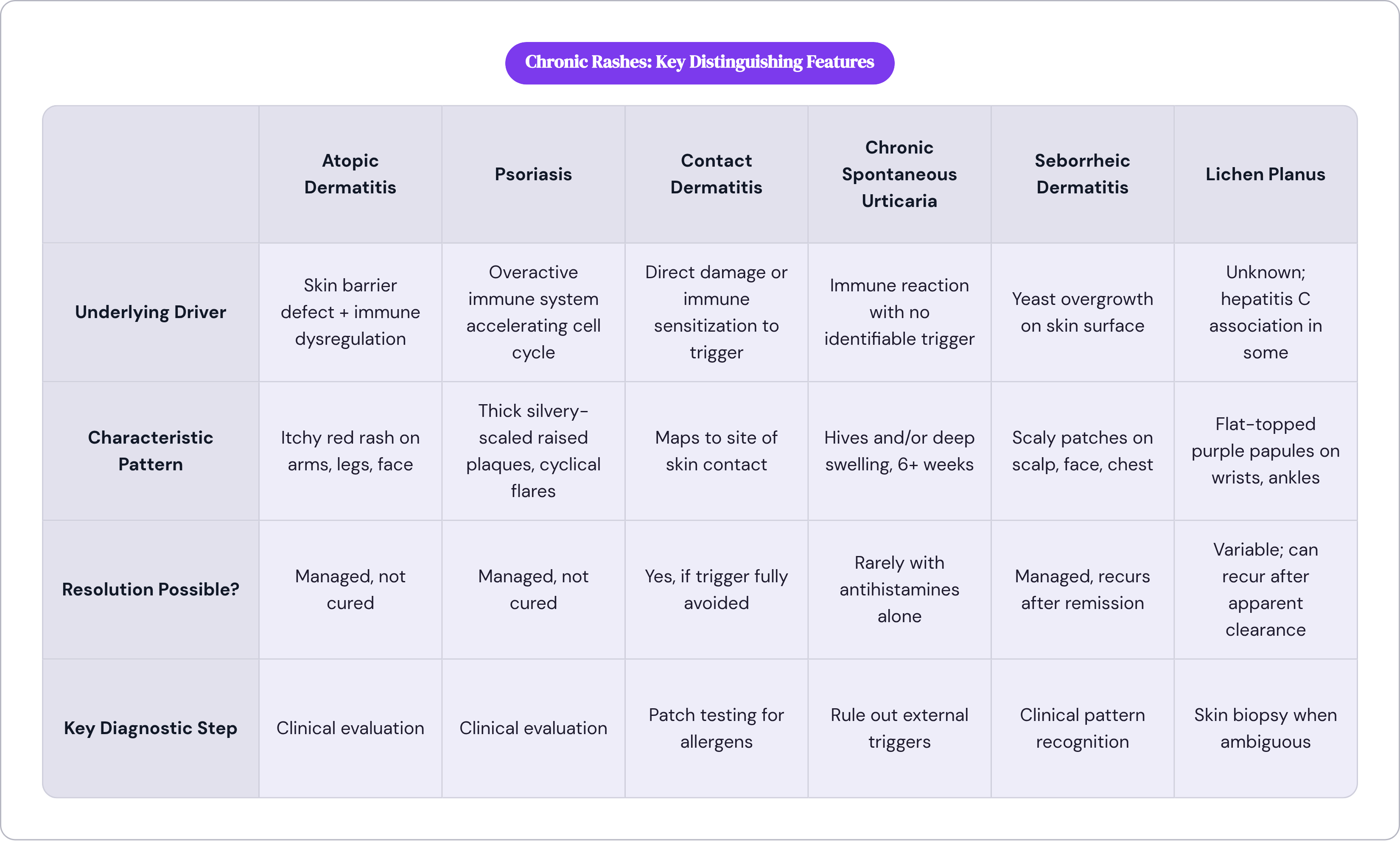
These three conditions are grouped here not because they are similar, but because they illustrate how varied the mechanisms of chronicity actually are. The same surface-level observation, a rash that will not resolve, can reflect three completely distinct biological stories.
Chronic spontaneous urticaria, or CSU, is defined by hives and/or angioedema (deep swelling beneath the skin, often around the eyes or lips) lasting more than six weeks with no identifiable external trigger. The word "spontaneous" in the name is the operative part: the immune system is generating the reaction without an obvious external prompt, which makes it considerably harder to address. Global point prevalence estimates range up to roughly 2.7%, corresponding to approximately 80 million people worldwide. Second-generation antihistamines, the current first-line approach, achieve complete disease control in fewer than 10% of patients. That single statistic explains a lot about why people with chronic hives often feel stranded. In April 2025, the FDA approved dupilumab for CSU patients who remain symptomatic despite antihistamines, the first new targeted option in this space in over a decade.
Seborrheic dermatitis operates on entirely different terrain. Linked to an overgrowth of yeast naturally present on the skin, it produces red, scaly, itchy patches on the scalp, sides of the nose, eyebrows, ears, eyelids, and central chest. There is no cure; it is managed, not resolved, and it returns after periods of apparent remission. Management is often effective, but it requires consistency rather than a one-time intervention.
Lichen planus is the outlier. It produces itchy, flat-topped purple bumps (papules), most characteristically on the wrists and ankles, and can involve the mucosa, hair follicles, and nails. In some populations, an association with hepatitis C virus has been documented. The prognosis is notably variable: some cases resolve spontaneously, others persist or recur after apparent clearance. A 2025 case report in the Journal of the American Academy of Dermatology documented a patient whose rash returned with new lesions a full year after resolution with prednisone. A satisfying initial response feels like a conclusion. In lichen planus, it often is not. That raises an important question: if apparent clearance cannot be trusted as an endpoint, what does meaningful resolution actually look like for this condition?
When a Rash on the Skin Signals a Condition Inside the Body
The skin is not a sealed compartment. Lupus, kidney disease, liver disease, and a range of autoimmune conditions can all manifest at the surface before systemic symptoms become prominent or before internal organ involvement is formally detected. Cutaneous lupus alone encompasses multiple distinct presentations, from the recognizable malar rash across the cheeks and nose to less familiar subtypes including chilblain lupus erythematosus and lupus panniculitis. Visual overlap with other chronic rashes creates real diagnostic difficulty, particularly in early stages.
The diagnostic delay in lupus is well-documented. Per the Lupus Foundation of America, it takes an average of six years from first symptom recognition to a confirmed lupus diagnosis, and nearly half of patients with systemic lupus erythematosus are initially misdiagnosed. Six years is a long time. It is six years of missed treatment, potential organ involvement progressing quietly, and cycling through explanations that never quite fit. But what if the rash that satisfies a localized explanation is actually the earliest visible signal of something systemic? Part of why this happens is straightforward: the surface presentation looks familiar enough to satisfy an early explanation, and a localized explanation that closes the inquiry prematurely can cost years.
The overlap with rosacea is especially pronounced. Persistent facial erythema attributed to rosacea stays localized to facial skin and eyes. Lupus can involve multiple organ systems and produce fatigue, joint pain, and systemic inflammation. The rashes look similar on the surface; the implications diverge dramatically.
If your persistent rash arrives alongside fatigue, joint pain, fever, or unexplained weight change, blood tests examining other organ systems become necessary. The skin finding is the prompt, not the full picture.
How Location, Pattern, and Accompanying Symptoms Guide a Diagnosis
Diagnosis of a persistent rash is fundamentally a process of triangulation. No single feature is usually sufficient; the combination of anatomical distribution, lesion pattern, and accompanying symptoms narrows the field considerably.
Distribution speaks first. Scalp, central face, and chest involvement points toward seborrheic dermatitis. Purple, flat-topped papules on the wrists and ankles suggest lichen planus with reasonable specificity. A rash concentrated on the hands, eyelids, and ears directs attention toward contact dermatitis. These are probabilistic signals, not certainties, and they guide the next question rather than answer it outright.
Pattern adds another layer. Widespread, symmetrical lesions raise concern for systemic disease. Involvement restricted to sun-exposed areas prompts consideration of photosensitivity conditions. Distribution following a dermatomal line, confined to one side of the body along a nerve pathway, is a strong indicator of herpes zoster. The geometry of a rash is rarely arbitrary.
Physical examination extends beyond the skin. Fever, swollen lymph nodes, and signs of systemic inflammation all modify the interpretation of what the rash actually means. The same rash in isolation reads differently than that rash accompanied by lymphadenopathy (enlarged lymph nodes).
Diagnostic tools follow from the question that needs answering: patch testing for suspected allergic triggers, skin scrapings for fungal infection, biopsy for cases where appearance alone cannot differentiate conditions. Granuloma annulare is useful here; its ring-patterned, reddish-brown lesions can resemble other conditions closely enough that confirmation through skin biopsy becomes necessary when the clinical presentation is ambiguous. The diagnostic tool should match the level of uncertainty.
Globally, dermatitis carries the highest estimated age-standardized prevalence rate among chronic skin conditions, followed by urticaria and then psoriasis, per a 2025 analysis drawing on Global Burden of Disease data. That distribution matters because it reflects how many distinct conditions exist beneath a single umbrella term, and why imprecise diagnosis reliably produces imprecise treatment.
Red Flags That Move a Persistent Rash from a Dermatology Appointment to an Emergency
Most persistent rashes belong in a dermatologist's office, not an emergency room. The distinction matters because the window in certain scenarios is narrow.
Rapid spread, fever, blistering, peeling skin, and involvement of the eyes or genitals are urgent warning signs. They indicate that whatever is driving your rash is doing so aggressively, and that your body's response has moved beyond localized skin involvement. Severe pain accompanying a rash, particularly pain disproportionate to what is visible on the surface, belongs in the same category.
Facial swelling, throat swelling, or difficulty breathing alongside a rash requires immediate care. These indicate anaphylaxis or a severe systemic reaction. The airway is the priority.
Secondary infection is a subtler urgency. A chronically disrupted skin barrier is more permeable to bacterial invasion, and a persistent, open rash creates conditions for superinfection. The longer a compromised surface goes unaddressed, the more opportunity develops for a second problem to layer on top of the first.
When a rash arrives with symptoms beyond the skin, the threshold for seeking care shifts from "soon" to "now."
What Treatment for a Persistent Rash Looks Like in 2025
The treatment landscape for chronic inflammatory skin conditions has changed more in the past decade than in the several decades preceding it, and the conceptual shift is as significant as the pharmaceutical one: away from chronic corticosteroid use and toward targeted biologic and small-molecule therapies that address the specific immune pathway driving a given condition. Broad anti-inflammatory suppression works, but it carries systemic risks over time and addresses the mechanism with no real precision. The newer approach is considerably more specific. What distinguishes targeted biologics from broad immunosuppression is precision at the pathway level: fewer off-target effects and, in many cases, more durable results.
For atopic dermatitis, dupilumab, approved in 2017, was the first biologic to reach patients. As of 2025, four biologics and three oral JAK inhibitors (a class of targeted anti-inflammatory pills) are approved for clinical use in this condition alone. That is a meaningful expansion from a period when prolonged topical steroid use was the primary option beyond emollients.
Psoriasis patients have seen expanded options as well, including spesolimab for generalized pustular psoriasis, bimekizumab, and upadacitinib for those who responded inadequately to earlier biologics. CSU gained dupilumab's FDA approval in April 2025, the first new targeted therapy for antihistamine-refractory patients in over a decade. For a condition where first-line treatment achieved complete control in fewer than 10% of patients, that is a real shift in what is possible.
Even rarer conditions are developing evidence-based options. Apremilast, a PDE4 inhibitor (a type of targeted anti-inflammatory drug), is emerging as a viable approach for granuloma annulare, based on its mechanism of reducing specific inflammatory proteins implicated in the condition. The throughline across all of these developments is the same: target the mechanism, not just the output.
None of it is accessible without accurate diagnosis. The right therapy depends on identifying the correct underlying mechanism, and that requires clinical evaluation. The longer you self-treat without that evaluation, the longer both the rash and its underlying driver continue unaddressed. The 2025 landscape is better equipped than it has been in prior decades; getting there still requires actually getting there.