Stress and Sleep Effects on Personalized Skin Health
There's a version of this conversation that goes: stress causes breakouts, bad sleep causes dark circles, drink more water. If that were the whole story, skincare would be a lot…
There's a version of this conversation that goes: stress causes breakouts, bad sleep causes dark circles, drink more water. If that were the whole story, skincare would be a lot simpler.
Here's what becomes apparent when you pay close attention to your own skin over time: the same brutal week at work, the same three nights of fractured sleep, can produce markedly different outcomes depending on your skin's particular vulnerabilities. You might break out along the jaw. Or your eczema flares on the inner arm. Or you just look older somehow, dull and thin in a way that's hard to name precisely. Same inputs, different outputs. That's not random, and it's not just skin type in the oversimplified sense. The reason it happens is more interesting than most people expect, and worth sitting with carefully.
The Stress–Skin Connection Runs Deeper Than Hormones
Cortisol drives sebum production. Sleep deprivation affects the skin under your eyes. Both true. But reducing the whole conversation to those two outputs misses most of what's actually happening, and more importantly, misses the part that would help you do something useful with the information.
What determines which symptoms show up, and how severely, is a convergence of individual biology, skin type, existing conditions, and the composition of your skin's microbial community. Some of those factors you can observe yourself, with patience and honest attention. None of them are accessible if your framework is too simplified to hold them.
When your brain perceives stress, it activates the HPA axis, your hypothalamic-pituitary-adrenal pathway, which releases corticotropin-releasing hormone (CRH), signals the pituitary gland, and tells the adrenal glands to produce cortisol. Cortisol then does two things that appear contradictory: it suppresses certain protective immune functions in the skin while simultaneously promoting pro-inflammatory cytokines. Less defended and more reactive, at the same time.
That's the hormonal layer. But nerve endings in your skin also release signaling molecules called neuropeptides, specifically Substance P and calcitonin gene-related peptide, in response to stress, driving inflammation through a pathway entirely independent of cortisol. Two distinct routes to disruption, producing different downstream effects.
What complicates this further: your skin is not a passive recipient of stress signals. It functions as its own hormone-producing organ, generating stress signals that travel back toward the brain. Inflammatory messengers your skin produces, including cytokines, chemokines, and neurotrophins, can cross the blood-brain barrier, worsening both skin and psychological symptoms at once. Skin symptoms amplify psychological stress, which worsens skin symptoms. It's a loop, not a line. But what if the loop itself is the real problem, not the original stressor?
What Chronic Stress Actually Does to Skin. The Specific Damage
The specificity is where understanding becomes useful.
Barrier Breakdown
A study in the Journal of Cosmetic Dermatologyfound that cortisol-induced stress decreased synthesis of filaggrin, a protein that holds your skin's outermost cells together, and reduced loricrin, which gives that barrier its structural integrity, by around a fifth. Lose them, and the skin becomes more permeable, more reactive, more susceptible to irritants and allergens it previously tolerated without complaint. A separate study in Scientific Reports confirmed that psychological stress impairs the integrity of the stratum corneum, your skin's outermost protective layer, and barrier function more broadly.
This shows up in a recognizable pattern: under sustained stress, you may develop sensitivities you didn't have before, or existing sensitivities intensify in a way that feels disproportionate to what you're applying. The product didn't change. Your barrier did. That raises an important question: if sensitivity is actually a barrier problem in disguise, how many people are treating the wrong thing?
Sebum, Immunity, and Inflammatory Conditions
Cortisol instructs your sebaceous glands, the oil-producing glands in your skin, to produce more oil. For someone with oily or acne-prone skin, a sustained stress period doesn't just risk a few extra breakouts; it shifts the baseline environment of the skin. At the same time, stress alters key immune cells, including T cells, dendritic cells, and mast cells, disrupting the balance between inflammation-promoting and inflammation-suppressing signals in your skin. The clinical consequences of that immune dysregulation include psoriasis, atopic dermatitis, vitiligo, alopecia areata, and acne. Cortisol also accelerates collagen degradation, contributing to wrinkles, dehydration, and the kind of heightened sensitivity that characterizes skin aged by chronic stress rather than simply by time.
Which of these effects dominates in a given person is the real question, and it requires looking beyond the stress itself to answer.
Sleep Does Its Own Damage. And the Mechanisms Are Different
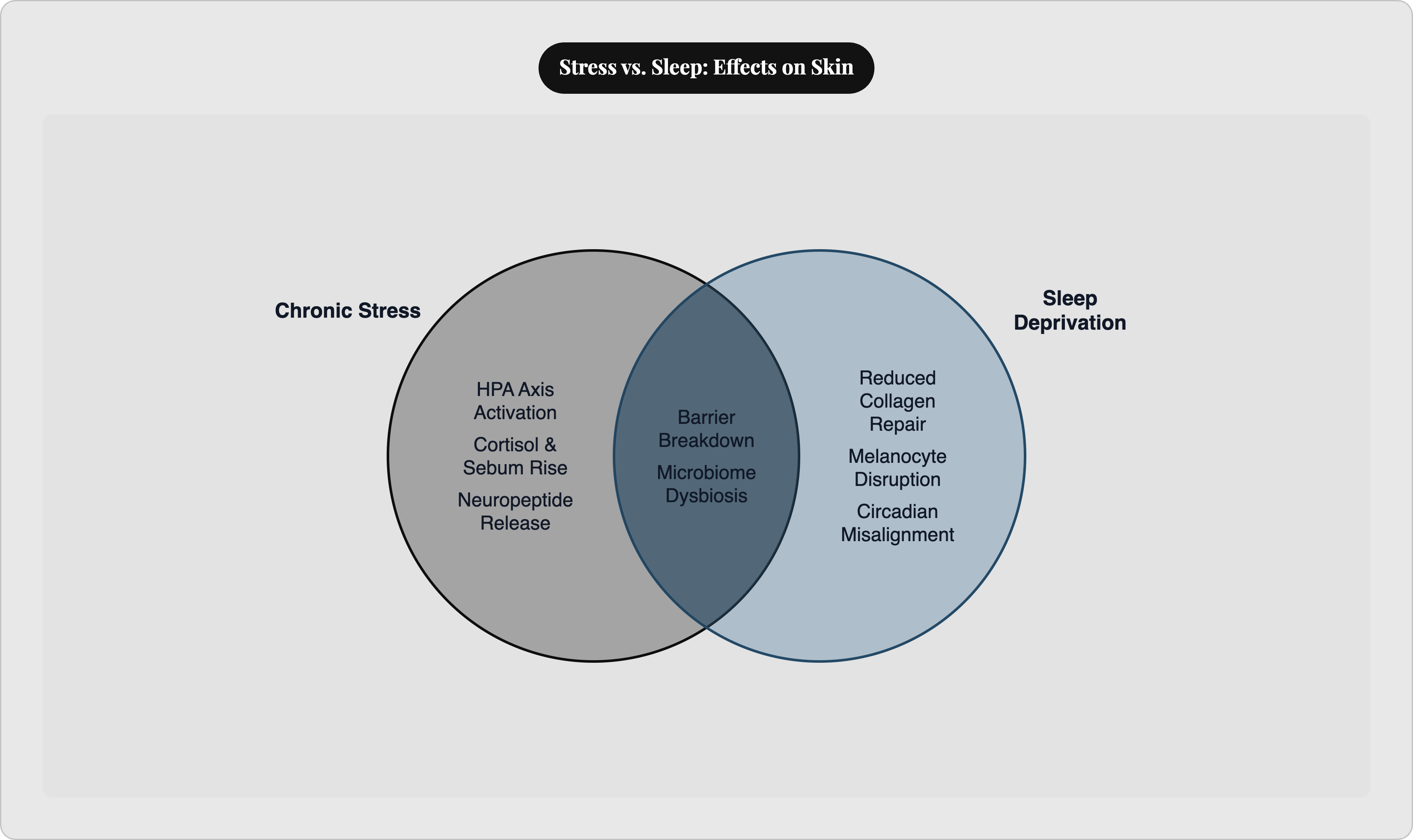
Sleep deprivation and stress often travel together, which makes it tempting to conflate what they do to skin. They are not the same thing, and conflating them leads to interventions that address only part of the problem.
A well-cited study published in Clinical and Experimental Dermatology compared sixty healthy women: those averaging five hours of sleep per night showed thirty percent higher transepidermal water loss, the rate at which moisture escapes through your skin, and a direct measure of barrier function, than those averaging eight hours, alongside lower skin aging scores and reduced recovery capacity after UV exposure. Thirty percent is not a rounding error.
Collagen synthesis and cellular repair are concentrated in sleep. Deprivation disrupts that window, and the inflammation that insufficient sleep generates further degrades existing collagen. Two separate deprivation studies found significant increases in facial skin yellowness that persisted even after the deprivation ended. Swedish research using photographic assessment found sleep-deprived individuals consistently rated as less healthy, more tired, and less attractive by observers who had no idea what they were evaluating. They were registering measurable skin changes without knowing it.
For people prone to hyperpigmentation, there's an additional dimension: circadian disruption affects the cells that produce skin pigment, melanocytes, in ways that alter how your skin tones and darkens. That pathway rarely gets discussed in the same breath as dark circles, but it's consequential.
Stress and sleep deprivation share some downstream effects, particularly at the level of barrier function and inflammation. They arrive through different upstream mechanisms, though, and most people experience both simultaneously, which compounds the effects in ways that are genuinely difficult to separate out.
The Skin Has Its Own Clock. And Disrupting It Has Consequences
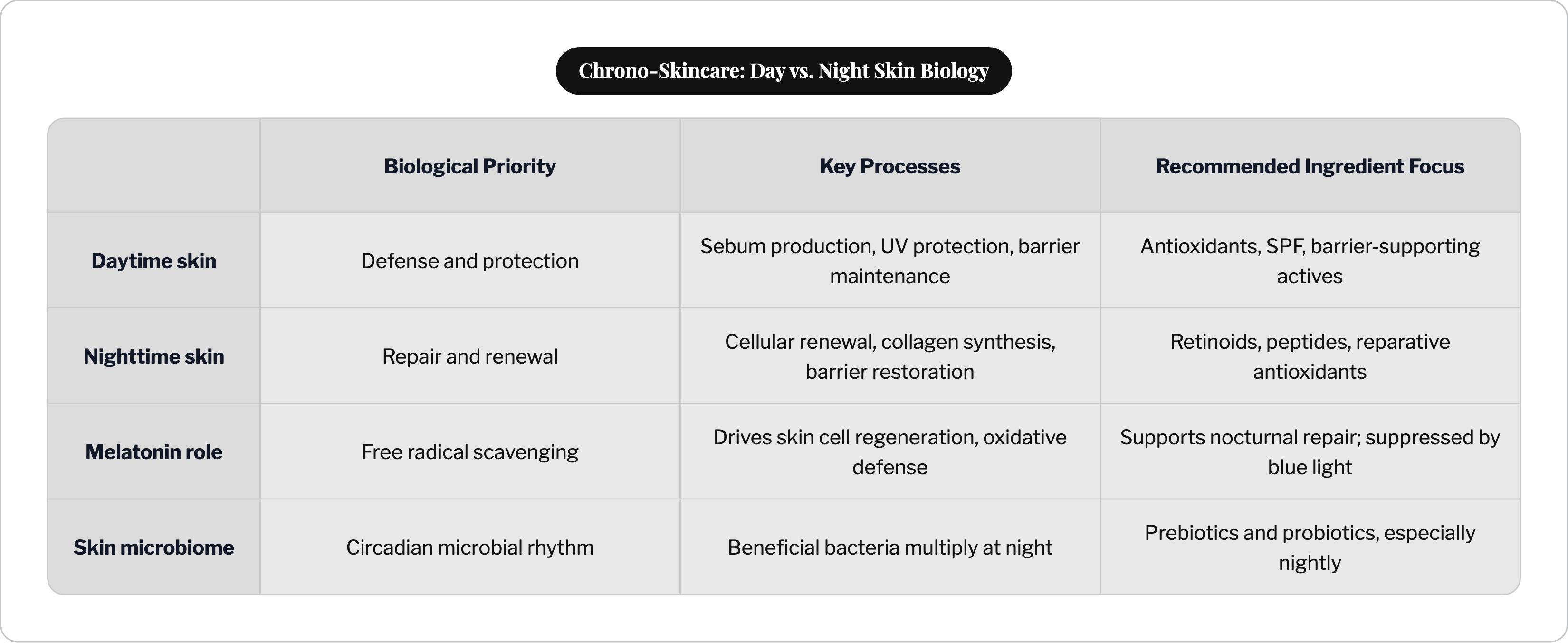
Skin runs a protection-and-repair cycle across the 24-hour period, and it's remarkably organized when left undisrupted.
During the day, the skin prioritizes defense: sebum production, UV protection, and barrier maintenance are all elevated. At night, it shifts toward repair, accelerating cellular renewal, collagen synthesis, and barrier restoration. Melatonin, which most people associate narrowly with sleep onset, also functions as a direct driver of skin cell regeneration. It scavenges free radicals, activates endogenous defense systems, and protects against oxidative stress. Blue light from screens suppresses it. Natural production also declines with age, which is part of why overnight renewal capacity diminishes over time independent of how many hours someone sleeps.
The skin microbiome runs its own circadian rhythm alongside this: beneficial bacteria multiply at night and shift into a protective role during the day. Disrupt the sleep-wake cycle, and this microbial rhythm destabilizes too, contributing to inflammation through pathways distinct from cortisol's direct effects.
One practical consequence of circadian skin biology: skin becomes more permeable at night, making it considerably more receptive to reparative ingredients than it is during the day. Retinoids, antioxidants, peptides, all of them land differently on nocturnal skin. This is the mechanistic basis for what some researchers call chrono-skincare, a framework built around protective ingredients in the morning and reparative actives at night, aligned to what the skin is biologically prepared to do.
Where Stress, Sleep, and Individual Skin Type Converge
Chronic stress shifts the skin's microbial community toward dysbiosis, a state in which pathogenic or inflammatory species gain a relative advantage over beneficial ones. This shift alters antimicrobial peptide expression and barrier function in ways that amplify the very conditions that generated the stress.
One of the clearest documented examples: itch leads to sleep disruption, which elevates stress, which worsens the skin condition driving the itch. The cycle has measurable clinical consequences. It does not self-correct without deliberate interruption.
What makes the microbiome especially relevant is that individual composition varies significantly. Two people with the same skin type, exposed to the same stressor, bring very different microbial communities to the encounter. That's part of why one person's skin flares and the other's doesn't. The microbiome is not a fixed characteristic; it responds to sleep, stress, diet, and environment in ways specific to the individual, which is also why consistent sleep functions as a real skincare intervention rather than a wellness platitude with good branding.
The skin-brain-microbiome axis is still an emerging research frontier, and the interplay between microbial ecology, emotional states, and skin response is not fully mapped. But early findings consistently implicate the microbiome as a primary mediator of the individual variation we observe. It is also worth considering what this means for blanket recommendations: the same intervention is mechanistically sound for one person and essentially irrelevant for another.
Why Your Skin Type and Existing Conditions Change Everything
These mechanisms don't operate at uniform intensity across all skin types. Which pathway dominates depends substantially on which biological vulnerabilities are already present.
If your skin is oily or acne-prone, cortisol-driven sebum increase hits an already-active system. The effect amplifies. Barrier disruption compounds it further, because compromised integrity increases the reactivity of skin that's already prone to inflammatory breakouts.
If your skin is dry or sensitive, the loss of those barrier proteins under stress is the central problem. Transepidermal water loss is already elevated; stress accelerates it. Your skin becomes reactive to products and environmental factors it previously tolerated without incident.
Eczema and atopic dermatitis present perhaps the most documented case of this. HPA axis activation and neuropeptide release are established flare triggers, and the itch-sleep disruption-stress loop is one of the most clinically recognized vicious cycles in dermatology. Psoriasis follows a similar pattern through T cell and cytokine dysregulation.
If your skin is prone to hyperpigmentation, sleep deprivation's effects on melanocyte biology are more consequential for you than they would be for someone without that underlying tendency. In aging skin, declining melatonin combined with cortisol-driven collagen degradation and reduced overnight repair capacity visibly accelerates aging in ways that younger skin, with greater resilience and higher baseline melatonin production, is better positioned to absorb.
The same stress exposure and sleep deficit produce different dominant effects depending on which biological vulnerability is most active in a given person. Identifying yours is the first genuinely useful step toward doing anything about it.
Recognizing Your Own Stress-Sleep-Skin Pattern
Pattern recognition here is less about finding a definitive answer and more about developing a working hypothesis you can test and revise over time. You're building a model of your own skin, not consulting a fixed diagnostic chart.
Start with timing. Do flares correlate with identifiable stress periods, sleep disruption, or both? The temporal relationship is one of the clearest signals available without laboratory testing. Excess oiliness and breakouts worsening during high-pressure weeks point toward cortisol-driven sebum. Increased sensitivity, redness, stinging from previously tolerated products point toward barrier compromise. Worsening eczema or psoriasis implicates immune dysregulation. New or intensifying pigmentation often reflects circadian disruption at the melanocyte level. Accelerated dullness and fine lines point toward collagen and repair deficits.
One distinction that doesn't get nearly enough attention: sleep quality and sleep quantity are not the same variable. Fragmented sleep, even at a normal total duration, produces barrier and pigmentation effects comparable to genuinely short sleep. If your sleep feels unrefreshing even at seven or eight hours, the circadian and microbiome pathways are still disrupted. Total hours isn't the whole picture.
Chronic and acute stress also produce qualitatively different effects. An acute stressor produces a flare that resolves. Chronic stress drives structural changes: barrier protein loss, collagen degradation, microbiome dysbiosis. These do not resolve quickly when the stressor ends. If your skin no longer fully recovers after stressful periods the way it once did, that structural dimension is at work.
The bidirectionality is also a diagnostic signal in its own right. If skin symptoms are generating anxiety or disrupting sleep, and you find it difficult to separate the emotional distress about your skin from the condition itself, you are experiencing the feedback loop from the inside. Interventions aimed at only one end of that loop produce partial results at best.
Persistent or worsening inflammatory conditions warrant professional evaluation. Pattern recognition is a useful starting point, not a substitute for it.
Matching the Intervention to Your Pattern
The interventions worth considering are organized by pattern rather than product category, because the same ingredient is appropriate in one context and counterproductive in another.
For Barrier-Compromised Skin Under Stress
If you have dry, sensitive, or eczema-prone skin and stress is your primary trigger, the priority is supporting filaggrin and ceramide levels, which underpin barrier integrity. This is also the time to reduce or pause actives that challenge a compromised barrier: strong exfoliants, high-concentration retinoids, aggressive acids. The barrier needs stabilization before it can benefit from optimization. The instinct to push harder when a routine stops working is understandable, but a flare is usually a sign the skin needs less, not more.
For Oily and Acne-Prone Skin
Cortisol-driven oil production is distinct from baseline oiliness, and it produces a specific pattern: excess sebum alongside increased reactivity and sometimes sensitivity. Over-stripping in response to the extra oil worsens the reactivity. Recognizing stress-period spikes as their own condition, rather than an intensification of your baseline, allows for a more calibrated response.
Circadian Alignment
Regardless of skin type, the night routine merits more investment than it typically receives. Skin's increased nocturnal permeability makes reparative actives considerably more effective when applied at night — not as a minor optimization, but as a reflection of a fundamentally different biological environment than daytime skin presents. Most routines don't account for this distinction at all.
Microbiome Support
Prebiotics and probiotics in skincare have moved well past experimental. The clinical interest is real and growing. For those whose stress-skin pattern involves recurrent dysbiosis or inflammatory cycling, microbiome-supportive products represent a mechanistically coherent intervention.
Emerging Categories
Neurocosmetics and adaptogenic ingredients are being developed explicitly to counteract cortisol- and inflammation-driven aging at the cellular level. AI-driven analysis tools integrating hydration, sebum balance, microbiome composition, and environmental exposures are becoming more available for personalized assessment. Both categories are worth watching carefully, with the caveat that marketing in this space runs significantly ahead of clinical evidence.
Sleep hygiene belongs in this list not as a lifestyle suggestion but as a direct skincare intervention. Consistent, quality sleep gives the circadian repair cycle, the microbial community, and the melatonin-driven renewal system the conditions they require. Topical care and sleep operate on the same skin through complementary pathways. Treating them as separate categories is one of the more consequential errors people make.
Your stress-sleep-skin relationship shifts with age, with seasons, with life circumstances, with changes in your microbiome. The pattern you're in now is not the pattern you'll be in a year from now. Learning to read your own skin, noticing what correlates with what and staying genuinely curious about how it changes, is not preliminary work before real skincare begins. It is, in fact, the practice itself.
Sources
- Impact of Chronic Moderate Psychological Stress on Skin Aging: Exploratory Clinical Study and Cellular Functioning - PMC
- Stress-Induced Changes of the Skin: A Narrative Review
- Psychological Stress Deteriorates Skin Barrier Function by Activating 11β-Hydroxysteroid Dehydrogenase 1 and the HPA Axis | Scientific Reports
- Stress may be getting to your skin, but it’s not a one-way street - Harvard Health