Why Skin Tags Form on the Neck and Body
Friction and insulin resistance combine to trigger these common skin growths.

Skin tags form through a fairly predictable chain of friction, cell biology, and metabolic signaling, and that chain explains why certain spots on the body (the neck especially) end up covered in them while others stay clear.
The composition of skin tags
Start with the medical name, because it strips away some of the mystery: acrochordon. That's the clinical term for the soft little growth hanging off someone's neck or tucked into an armpit.
Structurally, a skin tag is collagen fibers and small blood vessels, wrapped in ordinary skin. It isn't a cyst. It isn't a tumor. It isn't, by default, caused by a virus, even though that question comes up later in a more nuanced way. The color runs from flesh-toned to a shade or two darker, and the shape varies too: some hang off a thin stalk (pedunculated, in the clinical vocabulary), others sit flush against the skin.
At the cellular level, two types of cells are doing the work. Keratinocytes, the outer skin cells, multiply past their usual rate. Fibroblasts, which build connective tissue, do the same underneath. Together they lay down the raw material for a tag. Keep those two cell types in mind, because they appear again when the metabolic mechanism gets explained.
How common is this, really? Cleveland Clinic puts it at roughly half of all adults developing at least one skin tag at some point, and separate estimates run as high as 50 to 60 percent Aventus Clinic. Men and women are affected at similar rates. So if someone's staring at one on their neck feeling like an outlier, they're not. This is closer to the norm than the exception, before diving into why it happens where it happens.
Why the neck is the single most common site
Why the neck, specifically? Three forces converge there in a way they don't anywhere else on the body.
First, movement. The neck rotates, tilts, and extends constantly, all day, every day, whether someone's checking a phone, driving, or just glancing sideways at a coworker. That's continuous mechanical shear on the skin's surface, hour after hour, for decades.
Second, external contact. Collars rub. Necklaces sit in the same crease day after day. Scarves in cold weather, tight turtlenecks, even facial hair for some men, all create sources of friction that simply don't exist on, say, the forearm or the shin.
Third, and easy to overlook: neck skin itself is thinner and more sensitive than skin on the trunk or limbs. That lowers the threshold at which friction starts triggering an overgrowth response. Less rubbing is needed to get the same result.
Put those three together and the mechanism becomes clear. Sustained rubbing creates tiny, repeated disruptions in the outer skin layer. The body responds locally with extra cell growth at that exact spot, and over time, that localized overgrowth becomes an acrochordon. This isn't a one-time injury response, either. A necklace worn every day for a year does something different to the skin than a single hard scrape. It builds, accumulating over repeated exposure rather than appearing after a single incident.
A change in weight, a new job that requires a uniform with a stiffer collar, or a jump in physical activity can all increase friction exposure and explain a tag appearing where none existed before.
Other body sites where the same friction logic applies
Once the friction principle clicks for the neck, the rest of the map draws itself. The American Academy of Dermatology lists the most common sites as beneath the breasts, the eyelids, the groin and inner thighs, the underarms, and the neck, with occasional appearances on the sides, abdomen, and back.
Each site earns its spot on that list for a slightly different reason. Armpits combine arm movement with tight clothing and, often, sweat and moisture, which makes for close to ideal conditions for skin irritation. Under the breasts, the mechanism shifts a bit: it's less about dynamic rubbing and more about sustained pressure, bra straps and the natural skin fold sitting against itself for hours at a stretch. Groin and inner thighs get hit by the simple mechanics of walking, which creates repetitive skin-on-skin contact, and moisture compounds that further. Eyelids are the odd one out mechanically, low-force but extremely high-frequency: rubbing tired eyes, applying and removing makeup, day after day, on some of the thinnest skin anywhere on the body.
Looking at that list, a pattern jumps out. Every single site is either a skin fold, a clothing-contact zone, or both. Friction is the common denominator, and it predicts the geography with real consistency.
But that raises an obvious question. If friction were the whole story, wouldn't everyone with a tight collar or a heavy bra strap end up with the same cluster of tags? Some people go their whole lives without one, while others develop them in bunches under identical friction conditions. That gap between exposure and outcome is where the story gets more interesting, and it's not explained by rubbing alone.
The metabolic signals that amplify friction into growth
To understand why some people develop tags easily and others don't, it helps to trace the biological chain one link at a time.
It starts with insulin resistance. When cells stop responding normally to insulin, the body compensates by pumping out more of it, a state called hyperinsulinemia. That excess insulin doesn't just sit around: it elevates a hormone called insulin-like growth factor 1, or IGF-1. IGF-1 then goes to work directly on the two cell types mentioned earlier. It stimulates keratinocytes to overproduce, thickening the skin's surface layer. It also stimulates fibroblasts, adding extra connective tissue underneath.
This combination lays down the raw material for a skin tag before any meaningful friction has even occurred. Friction, in that light, isn't the cause so much as the trigger that shapes where an already-primed growth response occurs. Someone with elevated IGF-1 and a rubbing collar is going to develop a tag faster and more often than someone with the same collar and normal insulin levels.
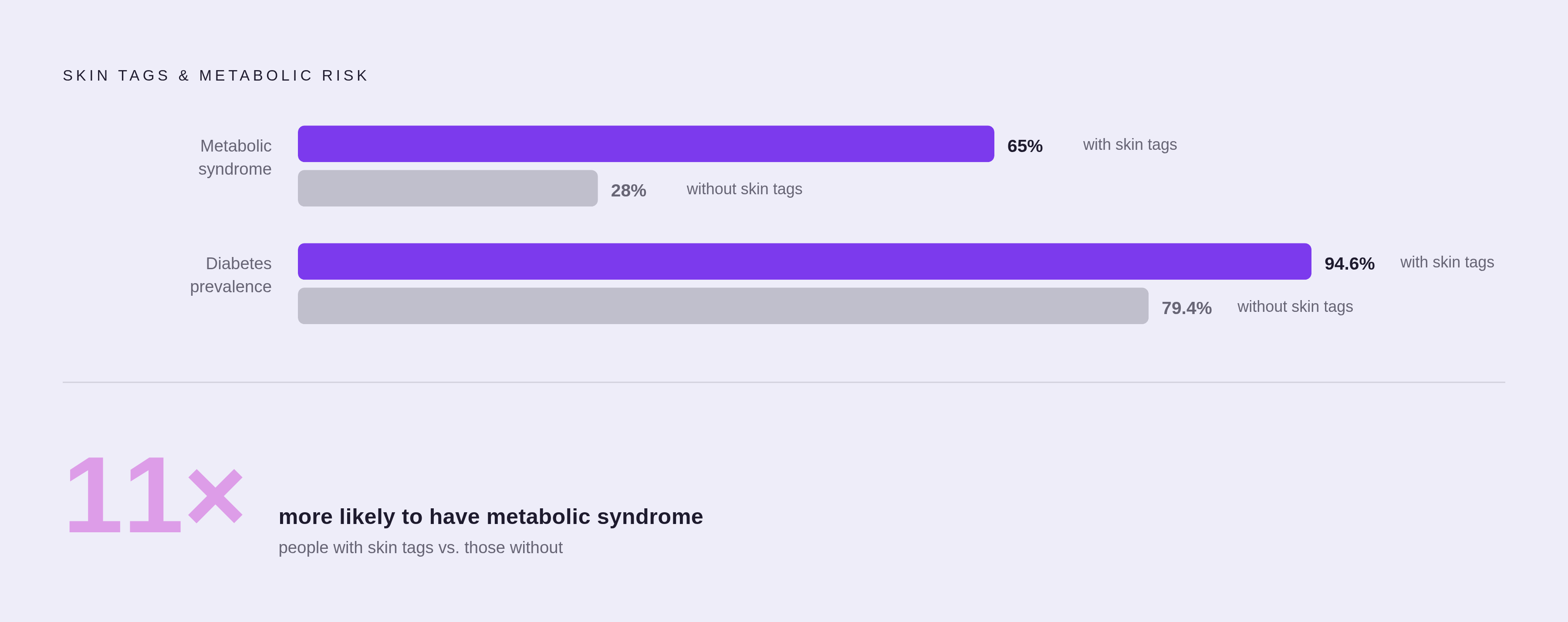
The data backs this up in a way that's hard to dismiss as coincidence. A South Indian study found that 65 percent of people with skin tags met the clinical criteria for metabolic syndrome, compared to just 28 percent of people without tags scienceinsights.org. A 2020 study out of an Irish bariatric center found 94.6 percent of diabetic patients presented with skin tags, versus 79.4 percent of non-diabetic patients Aventus Clinic. And the headline figure, the one that ties the whole mechanism together: people with skin tags were found to be 11 times more likely to have metabolic syndrome than people without them Aventus Clinic.
That's a big number. Eleven times isn't a marginal correlation, it's a signal strong enough that some clinicians treat visible skin tags as a prompt to check in on someone's metabolic health, sometimes years before a formal diabetes diagnosis shows up on paper Aventus Clinic.
None of this means a skin tag equals diabetes. Plenty of people develop them purely from friction, with no metabolic issue involved at all. The association is probabilistic, and that distinction matters. But when someone's asking what "metabolic risk" even covers, it's more than blood sugar. It includes an adverse lipid profile and elevated blood pressure too, alongside impaired glucose metabolism. Skin tags sit at the visible edge of that broader picture. Only after tracing the mechanism through the friction-driven metabolic cascade does Aventus Clinic's data resolve into its full payoff: a striking 11× amplification in growth.
How obesity, age, and genetics layer onto the metabolic picture
Obesity works through two separate channels at once, and they don't overlap the way people assume.
The mechanical channel is intuitive: more body weight means more and deeper skin folds, which multiplies the number of friction sites on a given person's body. But the metabolic channel runs independently of that. Adipose tissue, fat tissue, is hormonally active. It produces inflammatory mediators and hormones that influence skin cell growth on their own, without needing any rubbing at all. So obesity doesn't just create more friction zones, it also feeds the same IGF-1 pathway described above. Two separate roads leading to the same destination.
Age adds another layer. Skin tags become more common after 40 due to cumulative friction exposure, declining skin elasticity, and age-related metabolic shifts converging, though younger people with insulin resistance or obesity may develop them earlier. The timeline just compresses for them.
Genetics plays a real role too, family history is a legitimate risk factor according to both Cleveland Clinic and the AAD. Birt-Hogg-Dubé syndrome is listed by Cleveland Clinic as an associated condition, though it's an unusual case and not something most readers need to worry about Aventus Clinic.
Some studies have detected HPV DNA in up to 88% of biopsied skin tags, though the virus's causal role, if any, has not been established Aventus Clinic MedicineNet. It could be a passenger, not a driver. Treat this as an open research question rather than a settled mechanism, because that's what the evidence currently supports.
Hypothyroidism is associated with both insulin resistance and weight gain, and both of those are already established risk factors in their own right. So thyroid function matters here, but as a downstream contributor rather than a direct cause.
Hormonal changes during pregnancy and PCOS as distinct drivers
Pregnancy deserves its own explanation, because the mechanism differs from the general metabolic story above, even though it overlaps with it.
Elevated estrogen and progesterone, combined with weight gain and increased skin friction from a changing body, all stack together during pregnancy. But there's an additional pathway at work: pregnancy raises leptin levels, the same hormone that's elevated in obesity and diabetes. Leptin stimulates blood vessel growth and triggers cell multiplication in both keratinocytes and fibroblasts, the same two cell types doing the work everywhere else in this piece.
Research published in the Indian Journal of Dermatology found something specific and useful here: leptin levels were higher in small, newly forming skin tags than in larger, already-established ones. That suggests leptin drives the early growth phase specifically, not the ongoing maintenance of a tag once it's formed. Most people notice pregnancy-related tags showing up in the second and third trimesters, and the encouraging part is that they often resolve on their own after delivery, without any treatment needed.
PCOS runs on a related but distinct engine. The mechanism combines the insulin resistance pathway already described with androgen excess layered on top. A 2025 review of cutaneous manifestations in PCOS estimated acrochordon prevalence at 9 to 10 percent among PCOS patients, tying their development to insulin resistance and elevated insulin stimulating epidermal growth. High androgen levels can contribute to tag formation directly too, particularly in women with PCOS.
This has a genuine clinical use. The same 2025 review noted that dermatologists sometimes treat the presence of skin tags in a PCOS patient as a marker warranting a closer look at glucose metabolism. And the treatment angle follows directly from the mechanism: addressing hyperinsulinemia, through metformin or through lifestyle changes, was linked to reduced recurrence in that same review. That's a significant detail. It means the presence of tags can point toward an actionable next step, not just a cosmetic one.
For women noticing multiple tags alongside irregular menstrual cycles, that combination is worth raising with a doctor specifically, a hormone panel covering total testosterone, free testosterone, SHBG, and the LH/FSH ratio is a reasonable starting conversation. Not a self-diagnosis, just a starting point for the right conversation.
When a skin tag is not a skin tag (reading the warning signs)
Not everything that looks like a skin tag is one. Warts, seborrheic keratosis, moles, and in rare cases, skin cancer can all resemble an acrochordon closely enough to fool an untrained eye.
So what does a genuine skin tag look like, reliably? Consistent flesh-tone to light brown coloring. A soft, moveable texture, not fixed hard against underlying tissue. Slow, stable growth over time rather than sudden change. Painless, unless something's mechanically catching on it. No bleeding, no oozing, ever, under normal circumstances.
Anything that breaks from that pattern deserves a second look from a professional. Darkening or sudden redness that friction doesn't explain. Growth that speeds up or a shape that turns irregular. A texture that hardens where it used to be soft. Bleeding without an obvious cause, or pain that persists. And one the AAD specifically flags: suddenly developing many tags at once, all at the same time, is rare, but when it happens, it can be a sign that something is going on inside the body beyond the skin itself.
There's a metabolic version of this warning too. Multiple tags clustered in the classic friction zones, neck, armpits, groin, combined with other signs like dark, velvety patches of skin (acanthosis nigricans), unexplained abdominal weight gain, or persistent fatigue, can together point toward early insulin resistance. For a reader who wants something concrete to bring to a doctor's appointment, fasting insulin, fasting glucose, HbA1c, and a lipid panel are the tests to ask about. These are conversation starters, not something to order and interpret solo.
The process and risks of professional versus home removal
Not every skin tag needs to go anywhere. If it isn't catching on clothing, isn't changing, and isn't bothering anyone cosmetically, Cleveland Clinic is clear that no treatment is medically necessary. Plenty of people just leave them alone indefinitely.
For those who do want removal, a handful of professional methods cover most cases, each with its own tradeoffs. Cryotherapy freezes the tag with liquid nitrogen; a blister or scab forms, and the tag falls off within days. A 2021 European trial of the Pixie cryogenic device recorded a 64.3 percent clearance rate for tags on the neck and elsewhere, a solid result, though not universal Aventus Clinic. Electrosurgery, sometimes called electrodesiccation, uses a fine needle to destroy the tag with targeted heat. A 2024 blinded clinical trial found electrosurgery scored higher on patient and physician satisfaction compared to cryotherapy, though cryotherapy showed slightly fewer pigment-related side effects. Neither wins outright, it's a genuine tradeoff depending on priorities. Surgical excision, snipping the tag off at the base with sterile scissors after local anesthetic, tends to get used on larger tags and delivers an immediate result. Ligation ties surgical thread at the base, cutting off blood supply so the tag shrinks and drops off on its own over time.
The field hasn't stopped refining these tools, either. A study registered on ClinicalTrials.gov (NCT06463613), run by UK Innovations GP LTD, is currently examining outcomes from a newer skin tag removal device, with an estimated 200 participants enrolled and status verified as of November 2025. That's a small but telling sign that even a condition this common and this well understood still has room for better tools.
As for doing it at home: the AAD's language on this is blunt, and worth repeating rather than softening. Removing a mole or skin tag yourself can cause a deep-seated infection. It's easy to nick a blood vessel without meaning to, and that can lead to significant bleeding. Over-the-counter removal kits aren't FDA approved and have been linked to serious skin injuries. Cleveland Clinic adds scarring, incomplete removal that just grows back, damage to the healthy skin around it, and the risk of using a removal tool on something that isn't a tag at all, including, in the worst case, skin cancer. None of that is meant as a scare tactic.