Does Poison Ivy Rash Spread from Scratching or Contact
The rash spreads from dirty nails and contaminated objects, not from scratching itself.
Poison ivy rash doesn't spread from scratching, and it doesn't spread from touching the blisters either. Once the oil that causes the reaction is off the skin, the rash only shows up where that oil actually made contact. What looks like spreading is almost always something else: a staggered immune response, fresh contact with oil hiding under fingernails, or reinfection from a pet that walked through the plant. Get the mechanism wrong and you end up treating the wrong problem entirely, avoiding hygiene when you should be scrubbing under your nails, or panicking about a "worsening" case that's actually right on schedule.
The oil is urushiol, a resin found in poison ivy, poison oak, and poison sumac. It's in the leaves, the stems, the roots, even in plants that died last season. Around 90% of people who touch it develop a rash, and the dose required is almost absurd: as little as 50 micrograms, smaller than a single grain of salt, according to the Cleveland Clinic. Sit with that for a second. A rash covering someone's entire forearm can trace back to an amount of oil too small to see with the naked eye.
What's actually happening is an immune system overreaction, not a chemical burn. This is allergic contact dermatitis: the immune system does the damage, not the oil itself. Urushiol molecules are too small on their own to trigger anything. Instead they bind to proteins in the skin and act as a hapten, flagging the skin as foreign material and setting off a Type IV hypersensitivity reaction. First-time exposure sensitizes the body without producing a visible rash at all, and that first reaction can take up to three weeks to show. After that, the immune system remembers. Repeat exposures produce a rash in as little as 4 to 48 hours, and exposure in general typically produces a rash within a 12 to 72 hour window.
Why the rash appears to keep spreading after the first patches show up
Once urushiol is washed off, scratching doesn't move it anywhere. The rash shows up only where the oil touched. Full stop. Both the FDA and Harvard Health confirm this. So why does it look, day after day, like the rash is crawling across someone's arm or migrating down a leg?
Three separate things are happening at once, and none of them involve the rash moving.
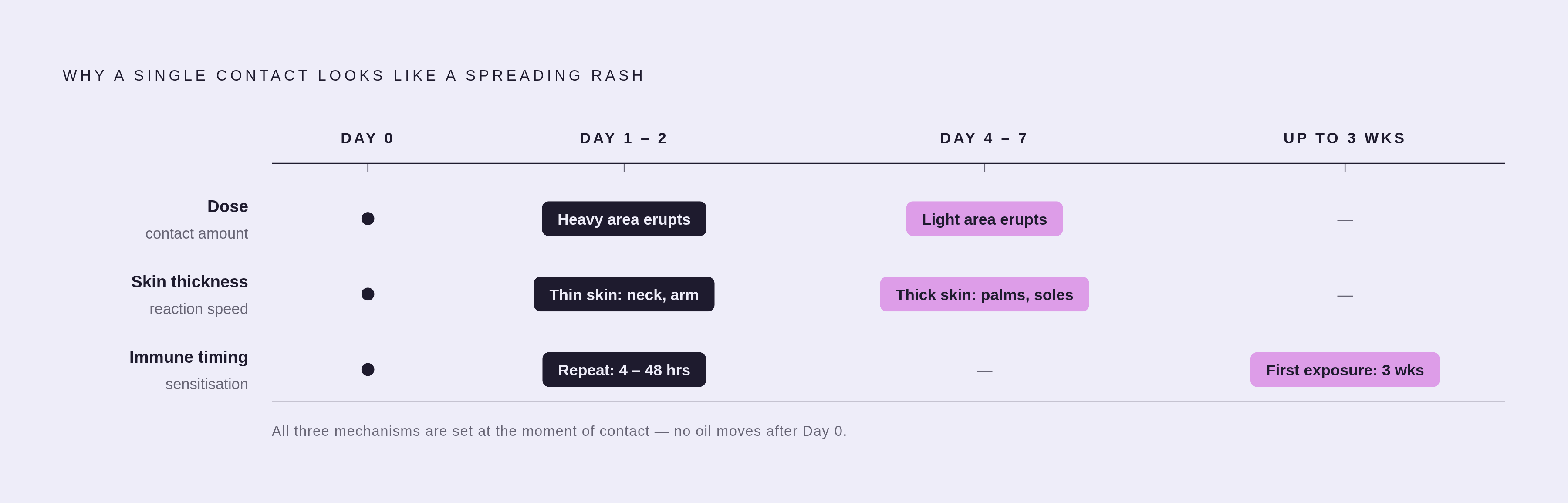
Skin areas that got a smaller dose react later than areas that got hit hard. A patch that received a trace amount of oil might not show anything until day 4 or day 7, long after the original outbreak has already scabbed over. According to dermatology sources like harlanmd.com, this delayed timing alone accounts for a lot of the "it's spreading" panic.
Skin thickness matters too. Palms and soles react more slowly than the thin skin on an inner arm or neck. Identical exposure, different body parts, different days, purely because of how fast the immune system can mount a visible response in that particular tissue.
And here's the one people miss most: the original contact was patchy and uneven from the start. Someone brushing past a plant might pick up a heavy dose on one forearm and a faint trace on the back of a hand. Per Duly Health and Care, the heavy-contact area erupts first, and the lighter-contact area follows days later. Stack all three together, delayed response, variable skin thickness, uneven original exposure, and a rash that appeared once, in one place, on one day, ends up looking like a slow-motion invasion over a week or more.
The real mistake here goes beyond just misunderstanding biology. It's the behavior that follows from the misunderstanding. People who believe scratching spreads the rash sometimes avoid washing the area entirely, wrapping it up or refusing to touch it, when hygiene is exactly what they need. Others assume their case is getting worse when it's just following a predictable immune timeline. Both reactions make things harder than they need to be.
The two real ways urushiol can reach new skin after initial exposure
If scratching doesn't spread the rash, and blister fluid doesn't either, how does new poison ivy show up days later on skin that looked clear? Two mechanisms explain almost all of it, and both come down to fresh contact with oil that never left the picture.
Fingernails trap urushiol remarkably well. Scratch the plant's oil onto your skin, then scratch an itchy patch later without washing your hands, and whatever's sitting under the nail transfers straight onto new skin. That's a real, new exposure. It just looks like the old rash traveling. The Iowa Department of Public Health specifically recommends cleaning under fingernails after contact for exactly this reason, and Harvard Health confirms the mechanism: a rash appears to spread when urushiol trapped under the nails ends up on fresh skin during scratching. Scratching isn't the problem. Dirty nails are.
The second mechanism is object contamination, and it's arguably the sneakier of the two. Urushiol clings to clothing, shoes, garden tools, gloves, and pet fur, and it stays chemically active on those surfaces for a year or more if nothing gets washed. Someone who pulls weeds in June, tosses the gloves in a closet, and reaches for them again in August is handling live oil again, months later. A dog that wandered through a patch of poison ivy can carry oil on its coat and pass it to a person's hands or legs without that person touching a single leaf. New patches showing up a week after the original rash looked like it was healing usually trace back to one of these two sources: dirty fingernails, or a contaminated object nobody thought to wash.
What blister fluid does and does not do
Blister fluid does not spread the rash. Not to new patches of skin, and not to other people. This one gets repeated so often as a warning, yet it's false, and both Oklahoma State University Extension and Johns Hopkins Medicine confirm it directly.
Johns Hopkins states that the rash cannot pass from person to person through contact with blisters or the fluid inside them. The blisters are a symptom, nothing more, evidence of an immune reaction already underway at the exact spot where urushiol touched skin. They're not a delivery mechanism for anything, and popping one doesn't release more allergen into the world.
Person-to-person transfer happens through leftover oil, on someone's skin, on their clothing, on their shoes. Not through broken skin. Not through blister fluid. So a parent worried about "catching" poison ivy from a child's blisters can drop that particular worry. The oil still sitting on the child's sleeve is the actual concern, not the rash itself.
Why scratching is still genuinely harmful, just not for the reason people think
None of this makes scratching fine. It's harmful, just not for the reason most people assume.
Scratching breaks the skin and increases blood flow to the area, which brings more histamine along with it, according to Oklahoma State University Extension. More histamine intensifies the itch instead of relieving it, so the person scratches more, not less. That's a feedback loop, and a nasty one, because every scratch makes the next one feel more necessary.
Broken skin is also an open door for bacteria. Infected blisters stop producing clear fluid and start producing pus, and at that point antibiotic treatment may be needed. Scratching raises the risk of scarring too, particularly on rashes covering a large area. And the fingernail issue from earlier compounds all of it: scratching with unwashed hands after the original exposure can deposit leftover urushiol on skin the plant never touched the first time around.
So drop "scratching spreads it" as the warning. Replace it with something closer to the truth: don't scratch, because you'll raise your infection risk and make the itching worse. Less dramatic, sure. But it's accurate, and people tend to actually follow advice once they understand the mechanism behind it instead of just the scare tactic.
What to do in the first minutes after contact, and what to do in the days that follow
Timing matters more than almost anything else in the first hour after contact. Washing the affected skin with cold water and soap for at least 10 minutes, done immediately, can meaningfully cut down how much urushiol actually binds to the skin, according to Oklahoma State University Extension. Some guidance, including from Ubie Doctor's Note, narrows the ideal window to 10 to 30 minutes after exposure. Clean under the fingernails specifically, since that's where round two usually starts. Wash clothing separately from the rest of the laundry, and don't skip shoes, tools, or a pet that brushed against the plant. Leave any one of those untouched and it becomes a re-exposure risk days or weeks down the line.
Once the rash has shown up, treatment shifts from prevention to symptom control. Cool compresses, colloidal oatmeal baths, and calamine lotion all help with itch. Over-the-counter hydrocortisone cream at 1% suppresses some of the immune-driven inflammation directly, cutting down redness, swelling, and itch. Oral antihistamines don't do much for the itch itself, but they help someone actually sleep through the night, which counts for more than it sounds like. Two things worth actively avoiding: topical Benadryl, which can worsen the rash, and homemade remedies involving vinegar or bleach, which can cause additional irritation and blistering instead of relief.
Left alone, a mild case tends to resolve in around two weeks, per the Iowa Department of Public Health. For rashes that are severe, widespread, or involve the face, eyes, mouth, or genitals, or that cover more than 10% of the body, oral corticosteroids like prednisone become the standard treatment, often bringing relief within a day or two.
Above all the others, remember this detail: how long that steroid course runs. A Penn State study published in the Western Journal of Emergency Medicine found a 14-day minimum course was the benchmark for avoiding relapse. Shorter prescriptions were linked to a higher rate of return visits, patients on the shorter courses were about 30% more likely to need additional care, according to Harvard Health's reporting on the study. Anyone tempted to stop early because the rash looks better by day 6 or 7 should know: stopping steroids too soon doesn't just risk the rash coming back. It can trigger rebound dermatitis, which sometimes hits harder than the original outbreak.
Anyone unsure whether their case needs oral steroids at all should treat a message-based consult with a licensed clinician as a practical first move, particularly for judging severity before committing to a full treatment course.
Signs that a poison ivy rash needs urgent or emergency care
Most poison ivy rashes never need anything beyond hydrocortisone and patience. A few warning signs, though, point toward something that needs a clinician's eyes on it sooner rather than later.
Pus draining from blisters, instead of clear fluid, signals bacterial infection, not just an intense allergic reaction. Fever, increasing pain, or redness that's actively expanding around the rash site are signs that warrant prompt evaluation. These call for antibiotics, not steroids, so the treatment plan changes entirely at this point.
A smaller set of symptoms crosses into emergency territory. Difficulty breathing, wheezing, or a tightening feeling in the throat can follow inhaling smoke from burning poison ivy plants, since the resin becomes airborne and can inflame the respiratory tract. Eyes swollen shut, or serious swelling around the face or neck, both warrant an ER visit rather than a wait-and-see approach.
Rashes not improving after several weeks are also worth a clinician's evaluation, mostly to rule out ongoing reinfection from a contaminated object or a secondary bacterial infection hiding under the surface.
This isn't some rare condition sitting at the margins of emergency medicine. Poison ivy dermatitis accounts for an estimated 43,000 emergency department visits a year in the US, according to research published in PMC. That volume is exactly why most urgent care clinics and telehealth platforms treat it as routine business, not an edge case. For the mild-to-moderate cases, no fever, no breathing trouble, no eyes swelling shut, a telehealth visit is usually enough to confirm there's no infection brewing and get a properly dosed steroid course started if the rash calls for one.
Sources
- Is It Spreading? Why Your Poison Ivy Rash Reacts & Medically Approved Steps | Ubie Doctor's Note
- Poison Ivy, Oak, and Sumac Rash | Johns Hopkins Medicine
- Is poison ivy contagious? - Harvard Health
- Poison Ivy Rash, Poison Oak, Poison Sumac: Symptoms, Causes & Treatment
- Responding to Poison Ivy | Oklahoma State University
- Outsmarting Poison Ivy and Other Poisonous Plants
- hhs.iowa.gov
- health.harvard.edu