AI-Assisted Versus AI-Autonomous Skin Diagnosis
Human clinicians reviewing AI results catch errors the algorithm alone would miss.
About 11,000 board-certified dermatologists work in the entire country, roughly 3.5 for every 100,000 people. That shortage is the actual reason AI showed up in skin diagnosis at all, and it's why the question of what kind of AI a patient meets when they open a digital skin tool matters more than any accuracy figure on a landing page. Some of these tools put a licensed clinician between the algorithm and the patient. Others don't. That single design choice, not the underlying model, is what this piece is about.
Wait times for a dermatology appointment run as long as 50 days in some of the country's biggest cities. In rural areas served by Indian Health Service hospitals, the nearest dermatologist can sit 68 miles away. Skin complaints make up a large share of physician visits, yet the specialist pipeline never widened to match. That gap pulled teledermatology into the picture years before anyone talked about AI, and it's the same gap AI tools are now trying to fill. Understanding how that scaffolding got built is the only way to judge what's sitting on top of it now.
How teledermatology bridged the gap before AI entered the picture
Teledermatology comes in three forms: store-and-forward (asynchronous), live video, and hybrid setups that mix the two. Store-and-forward won. By 2024 it held 68.4% of the market, the dominant way patients got a dermatologist's eyes on their skin without sitting in a waiting room.
The mechanics are simple. A patient submits high-resolution photos with their medical history, and a clinician reviews it whenever they get to it, not in real time. That "whenever" turned out to be fast: average response time in online dermatology consults clocked in around 5 hours, against 84 days for patients stuck in the primary care referral pipeline. That's the difference between a rash getting looked at this week versus this season.
But store-and-forward has a ceiling. Only 30% to 50% of telehealth skin requests get fully resolved without ever bringing the patient into a clinic. The rest need triage into in-person care: genital complaints, full-body skin checks, anything that might need a biopsy. A photo can start the conversation. It can't finish all of them.
Did the model actually save resources, or just move the bottleneck somewhere else? A triage study out of the University of Pennsylvania, run in an underserved Philadelphia community, found store-and-forward triage cut in-person visits by 27% and trimmed emergency department visits by 3%. Clinician feedback has suggested many dermatologists preferred hybrid models, live video paired with photo submission, over pure store-and-forward. That hybrid instinct is the tell. Dermatologists themselves didn't trust a photo alone to close the loop, and that skepticism carries straight into the AI era.
What AI can genuinely do with a skin image
On paper, the numbers are strong. A 2025 systematic review and meta-analysis pooled more than 70,000 test images and found sensitivity of 0.91 and an AUROC of 0.88. A separate analysis found convolutional neural networks hitting 91% sensitivity and 94% specificity distinguishing melanoma from benign lesions.
Put that next to human performance. Dermatologists with deep experience land in the 85% to 95% accuracy range; residents still in training run 60% to 70%. A 2024 meta-analysis of 100 studies found dermatologists using dermoscopy (a magnified, lit examination tool) hit 85.7% sensitivity and 81.3% specificity for skin cancer diagnosis, a range that overlaps meaningfully with the AI numbers above.
So the AI is competitive on paper. Competitive under what conditions, though? These benchmark numbers come from curated datasets: controlled lighting, consistent image quality, a demographic mix that skews narrow. That's not a footnote. That caveat is the whole ballgame, and it comes back later when the same models meet skin tones they were never trained to see.
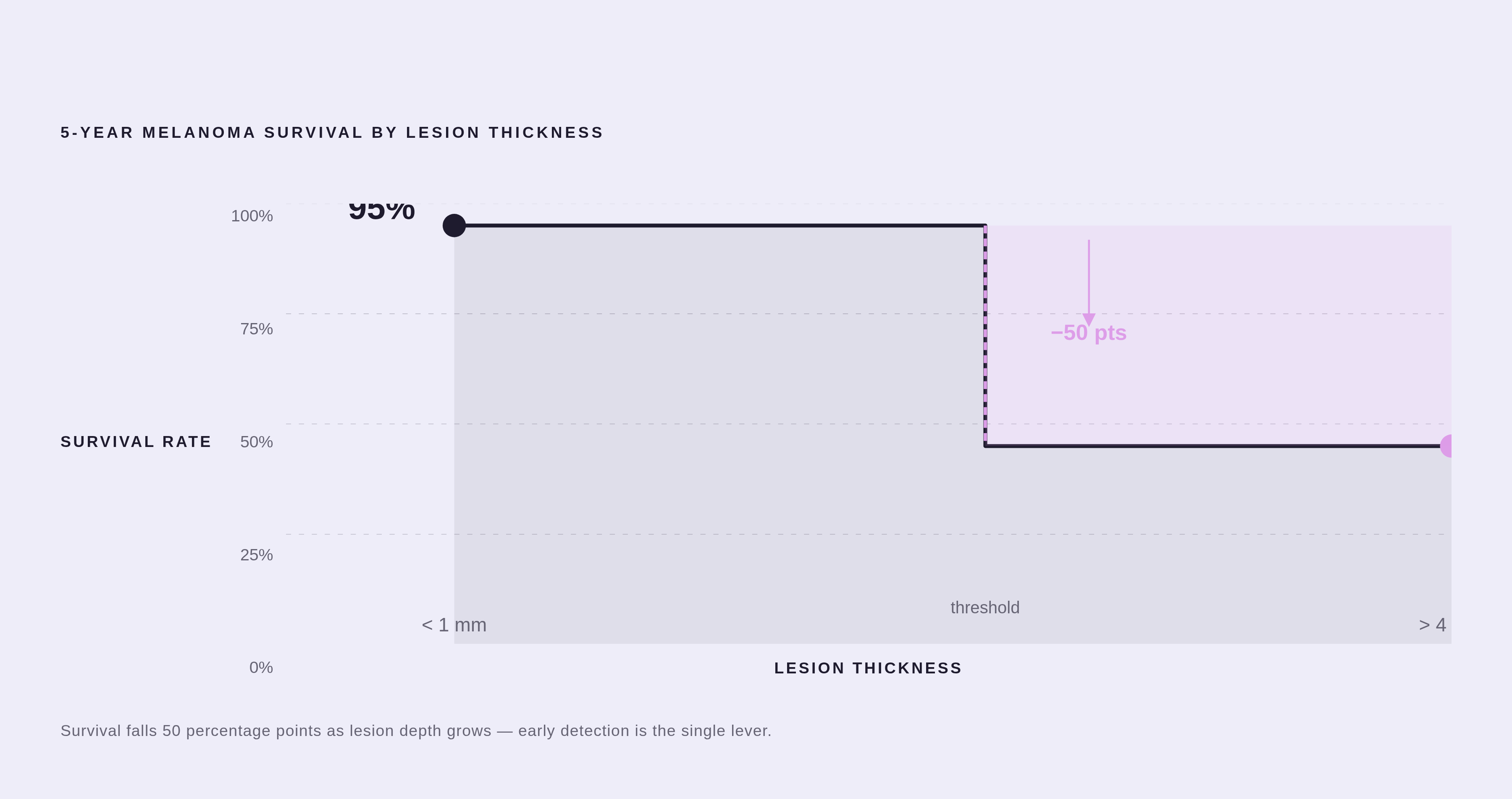
Melanoma survival is brutally sensitive to timing, which is why the accuracy race gets so much attention in the first place. Five-year survival sits at 95% when a lesion is under 1 mm thick. Let it grow past 4 mm, and that number drops to 45%. Early detection is the single lever that moves that outcome. But accuracy alone doesn't answer the question a patient actually has sitting in front of their phone: what kind of system is looking at their skin, and who's accountable if it gets this wrong?
Why a photograph alone is never the whole clinical story
Dermatologists don't diagnose off a picture. They read morphology, distribution across the body, symptoms, how a lesion feels to the touch, how it's changed over weeks or months, personal and family history, sometimes biopsy results, sometimes how a rash responds to treatment already tried. A photograph captures one frozen slice of that.
Some of the hardest calls in dermatology hinge on exactly the information a photo leaves out. Eczema versus psoriasis. Cutaneous T-cell lymphoma versus a stubborn case of chronic dermatitis. A drug reaction versus a viral rash. Lupus versus dermatomyositis. Melanoma versus an atypical but harmless mole. None of these resolve cleanly from an image alone, because the deciding detail is usually how fast something changed, or what medication someone started last month, or whether a family member had melanoma.
That's the structural reason benchmark accuracy doesn't automatically carry over into a real clinic. Multimodal AI, meaning tools that combine image analysis with a patient's actual history and symptoms, is designed to address the gap that image-only tools leave across both inflammatory conditions like eczema and neoplastic ones like melanoma. The gap between a clean benchmark score and a messy real-world case is exactly where a clinician's presence starts to matter.
The actual difference between AI-assisted and AI-autonomous skin diagnosis
The split is not about which system scores higher. AI-assisted means the system processes an image, maybe a history, and surfaces a differential or a risk flag, and a licensed clinician looks at that output before the patient ever hears it framed as an assessment. AI-autonomous means the system's output, a classification, a risk score, a recommendation, goes straight to the patient. No human checkpoint in between.
What that distinction actually buys you is accountability: a person positioned to catch an error before a patient acts on it. Research from Tschandl and colleagues found that pairing AI with clinicians of varying expertise, across different teledermatology workflows, improved diagnostic accuracy substantially. That's the "augmented intelligence" model in practice. AI doesn't replace judgment. It feeds it.
A 2026 systematic review and meta-analysis looked at standalone AI against conventional dermoscopy for sorting pigmented lesions by risk. The result was a wash, performance was broadly comparable, but the evidence didn't support autonomous AI being consistently better, and results varied a lot depending on which system was tested. Standalone AI pulled slightly ahead on specificity, but its sensitivity came in lower, meaning it missed more true positives than dermoscopy alone caught. No clear win for going fully autonomous, and that's worth sitting with given how often "autonomous" gets marketed as the upgrade.
The one study in that review looking at AI-assisted clinicians (small sample, read this as a hypothesis rather than a verdict) pointed toward improved sensitivity and specificity compared to either humans or AI working alone. Small numbers, but the direction lines up with the augmentation argument: pairing AI with a human catches things either one might miss alone. That points to the actual question patients should be asking. Not "is this AI accurate?" Instead, "who's accountable for what I'm about to be told?"
What the DermFlow study shows about where multimodal AI fits in the assisted model
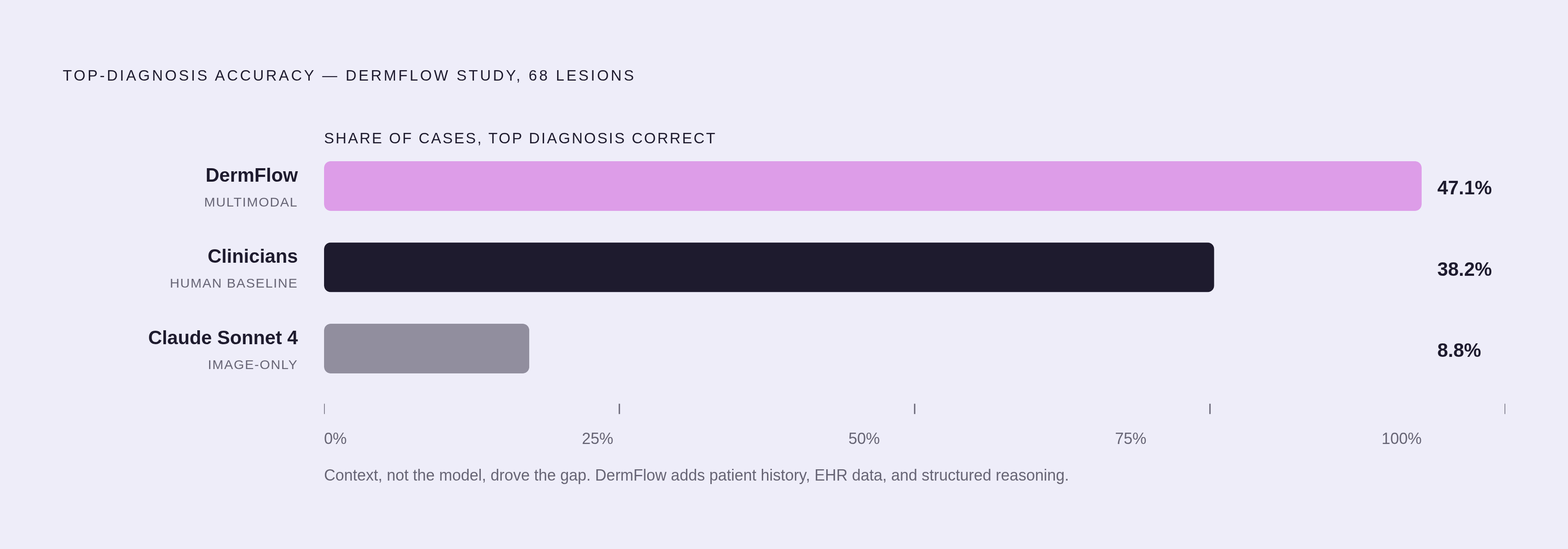
A retrospective study at Indiana University, covering 59 patients and 68 biopsy-confirmed pigmented lesions between February 2023 and May 2025, put this to a direct test. One system, DermFlow (based in Delaware), got de-identified patient histories alongside clinical images, the full multimodal input. Another, Claude Sonnet 4, got the images only, no history, mimicking the stripped-down, image-only style of an autonomous tool.
The gap was not subtle. DermFlow hit 47.1% top-diagnosis accuracy and 92.6% any-diagnosis accuracy (meaning the correct answer showed up somewhere in its list of possibilities), with sensitivity of 93.9% and specificity of 89.5%. Claude, working off images alone, managed 8.8% top-diagnosis accuracy and 73.5% any-diagnosis accuracy, with sensitivity of 81.6% and specificity of 52.6%. The human clinicians in the study landed at 38.2% top-diagnosis accuracy and 67.3% sensitivity, worth noting since it means the multimodal tool outperformed the humans in the room, not just the image-only model.
One more number worth sitting with: DermFlow recommended a biopsy in 95.6% of cases, versus 82.4% for Claude. When missing something dangerous is the risk that matters most, a tool erring toward "let's check this" is doing exactly what it should.
Was Claude simply the weaker model? That's the wrong read. The gap here is a design gap, not a raw-capability gap. One system had context to reason with. The other didn't. The study's authors are upfront that this is preliminary, and more data is needed before anyone validates it in a live clinical setting. But the lesson holds regardless of the exact numbers: what a model receives, and who checks its output afterward, shapes real-world results more than which model you picked.
How AI bias on darker skin tones changes the calculus for autonomous tools
Accuracy isn't evenly distributed across skin tones, and the gap is large enough that it should decide, on its own, whether a tool gets used without a clinician in the loop.
The root cause traces back to training data. Training datasets commonly used to build these models are heavily skewed toward lighter skin tones, with darker skin tones substantially underrepresented. The consequence shows up directly in performance: melanoma detection sensitivity that hit 67% on the HAM10000 dataset dropped to 11% on Pipsqueak, a dataset curated specifically to represent darker-skin-tone lesions. A model that misses nearly 9 out of 10 melanomas on a population it was never properly trained to see isn't a system with a minor blind spot. It's a system that shouldn't be making that call alone.
The bias doesn't stop at diagnosis. Looking at AI-generated medical images, only a small fraction depicted dark skin at all, and representation of conditions on darker skin tones was frequently inaccurate. When models do get trained on more diverse datasets, accuracy for darker skin tones climbs, which means this isn't some fixed property of AI. It's a dataset problem, and dataset problems get solved with better data, not with more trust placed in the current models.
Here's why this bears directly on the assisted-versus-autonomous question. In an assisted setup, a clinician looking at a low-confidence or off-pattern result can apply judgment the algorithm doesn't have, and catch what the model missed. That catch doesn't exist in a fully autonomous tool. And the population most likely to feel the dermatologist shortage, and most likely to reach for a digital tool as a first step, is often the same population for whom autonomous AI currently carries the least tested, worst-performing results. That overlap is the strongest argument in this entire piece against letting any skin-diagnosis tool run without a clinician checking its work.
What "agentic AI" means for skin diagnosis and why clinician oversight still applies
Agentic AI is a step beyond a system that just classifies a photo. These are systems that plan a sequence of actions: they call other tools, pull in outside information, ask a follow-up question, and manage a multi-step workflow on their own.
Picture what a well-built agentic dermatology tool might actually do. Check whether the submitted photo is even clear enough to work with. Ask for a close-up shot and a wider one showing how the rash spreads across the body. Ask about pain, itching, fever, new medications, whether any mucous membranes are involved, pregnancy status, immune suppression, how long this has been going on. Pull up any prior photos on file. Build a differential. Flag whether this needs urgent referral. Write up a structured note for a clinician to review.
That last step is the one that decides whether the rest of it is safe. The prevailing view in the field is blunt about the framing: these systems should function as copilots, not as autonomous dermatologists. A safely built agentic tool needs escalation rules for red-flag symptoms, the ability to say "I don't have enough to go on" instead of guessing, honesty about its own uncertainty, and a record of what it did and why. Systemic symptoms, a fast-spreading rash, mucosal involvement, tissue that looks like it's dying, purpura (that purplish skin discoloration from bleeding under the skin), or anything that looks like it could be melanoma: these should trigger an automatic "see a doctor now, not later." In those cases, the tool shouldn't hand down a diagnosis. It should point the patient toward urgent care and stop there.
There's a counterintuitive risk buried in all this capability. The more sophisticated an agentic system gets at asking the right clinical questions, the more convincing its final answer sounds, and the more dangerous that answer becomes if it skips human review. Capability and oversight need to grow together, not trade off against each other. Whether the system in question is a simple image classifier or a multi-step reasoning agent, the design principle stays the same: AI gathers information and organizes it, a clinician interprets it and owns the outcome.
How to read a digital skin tool and know what you are actually getting
Most tools don't spell out which category they fall into. Nothing on the landing page says "autonomous" or "assisted" in plain letters. Patients have to go looking for it, and a handful of direct questions do most of the work.
Does a licensed clinician actually review the AI's output before it reaches the patient, or does the patient get the algorithm's answer raw? What information did the tool actually use, just the photo, or the photo plus the patient's history and symptoms? What happens when the tool isn't confident: does it say so, does it escalate, or does it quietly default to a low-risk answer? What kinds of cases can't this tool handle, and will it tell the patient when they've landed in one of them? If it tells the patient to see someone in person, is there an actual path to make that happen?
A few tells give away an autonomous setup fast: results that appear instantly, no mention anywhere of a clinician reviewing anything, no questions asked about history or how long something's been going on, no acknowledgment that the system might be wrong. An assisted tool tends to look different. It names the clinician review step outright, its response time reflects an actual human reading the case (hours, not seconds), it asks for context beyond the photo, and its output reads like a recommendation rather than a verdict.
There's a real, useful place for asynchronous AI-assisted teledermatology: common concerns, non-urgent presentations, situations where a 50-day wait makes waiting for specialist access impractical. That lines up with the research showing telehealth resolves 30% to 50% of dermatology requests without needing an in-person visit at all.
But it's not built for everything, and a good tool says so out loud. Fast-spreading rashes, suspected melanoma, mucosal involvement, anything that likely needs a biopsy: these need a body in a room, not a photo in an app. If a tool pushes forward on one of these anyway, without flagging its own limits, that silence is itself useful information about how the tool was built.
None of this is an argument for distrusting AI in dermatology. It's an argument for knowing exactly what's answering when a skin concern gets typed into an app: a licensed clinician backed by a tool, or a tool standing alone, unreviewed. Given what the DermFlow numbers show about image-only models, and what the Fitzpatrick17k gap shows about who those models fail hardest, standing alone is not the version of this technology worth trusting yet. That distinction, more than any accuracy percentage on a homepage, decides whether a digital skin tool is a smart first step or something to treat with real caution.
Sources
- AI in dermatology: a comprehensive review into skin cancer detection
- Validation of a Dermatology-Focused Multimodal Large Language Model in Classification of Pigmented Skin Lesions
- Frontiers | Advancements and challenges of artificial intelligence in dermatology: a review of applications and perspectives in China
- Equity and Generalizability of Artificial Intelligence for Skin-Lesion Diagnosis Using Clinical, Dermoscopic, and Smartphone Images: A Systematic Review and Meta-Analysis