Privacy and Data Security in Skin Analysis Apps

The skin analysis app market crossed USD 1.82 billion in 2025 and is projected to reach USD 2.12 billion in 2026, growing at a 17.2% annual clip. Those numbers describe a market. What they do not describe is the person standing in a bathroom, holding up a phone, tapping "scan," and uploading one of the most irreplaceable pieces of biometric data they possess: an image of their face.
I have spent years working at the intersection of clinical AI and digital health, and the thing that still gets me is the casualness of the upload moment. It feels like taking a selfie. It is not. And the gap between what users experience and what actually happens to that data is, at this point, wide enough to drive a data-broker's business model through.
Personalized skincare apps represent the largest segment of this market, accounting for 52.1% of the app-type share in 2026. The dominant use case is consumer-facing, not clinical. Which means the tools that feel most like beauty utilities are, structurally, operating as health-data collectors. That is the tension this piece is really about.
The Full Picture of What Gets Collected When You Scan Your Face
Start with what you can see. You upload a facial image. The app processes it, returns a result about your pores or your hydration levels or your likelihood of sun damage. That part is visible.
Now consider what you cannot see. Most consumer skin apps embed multiple analytics software development kits: Firebase, Google Analytics, Appsflyer, AppMetrica, Amplitude, and crash-logging tools are documented in published privacy policies. These SDKs are not analyzing your skin. They are tracking your behavior in the app, your device characteristics, your session duration, and your engagement patterns. That data travels alongside, or in parallel with, the biometric data you actually came to submit.
Then there are two clauses almost no one reads: the training data clause and the business transfer clause.
On training data: some platforms explicitly reserve the right to use your uploaded images for model training and commercial product development. Skin Analytics, for example, states in its published policy that it will seek consent to use images and data for "medical, clinical and commercial training and product development," with images potentially reviewed by staff. The phrase "seeking consent" sounds reassuring. It is less reassuring when consent is obtained via a pre-ticked opt-in box you scrolled past during onboarding. The legal validity of that consent and the user's subjective understanding of it are two entirely different things.
On business transfers: standard policy language across many platforms permits facial scan data to transfer to a successor entity, in a merger, acquisition, or asset sale, under confidentiality terms alone. No new consent required. A selfie you uploaded to a scrappy wellness startup in 2022 is now held by a company you have never heard of, subject to a privacy policy you have never read.
One more compounding factor worth naming. If a platform operates across multiple health and wellness verticals, including reproductive or hormonal health alongside skin analysis, the combined profile becomes uniquely sensitive. Skin condition data correlated with menstrual cycle data, for instance, creates an inference surface that is considerably more revealing than either data point alone.
A face scan is not an anonymous data point. It is a biometric identifier in the same legal and technical category as a fingerprint or an iris scan. The upload moment feels trivial. The data implications are not.
Why HIPAA Almost Certainly Does Not Protect Your Skin App Data
Here is one of the most persistent and consequential misconceptions in consumer health technology: that uploading health-adjacent data to an app means HIPAA protections apply. They almost certainly do not, and understanding why is worth the effort.
HIPAA applies to covered entities, specifically healthcare providers, insurers, and clearinghouses, and to their business associates. Consumer-facing skin analysis apps are not covered entities. They fall entirely outside HIPAA's jurisdiction, regardless of how medically sensitive the data they collect is. The FTC, not the Department of Health and Human Services, governs most consumer health apps, and the FTC's framework was built for trade practices, not clinical data protection.
To understand what HIPAA compliance actually looks like in practice: clinical-grade dermatology AI systems encrypt images, restrict access to the patient's care team, and strip identifying information before analysis. Any clinic working with an outside AI vendor must execute a Business Associate Agreement, a legal contract that obligates the vendor to protect patient health information under HIPAA's specific requirements. Consumer cloud platforms like Google Photos, Dropbox, and iCloud are not BAA-covered. Clinically speaking, they cannot be used for clinical patient photographs.
This creates a specific reading problem for consumers. When an app markets itself as "clinical" or "dermatologist-developed," that language describes its methodology, or at least its marketing claims about methodology. It says nothing about its data-protection obligations. Those are separate questions, requiring separate answers. You have to look for an explicit statement of HIPAA compliance and BAA coverage. If it is not there, assume it is absent.
Platforms built into actual clinical workflows, where a licensed clinician supervises AI output, operate under a categorically different compliance standard. That distinction is not a marketing detail. It is the structural difference between your image being handled as patient data and your image being handled as a product asset.
The Regulatory Frameworks That Do Apply, and What They Actually Require
If HIPAA is not the governing framework, what is? Several things, with varying degrees of teeth.
The FTC's Health Breach Notification Rule, amended in July 2024, now covers most health and wellness app developers that furnish health care services or supplies, including the app itself as a qualifying service. Breach notification to consumers and the FTC is required within 60 days of discovery, with civil penalties for non-compliance. That is real enforcement authority.
The FTC's enforcement record over the past several years provides useful context. Actions against GoodRx and BetterHelp established that sharing health-related user data with advertising platforms, while claiming in a published privacy policy that you would not, constitutes a deceptive trade practice. The Advocate Aurora Health case involved Meta Pixel code on appointment-scheduling pages that affected roughly three million patients and resulted in a $12.25 million settlement. Between 2023 and 2025, US healthcare organizations collectively paid over $100 million in pixel-related settlements. Consumer skin apps with embedded advertising SDKs face structurally identical exposure.
The Flo Health case is perhaps the closest analog to what skin apps face. The FTC alleged that Flo shared sensitive health data with Facebook and Google analytics despite explicit assurances to users that data would remain private, and placed no meaningful limits on how third parties used or resold that data. Intimate health data, quietly routed to ad networks. The same dynamic is structurally available to any skin app with condition data, facial imagery, and an analytics SDK stack.
On biometric data specifically: the FTC's own definition includes faceprints, which means facial images uploaded to AI skin analysis platforms qualify as biometric data under that regulatory framework. A December 2024 Department of Justice final rule restricts bulk transfers of biometric data to countries of concern, which is directly relevant because several major skin AI platforms are headquartered outside the United States.
State law adds another layer, and a complicated one. At least 26 states are advancing privacy protections, but they vary substantially. Washington's My Health My Data Act allows private lawsuits and requires opt-in consent. Virginia's VCDPA limits enforcement to the Attorney General. California's CPRA grants access and deletion rights. Where you live materially changes your protections. There is no federal standard yet.
For EU users, the bar is higher. Under GDPR, facial imaging is classified as a high-risk activity, requiring a Data Protection Impact Assessment before deployment. Valid consent must be freely given, specific, informed, unambiguous, documented, and withdrawable; pre-ticked boxes and consent-by-continued-use are explicitly invalid. Non-compliance fines reach up to $20 million or 4% of annual global turnover, whichever is greater. That is a different regulatory posture entirely.
What the Privacy Policy Actually Says: How to Read One Before You Upload
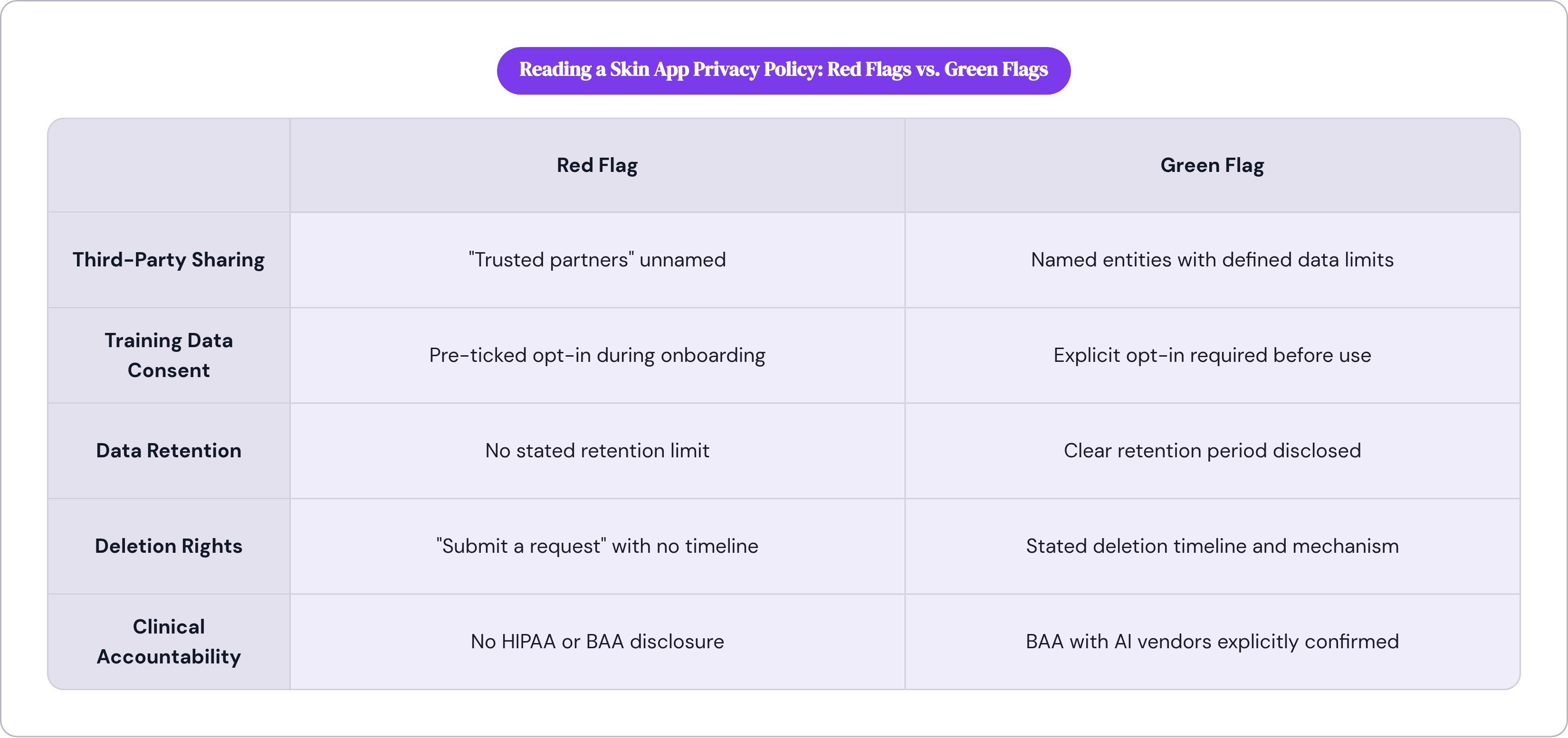
Most users never read privacy policies. That is understandable; the relevant language is deliberately buried and written for legal defensibility, not user comprehension. But there are five specific things worth finding before you upload a facial image to any skin analysis platform.
First, the training data clause. Does the app reserve the right to use your images for model training or commercial product development? If so, is consent obtained through opt-in or opt-out? Pre-ticked boxes are not the same as informed consent, whatever a US court eventually says about them.
Second, third-party sharing. Which analytics, advertising, or data-broker partners receive your data, and under what terms? "Trusted partners" is not an answer. Named entities with defined data use limits are.
Third, business transfer language. What happens to your data if the company is acquired or its assets are sold? Most policies allow transfer under confidentiality terms alone, with no requirement for new consent.
Fourth, data retention. How long does the platform store your facial images? Do you have an explicit deletion right, and is there a stated timeline for honoring a deletion request?
Fifth, HIPAA and BAA disclosure. Is there any statement that a Business Associate Agreement is in place with AI or technology vendors? The absence of this language, for a platform making clinical claims, is informative.
Red flags in the language include "we may share with trusted partners" without naming them; consent framed as continued use of the app; no stated retention limit; and no deletion mechanism beyond a "submit a request" process with no timeline attached.
Green flags signal a more protective posture: a named, limited list of third parties; explicit opt-in for training data use; a stated deletion timeline; and a clear disclosure that licensed clinicians are involved in reviewing AI outputs.
One more distinction worth drawing clearly: "dermatologist-approved" is a marketing claim about methodology. "Licensed clinician reviews outputs" is a data-governance claim about accountability. These are not the same thing, and they are rarely presented as distinct.
What Safer Skin Assessment Looks Like, and Why Clinical Oversight Changes the Equation
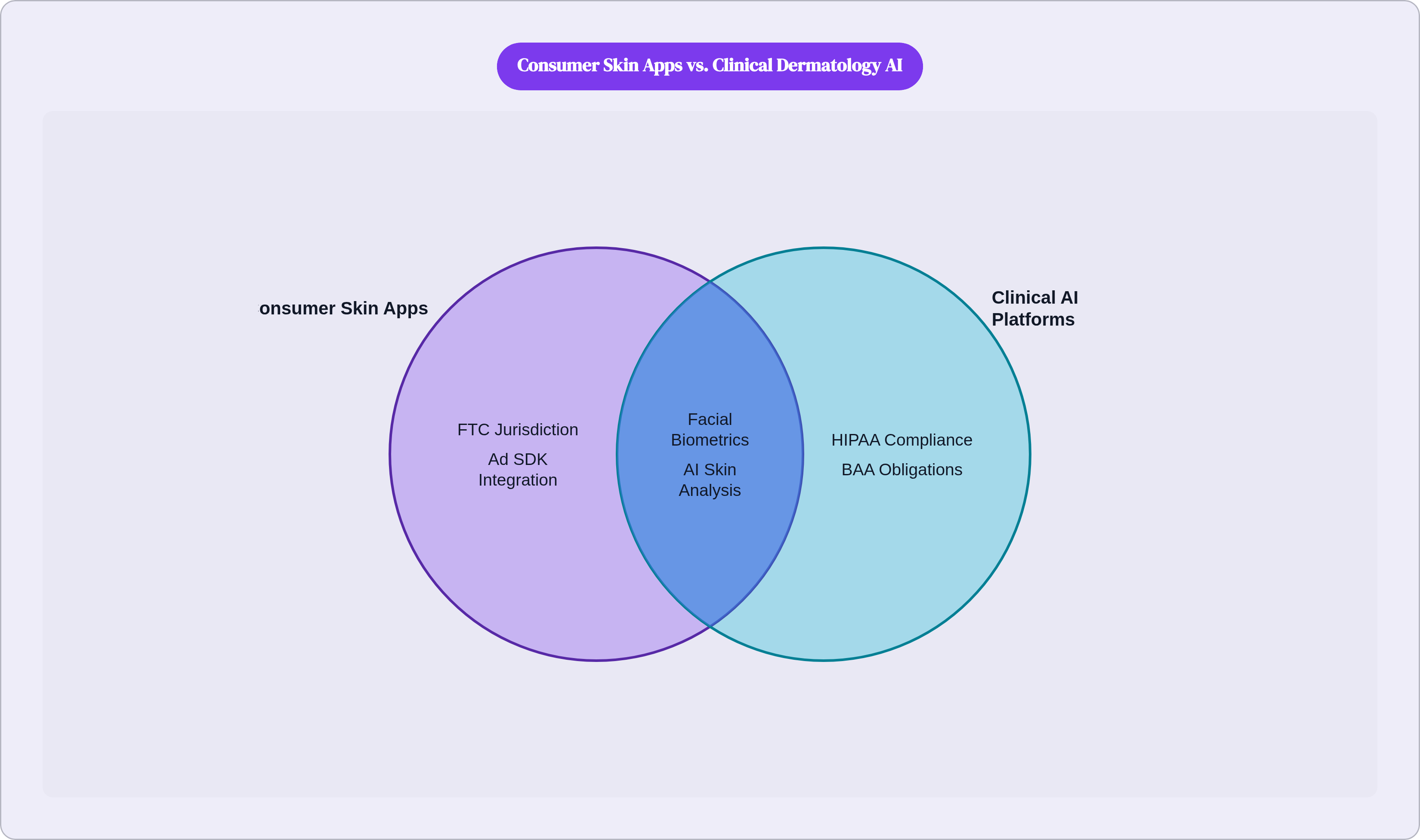
The distinction that actually matters is not which app has the cleanest interface or the most accurate-seeming percentage scores. It is whether the AI you are interacting with feeds a marketing and recommendation engine or supports a licensed clinician's assessment of a medical skin concern.
In a clinically supervised model, images are reviewed in the context of a care plan, not retained for commercial model training without consent. The clinician, not the AI, bears accountability for the assessment. Data architecture is designed around HIPAA compliance and BAA obligations, not advertising SDK integration. These are structural differences, not marketing differences, and they flow from a founding premise about what the technology is for.
Platforms like Nolla, an AI-assisted skincare telehealth service where licensed US clinicians review symptoms and issue prescriptions, start from that premise. The technology exists to support clinician judgment, not to replace it. Data handling follows from that structure. That is a meaningful distinction from a platform whose primary design objective is product recommendation at scale.
There is an affordability dimension here worth considering. A message-based consultation with a real clinician at a price point accessible to most people is not only a different privacy model. It is also a different clinical model. The question being answered shifts from "which product matches my skin type" to "what is actually happening with my skin and what should I do about it." Those are not equivalent questions, and the platform's purpose shapes how it answers them.
Skin health is medical health. Conditions that present as cosmetic, acne, hyperpigmentation, unusual lesions, changes in texture, can carry real clinical significance. The platform where you upload that image should be built for that responsibility, not for the engagement funnel adjacent to it.
Before choosing any skin assessment platform, consider three questions. Is a licensed clinician reviewing AI outputs, or is the AI the final word? Is the platform subject to HIPAA and does it maintain BAAs with its technology vendors? And does it operate from an access gap, helping people who cannot easily reach a dermatologist, or from an engagement model designed to keep users interacting with content and products?
The practical implication runs in both directions. Understanding what skin analysis apps do with your data is a privacy exercise. It is also a diagnostic signal. How a platform handles your image tells you something about whether the clinical judgment behind it is trustworthy enough to act on. Those two things are not as separable as the app stores make them appear.