Skin Cancer Mortality and Survival Rate Realities

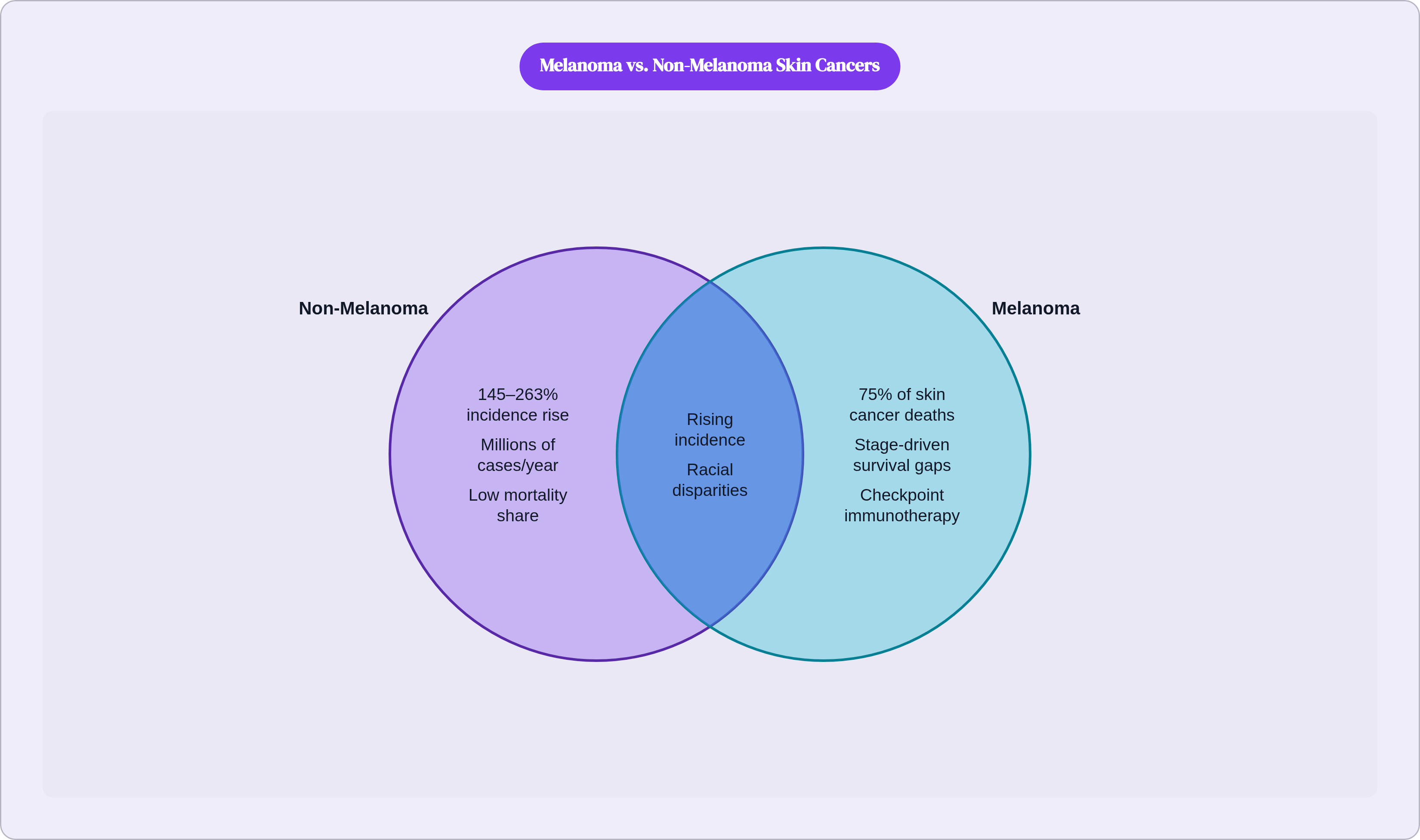
Basal cell carcinoma runs at roughly 3.6 million cases per year in the United States, making it the most commonly diagnosed cancer of any kind, full stop. Squamous cell carcinoma follows at about 1.8 million annually. Together, these two travel under the label "non-melanoma skin cancers," and their incidence has climbed sharply: BCC up 145%, SCC up 263%, comparing the mid-1970s through 1980s against the 2000s. Caught early, which most are, they account for a small fraction of skin cancer deaths.
Melanoma tells a different story. Projected 2026 cases sit at approximately 234,680, of which around 112,000 are invasive. That's a fraction of BCC or SCC in raw numbers, yet melanoma accounts for roughly 75% of all skin cancer deaths in the United States.
So you have the rarest of the three types responsible for three out of four deaths. That inversion is exactly why aggregate survival statistics mislead people. Rising incidence in non-melanoma types doesn't translate to rising mortality; the relationship depends entirely on stage at detection and treatment access. For melanoma, every stage transition carries real consequences.
What "99% survival" actually refers to, and what it quietly omits
The 99% figure applies specifically to localized melanoma, cases where the tumor hasn't spread beyond its original site. That's a real statistic, reflecting a genuine truth: catching melanoma early produces excellent outcomes. But it describes one segment of patients, not the full population of people diagnosed.
SEER, the national cancer database, groups melanoma survival into three broad stages for reporting purposes:
- Localized (confined to the original site)
- Regional (spread to nearby lymph nodes or adjacent tissue)
- Distant (spread to other organs)
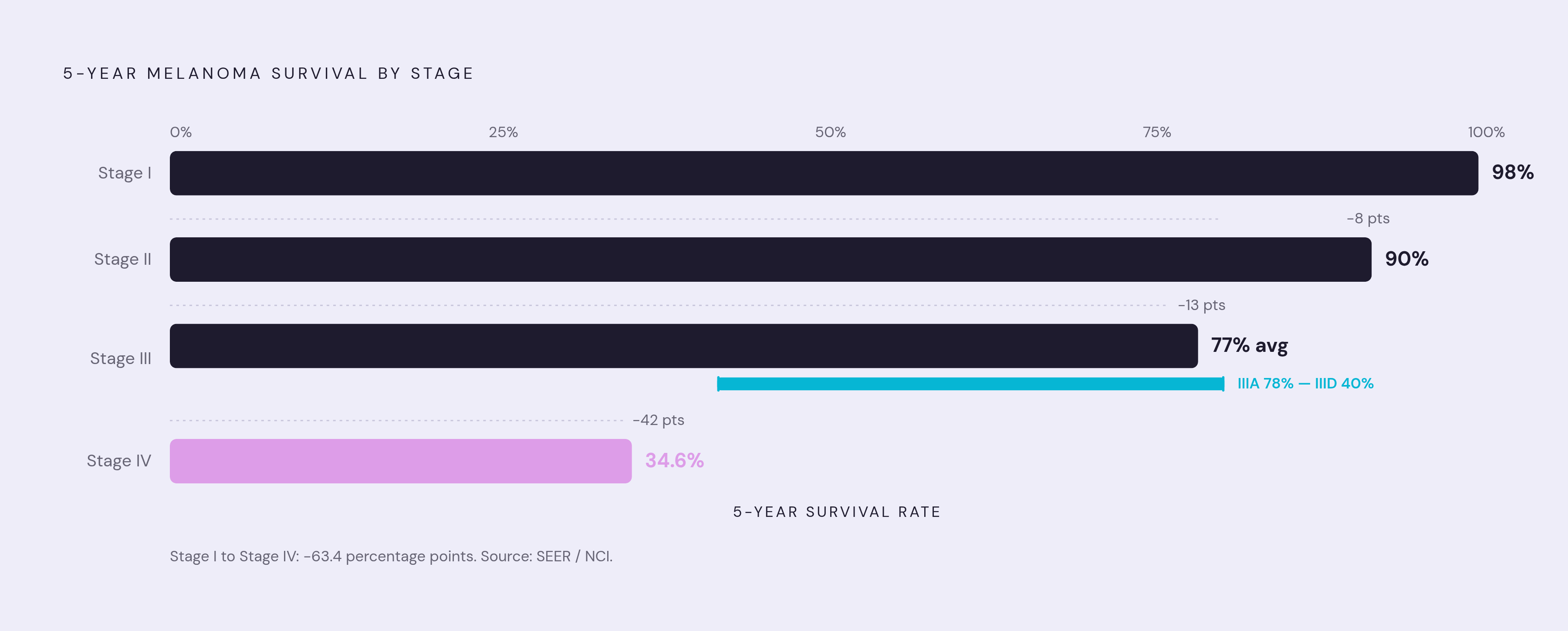
Five-year survival by stage tells a progressively different story. Stage I sits at approximately 98%. Stage II drops to around 90%. Stage III lands at roughly 77% on average, but that average conceals a wide range: Stage IIIA carries approximately 78% five-year survival, while Stage IIID drops to around 40%. Stage IV, distant-spread disease, sits at approximately 34.6% at the population baseline for patients diagnosed between 2015 and 2021.
Between 1999 and 2021, 77% of U.S. melanoma cases were localized at diagnosis, which is why the optimistic headline statistic exists and why it's defensible in context. But 4.7% of cases were already distant at diagnosis, and another 9.5% were regional. Those patients are working from a radically different baseline. The 99% figure is accurate for the largest group; it says nothing about what happens when diagnosis is delayed.
The mortality reality behind the optimistic averages
An estimated 8,510 people in the United States will die from melanoma in 2026, up from 8,430 in 2025 and 7,990 in 2024. In 2023, roughly 22 people died from melanoma every single day, one person approximately every 65 minutes.
The current incidence rate is 22.3 per 100,000 people per year; the age-adjusted death rate is 2.0 per 100,000, based on 2019 through 2023 case data and 2020 through 2024 death data from SEER. The death rate has been declining, averaging approximately 2.2% per year between 2015 and 2024, with the decline steeper in younger adults: roughly 5% per year in those under 50 and approximately 3% per year in those over 50 between 2011 and 2020.
But why are absolute deaths still rising if the rate is falling? Incidence is climbing faster than mortality improvements can offset. Across all skin cancer types, annual medical costs total $8.9 billion, covering approximately 6.1 million people treated each year. Population-level improvement and a growing absolute burden are coexisting right now, and holding both numbers at once is the only way to see the picture clearly.
How treatment advances have reshaped Stage IV outcomes since 2011
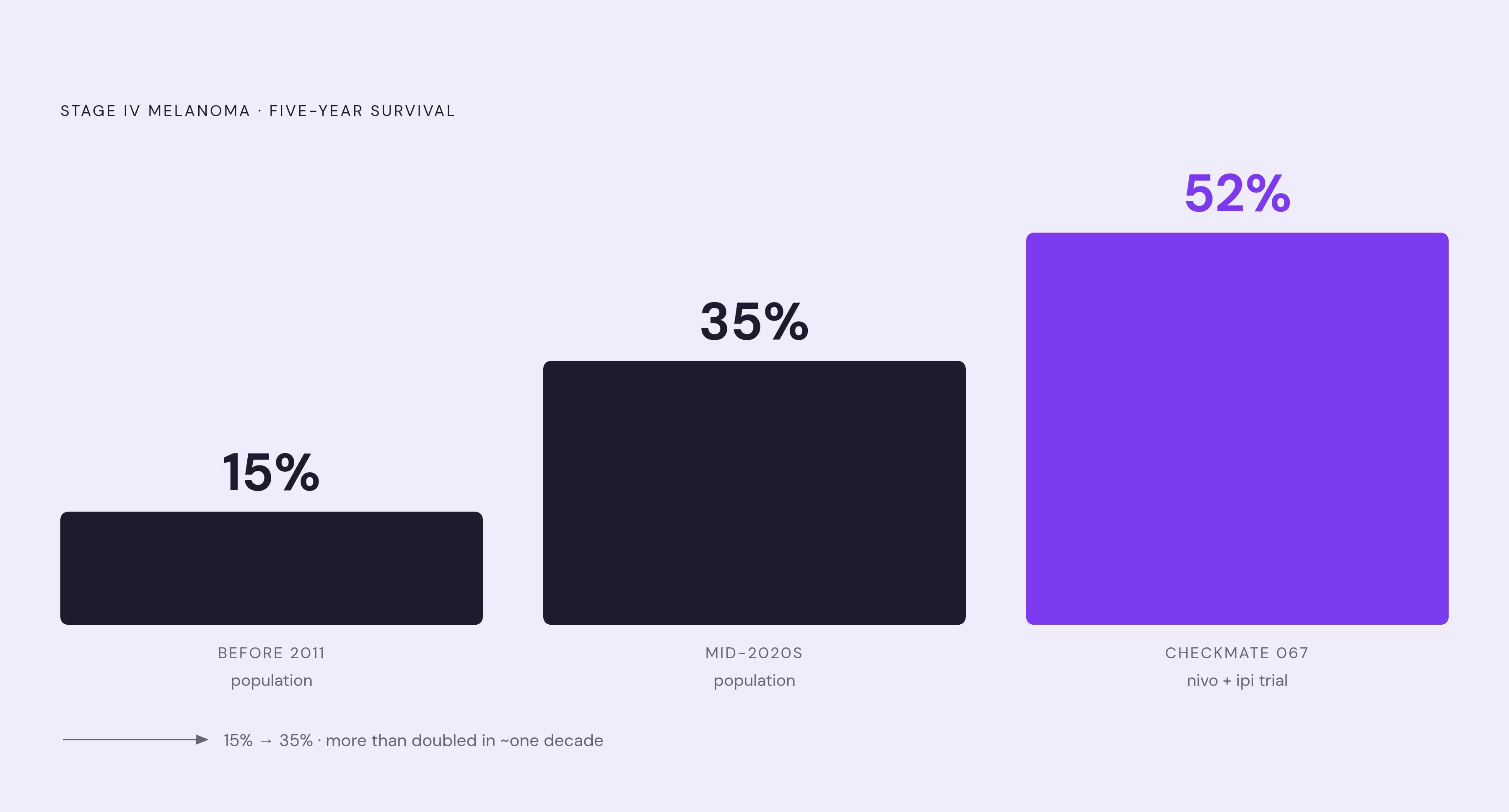
Before 2011, the five-year survival rate for Stage IV melanoma was approximately 15%. By the mid-2020s, that figure has reached roughly 35% at the population level. More than doubling survival in a little over a decade is not a small shift, and I'll be honest: when I lay the before-and-after numbers side by side, the scale of it still gets me.
The primary driver was checkpoint immunotherapy, drugs that remove the molecular brakes cancer cells use to hide from the immune system. In the landmark CheckMate 067 trial, the combination of nivolumab and ipilimumab achieved a five-year overall survival rate of 52% in metastatic melanoma patients, compared to 26% with ipilimumab alone. Research published in 2024 from Dana-Farber showed that roughly half of combination immunotherapy responders remained alive and cancer-free at 10 years.
Targeted therapy added another avenue for patients whose tumors carry the BRAF V600E mutation, which applies to roughly half of all melanoma patients. Five-year overall survival data for Stage IV patients on BRAF-targeted drug combinations now ranges from the mid-30s to mid-40s, a genuinely different prognosis than anything available a decade ago.
Two 2024 developments deserve close attention. The NADINA trial demonstrated that giving immunotherapy before surgery, rather than after, produced 12-month event-free survival of 84% versus 57% with adjuvant therapy alone for resectable Stage III disease. The FDA also approved lifileucel (Amtagvi), the first cellular therapy approved for any solid tumor, for advanced melanoma that had progressed after other treatments; the objective response rate in the pivotal trial was 31.5%.
That raises an important question for how we read survival statistics: figures attached to diagnosis years before 2015 don't reflect what a patient diagnosed today actually faces. These advances haven't eliminated Stage IV mortality, but durable remission is now possible for a real share of patients who, a decade ago, had very few options.
Why survival gaps by race and ethnicity are not explained by biology
Five-year melanoma survival runs at approximately 92% for non-Hispanic White patients and approximately 70% for Black patients. That 22-percentage-point gap is rooted in when the disease gets found and whether the patient can access care, not in biology.
The share of melanoma cases diagnosed at Stage III or IV was roughly twice as high for Black and Native American patients compared to White patients. Even after accounting for stage, Hispanic, Native American, Asian, and Black patients face greater mortality risk, which points to barriers extending well beyond late detection alone. Hispanic individuals are diagnosed with advanced-stage melanoma at roughly 2.4 times the rate of non-Hispanic Whites, and average diagnostic delay for people of color extends approximately 8 months beyond typical timelines for White patients.
Part of this comes from a genuine awareness gap: roughly 63% of Black adults report believing they're not at risk for skin cancer, a misconception that directly delays help-seeking. Part of it comes from where melanoma physically presents. In Black and Hispanic populations, melanoma occurs most often in sun-protected areas, the palms, soles, nail beds, and oral mucosa, not in the sun-exposed sites people typically check. The standard ABCDE self-exam framework was developed around fair-skin presentations; it doesn't transfer cleanly to darker skin tones or acral sites, which means standard public health guidance is effectively less useful for the populations facing the worst outcomes.
Structural factors compound everything. A 2024 study linked to the American Cancer Society found that lack of health insurance raises the likelihood of late-stage cancer diagnosis for Black and Hispanic Americans, and insurance status accounts for a significant share of the racial disparity in stage at diagnosis. Rural populations face overlapping disadvantages: limited dermatology access and higher skin cancer rates across multiple demographic variables, findings presented at the 2024 AAD annual meeting.
But what if improved access to a first-step evaluation changed the trajectory for even a fraction of these patients? Stage at diagnosis is where the disparity is rooted, which makes earlier detection a structural equity issue, not just a clinical one.
What the statistics mean for how you think about your own skin
Stage at diagnosis is the single most controllable variable in survival outcomes. Everything else, tumor biology, treatment regimen, long-term prognosis, flows downstream from that one inflection point.
The 99% figure describes patients who are already in the localized-stage column when they're diagnosed. Getting there requires noticing a change and acting on it before the disease progresses. That sounds obvious, and it's genuinely hard to do consistently, especially when you're unsure whether something warrants a visit or whether you're overreacting.
Self-examination works differently depending on your skin tone and where on your body you look. The palms, soles, scalp, and nail beds warrant attention regardless of skin color and regardless of sun exposure history. The classic ABCDE criteria cover a lot of ground, but new growths that don't fit the pattern still deserve a second look.
The threshold most people face is a simple one: is this worth having looked at? Almost always, the answer is yes, and sooner matters more than later. The barriers are real, including cost, geography, and genuine uncertainty about whether something warrants a visit. Telehealth-based skin assessment, including asynchronous photo-based review by a licensed clinician, lowers the barrier for that first evaluation step without replacing in-person biopsy when one is needed.
Nolla's clinical AI platform, trained on over three million labeled clinical cases and supervised by licensed clinicians, addresses exactly this triage moment: helping people assess whether a skin change warrants follow-up before they dismiss it. For patients facing structural access barriers, a low-cost first-step consultation has concrete value, separating "monitor this" from "see someone in person urgently" without requiring a dermatology appointment as the entry point.
We have better treatments than ever and better tools for earlier evaluation than ever. Neither does much good if someone waits too long to use them.