Dermatologist Waitlist Alternatives for Common Skin Conditions
AI-assisted diagnosis and telehealth can bridge the gap while you wait months for a dermatologist.
Getting a dermatology appointment now takes an average of 36.5 days nationally, up from 34.5 days in 2022, and that average hides far longer waits in underserved regions. This piece lays out what patients with common skin conditions can actually do about that wait: asynchronous teledermatology with clinician sign-off, AI-assisted triage that still requires physician approval before any prescription, and strategic use of primary care, each suited to a different kind of case.
Dermatology Wait Times: A Structural Problem, Not a Temporary Backlog
The gap between how many people need a dermatologist and how many dermatologists exist to see them has been widening for years, and nothing in the current pipeline suggests it closes soon. On the demand side, an aging population carries a heavier burden of skin disease, and Healthgrades (2025) reports that the number of new invasive melanoma cases diagnosed annually rose substantially between 2015 and 2025. Cosmetic demand adds further pressure on the same limited pool of appointment slots.
Supply has not kept pace. Dermatologists are aging out of practice faster than new graduates can replace them, and that imbalance is most severe in places already short on specialists.
The national average of 36.5 days obscures the worst cases. KRQE reported in December 2025 that the University of New Mexico Hospital's dermatology department sent a memo, roughly six months earlier, stating new patient wait lists had reached one to one-and-a-half years. New Mexico's legal liability environment discourages physicians from practicing there at all, compounding workforce attrition in a region that was already underserved before the shortage became acute.
None of this is a temporary disruption that resolves itself once a few more residency slots open up. It is a structural mismatch between an aging workforce, an aging patient population, and a specialty that takes years to train new practitioners into. That context matters, because it changes the question for patients from "how long until this gets better" to "what are the clinically sound options available right now."
What Happens to Patients Who Wait
Waiting for a dermatology appointment is not a neutral holding pattern. Nearly two-thirds resorted to over-the-counter medications or herbal remedies in the meantime.
Self-treating with OTC products is not inherently a mistake. Self-treating without clinical guidance carries its own risk. A patient might apply a potent OTC steroid to what looks like eczema but is actually a fungal infection, making it worse. A patient might delay attention to a lesion that looks suspicious because an OTC cream seems like the available first step, and the risk is not just that the home remedy fails to help but that the wrong treatment actively interferes with the right one, or that time passes on something that needed early attention.
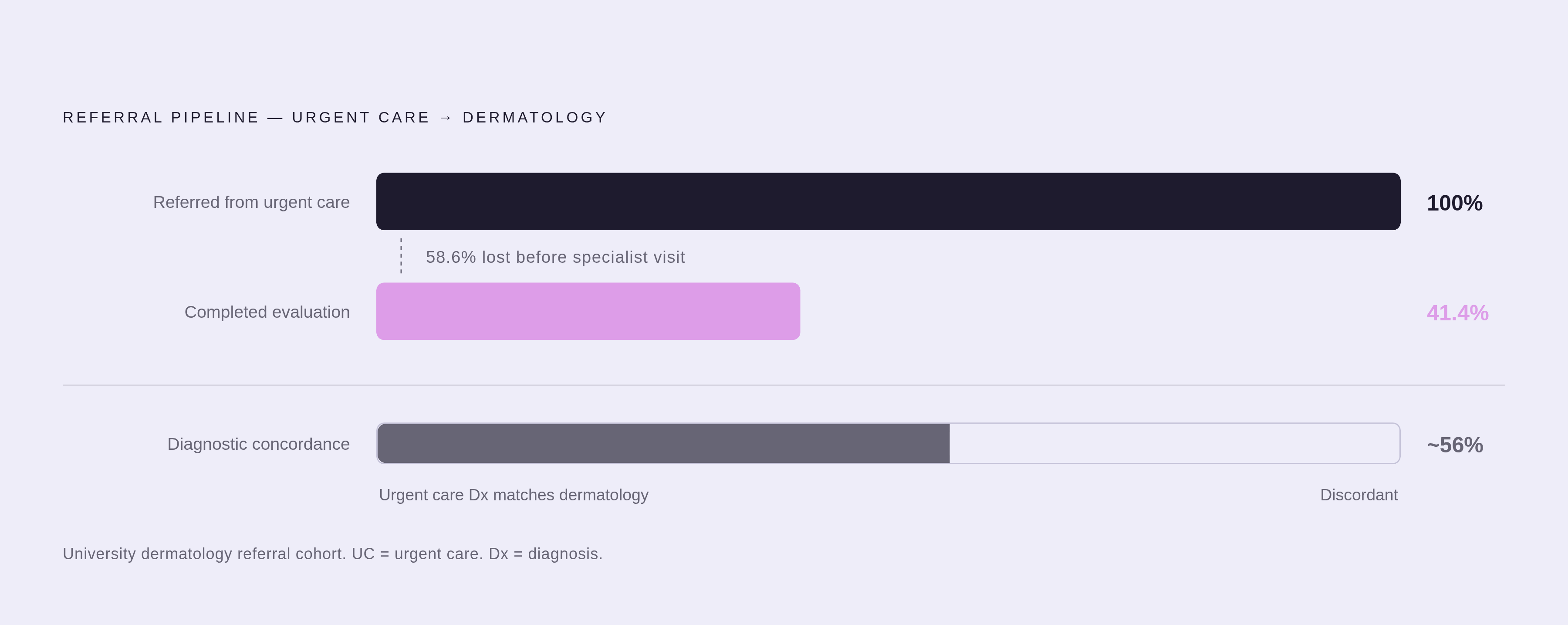
The burden falls hardest on patients with genuine clinical need rather than cosmetic preference, and it does not stop at symptom severity. Among patients referred from urgent care to a university dermatology clinic, 58.6% never completed an in-person dermatology evaluation. That is diagnostic attrition: a scheduling delay alone would not explain patients who entered the referral pipeline and simply fell out of it before a specialist ever saw them.
None of this means waiting is always the wrong call. Some conditions genuinely warrant watching, and some symptoms resolve on their own. But waiting passively, with no interim plan, while a condition that needs treatment keeps progressing, is the choice that carries real and measurable risk. The alternatives covered in the rest of this piece exist precisely for the stretch of time between "I have a problem" and "a specialist can see me."
Common skin conditions well-suited to remote assessment
Not every skin condition belongs on a screen, but a large share of what sends patients to dermatology waitlists does. The conditions that make up most routine dermatology visits, acne, eczema, psoriasis, rosacea, and hyperpigmentation, share three traits that make remote assessment genuinely appropriate. They also tend to be chronic or recurrent conditions, giving a clinician time to assess and adjust at their own pace.
Acne vulgaris is highly photographable and graded by type and severity, with a treatment ladder running from topical agents to hormonal therapy to oral antibiotics, all of which a remote clinician can evaluate and prescribe from images and history. Hyperpigmentation, including melasma and post-inflammatory marks, responds to topical retinoids and related agents, and clinical photography is already the standard way dermatologists document and track it.
Some presentations should not wait for a remote option, and patients should know the line clearly. A rapidly changing or asymmetrical lesion with irregular borders or shifting color needs in-person evaluation, not a photo review. A possible skin infection with systemic signs, fever, spreading redness, warmth, needs urgent attention. And anything that would normally call for dermoscopy, a biopsy, or physical palpation belongs in an exam room, not on a phone screen. The point of this section is to help a reader locate their own situation: if it looks like the first list, remote assessment is a legitimate option. If it looks like the second, it is not the place to start.
How asynchronous teledermatology works, and what the evidence says about its accuracy
Store-and-forward teledermatology works on a simple structure. A patient submits clear photographs of the affected area along with a description of symptoms, and a dermatologist or supervised clinician reviews the case on their own schedule rather than in a live call, then returns a diagnosis or treatment plan, typically within hours to a day. Three delivery modes exist in telehealth broadly: asynchronous (store-and-forward), synchronous (live video), and hybrid combinations of the two. Asynchronous is the most scalable of the three and the most studied for expanding access, since it does not require both patient and clinician to be available at the same moment.
The evidence on accuracy is specific. A 2025 retrospective study on lichen planus found teledermatology delivered a mean response time of 15 hours, with diagnostic concordance between teledermatologists and in-person dermatologists reaching a high level. Most published research in the field shows teledermatology reduces the time to advice and to definitive treatment compared with waiting for a standard outpatient clinic visit.
Image quality is the main variable that limits accuracy in a store-and-forward model, and the bar for "good enough" is not complicated. Natural light rather than harsh indoor lighting, a close-up shot that captures texture and border detail, and a few different angles of the same area give a clinician what they need to assess most common conditions. Research on patient education and image quality found no significant association between a patient's education level and their clinical outcomes, which suggests the format holds up across different populations once basic image guidance is given, rather than favoring patients who are more tech-savvy or medically literate to begin with.
The model also works outside of controlled studies, serving as a working example of how asynchronous review integrates with local follow-up care.
AI-assisted teledermatology with mandatory clinician sign-off
Patients using online skin care platforms increasingly encounter AI somewhere in the intake process, and it helps to be specific about what that actually means. AI-assisted dermatology, in the models with real clinical grounding, refers to pattern recognition run against submitted photographs that surfaces likely findings for a licensed clinician to review, confirm, and act on. It is not an autonomous diagnosis handed to a patient without a clinician in the loop.
The research on AI performance is genuinely strong. But dermatologists working with AI outperformed either one alone on both sensitivity and specificity, reaching 91.9% sensitivity for melanoma detection. A separate meta-analysis covering studies from 2003 to 2025 found AI matched or surpassed specialist dermatologists in a majority of direct comparisons, with high pooled diagnostic accuracy across the body of research.
Those numbers come with a real limitation. AI also cannot detect odor, assess skin warmth or texture, or take in the fuller clinical context that a live or in-person encounter provides, details that matter directly in conditions like cellulitis or when a clinician is trying to estimate how deep a lesion runs.
That combination of strengths and gaps points to one working model: AI as a pattern-recognition and triage layer, with a licensed clinician reviewing the findings, making the actual diagnosis, and writing any prescription. The two together outperform either alone, and the clinician's review is what makes the result something a patient and a pharmacy can actually trust. Platforms built this way, including Nolla, use large multimodal models and vision-language systems trained on large sets of labeled clinical cases to support fast initial assessment, with clinician oversight built into the workflow. That structure, AI for speed and pattern-matching, a licensed clinician for judgment and sign-off, is the specific thing to look for when evaluating whether an online dermatology service is actually safe to use for a prescription.
What a clinician-supervised online consultation can actually prescribe (and what it cannot)
For most of the common conditions discussed above, a licensed clinician working through a virtual or asynchronous consultation can prescribe the same first-line treatments a patient would get in a traditional exam room. Topical retinoids are a good example: tretinoin has long been approved for acne and for photoaging, and it sits alongside adapalene and tazarotene as options prescribable through telehealth. Patients starting a retinoid for the first time should expect some redness, dryness, or peeling in the first few weeks. That irritation is a known and manageable part of starting the medication, typically addressed by applying it less frequently at first or pairing it with a moisturizer, not a sign that something has gone wrong.
Oral antibiotics for inflammatory acne, doxycycline and minocycline among them, are routinely prescribed through virtual consultations. Initial assessment and topical management do not.
One exception stands apart from the rest. Isotretinoin remains governed by the iPLEDGE REMS program, which requires in-person pregnancy testing before treatment starts, lab work, and formal registration steps. A patient who needs isotretinoin has to see a dermatologist in person at some point. What a virtual consultation can do is assess whether isotretinoin is likely the right path and help that patient prioritize getting into an in-person appointment, rather than leaving them to guess whether it's even worth the wait.
When primary care is the right bridge
A primary care visit is one of the most underused entry points into dermatologic care, and it can do more than most patients assume. A primary care physician can prescribe first-line topicals and oral antibiotics for acne, manage an eczema flare, and start treatment for rosacea, the same categories of treatment available through telehealth, often through a relationship that already includes a patient's full medical history.
A documented referral from a PCP is frequently required for insurance to cover a specialist visit, and getting that referral started early, even before pursuing another care path in the meantime, puts a patient in the queue while they manage the condition through other means. That concordance gap matters when thinking about what a PCP visit can and can't settle on its own: research on referrals from urgent care to dermatology found diagnostic concordance between the two was only about 56%. Primary care assessment alone may not be enough for conditions that genuinely require a specialist's visual diagnosis, but it remains entirely appropriate for starting standard treatment while specialist access gets arranged.
A few specific questions can shorten the actual wait when calling a dermatology practice. Ask whether the practice accepts e-consults referred from primary care. Any of these three can move up the actual date a patient gets seen, sometimes significantly.
Choosing between these options based on condition and situation
The right path depends on what the condition is, how urgent it looks, and what the patient actually needs answered. For most common, stable, photographable conditions, acne, eczema flares, rosacea, hyperpigmentation, an asynchronous teledermatology consultation or a clinician-supervised online visit is the fastest route to an accurate assessment and an actual treatment plan. For most patients facing a multi-week wait for a routine appointment, that's the sensible first step.
Patients in rural areas without a nearby dermatologist have a working model already in place: teledermatology paired with a local primary care provider for anything that needs an in-person step, a biopsy or blood draw, is the exact structure New Mexico's Presbyterian Healthcare system has implemented at scale. And for a lesion that's changing rapidly, asymmetrical, or otherwise looks suspicious, none of the remote options above are the right call. That calls for a direct call to a dermatology practice requesting urgent triage, or an urgent care visit with a documented referral. Asynchronous teledermatology is not an appropriate sole evaluation when malignancy is a possibility.
Acne, rosacea, and hyperpigmentation sit especially well with remote clinician review, precisely because they're highly photographable and backed by established treatment protocols, the kind of visual-first case that AI-assisted intake paired with real physician review can handle both reliably and quickly. Clinician-supervised platforms built around that structure, Nolla among them, let a licensed dermatologist review symptoms and photographs and issue a prescription in roughly 10 minutes, closing the gap between a worsening condition and a guided treatment plan without the weeks-long wait a traditional appointment requires.
Sources
- Asynchronous Teledermatology Reduces Wait Times and Maintains High Adherence to Standard Care for Lichen Planus: A Retrospective Study - PMC
- Dermatology Appointments as an Indicator of Systemic Healthcare Issues
- Identifying Care Gaps and Referral Patterns in Acute Dermatology at Urgent Care Centers
- Measuring geographical disparities in waiting times for community-based specialist care - a novel statistical application
- JMIR Dermatology - Store-and-Forward Images in Teledermatology: Narrative Literature Review
- Teledermatology Diagnostic Accuracy: A Randomized Cohort Study Comparing Three Image Acquisition Techniques - Saade - 2025 - International Journal of Telemedicine and Applications - Wiley Online Library