What Telehealth Acne Prescriptions Actually Require From You Before Approval
You'll need clear photos, medical history, and identity verification before getting approved.
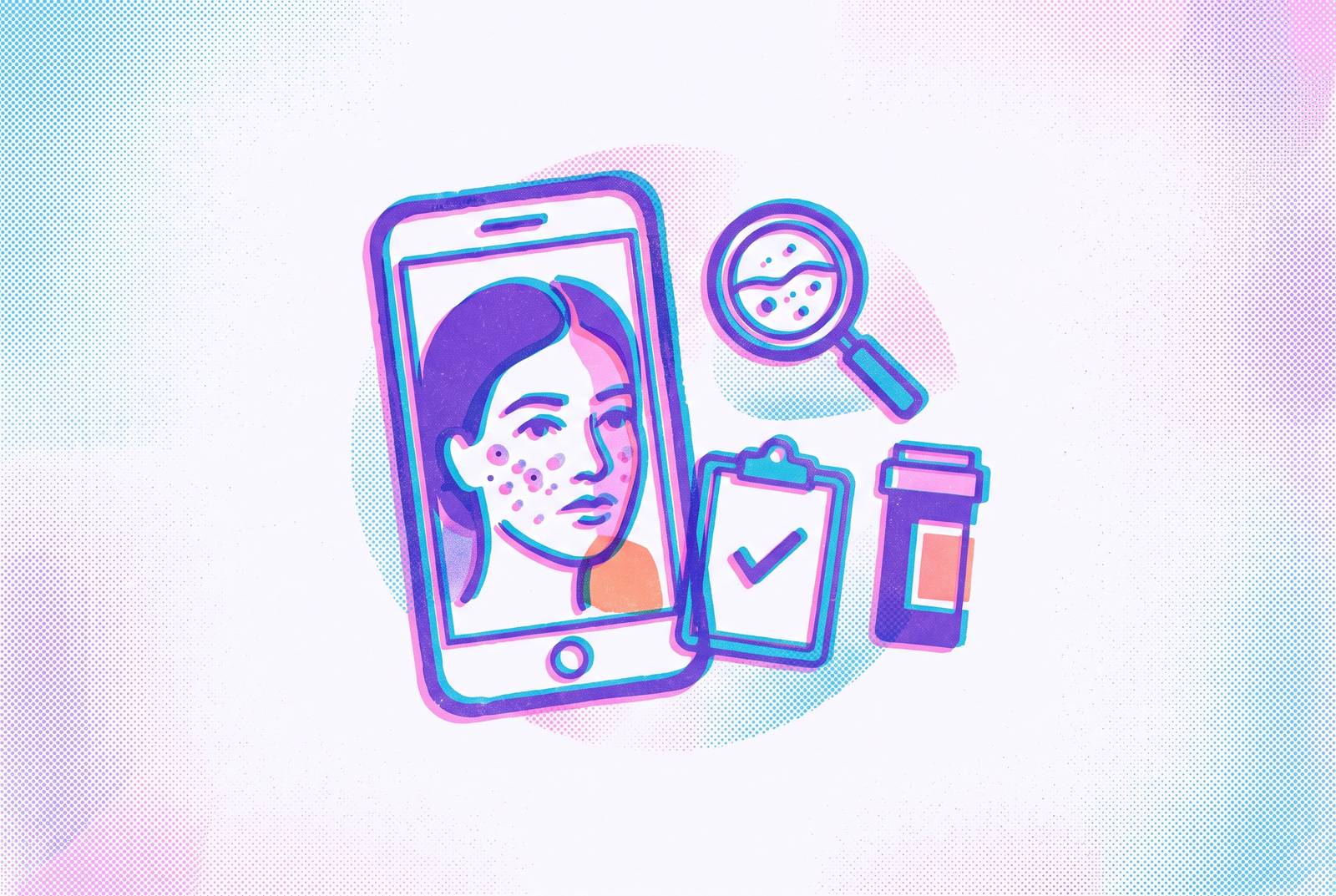
A telehealth acne prescription requires the same clinical evaluation a dermatologist's office does: a documented history, a visual diagnosis, and a safety screen before any medication gets approved. Knowing what the clinician needs from you, in what form, and why is the fastest route to getting your intake approved.
Telehealth acne prescriptions as a genuine clinical encounter
A prescription written through a telehealth platform carries the same legal weight as one written in an exam room. That means the clinician issuing it has to meet the same standard of care: a documented patient evaluation that establishes a diagnosis, checks for underlying conditions, and rules out contraindications before any treatment gets sent to a pharmacy.
Two models shape how that evaluation happens. Asynchronous care, sometimes called store-and-forward, has a patient submit photos and a questionnaire that a clinician reviews later, on their own schedule. Synchronous care is a real-time video visit. Most platforms blend the two: a structured intake collects photos and history first, and a clinician reviews that material before any live conversation happens.
Acne happens to be a condition that fits this model unusually well. Diagnosis and severity grading are almost entirely visual tasks, which is part of why a 2025 analysis found diagnostic concordance for acne and rosacea across different image modes reaching as high as 98%. Systematic reviews of telemedicine-based acne management describe the approach as reliable and well-accepted, and the medications available through it (topical retinoids, topical antibiotics, oral antibiotics, spironolactone, combined oral contraceptives) are the same first-line options a dermatologist would reach for in person. Isotretinoin is the one drug that breaks this pattern, and it gets its own explanation later.
None of this makes the process a formality. Every question on an intake form and every photo requirement exists because a clinician somewhere has to answer a specific question before they can prescribe safely. The rest of this piece walks through what those questions are and why each one matters.
Photo quality as the most consequential factor a patient controls
In a remote visit, with no physical exam, the photos serve as the primary clinical data. A clinician grading severity, identifying lesion type, or distinguishing acne from a look-alike condition is working entirely from what the camera captured.
That's exactly where things go wrong most often. Patients commonly submit images with poor lighting, motion blur, heavy filters, or angles that hide the area in question, and research has treated image quality as a defined problem in teledermatology. A clinician who can't see a lesion clearly can't make a prescribing decision about it, no matter how detailed the written questionnaire is.
Stanford researchers built a clinical photo quality assessment algorithm specifically to catch this gap: a tool that gives patients real-time feedback on an image before it ever reaches a clinician's queue. The fact that this is an active area of research says something on its own. The distance between what patients think is a usable photo and what a clinician actually needs is wide enough to be a recognized bottleneck, not an occasional inconvenience. Because photos function as the clinician's only diagnostic data in a remote encounter, telehealth acne platforms increasingly build AI-assisted image intake directly into the submission step, flagging lighting, angle, blur, or filters before a photo set ever gets sent for review.
A few things are within a patient's direct control here. Use natural light, daylight or a well-lit room, and skip the flash. Skip filters. Don't let makeup cover active lesions; a clinician needs to see the skin itself. Get close enough to show individual lesions, but pull back far enough to show how they're distributed across the face. Include the clear areas too, not just the worst spots, because a clinician grading severity needs the full picture, not a highlight reel of the problem.
A rejected or unclear photo set is the single most common reason a telehealth acne intake stalls before it even reaches a clinician for review.
What your medical and medication history tells the clinician
A photo can show a clinician what acne looks like. It can't show what else is happening in a patient's body, and that's the entire reason the intake form exists alongside the images.
Drug interactions in dermatology are a real constraint, not a theoretical one. A clinician can't safely prescribe oral doxycycline, for instance, without knowing what else a patient is taking. That's why the intake covers current prescriptions, over-the-counter products, vitamins, and herbal supplements alongside skin concerns, medical history, known allergies, and lifestyle factors. None of it is filler. Each category answers a question the clinician has to resolve before a prescription can go out.
Treatment history carries its own weight. Every topical or oral acne medication a patient has already tried, how long they used it, and why they stopped tells the clinician which first-line options have already failed. It also flags resistance risk: a patient who's been on prolonged topical antibiotics without benzoyl peroxide, for example, may need a different approach than someone starting fresh. The intake form is not redundant with the photos. It captures dimensions of clinical risk that no image can show, and a clinician has to review all of it, current prescriptions, non-prescription products, vitamins, supplements, treatment history, allergies, before a prescription gets approved. That's why a legitimate telehealth acne service runs an intake process as thorough as an in-person consultation, not a shortcut around one.
Lifestyle factors matter too, for specific reasons. Sun exposure interacts with treatment, since both retinoids and doxycycline increase photosensitivity. Diet shows some emerging correlation with acne patterns, which clinicians weigh alongside everything else. And current skin-care products matter because something a patient is already using might undercut or interact with whatever gets prescribed. One might ask why a dermatology app needs to know about a multivitamin: the clinician isn't just diagnosing a skin condition, but deciding whether a specific drug is safe for this specific body, a judgment that depends on information a photo simply can't carry.
Verifying location and identity before a prescription is issued
A clinician's license is tied to a specific state, and which state's laws govern a telehealth visit depends on where the patient is physically located at the time of the visit, not where the platform is headquartered or where the clinician happens to sit. That single fact is why identity and location verification shows up early in almost every telehealth intake.
The requirement is straightforward in principle: a clinician needs to hold a license in the state where the patient is physically located during the visit. Platforms handle the verification itself through HIPAA-compliant systems with encrypted communication, which keeps the process secure, but the reason verification exists in the first place is legal exposure. Skipping it puts both the clinician and the patient at risk.
State rules don't stop at licensure. What a clinician can prescribe through telehealth varies by state too. Some states allow telehealth prescribing of non-controlled medications like spironolactone with no in-person visit required. Others impose tighter standards that limit what a remote clinician can issue. A platform operating legally in one state may genuinely not be able to offer the same treatment in another, because it must follow the regulatory landscape set for each state.
A federal layer applies too, though it rarely touches acne care directly. Temporary DEA flexibilities governing remote prescribing of controlled substances without a prior in-person exam run through December 31, 2026. Acne medications are generally not controlled substances, so this deadline doesn't usually touch an acne prescription directly. But it explains the broader caution legitimate platforms bring to prescribing boundaries, and it's part of why a patient might get asked questions that feel unrelated to their skin. The clinician is operating inside a regulatory structure that was built to protect the patient on the other end of the screen.
Pregnancy status and contraceptive use as clinical requirements for certain acne medications
Pregnancy and contraceptive status stop being optional intake questions the moment spironolactone or isotretinoin becomes a realistic treatment option. For adult women presenting with hormonal acne patterns, that moment often arrives in the very first visit.
Spironolactone is an aldosterone antagonist, a potassium-sparing diuretic with meaningful antiandrogenic hormonal effects, and its FDA label warns explicitly about feminization of male fetuses. The American Academy of Dermatology's prescribing guidelines give spironolactone a conditional recommendation for acne and advise against its use during pregnancy, though the guidelines don't mandate that every woman of reproductive potential use effective contraception while taking it. That distinction matters: the questions a clinician asks about menstrual cycle, pregnancy status, and birth control aren't procedural boxes to check. They establish whether spironolactone is an appropriate and safe option to prescribe remotely.
Before starting spironolactone, baseline labs checking serum potassium and renal function are standard. Depending on the platform and the state, some of this lab work can happen remotely, and some requires an in-person draw. The intake process is what sorts out which applies to a given patient.
The reproductive-health questions also open onto a second clinical path that patients don't always expect. Research published in the British Journal of Dermatology found that spironolactone combined with a combined oral contraceptive produced greater acne improvement than either drug used alone. That's a meaningful reason clinicians often weigh the two together, and it's why a telehealth acne visit can turn into a conversation about birth control even when that wasn't the question a patient came in with.
Isotretinoin sits at the far edge of this entire discussion, the one acne medication where the reproductive-health screening becomes nearly the whole story. Under the FDA's 2026 updates to iPLEDGE, approved February 9, 2026 but not taking effect until November 15, 2026, patients will be able to use at-home pregnancy tests during and after isotretinoin treatment, provided their prescriber opts in and sets up procedures to guard against misinterpretation or falsification. That change meaningfully reduces the burden of repeated in-person visits across a course of treatment that often runs four to six months. But the baseline pregnancy test before starting isotretinoin still has to happen in a certified medical setting, no exceptions. That single requirement is what makes isotretinoin the clearest exception in an otherwise telehealth-compatible acne medication landscape, a boundary the next section covers in full.
Where the telehealth model reaches its limits
A well-built telehealth intake is a filter, built to identify which cases belong in a remote visit and which don't.
Severe or atypical acne, or a skin presentation accompanied by new systemic symptoms, requires an in-person exam. A remote clinician reviewing photos can diagnose plenty, but they can't palpate a nodule, assess for sinus tracts, or rule out a condition that mimics acne but needs an entirely different treatment path. That's a limitation of the format, not of any one platform's effort.
Isotretinoin remains the clearest hard boundary in acne care generally. Its management under the iPLEDGE REMS program requires certified prescribers, certified pharmacies, and in-person baseline pregnancy testing, regardless of how thoroughly a patient has documented their history online. That's a regulatory requirement set at the federal level, not a gap in any particular platform's process, and no intake form changes it.
AI-assisted triage tools show up increasingly often in this space, helping organize intake data and flag patterns before a clinician ever looks at a case. Those tools are decision support, not decision-makers. The American Academy of Dermatology's teledermatology standards call for appropriate state licensure, care directed by a board-certified dermatologist, and the option for patients to access in-person services when needed or preferred. Clinician oversight is what makes remote prescribing legitimate in the first place, not the sophistication of the software routing the intake.
For a patient preparing to go through this process, the practical move is simple: describe acne that is severe, nodular, or accompanied by symptoms that feel systemic fully in the intake. An honest submission that gets routed to in-person care is a better outcome than an incomplete one that results in a prescription that was never the right fit to begin with.
Platforms built with real clinical rigor reflect this directly in how they're structured. Nolla, for one, is an AI-assisted telehealth service where licensed clinicians review patient symptoms and issue prescriptions, using AI to guide the initial collection of symptoms and history so nothing gets missed, while keeping the actual diagnostic and prescribing decision with a licensed clinician in the patient's state. That structure is what makes the digital encounter clinically equivalent to an in-person one, and it's also what should surface a boundary case, pointing a patient toward in-person care, rather than quietly pushing a prescription through anyway. A patient who understands both the requirements and the limits of telehealth acne care is the one best positioned to get the right treatment, through whichever setting actually fits the case in front of them.
Sources
- DEA Extend Telehealth Flexibilities Through 2026 - California Telehealth Resource Center
- Teledermatology and Virtual Visits for Acne Management: A Review - PMC
- Telehealth legal requirements by state
- iPLEDGE Risk Evaluation and Mitigation Strategy (REMS)
- iPLEDGE REMS - Home
- Federal Register :: Fourth Temporary Extension of COVID-19 Telemedicine Flexibilities for Prescription of Controlled Medications
- Artificial intelligence in acne vulgaris: Current applications, limitations, and future directions - Cosmoderma