Contact Dermatitis Versus Allergic Reaction Patterns
The timing and location of your rash reveal whether irritants or allergens are to blame.

Contact dermatitis is not one condition. It's a family of conditions, and the two you're most likely to encounter, irritant contact dermatitis (ICD) and allergic contact dermatitis (ACD), differ in ways that actually change how you piece together what happened to your skin.
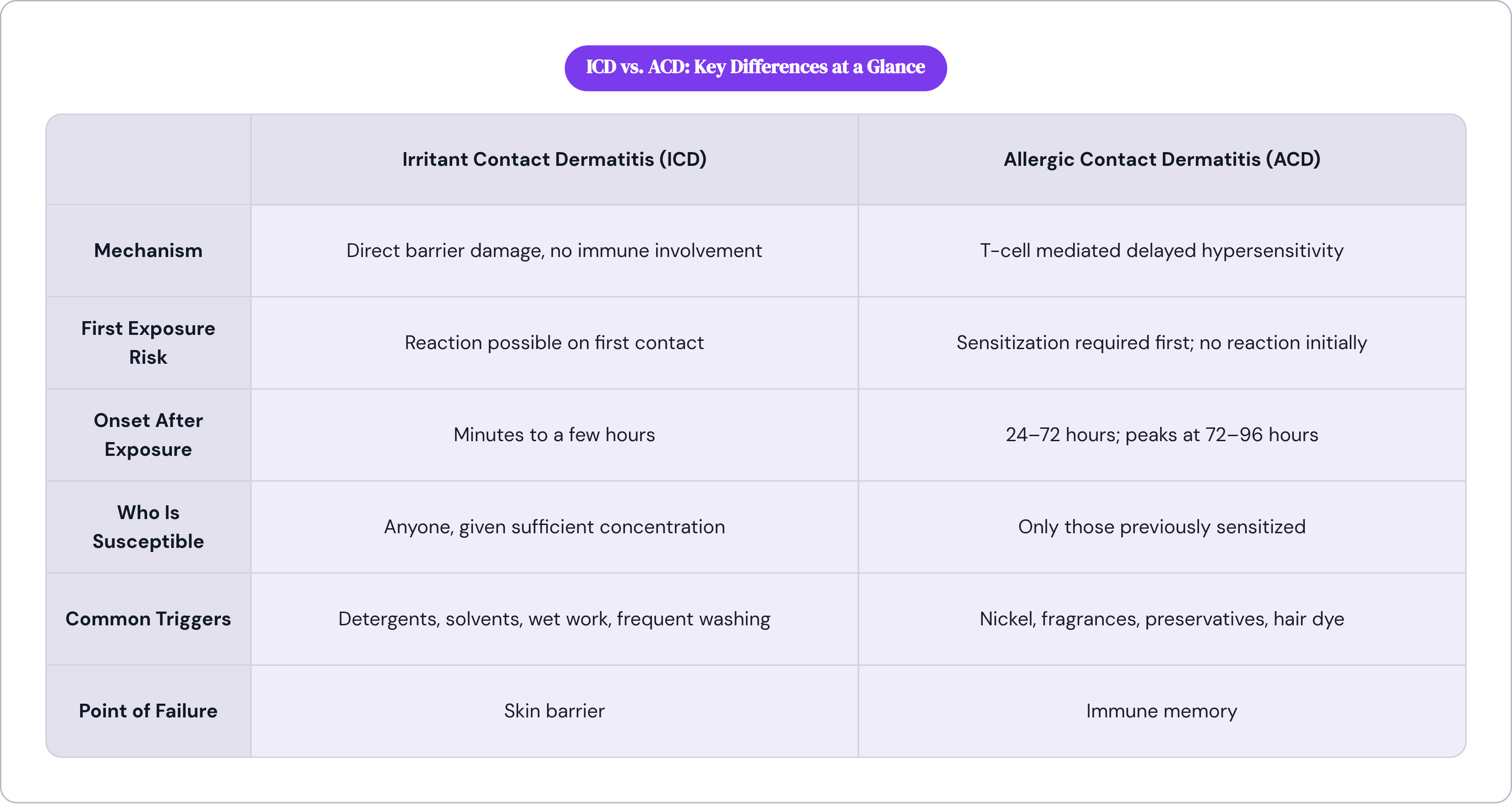
ICD is a direct injury. The substance damages keratinocytes, the cells forming the outer skin barrier, without any immune involvement whatsoever. Given the right concentration and enough contact time, almost anyone will develop ICD from the right substance. Frequent handwashing, cleaning agents, prolonged wet work, harsh solvents. The immune system isn't the point of failure here; the barrier is.
ACD is stranger, and more counterintuitive. It's a delayed-type hypersensitivity reaction driven by T cells and antigen-presenting dendritic cells, with the innate immune system contributing in ways researchers have only recently started to map. The part that surprises most people: ACD cannot occur on first exposure. The immune system must first encounter the substance, recognize it as a threat, and build a cellular memory of it. Sensitization. And it happens with no announcement whatsoever.
This is why a lotion you've used for two years can suddenly produce a reaction. Nothing changed about the lotion.
That timeline difference is one of the most useful signals you have. ICD typically peaks within minutes to a few hours of contact. ACD lesions usually appear 24 to 72 hours after re-exposure, reaching maximum severity somewhere around 72 to 96 hours. If you woke up with a rash and can't account for anything from the last three days, you're missing relevant time. If the rash appeared within an hour of contact, ACD is the less likely driver.
Both conditions move through similar morphological phases: an acute phase with redness, vesicles, and oozing; a subacute phase with crusting and scaling; and a chronic phase marked by lichenification, the thickening and hardening of skin from repeated scratching and inflammation. That phase overlap is part of why even experienced clinicians find the distinction challenging without a detailed history. The rash doesn't tell you its own timeline. You have to reconstruct it.
What the Rash's Location and Shape Reveal About the Likely Trigger
Distribution is the first thing to read, and it's more informative than most people realize.
A rash with geometric borders, crisp edges that correspond to an object, a watchband, a waistband elastic, a necklace clasp, eyeglass frames, points directly at whatever occupied that zone. Human bodies don't naturally develop rectangular inflammation on their own. That kind of border is a strong artifact of contact.
Diffuse or spreading rashes are harder to read. They suggest an airborne allergen, a transferred allergen carried by the hands, or systemic involvement. The absence of a sharp border doesn't rule out contact-related causes; it tells you the delivery mechanism was less precise.
The eyelids are among the most reactive surfaces on the body, and they present a particular interpretive problem because the product causing the reaction frequently never touches them directly. Fragrances, preservatives, and nail polish allergens transferred by fingertip contact are common culprits. If the rash is on your eyelids and you can't identify anything applied near your eyes, think about what your hands touched first.
The neck responds predictably to fragrance allergy and nickel from necklaces, with erythema concentrating at the contact points of a chain or clasp. Hands are the dominant site for occupational and household irritant reactions, where repeated wet work and detergents degrade the barrier incrementally. The face responds broadly to cosmetics, skincare, and hair care products, and airborne allergens can produce a diffuse, bilaterally symmetric pattern that doesn't correspond to any single applied product.
The distribution mismatch, a rash appearing somewhere other than where a product was applied, is one of the most common reasons people don't initially connect cause and effect. Mapping what touched where, and when, relative to when symptoms appeared is the mental exercise worth doing before anything else.
The Triggers Patients Most Often Overlook
Nickel is the single most common cause of ACD. Patients often associate nickel sensitivity with cheap jewelry and stop there, but nickel is also present in belt buckles, phone cases, watch straps, the snap buttons on jeans, and a range of items that don't read as metallic at all. If your lower abdomen breaks out in a regular, bordered pattern, the button on your pants deserves scrutiny before anything else does.
Fragrances are the second most common cause of ACD, and the scope of that category gets consistently underestimated. They appear not just in perfume but in lotions, shampoos, shaving products, wipes, candles, air fresheners, and products labeled "unscented," which sometimes contain masking fragrances that suppress odor rather than eliminate the fragrant compounds themselves. European regulatory bodies have expanded fragrance labeling requirements specifically because this category is so pervasive and so frequently implicated in reactions people cannot explain.
Sulfites were named allergen of the year in 2024, a designation that reflects growing clinical recognition of a trigger that previously received relatively little attention in dermatologic contexts. They appear in cosmetics and in food, which complicates the pattern considerably and often sends people down the wrong diagnostic path.
Preservatives deserve some granularity. Methylisothiazolinone, methylchloroisothiazolinone, and formaldehyde-releasing agents such as quaternium-15 and DMDM hydantoin appear across rinse-off and leave-on products, wet wipes, and many baby products. Sensitization to these compounds builds incrementally, which means someone can use a product for years before crossing the threshold into a visible reaction. That slow accumulation is exactly why the product feels like a sudden betrayal when it finally announces itself.
Para-phenylenediamine (PPD) in hair dye presents a cross-reactivity challenge worth understanding. Someone who develops a reaction to hair dye will also react to certain textile dyes, rubber chemicals, and some sunscreen ingredients, because those substances share structural similarities. A reaction that appears to have no discernible pattern often makes more sense once you understand what the original sensitizer cross-reacts with.
Latex is relevant beyond the obvious medical glove context. It appears in household gloves, condoms, and elastic-containing garments, and latex sensitization warrants early clinical attention because it can escalate quickly into something more serious.
The thread connecting all of these: sensitization develops through repeated low-level exposure, not a single dramatic encounter. The product that triggered your reaction last week is frequently something you've used before without incident, sometimes for years.
How Broader Allergic Reactions Differ from Contact Patterns, and When They Overlap
ACD is an allergic reaction, but describing it that way without qualification can obscure a mechanistic difference that matters enormously in practice. ACD is cell-mediated, localized, and delayed. The allergic reactions most people associate with the word "allergy," urticaria (hives), angioedema, anaphylaxis, are IgE-mediated and immediate.
IgE-mediated reactions typically manifest within minutes of exposure and can involve multiple body systems at once. This speed difference is the most reliable triage signal you have. A rash that appeared within minutes, spreads beyond the contact site, and comes with throat tightness, lip swelling, or difficulty breathing is not contact dermatitis. That's a potential systemic allergic reaction requiring emergency attention, not a careful review of what touched your left forearm last Tuesday.
The overlap zone is real, though. ACD can present with urticarial plaques, erythema multiforme-like patterns, and lichenoid eruptions, appearances most people associate with systemic allergy rather than a contact trigger. Latex is the clearest example of genuine mechanistic overlap: in sensitized individuals, it can trigger both contact dermatitis and IgE-mediated systemic reactions, sometimes simultaneously. Some fragrances and preservatives can provoke both irritant and immunologic responses depending on concentration and individual threshold.
A practical heuristic worth internalizing: rash confined to the contact zone, onset delayed by at least 24 hours, suggests contact dermatitis. Widespread distribution, rapid onset, and systemic symptoms point toward something requiring more urgent attention. These categories are not mutually exclusive, which is precisely why being accurate about what you experienced and when matters so much when you're describing it to anyone clinical.
Symptoms That Indicate a Need for Clinical Evaluation Rather Than Watchful Waiting
Most contact dermatitis resolves within two to four weeks once the trigger is identified and removed. That's the baseline expectation. The difficulty is that identifying the exposure is often the hardest part.
Certain signals warrant clinical contact sooner than that window implies. A rash that spreads well beyond the original contact area, or that appears on the face and eyelids when neither was directly exposed, is no longer behaving like simple contact dermatitis. Blistering, open skin, or signs of secondary infection, warmth, pus, fever, require assessment because infection introduces a different risk trajectory. Symptoms that persist or worsen after removing the suspected trigger suggest either that you haven't correctly identified the trigger, that re-exposure is occurring without your awareness, or that a different condition is present altogether. Occupational exposures, where the trigger cannot simply be avoided, often require earlier clinical involvement because the inflammatory cycle has no natural break point built into the person's environment.
Any systemic symptoms, difficulty breathing, throat tightness, swelling of the lips or tongue, require emergency care. Not a scheduled appointment. Emergency care.
The chronic phase of contact dermatitis, lichenification and persistent hyperpigmentation, is most often the consequence of a reaction that was undertreated or repeatedly re-triggered. Early evaluation shortens that trajectory considerably. The combination of pattern, timeline, and symptom trajectory is precisely what a clinician uses to make a triage decision, and providing that information accurately is not bureaucratic box-filling. It's clinically meaningful.
How to Describe a Skin Reaction So a Clinician Can Actually Use What You Say
Clinicians diagnosing contact dermatitis rely heavily on history. Patch testing can confirm a suspected allergen, but history guides where to look. Occupation, hobbies, recent product changes, new topical or oral medications, travel, all of it is relevant. The patient who walks in with a complete and specific account of events is providing something useful, not just background noise.
Before a consultation, document the following: the exact location on the body and whether the border is sharp or diffuse; when the rash appeared relative to any new product, exposure, activity, or change in routine; how it has changed since appearing, whether spreading, fading, or shifting phase; everything that has touched the affected area, including transferred contact from hands or a phone screen; what has been applied to it since it appeared, including over-the-counter treatments; and any similar reaction in the past, even if mild or never formally diagnosed.
Photographs taken in good lighting at multiple angles are worth the thirty seconds they take, particularly for asynchronous or message-based consultations where a clinician cannot examine the skin in real time. A photo taken at peak severity, three days into a reaction, often tells a different story than the same rash in recovery.
Asynchronous care, a message-based consultation with a licensed clinician reviewed on a same-day or next-day basis, is well suited to most contact dermatitis presentations. The condition evolves slowly enough that this timeline is clinically appropriate for non-urgent cases, and it removes the logistical friction that causes people to delay seeking care at all. Nolla is built around this model: an AI-guided intake structures the symptom collection, and licensed US clinicians review and respond, combining speed with the human judgment that cannot be automated out of the process. For a condition where detailed history is the primary clinical tool, a structured intake process is a meaningful improvement on the standard, not a workaround.
If you've already started using over-the-counter 1% hydrocortisone, mention it. It can help mild cases in the short term, but it's underpowered for moderate reactions and carries real risk with prolonged use on the face, particularly around the eyes. A clinician needs to know it's part of the picture.
What a Formal Clinical Workup Adds and Where Treatment Is Heading
Patch testing is the gold standard for identifying specific allergens in ACD. It involves controlled exposure to standardized panels of common allergens applied under occlusion over several days, with readings taken at specific intervals. The process is methodical and time-intensive by design, because the immune response being evaluated is itself slow. The result is not simply positive or negative; it's a map of what the immune system has learned to recognize as a threat, and that map changes how a person approaches every product they use going forward. That's a meaningfully different relationship with your own skin than most people have before they go through the process.
This level of specificity matters because eczematous conditions overlap considerably in both clinical appearance and histological findings. That overlap is an accurate reflection of how the skin actually behaves under inflammation, not a failure of the diagnostic system.
High-Definition Optical Coherence Tomography is an emerging non-invasive imaging tool that provides cellular-resolution images of skin layers without biopsy. Still investigational for this application, it represents a meaningful directional shift: the field is moving toward more precise, less invasive characterization of inflammatory skin conditions, and the tools are beginning to catch up to the ambition.
First-line treatment after diagnosis remains avoidance of the confirmed trigger. When avoidance isn't feasible, as it often isn't in occupational settings or where the trigger is an essential medical device, the therapeutic calculus becomes more complex. Topical corticosteroids are the current standard, with potency calibrated carefully to body site and severity, lower-potency formulations required on the face and skin folds.
JAK inhibitor research is an active frontier. The JAK1 inhibitor cream ARQ-252 is under active investigation specifically for contact dermatitis, reflecting a growing understanding that the JAK-STAT signaling pathway is central to both inflammatory signaling and skin barrier function. This is mechanistically novel, not incremental refinement, and the early data are being taken seriously.
The stratum corneum, the outermost skin layer, is what both ICD and ACD ultimately exploit. Barrier disruption lowers the threshold for both conditions, which is why ceramide-supporting and barrier-repair products aren't merely cosmetic considerations. For people with ongoing exposure risk, they're a rational adjunct to treatment, not an afterthought.
And most of the time, the trigger is identified not through imaging or panels alone, but through the story a patient can actually tell about what they touched, when they touched it, and what happened in the days that followed.