Retinoids in Dermatology Uses and Considerations
Different retinoids target different skin receptors with vastly different results.
Retinoids work by entering the cell nucleus and changing what gets transcribed. That mechanism explains both why these compounds are so effective and why they can feel so aggressive in the first weeks.
Once absorbed, retinoids bind to carrier proteins, CRBP and CRABP, which ferry them into the nucleus. There, they interact with one of two receptor families: retinoic acid receptors, the RARs, and retinoid X receptors, the RXRs. Each receptor has subtypes, and which subtype a given retinoid activates determines what it does to the skin. Not just how much it does, but what it does.
RAR-alpha governs collagen synthesis, sebum regulation, and inflammatory signaling. RAR-beta modulates melanin pathways. RAR-gamma is concentrated in truncal skin and is the primary target of trifarotene, the fourth-generation retinoid. So when a compound binds RAR-beta but not RAR-alpha, it is going to behave meaningfully differently from one that hits both. You cannot swap one retinoid for another and expect identical results, even at comparable concentrations. That is the part the label rarely tells you.
At the cellular level, retinoids accelerate proliferation in the basal layer and stratum corneum, turning over older cells faster. That same process is responsible for both the visible results and the early irritation. They also upregulate collagen types I and III, and retinol specifically stimulates fibronectin and tropoelastin in dermal fibroblasts, reinforcing the structural matrix below the surface.
The body pushes back on all of this. Enzymes, specifically CYP26A1 and CYP26B1, metabolize retinoic acid into inactive forms to keep the signaling within a functional range. Newer agents called RAMBAs, retinoic acid metabolism blocking agents, work by inhibiting those enzymes rather than flooding the system with more retinoic acid. DX314 is the most discussed example in current research. Instead of amplifying the signal, you slow down the mechanism that silences it. It is a counterintuitive approach, and the direction the next generation of retinoid-adjacent therapy is heading.
There is also increasing evidence of activity beyond direct RAR transcription: epigenetic modifications, kinase signaling cascades, interactions with the skin microbiome. This is the most underappreciated dimension of why two people using the same product at the same concentration have such different experiences. Biological variability at a layer of mechanism we are still mapping explains most of it. "Sensitive skin" as a fixed personality trait is not a satisfying answer; the actual answer is messier and more interesting.
Potency and selectivity are different axes entirely. Conflating them is where most retinoid confusion begins, and it starts at the very first product recommendation.
The Potency Ladder from Drugstore Shelf to Prescription Pad
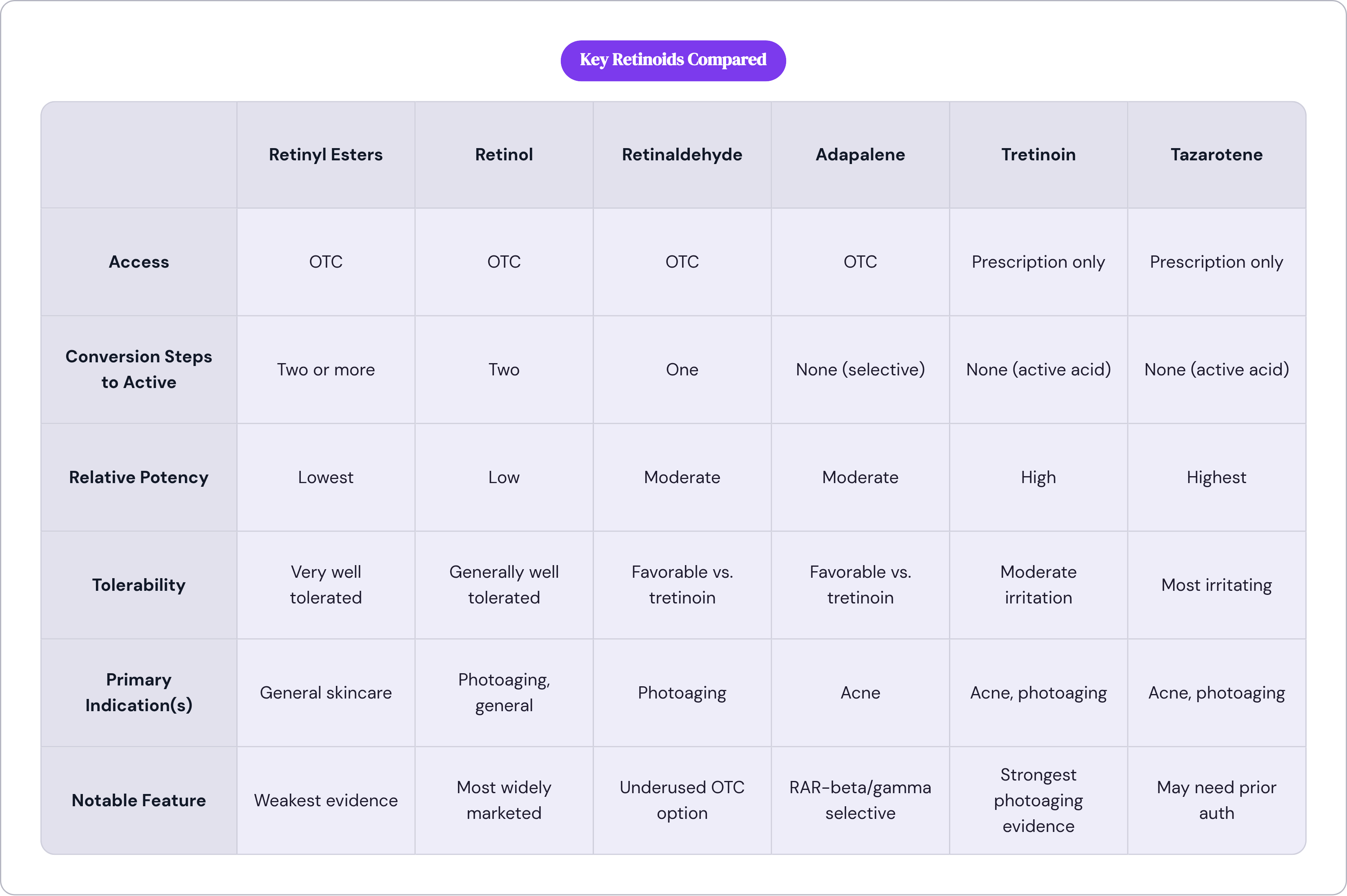
Every OTC retinoid requires enzymatic conversion before it becomes biologically active retinoic acid, and every conversion step costs roughly 20-fold potency. That is not a small margin. A 1 percent retinol serum delivers the approximate biological activity of 0.01 to 0.02 percent tretinoin. Some brands have built entire marketing campaigns around their retinol percentages without ever mentioning that number.
The hierarchy, weakest to strongest: retinyl esters, then retinol, then retinaldehyde, then the active acid forms. Retinaldehyde, sometimes called retinal, sits one conversion step from retinoic acid and is the most bioavailable OTC option. A 1998 study found that 0.05 percent retinaldehyde matched 0.05 percent tretinoin on wrinkle and roughness reduction with significantly less irritation. It remains underused, and I am not sure why. For someone who wants meaningful photoaging benefit without a prescription, or who has not tolerated stronger formulations, retinaldehyde is the obvious middle ground that rarely gets recommended. Ask for it and watch the hesitation on the other side of the counter.
Adapalene 0.1 percent gel became the first FDA-approved OTC retinoid for acne when it transitioned from prescription status in 2016. Its receptor selectivity, binding RAR-beta and RAR-gamma but not RAR-alpha, and its lack of CRABP binding, explain its comparatively favorable tolerability relative to tretinoin at similar concentrations. A 45-gram tube runs between about $13 and $25 at most major retailers as of mid-2025. For a lot of patients, this is not a consolation prize. It is the right first-line choice.
Tretinoin is prescription-only in the United States at all concentrations. Without insurance, a 45-gram tube runs roughly $18 to $80 depending on concentration and pharmacy, also mid-2025 pricing. Standard titration starts at 0.025 percent cream or 0.04 percent microsphere gel, with increases after eight to twelve weeks if tolerated.
Tazarotene is also prescription, and depending on the plan, it can require prior authorization or step therapy before insurance covers it. Here is a wrinkle most patients do not know about: when retinoids are prescribed for photoaging rather than acne, many insurers will not cover them at all. The indication on the prescription changes the out-of-pocket cost as meaningfully as the drug itself. That is the kind of thing that only comes up if someone thinks to ask.
What Retinoids Treat and What the Evidence Actually Shows
Acne is the most well-supported indication, which should not be surprising given that it affects an estimated 9.38 percent of the global population and has attracted decades of randomized controlled trial investment. Topical retinoids address multiple acne pathways simultaneously: comedolysis, reduction of inflammatory lesions, and prevention of new lesions forming. Trifarotene was specifically designed and studied for truncal acne, filling a gap that earlier agents largely ignored.
For photoaging, tretinoin holds the strongest evidentiary position among all topical options. A 2025 network meta-analysis published in Nature ranked it highest among topical interventions for fine wrinkles and hyperpigmentation. The mechanism tracks exactly with what the cellular biology predicts: collagen upregulation, accelerated epidermal turnover, melanin normalization through RAR-mediated pathways. The data did not surprise anyone who had been watching the mechanism closely.
Beyond those two, evidence exists for a range of other applications, though the trial robustness varies considerably. Melasma and post-inflammatory hyperpigmentation are supported by the RAR-beta mechanism; the logic is coherent even where the trial data is thinner. Striae distensae, flat warts, alopecia areata, androgenetic alopecia, hypertrophic scars, keloids, actinic keratosis, and pre-procedural priming before chemical peels or laser resurfacing all have prospective data of varying quality.
Systemically, the picture shifts substantially. Acitretin is used for pustular psoriasis and ichthyosis. Alitretinoin, a dual RAR and RXR agonist, is indicated for chronic hand eczema. In oncology, all-trans retinoic acid is used in managing acute promyelocytic leukemia and neuroblastoma. These are distinct contexts with entirely different risk profiles; they belong in this discussion only so the scope of the class is clear, not to suggest that topical skincare and chemotherapy adjuvants occupy the same therapeutic register.
Acne and photoaging are where the randomized controlled trial support is deep and replicable. Most other applications rest on smaller studies, and knowing which category an indication falls into shapes what a reasonable outcome expectation actually looks like.
The Adjustment Period Most People Aren't Prepared For
The clinical term is retinization: the adaptation phase during which the skin adjusts to accelerated cell turnover. Dryness, scaling, erythema, burning, stinging, desquamation. These typically peak in the first two to four weeks, and they are rarely discussed before someone starts.
A pilot study published in 2026 found that 81 percent of participants experienced at least one retinoid-associated effect in the first four weeks, primarily mild erythema, desquamation, and dryness. Eighty-one percent is a figure that should be the first thing anyone new to retinoids hears, not buried in fine print, not mentioned as a footnote after the pitch. Peeling and redness in week two does not mean something has gone wrong. It means you are in the statistical majority, and you are probably right on schedule.
What distinguishes retinization from retinoid dermatitis, which is a more pronounced inflammatory response at the application site, is degree and persistence. That distinction matters because one warrants continuing and one warrants pulling back, and most people cannot tell the difference when they are mid-peel and questioning everything.
Practical management: start two to three nights per week, increase frequency over several weeks as tolerance builds. Apply a non-medicated moisturizer before or after the retinoid to buffer the surface response, sometimes called the sandwich method. Avoid layering AHAs, glycolic acid, or other active acne medications during the adjustment window.
The patients who stop in week two are the ones who never find out whether the product was working. That is a structural problem with how these products get introduced, not a character flaw in the patients. Higher-potency formulations, tretinoin and tazarotene especially, produce more pronounced retinization than adapalene or retinaldehyde, which means product selection shapes the adaptation experience as much as any buffering strategy does.
Sun Sensitivity and Daily SPF as Non-Negotiable Partners
Two things happen simultaneously when you use a retinoid. Accelerated cell turnover thins the stratum corneum, which reduces the skin's natural UV buffer. Retinoic acid is also photolabile, meaning light exposure degrades it. Both mechanisms point to the same instruction: apply retinoids at night and use a broad-spectrum SPF 30 or higher every morning.
But sit with this for a moment. If the retinoid is building collagen and improving texture while unprotected sun exposure is degrading collagen through the same matrix metalloproteinase pathways, these two things are not running in parallel. They are in direct opposition. The ACOFP Journal, in its Fall 2024 issue, noted that daily broad-spectrum mineral sunscreen applied 15 minutes before sun exposure provides the greatest UV protection in photoaging prevention.
Sunscreen is not an add-on to retinoid therapy. It protects the structural changes the retinoid is actually creating. Without it, a portion of the retinoid's benefit is being actively dismantled every morning.
When Retinoids Carry Serious Risks: Pregnancy, Systemic Use, and Contraindications
All retinoids are teratogenic. Topical formulations included. This is not a risk that scales down gracefully with dose or formulation the way other drug risks sometimes do; it is a property of retinoic acid receptor signaling during embryonic development. The clinical guidance across every regulatory body is consistent: discontinue retinoid use before conception, regardless of formulation.
Systemic isotretinoin carries a broader adverse effect profile: cheilitis, xerosis, dyslipidemia, musculoskeletal pain, ocular surface changes, hepatic function alterations. Most are mild and reversible with discontinuation, but they require monitoring throughout treatment.
The FDA-mandated iPLEDGE program exists specifically because the teratogenic risk is not ambiguous. It requires two forms of contraception for patients who can become pregnant, monthly pregnancy testing, and registration by both the prescriber and the dispensing pharmacy. That is federal safety infrastructure built around a firm contraindication, and the administrative burden reflects how seriously regulators have taken the risk.
For patients simultaneously managing acne or photoaging while navigating contraception decisions or pregnancy planning, retinoid use needs to be part of that conversation explicitly. Not treated as a separate skincare matter sitting outside the scope of reproductive health. The two are not separable, and handling them in separate conversations is where important information tends to fall through the cracks.
Matching the Right Retinoid to the Patient and the Goal
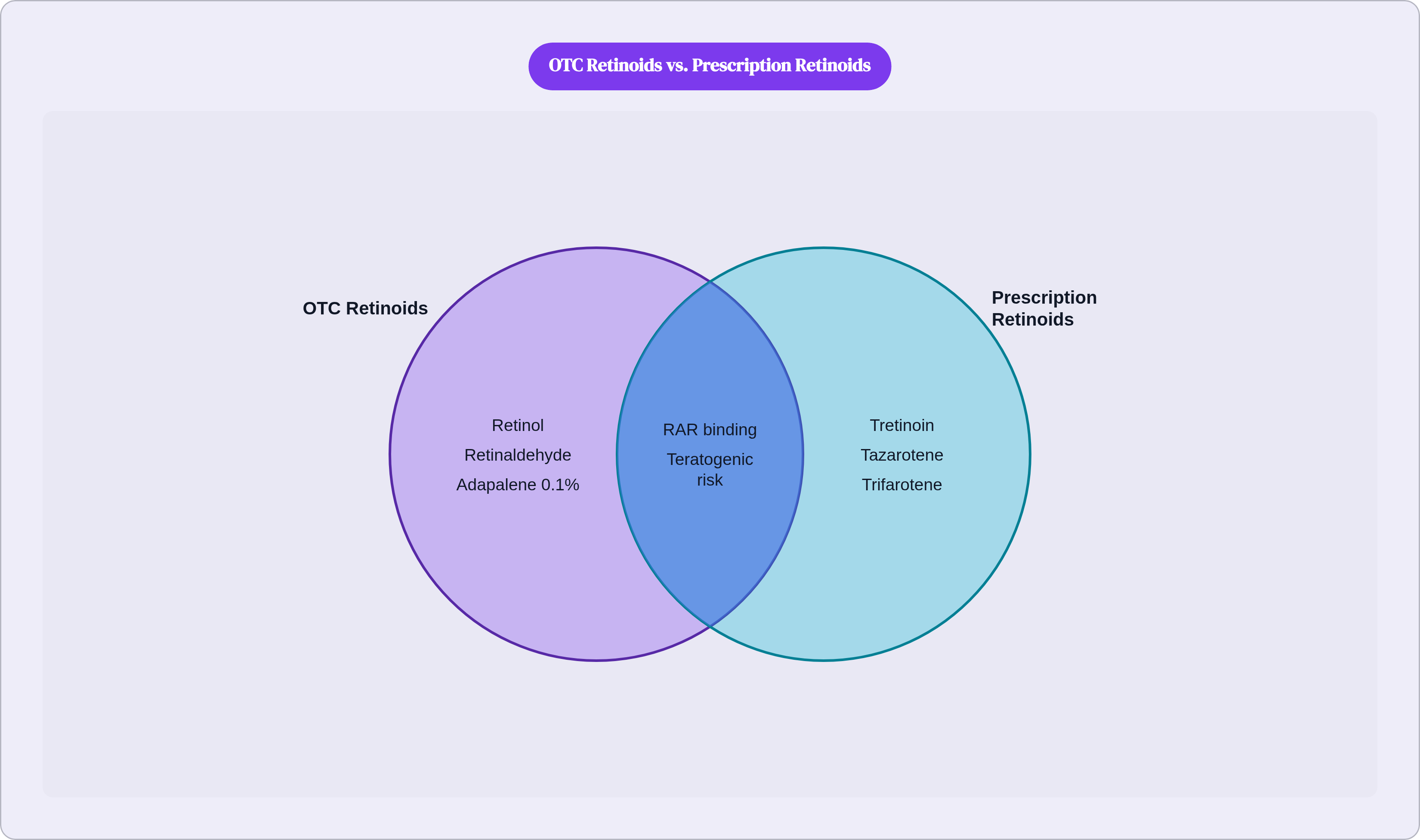
No single retinoid is optimal across all indications or all patients. The right choice follows from indication, tolerance history, access, and life circumstances considered together, not from a ranked list applied universally.
For acne, the OTC accessibility of adapalene makes it a legitimate clinical starting point, not a compromise. For photoaging, tretinoin holds the strongest evidence, and the cost of a generic prescription is frequently lower than people expect. For hyperpigmentation or melasma, the RAR-beta pathway is the relevant target, which shapes the preferred agent. For truncal acne specifically, trifarotene has trial evidence for that site; it is not simply a facial regimen applied to the back.
Tolerance history changes the calculus. Someone who tried tretinoin and stopped because of irritation is not a retinoid failure. They are an adapalene or retinaldehyde candidate who was started at the wrong entry point. That reframing matters because the alternative narrative, that they simply cannot tolerate retinoids, leads them to abandon the class entirely.
Without a prescription, the accessible path looks like this: start adapalene OTC with a step-up frequency protocol, add daily broad-spectrum SPF 30, watch for retinoid dermatitis rather than treating all irritation as expected, and give the regimen 12 weeks before drawing conclusions. Evaluating at three weeks is evaluating the adaptation phase, not the therapeutic outcome. The distinction is worth being clear about before someone starts.
A clinician conversation becomes the right next step with persistent or severe acne, with hyperpigmentation warranting RAR-beta-targeted therapy, with a desire for tretinoin's stronger photoaging evidence, or with any reproductive health consideration in play. The complexity lives there. Knowing when to escalate is as important as knowing what to start with, and it is often the part of the conversation that gets skipped.