Skin Symptoms That Require Emergency Care
Look for rapid spread, fever, mucosal blistering, or pain out of proportion to visible rash.

Most skin symptoms that land someone in an ER aren't emergencies. Contact dermatitis, a mild hive flare, a stress rash, these make up most of the visits, and only a sliver turn out dangerous. But here's the catch: the dangerous ones can look almost identical to the harmless ones for the first several hours, and that overlap is what I want to walk through here.
I've talked to enough emergency physicians to know this is a genuinely hard call, even twenty years into practice. A rash on the trunk with some redness could be nothing. Or it could be the opening act of toxic epidermal necrolysis, a condition that kills a substantial proportion of the people who get it. Guess wrong in either direction and something gets lost: unnecessary ER trips create real financial and access barriers, while delayed ones can cost a life.
Severity alone won't tell you which side of that line you're on. Pattern does. What separates the scary-looking-but-fine cases from the mild-looking-but-dangerous ones comes down to a small set of signals that show up again and again across nearly every true skin emergency, and once you know them, most of the guesswork falls away.
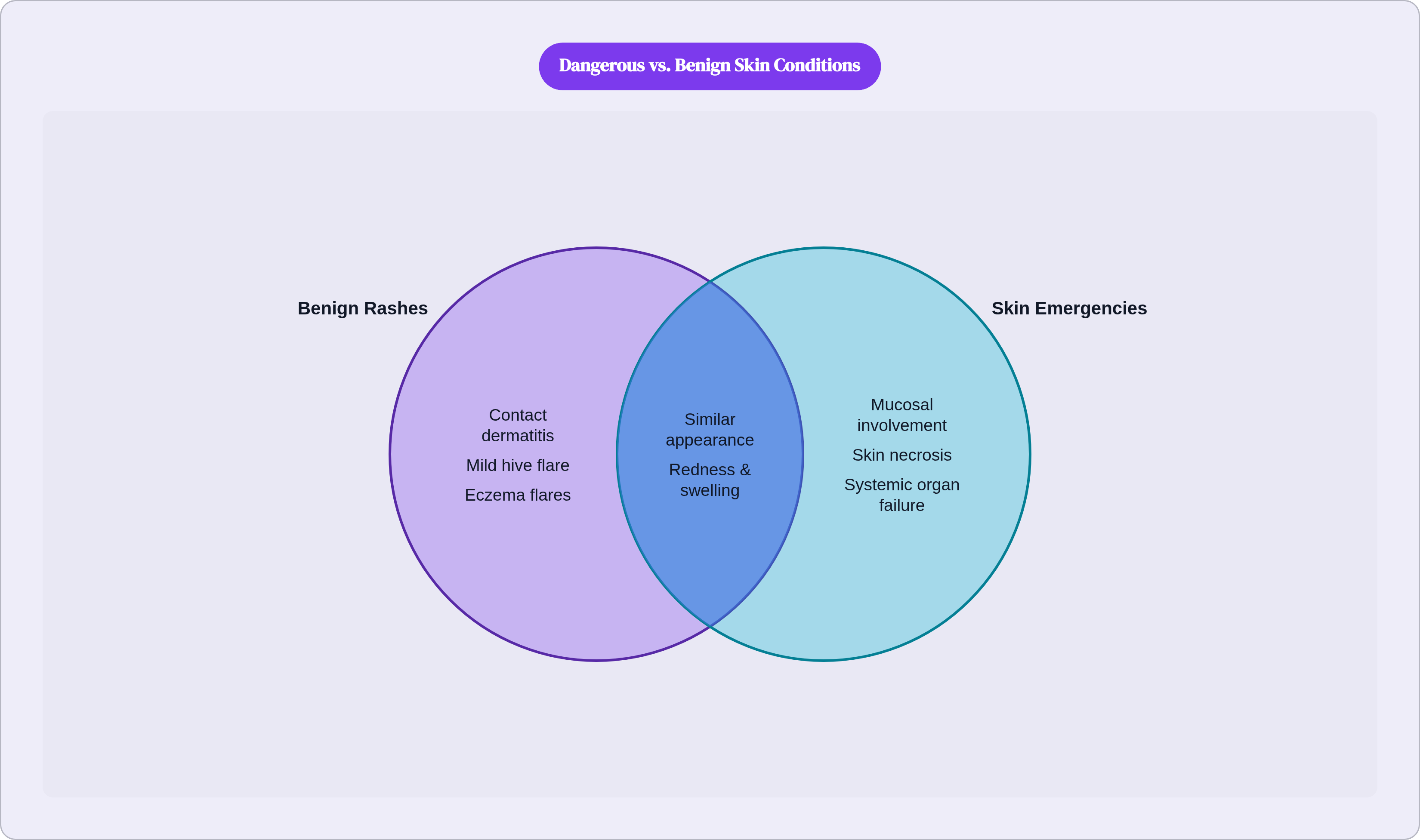
Four signal patterns that cut across nearly every true skin emergency
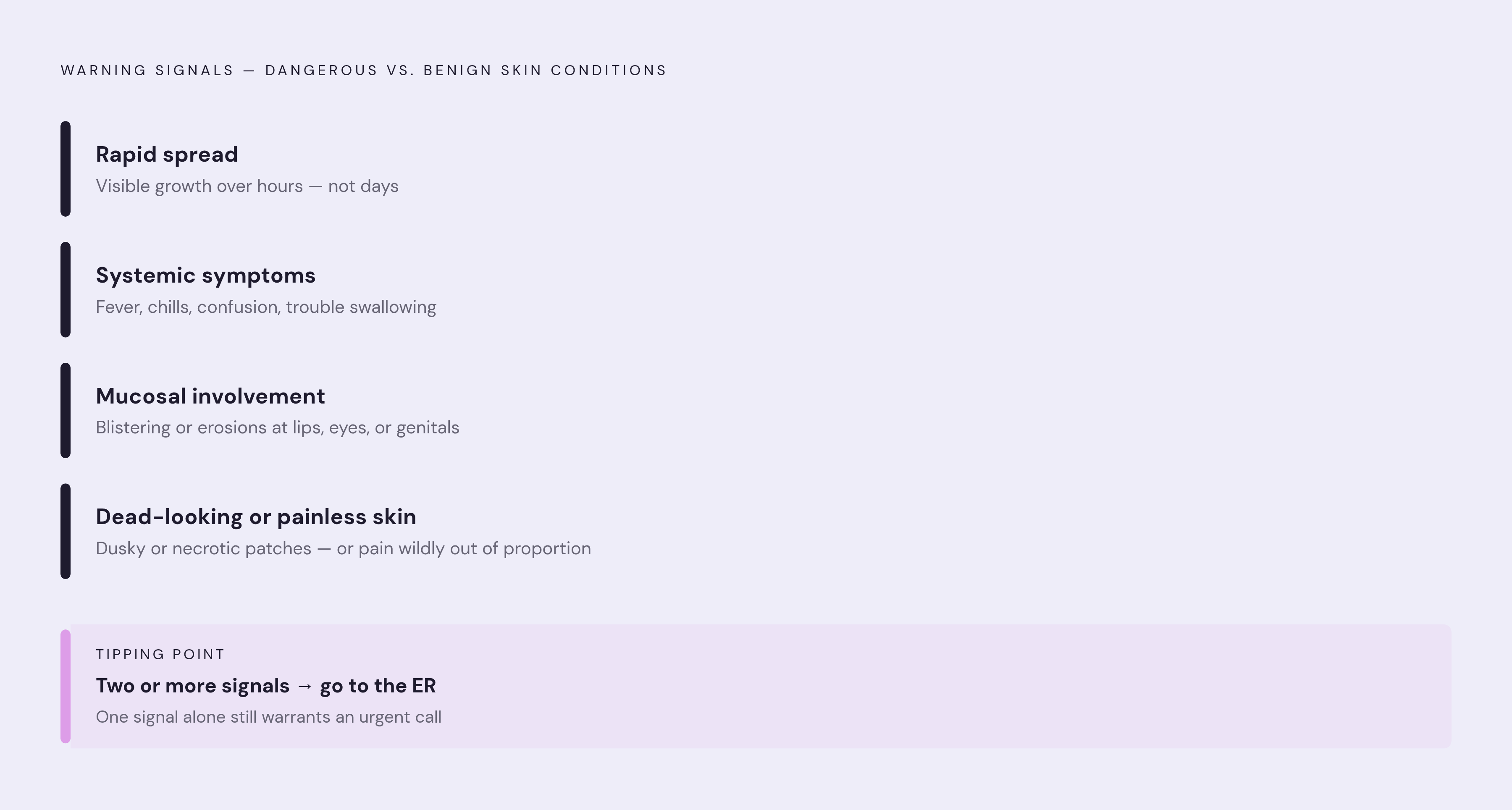
Rapid spread is the one I'd flag first. Skin changes that visibly grow over hours, not days, deserve attention on their own. Most benign rashes creep. The dangerous ones sprint.
Then there's the systemic stuff: fever, chills, body aches, trouble swallowing, confusion. Any sign the whole body is struggling, not just the patch of skin in front of you. That points to a problem running deeper than skin.
Mucosal involvement changes the picture fast, too. Blistering, erosions, or crusting at the lips, eyes, or genitals means something is seriously wrong. Garden-variety rashes almost never touch the mucous membranes; skin emergencies go there constantly.
And then skin that looks dead, or skin that doesn't hurt when it should. Dusky, gray, or necrotic-looking patches are never a good sign, and neither is pain wildly out of proportion to what you can see. That mismatch, pain without a visual explanation, is one of the more reliable warning signs I know of in emergency dermatology.
None of these four are diagnoses on their own. They're signals telling a clinician to look now, not next week. One alone is worth an urgent call; two or more together should push you toward an ER instead of a wait-and-see approach. And the textbook picture of "red rash on light skin" isn't the only way any of this shows up, which is a problem I'll come back to.
Stevens-Johnson syndrome and toxic epidermal necrolysis: when a drug reaction becomes a burn-unit emergency
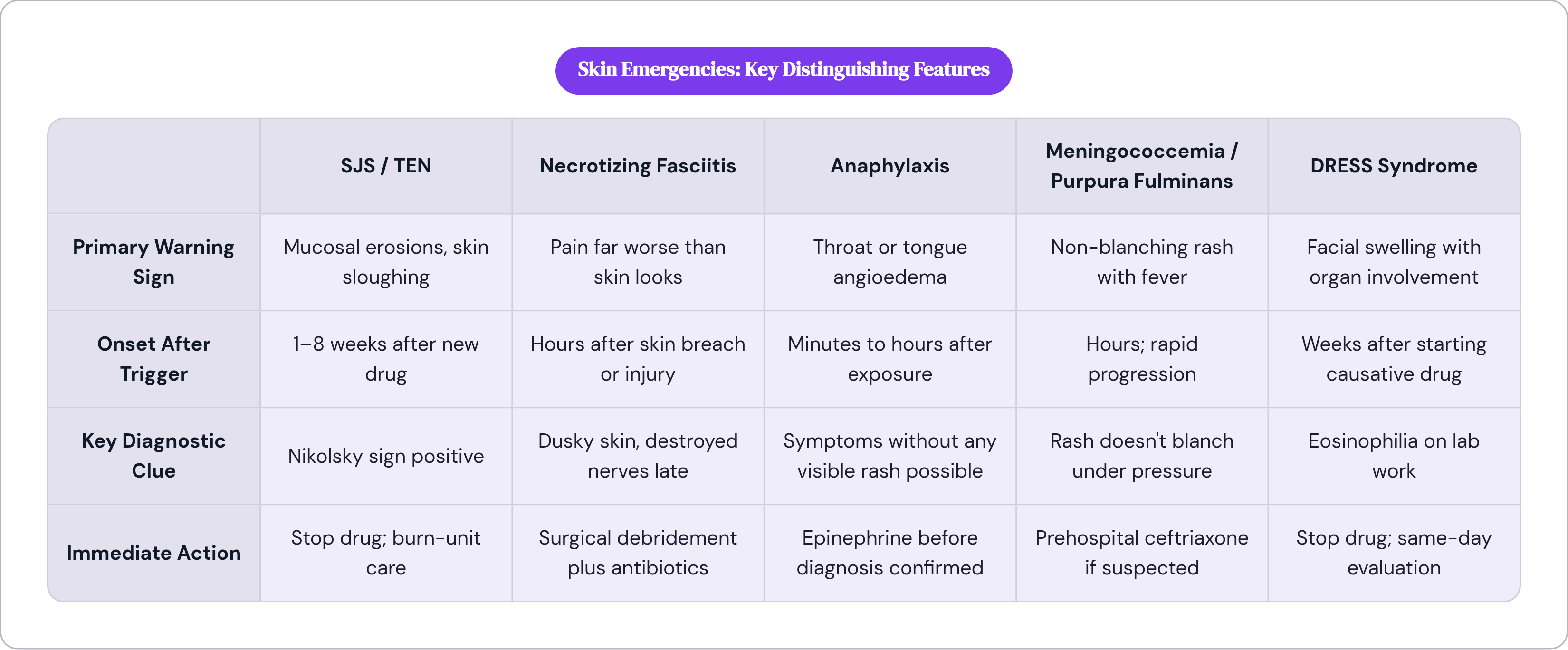
SJS and TEN are the same disease, measured on different scales. The distinction comes down to how much of the body's skin surface is sloughing off: under 10% is SJS, over 30% is TEN, and the zone in between gets called SJS/TEN overlap. Mortality runs as high as 30%, which puts it among the deadliest things that can happen to skin.
Both are rare, thankfully. National incidence runs around 6.3 cases per 100,000 for SJS and 0.5 per 100,000 for TEN, so combined, they hit roughly 1 to 2 people per million each year. When it happens, though, the stakes are about as high as dermatology gets.
Almost nobody catches the prodrome in time. For 1 to 3 days before any rash shows up, patients often feel like they're coming down with the flu: fever, burning eyes, pain on swallowing. There's no rash yet, so nobody thinks "drug reaction." Then the rash shows up, usually on the trunk first, as target-like or dusky patches, and mucosal erosions at the mouth, eyes, or genitals appear in the vast majority of cases. That's close to a hallmark here, not a coincidence. Blisters spread, and sheets of skin start separating with nothing more than light lateral pressure. That's the Nikolsky sign, and if you see it, you're well past ordinary rash territory.
Drug timing matters enormously. Suspect SJS/TEN whenever an acute rash develops within roughly 8 weeks of starting a new medication, particularly sulfonamides, anticonvulsants, or NSAIDs. The single most useful thing you can do before you even reach a hospital is stop the suspected drug immediately. After that, this needs burn-center-level, multidisciplinary care. There's no version of this that gets managed at home.
Necrotizing fasciitis: the infection that hides beneath ordinary-looking skin
Necrotizing fasciitis destroys the fascia and soft tissue underneath the skin, while the surface can look almost fine, or at worst like a standard case of cellulitis. That's the trap built into this disease: early NF can be visually indistinguishable from cellulitis, an abscess, or erysipelas, because the real damage happens below the surface where nobody can see it.
So how do you catch something invisible? Severe pain that's grossly out of proportion to what the skin looks like is the single most useful alarm here, and it's worth taking seriously even when everything else about the picture seems mild.
The disease moves in stages. Early on it's redness, warmth, and swelling, easy to write off as ordinary cellulitis. Then serous blisters appear, followed by hemorrhagic bullae, usually the point a trained eye stops second-guessing. Late-stage NF turns the skin dusky or frankly necrotic, and here's the cruel part: the area can go painless, because the infection has already destroyed the nerves that were screaming an hour earlier. Per 2025 consensus guidance on the condition, untreated cases progress to sepsis, multi-organ failure, and death.
Treatment means immediate surgical debridement plus antibiotics. No cream or oral course touches this. Diabetes, immunosuppression, advanced age, and recent skin trauma all raise the risk, but NF shows up plenty in people with none of those factors. Healthy doesn't mean immune, not to this one.
Anaphylaxis: when hives are the warning, not the problem
Hives and swelling, urticaria and angioedema in clinical terms, are the most common skin signs of anaphylaxis. But they're signs. Treating them as the endpoint is exactly the mistake that gets people into trouble.
Think of it as a ladder. Mild looks like rash, redness, and itching. Moderate adds spreading hives and mild swelling of the lips or tongue. Severe brings difficulty breathing, extensive swelling, a weak pulse, dizziness, the collapse phase.
Here's what trips people up: a meaningful minority of anaphylaxis cases have no skin symptoms at all. Someone can go into full systemic collapse without a single hive showing up, so the absence of a rash doesn't rule anything out. Speed matters too. The faster symptoms come on after exposure, the more severe the episode tends to run, and angioedema at the throat or tongue is the specific feature that turns a skin problem into an airway problem, a different emergency entirely.
One more wrinkle worth knowing: biphasic reactions. Symptoms can get knocked down by epinephrine and then return hours later, even after the person feels completely fine. That's why ER evaluation still makes sense even after a first dose of epi seems to have worked. If anaphylaxis is even suspected, intramuscular epinephrine into the outer thigh is the right first move, before anyone's fully sure of the diagnosis. Waiting for certainty burns the only window you get.
Purpuric rashes and the sepsis they can signal
A purpuric rash happens when blood leaks out of vessels into the skin. There's a simple bedside test that tells you a lot here: press on it. If it blanches, turning white under pressure, it's probably just inflammation. If it doesn't blanch, that's purpura, and purpura sits in a different category of concern entirely.
Purpuric spots alongside fever, headache, and a stiff neck point toward meningococcemia. That combination gets treated as meningococcal sepsis until someone proves otherwise. There's no room for a wait-and-see approach here.
The most severe expression of this is purpura fulminans, where the purpuric rash progresses into acute skin hemorrhage, necrosis, and bullae, essentially vascular collapse happening in real time. Per Medscape's clinical guidance, when purpura fulminans is suspected alongside possible bacterial sepsis, prehospital intramuscular or intravenous ceftriaxone gets recommended immediately, before the patient even reaches a hospital. That's how urgently the people who manage this treat it.
Rocky Mountain Spotted Fever deserves a mention too. Tick exposure plus fever, headache, and a rash that often starts on the wrists and ankles before spreading inward is the classic pattern. Overall mortality runs 5 to 10%, doxycycline is first-line treatment, and delay makes outcomes substantially worse. Purpuric spots mean blood vessel integrity, and possibly the clotting system, is failing somewhere in the body. That's the thread running through all of this.
DRESS syndrome: the delayed drug reaction that looks like it's improving before it gets worse
DRESS syndrome starts out looking almost forgettable: a widespread, itchy, maculopapular rash that gets mistaken for a viral illness or a mild drug reaction more often than not. What sets it apart is what shows up alongside the rash, facial swelling, organ involvement in the liver, kidneys, or lungs, and eosinophilia on lab work.
The timing throws people off. DRESS can develop weeks after someone starts the drug causing it, well outside the window most patients associate with a drug reaction. Started a new medication a month ago and mostly forgotten about it? DRESS doesn't care about that timeline at all.
Even after the acute episode resolves, the story isn't over. Patients face an elevated risk of autoimmune complications afterward, including thyroiditis, type 1 diabetes, and lupus. That's exactly why follow-up care matters here as much as the emergency stabilization does. A diffuse rash with facial puffiness and fatigue, weeks after starting something new, is worth acting on rather than riding out.
How erythema presents differently on darker skin, and why the classic descriptions can mislead
Most of the classic descriptions used to teach these emergencies were written on lighter skin, and the word "red" runs through nearly all of them. Increased blood flow under the skin doesn't always read red, though. It depends entirely on the skin it's happening under.
On darker skin tones, erythema can present as brown, violaceous, gray, or simply a patch that reads slightly off in tone from what surrounds it. That has real consequences, condition by condition. With SJS/TEN, target-like lesions can be less visually distinct, which pushes mucosal involvement into an even more important role as a diagnostic anchor. With DRESS, coalescing erythroderma can be genuinely hard to assess on skin of color. With meningococcal purpura, the non-blanching spots may show up darker or more subtly different than the bright-red petechiae most training materials describe.
So what do you lean on when the color cues aren't reliable? The systemic symptoms carry more weight. Fever, pain out of proportion to appearance, mucosal changes, rapid spread, these become the primary signal when skin color changes are hard to read. AI diagnostic tools currently perform worse on Fitzpatrick IV through VI skin tones than on lighter skin, too, which makes a human clinician's judgment even more important for patients with darker skin. If the visual picture is ambiguous but the systemic symptoms are there, treat the systemic symptoms as the alarm. Don't wait for the rash to match the textbook photo, because for a lot of people, it never will.
What belongs in an ER versus what telehealth can handle
Most skin complaints don't need an ER visit at all. Localized rashes, mild hives with no systemic symptoms, eczema flares, contact dermatitis, these make up the bulk of skin concerns people bring in, and they're manageable outside an emergency room.
Go to the ER now if you see any of the four signal patterns from earlier: rapid spread, systemic symptoms, mucosal blistering, or skin that looks dead or is oddly painless. Same goes for non-blanching spots with fever, any airway involvement, or skin coming off in sheets.
There's a middle category too, and it's the one people struggle with most. A spreading rash that started after a new medication, with no systemic symptoms yet, is urgent but not necessarily an ER trip. Stop the drug and get evaluated the same day.
For everything else, mild and stable rashes, eczema or psoriasis management, follow-up on something already diagnosed, telehealth is genuinely the right first stop. Nolla, for instance, pairs asynchronous clinical review with oversight from licensed clinicians, and that model covers most skin concerns that need an actual clinical eye but don't need an emergency department. A clinician looking at your photos and history can tell you whether what you're seeing is reassuring or needs escalation. Telehealth works as the sorting mechanism here, the thing that points you in a direction before you've burned time or money guessing on your own.
Describing your symptoms so a clinician can triage you accurately
How you describe what's happening changes how fast you get the right care. A few things matter more than the rest.
Speed of change is the big one: when did it start, and how fast has it spread or gotten worse? Hours matter here, not just days. Associated symptoms matter too: fever, pain relative to what's visible, trouble breathing or swallowing, any eye involvement. Recent exposures are easy to forget but worth mentioning, new medications in the last 8 weeks, tick exposure, contact with a known allergen, all relevant even if it doesn't feel connected. And location matters: trunk, arms and legs, mucous membranes, whether it's spreading across different regions of the body.
If you're sending photos for a telehealth visit, natural light makes a real difference, and including something for scale, a coin, a ruler, helps more than you'd expect. Photograph mucosal areas if they're involved. Try the blanch test yourself too: press a glass or your fingertip firmly on the rash. If the color disappears, that's likely inflammatory; if it stays, that could be purpuric, and you should say exactly what you observed rather than just calling it "a rash."
Don't skip what you can't photograph, either. "The pain is way worse than it looks" is one of the more clinically useful sentences you can say, especially for something like necrotizing fasciitis, where the visible skin lags behind what's actually happening underneath. A clinician working from a clear history and a well-documented photo can route you to the right level of care far faster than one working from "it's red and it itches." I've seen that gap decide, more than once, whether care arrives on time or arrives too late.