DermaSensor Device Accuracy and Clinical Use
AI device catches most skin cancers in primary care, but flags many benign lesions too.
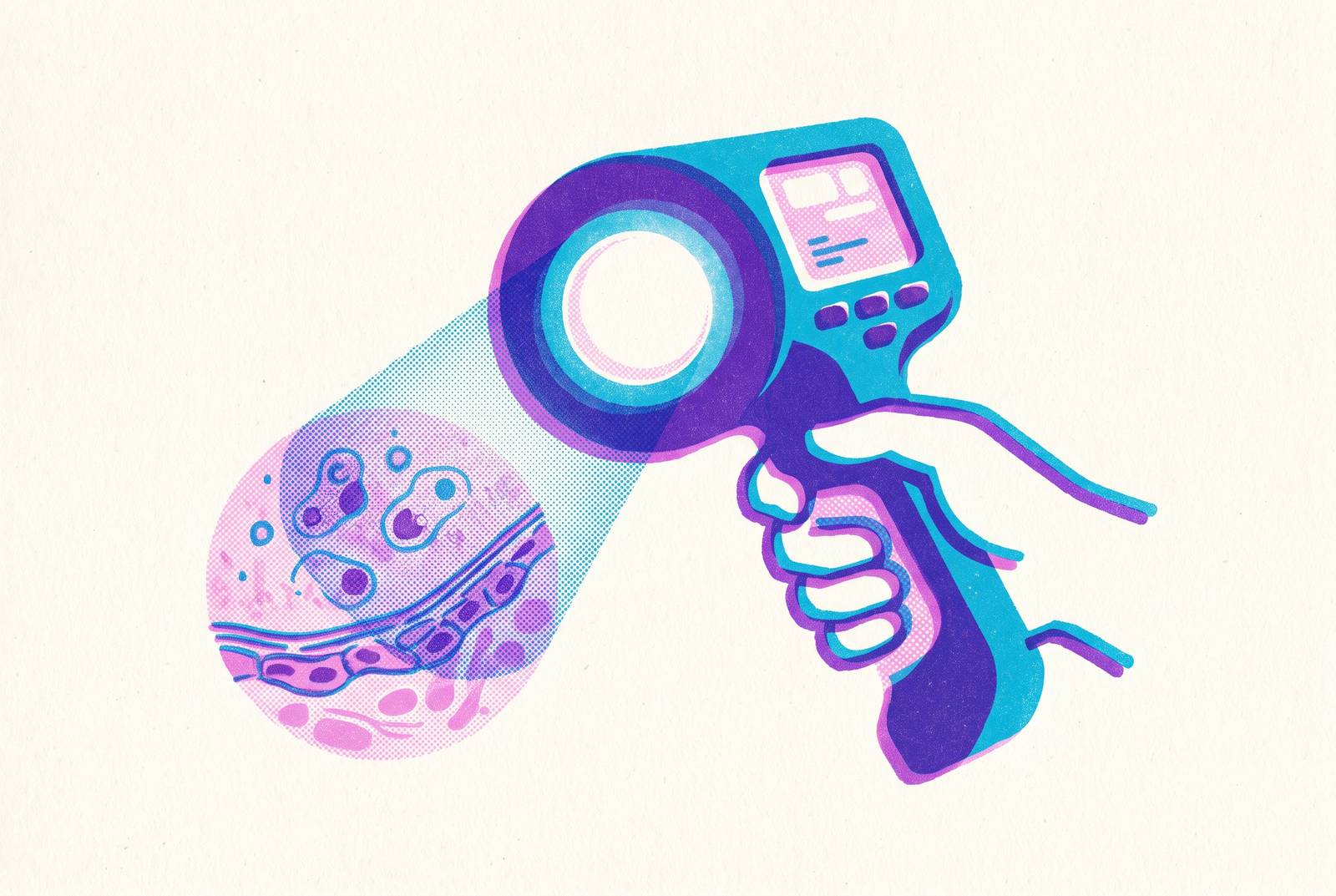
Skin cancer is the most common cancer diagnosed in the United States. Many of those patients see a primary care physician first, long before a dermatologist ever looks at the lesion, if a dermatologist looks at it at all. DermaSensor's clinical data shows what happens when an AI-enabled device gets handed to that PCP at the first visit, before any referral gets made. The device catches cancer at a rate that beats unaided PCPs by a wide margin, but the tradeoff it makes to get there, a high rate of false positives, is the part worth sitting with.
What DermaSensor is and how it actually works at the point of care
The FDA cleared DermaSensor on January 17, 2024, through the de novo pathway. That made it the first AI-enabled device authorized specifically for skin cancer evaluation in a primary care setting in the US. It had already been authorized in the EU and in Australia before that, so the American clearance was a catch-up more than a launch.
The device is indicated for patients 40 and older with lesions that raise concern for melanoma, basal cell carcinoma, or squamous cell carcinoma.
Here's what's actually happening inside the handheld unit: DermaSensor runs on elastic scattering spectroscopy, a sub-diffuse reflectance method that measures how light bounces off tissue at the cellular and subcellular level, across a band running roughly from near-UV to near-infrared. That's a fundamentally different approach from the camera-based AI tools most people picture when they hear "skin cancer app." Image-based systems read surface appearance. Spectroscopy doesn't care what the lesion looks like to the eye; it reads the architecture underneath, picking up how tumor cells scatter light differently than healthy tissue does.
One scan takes five spectral readings in a single pass. Those readings feed into an FDA-cleared algorithm trained on tens of thousands of scans, and the output is deliberately blunt: "Investigate Further" or "Monitor." No diagnosis. Just a binary prompt meant to steer the referral conversation one way or the other.
That restraint is the whole point, and it's also the thing worth taking a side on: image-based AI tools have a documented weak spot across skin tones, largely because they depend on image quality, lighting, and camera variance to work at all. Spectroscopy sidesteps a chunk of that problem simply by never relying on a picture in the first place. The mechanism backs that argument up: a method that measures tissue physics rather than surface color has less reason to break down when the surface color changes.
What the pivotal trial data shows about the device's sensitivity and what it doesn't show
The pivotal study behind the FDA clearance, DERM-SUCCESS, was a blinded, prospective, multicenter trial across 18 US clinics and 4 Australian clinics, evaluating 1,579 lesions. Dermatopathology confirmed 224 of those as cancerous, about 14.2% of the total.
The number that anchors everything else: device sensitivity came in at 96%, against 83% for primary care physicians working unaided. Broken out by cancer type, sensitivity was 90.2% for melanoma, 97.8% for basal cell carcinoma, and 97.7% for squamous cell carcinoma.
Now the number that complicates the headline. Specificity was 20.7%. Sit with that for a second: it means roughly 4 out of 5 benign lesions still get flagged "Investigate Further." Positive predictive value was only 16.6%, and the number needed to biopsy was 6, meaning most flags won't turn out to be cancer. Negative predictive value, though, was 96.6%. A "Monitor" result is the one a patient can actually lean on.
Call that specificity number a flaw, and the design gets missed entirely. The device is built to miss as few cancers as possible, and that means it accepts more false alarms in exchange for fewer missed cancers. That's not a bug to apologize for, it's the tradeoff the whole thing is engineered around. Among patients 40 and older, it still missed 8 cancers total (4 melanomas, 4 keratinocyte carcinomas), which works out to a small fraction of all lesions tested.
One limit sits baked into the trial's own design, and it's worth saying plainly: DERM-SUCCESS only tested lesions PCPs had already flagged as suspicious. That's a different population than an unselected group walking in for a routine physical, and it caps what the trial can actually claim about broad screening performance.
How the device changes what PCPs actually do when they see a suspicious lesion
Accuracy numbers only matter if they change what happens at the exam table. So what happened when PCPs actually had the device in hand?
In DermaSensor's clinical utility data, PCPs correctly referred 91.4% of malignant lesions with the device, versus 82.0% without it. Missed cancer referrals dropped from 18.0% to 8.6%, roughly cutting the miss rate in half. The gain in catching cancers is the number that anchors the clinical utility argument, even as specificity figures varied across settings.
Physician confidence shifted too, and that's not a soft metric to wave around for show. Physicians reporting high confidence in their management decisions rose substantially with the device in play. In a separate validation, DERM-ASSESS III, a large majority of 118 primary care physicians said the device added real value to clinical care.
The number that matters most sits inside the low-confidence subgroup. Overall AUC for management decisions improved from 0.708 to 0.762, but in cases where physicians started out unsure, AUC rose from 0.567 to 0.682. That's the group where a second data point does the most good, precisely because those are the physicians who needed it most. Melanoma detection in DERM-ASSESS III improved meaningfully, cutting the missed melanoma rate noticeably.
Laura Ferris, MD, PhD, Chair of Dermatology at UNC Chapel Hill and lead author on the utility study, described the tool as meeting "a long-time unaddressed goal of the dermatology and primary care communities to have an easy-to-use tool that can provide an automated risk assessment for suspicious lesions." Dan Siegel, Clinical Professor of Dermatology at SUNY Downstate, said the device "can significantly enhance diagnostic accuracy and empower clinicians to make more informed, confident decisions."
How performance held up across independent settings beyond the pivotal trial
One study is a data point. Repeated results across different institutions and patient populations start to look like a pattern, and the pattern here is the more interesting story.
A supplemental DERM-ASSESS validation, 440 lesions across 311 patients, found sensitivity and AUROC on par with in-person dermatologists. Melanoma NPV hit 98.1%, and melanoma PPV for high-score results (8 to 10 on the device's scale) reached 47.4%, a meaningfully stronger number than the binary cutpoint alone suggests. DERM-ASSESS III, the larger multicenter validation, found overall sensitivity of 97.04%, with no statistically significant gap against dermatologist performance.
A separate, investigator-initiated study out of UPMC, published in JAAD International, looked at 150 dermatology patients and found sensitivity of 100% and specificity of 9.4% at the standard cutpoint. Push the threshold up to 7-10 as the positive marker, and sensitivity drops notably while specificity climbs substantially. That's the tunable knob at work: sensitivity and specificity trade against each other depending on how the output gets used in an actual clinic.
What stands out most in the UPMC study isn't the raw numbers, it's the replication. The AUC came out to 0.79, identical to the AUC from the FDA pivotal trial, despite a different health system and a different patient-selection method (dermatology patients rather than PCP-flagged lesions). That's consistency, not coincidence.
Not every result lined up so neatly, and that's worth saying rather than smoothing over. A comparative effectiveness study in the Journal of the American Board of Family Medicine, run in a single-center setting in 2024, found device sensitivity of 90.0% and specificity of 60.7%, against a PCP standard-of-care sensitivity of just 40%. The device numbers sit below the pivotal trial's figures, sure. But the gap over unaided PCP sensitivity, roughly double, is the number that should actually drive the conversation, not the shortfall from the pivotal trial's ceiling.
Across all of it, one pattern holds steady: specificity and PPV swing depending on the population tested and the threshold applied, while sensitivity stays comparatively stable. That's exactly how the device was built to behave.
The real limits of the accuracy numbers and what critics have flagged
None of this should get taken at face value. A few limits deserve to be named directly instead of buried in a footnote.
DERM-SUCCESS tested only lesions PCPs already wanted to biopsy, so it says little about how the device performs as a broad screening tool on an unselected population walking in for an unrelated visit. The study population's demographic composition has not been detailed in the reviewed evidence, which limits what can be said about how the device performs across the full range of skin tones. And the trial's inclusion criteria defined a specific lesion population, which means real-world cases falling outside that range may not be well represented by the published results.
Specificity of 20.7% carries a real downstream consequence, not just a statistical footnote. Practical Dermatology's analysis notes that even at the device's most concerning scores, an "Investigate Further" result carries less than a 40% chance of actual malignancy. That's the honest weak point in the whole picture: a biopsy isn't free of cost or anxiety, and a tool that substantially increases referral volume without a matching jump in cancers caught is solving one problem while creating another.
Vishal Patel, MD, director of cutaneous oncology at the George Washington University Cancer Center, has flagged something more specific. The device doesn't distinguish between in situ and invasive lesions, or between low-risk and high-risk histologies. Lowering the referral threshold could push patients toward biopsies for lesions that might otherwise get managed with a topical treatment or watchful monitoring, a concern Patel raises particularly for elderly patients, per Medscape.
The skin tone question deserves its own scrutiny. Research on image-based AI skin cancer tools has documented performance gaps across skin tones, a known limitation of camera-dependent approaches. DermaSensor's spectroscopy approach is mechanically different from image-based AI, so there's a reasonable case that it narrows that gap. But nobody has confirmed that independently in the studies reviewed here, and claiming otherwise would be getting ahead of the data. That gap is the one to watch closest, because it's the one nobody has actually closed yet.
A "Monitor" result carries real reassurance behind it, backed by that 96.6% NPV. An "Investigate Further" result is a prompt for a closer look, not a diagnosis. Holding that distinction clearly is what makes the tool function the way it's supposed to.
Where AI-assisted point-of-care tools fit into the larger picture of accessible skin care
Step back, and the access problem this device targets isn't a niche issue. A meaningful share of patients face real limitations getting to a dermatologist, and specialist wait times are a well-documented barrier to timely care. For most patients, the primary care visit is where the actual triage decision gets made, whether anyone frames it that way or not.
DermaSensor isn't arriving into empty regulatory territory. The FDA has authorized a rapidly growing number of AI-enabled medical devices in recent years. This is a fast-moving category, and DermaSensor sits inside it rather than standing apart from it.
What the data keeps showing, over and over, is a specific and useful role for AI in a clinical setting, one worth stating plainly: the tool works best not as a general accuracy booster but as a corrective for uncertainty. It doesn't replace judgment. It supplements it, and it supplements it most where that judgment is shakiest. The AUC jump in low-confidence cases documented in the clinical utility data says exactly that. Human oversight isn't optional here either, since the device is indicated only for physicians already trained to assess skin lesions, and its output informs a referral decision rather than making one.
Skin health deserves the same clinical rigor as any other health decision. A suspicious lesion flagged at a routine PCP visit is a real diagnostic moment, not a footnote before the "real" appointment with a specialist. Tools that bring objective data into that moment raise the standard of what that first encounter actually accomplishes.
For patients, understanding what a device like this does and doesn't do matters in a direct, practical way. A "Monitor" result isn't a dismissal. An "Investigate Further" result isn't a diagnosis. The right next step after either one is a conversation with a clinician who can walk through what comes next.
The broader shift toward telehealth-adjacent care, where patients describe symptoms and get clinical review without waiting weeks for an opening, runs on that same logic. The goal isn't to skip the specialist. It's to make the triage decision earlier, with better information, so fewer people fall through the gap between a worried glance in the mirror and an appointment that's still five weeks out.