Primary Care Versus Dermatologist for Skin Concerns

I've spent enough time on both sides of this referral conversation, as a patient and as someone who's sat in on how these decisions get made, to know that most people ask the wrong question first. They ask "do I need a specialist?" It's the wrong question to lead with. The right ones are: what does this condition actually need, what can I get to, and how fast does it need to happen? Those three don't always point the same way, and untangling that is the point of this piece.
Access is a clinical variable, plain and simple, same as the diagnosis itself. There are roughly 3.4 dermatologists per 100,000 people in the U.S., and that number gets uglier the second you leave a city. National average wait for a dermatology appointment sits around 34.5 days, and in the Boston area, some institutions have reported waits stretching past 8 months, which is a sentence I still find hard to type. A 2024 study out of New York City found a mean wait of 50 days for a hospital-affiliated dermatology visit alone, and dermatology made up 13% of all community-based specialty visits in 2024. The demand is real, the system's straining, and the choice isn't always yours to make freely.
So here's a map: which conditions belong with a PCP, which ones genuinely need a dermatologist, and what to do when the gap between "I noticed something" and "I have an appointment" starts to feel unbearable.
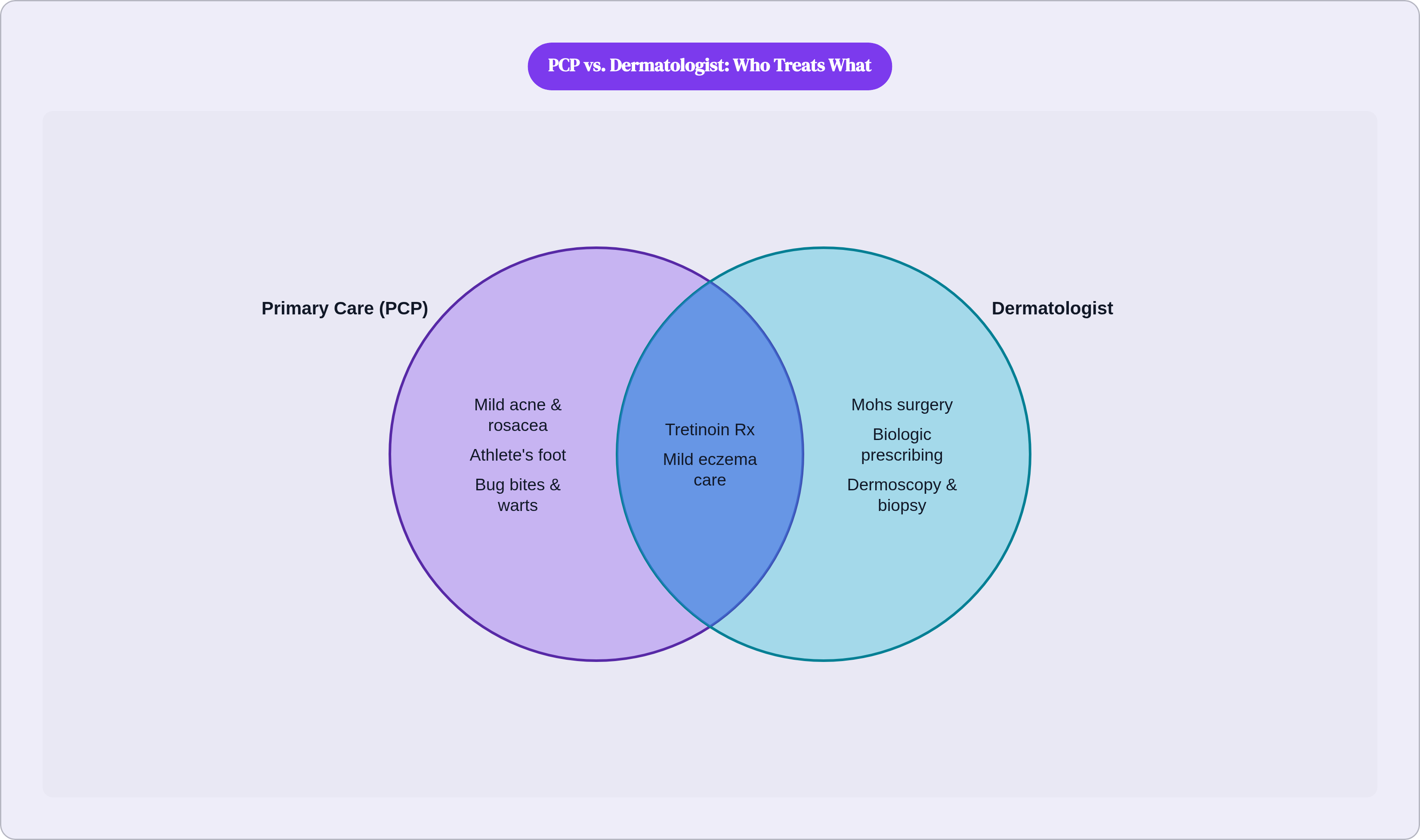
What a primary care provider can and cannot do for skin
PCPs handle more skin disease than people give them credit for. In Finnish primary care data from 2023, skin conditions ranked eighth among all diagnoses made in that setting, a striking place for a supposedly specialist concern to land. About two-thirds of middle-aged adults, three-quarters of adults over 70, have some kind of skin condition, and nearly half of those need treatment. Roughly 80% of atopic dermatitis patients start their care, and stay, in primary care.
In practice, that means mild acne, rosacea, warts, minor rashes, bug bites, athlete's foot, dandruff, simple cysts, and clearly benign lesions. First-line treatment for atopic dermatitis lives here too, before anyone starts talking about escalating.
I've heard dermatologists describe the pattern on the receiving end of a referral: by the time a PCP picks up the phone, they've usually already tried the standard stuff and the patient still isn't better. That's the real trigger. Changing or unusual moles, sores that won't heal, treatment-resistant acne, hair loss with no obvious cause, rashes that persist and defy diagnosis: those get bumped up.
Worth naming, since it trips people up constantly: some insurance plans require a PCP referral before you can even book with a dermatologist. In those cases, seeing your PCP first is a gate you have to walk through, whether or not it matches how urgent things feel.
For the overwhelming majority of everyday skin concerns, starting with a PCP is correct and convenient both.
The conditions that genuinely need a dermatologist
Dermatologists bring two things a PCP's training doesn't replicate: pattern recognition built from seeing thousands of cases, and procedural tools that live outside general practice. Dermoscopy, biopsy, patch testing, Mohs surgery, biologic prescribing, none of that sits in a typical PCP's office, and it shouldn't have to.
Any lesion showing features associated with melanoma deserves that path, full stop: asymmetry, an irregular border, uneven color, a growing diameter, any sign it's evolving. This isn't an abstract worry, since melanoma incidence rose 42% between 2015 and 2025, and that alone should push more people toward getting a suspicious spot read by someone trained for it.
Severe or cystic acne that hasn't responded to first-line treatment belongs here too, especially once isotretinoin enters the conversation. That drug requires a prescriber registered under iPLEDGE, no exceptions. Psoriasis, moderate-to-severe atopic dermatitis, hidradenitis suppurativa: these often need biologics or systemic treatment that lives squarely in dermatology's lane. Unexplained hair loss, whether it presents as alopecia areata or the more common androgenetic pattern, needs an accurate diagnosis before treatment starts, because the two are managed completely differently. Chronic rashes that haven't budged after reasonable attempts also deserve a specialist's eye.
But needing a dermatologist and actually seeing one soon are two separate problems, and that gap is where things get painful. A 2023 study out of Puerto Rico found 55% of patients waited more than three months for an appointment, and 38.7% said symptoms got worse during that wait. Worse still, 65.5% turned to over-the-counter products or herbal remedies to cope in the meantime, which raises its own safety questions when nobody's confirmed what's actually wrong.
Waiting is sometimes unavoidable. Knowing which conditions can tolerate it, and which can't, is the real skill here.
How skin conditions actually work, and why that shapes who treats them
Skin is a layered system, and understanding those layers explains why some conditions are simple while others really aren't.
The epidermis is the outer barrier, a semipermeable layer standing between you and everything the environment throws at it, while below sits the dermis, a matrix of collagen and elastin housing nerve endings, sebaceous glands, hair follicles, sweat glands, and blood vessels. A lot of what goes wrong with skin starts in how these layers talk to each other, or fail to.
Take sebaceous glands. They produce close to 90% of the lipids on your skin's surface, and that plays a real role in keeping the barrier intact. When lipid production tips out of balance in either direction, trouble follows. Too much sebum shifts the skin's microbiome and lets Cutibacterium acnes proliferate, driving acne, and it also feeds Malassezia overgrowth, driving seborrheic dermatitis. Different bacteria, different inflammatory pathway, same root cause: sebum dysregulation.
Too little sebum causes its own mess. A compromised barrier from underproduction raises your risk for atopic dermatitis and psoriasis. Sit with that for a second: "dry skin" conditions and "oily skin" conditions can trace back to the same broken mechanism, just pointed in opposite directions.
That's also why eczema gets mischaracterized as simply dry skin. A disrupted epidermal barrier lets allergens and irritants in where they shouldn't go, and the immune system overreacts. Barrier repair is the actual clinical target in eczema treatment, more central than moisturizing alone.
Why does any of this matter to someone just trying to decide who to call? Conditions rooted in mild sebum imbalance, light acne, dandruff, tend to respond to first-line over-the-counter or prescription ingredients, while conditions rooted in immune dysregulation, moderate-to-severe atopic dermatitis, psoriasis, usually need specialist-level intervention. Knowing the mechanism behind your own skin issue helps you describe it better, to a PCP or a dermatologist, and that clarity changes how fast you land on the right treatment.
Evidence-based treatments patients are likely to encounter at each level of care
A PCP visit for a skin issue tends to follow a familiar script: topical antibiotics, benzoyl peroxide, and mild retinoids for acne; low-to-mid potency topical corticosteroids for inflamed rashes and mild eczema; antifungals for athlete's foot, dandruff, or tinea; and first-generation antihistamines for allergic reactions. This is appropriate, evidence-backed care for what it's treating.
The American Academy of Dermatology's 2024 acne guidelines lay out where that first-line treatment ends. The guidelines include 18 evidence-based recommendations and 5 good practice statements, with strong support behind benzoyl peroxide, topical retinoids, topical antibiotics, and oral doxycycline. One detail worth flagging: topical antibiotics used alone aren't recommended anymore because of resistance concerns, so combination formulations are preferred instead. Oral isotretinoin, the strongest acne treatment on the table, is FDA-approved only for severe, treatment-resistant nodular acne, and it has to come from a dermatologist enrolled in iPLEDGE. That's a hard line, not a soft suggestion.
Tretinoin sits in an odder middle ground. It's a first-generation retinoid with solid randomized controlled trial data behind it for acne and photoaging, and it's also been studied for melasma and post-inflammatory hyperpigmentation. Both PCPs and dermatologists prescribe it, and being widely available doesn't make it low-stakes. Getting the formulation, concentration, and usage instructions right actually matters, and it's easy to get wrong without someone walking you through it.
What does a dermatologist offer that a PCP typically doesn't? Newer nonsteroidal topicals for atopic dermatitis, increasingly favored over traditional steroids for their safety profile, plus biologics for moderate-to-severe eczema and psoriasis. Procedural options too: cryotherapy, excision, dermoscopy-guided biopsy, Mohs surgery for skin cancer.
If you've been on a topical steroid for months with nothing to show for it, that's information worth acting on rather than sitting with.
When the wait for a dermatologist is too long to sit on
The workforce math isn't getting better soon, and it's worth understanding why. The U.S. faces a projected shortage of up to 86,000 physicians by 2036, and dermatology has its own specific bottleneck: residency slots have been effectively capped since the Balanced Budget Act of 1997 froze Medicare-funded training positions. Nearly three decades of a structural ceiling on how many new dermatologists the system can produce in a given year.
Advanced practice providers, nurse practitioners and physician assistants, have stepped into that gap. They now account for a large share of dermatology prescribers, averaging more than 100 patient visits a week. They're absorbing demand the physician workforce can't handle alone, and that's not a knock on anyone, it's just the math.
Teledermatology is another piece, particularly the store-and-forward model. A patient submits photos and a symptom history, and a licensed clinician reviews it asynchronously, with no live appointment required. Works well for anything assessable by sight: acne, rosacea, mild eczema, or a lesion that needs a first read on whether it's worth worrying about. In-person care is still non-negotiable for biopsies, patch testing, or a physical exam, but this model can shrink the time to a first clinical opinion by a lot.
There's also evidence that where care happens matters, independent of speed. A European study found that folding dermatologists directly into primary care settings led to cost savings of €853 per additional pre-malignancy or malignancy caught and treated, and €381 per additional skin finding addressed, compared to the standard referral pathway. The outcomes improved, and the pace did too.
Platforms like Nolla fit into this picture by offering asynchronous, clinician-supervised assessments, giving patients an actual first clinical opinion while they wait out a backlog for an in-person slot.
Where's the line, then? If a condition looks stable and nobody suspects malignancy, telehealth-first is a reasonable place to start, but if something's changing fast or clearly getting worse, get seen in person rather than waiting on a message thread for a reply.
A practical framework for deciding who to see first
Boil it down and three questions decide this, and they don't always agree with each other.
Urgency: is this changing fast, painful, or possibly malignant? Complexity: has first-line treatment already failed, or is the diagnosis genuinely murky? Access: what can you actually get, and how soon?
Start with a PCP when the condition is mild, familiar, and stable: acne, a minor rash, a suspected fungal infection, a known eczema flare you've dealt with before. Start there too if your insurance requires a referral regardless, or if urgency is low enough that a PCP can begin treatment while you wait on a specialist slot to open.
Go straight to a dermatologist when a mole or lesion is changing in size, shape, color, or has started bleeding; when severe acne hasn't responded to standard treatment and isotretinoin is on the table; or when you suspect psoriasis, moderate-to-severe atopic dermatitis, or something else likely to need a biologic. Progressive hair loss with no clear cause belongs here too.
Consider a telehealth or asynchronous assessment when access is the actual bottleneck: wait times stretching into months, geography limiting your in-person options. Good fit when the condition is visual and stable enough to judge from photos, and when the goal is simply figuring out whether in-person care needs to happen now or can wait. Clinician-supervised platforms, Nolla included, can serve that triage role with an actual person reviewing your case.
None of this replaces clinical judgment, on either side of the exam table, and it's just meant to get you to the right door faster. One thing worth remembering regardless of which door you pick: patients who can describe their condition clearly, when it started, how it's changed, what's helped or made it worse, what's already been tried, get more out of whatever appointment they land, no matter who ends up treating them.