Antibiotic Resistance Risks in Acne Treatment
Widespread acne antibiotic use fuels resistance that threatens broader skin health.
Acne treatment sits on a strange fault line. Antibiotics work well against it, and that success is exactly why overusing them has become a real problem. Worldwide and chronic, acne means prescribing happens at massive scale, and that pattern stops being a private matter between one patient and one doctor. It becomes a public health signal, and most people treating their skin have no idea they're part of it.
What acne actually is and why bacteria play a central but not exclusive role
Acne isn't one thing wearing a single face. Four separate processes drive it together: too much oil production, skin cells shedding abnormally inside the follicle, overgrowth of a bacterium called C. acnes, and the inflammation that follows. Knock out any one of those and a pimple can still show up, because it's the combination that makes acne, acne.
Here's where a lot of prescribing goes wrong from the start. Reaching for an antibiotic as if bacteria were the whole story leaves three-quarters of the mechanism untouched. Treating a four-part disease like a one-part infection is a real miscalibration, and it's the root of the overuse problem this piece keeps circling back to.
A hair follicle, its oil gland, and the small canal connecting them to the skin's surface make up the pilosebaceous unit, working together like a tiny self-contained organ. That's where the mechanism actually plays out. Androgens, the hormones behind a lot of puberty's chaos, tell the oil glands to ramp up production. That oil, made of triglycerides, squalene, wax esters and a handful of other lipids, is rich food for bacteria, which is why acne tracks so closely with hormonal shifts.
C. acnes lives on almost everyone's skin, acne or not, so its presence alone doesn't explain the disease. What matters is how much of it is there, and which strains are active. Strain type and bacterial load together carry more explanatory weight than mere presence alone. Strain and quantity carry the explanatory weight that mere presence can't.
There's a structural piece that's easy to miss, too. Inside acne lesions, bacteria don't sit around solo; they form biofilms, mixed communities that can include Staphylococcus, Cutibacterium, and Malassezia species living together under a shared shell. These biofilms physically clog the follicle and worsen comedo formation, the whitehead-and-blackhead stage of acne. Different species sharing a biofilm can make each other more resistant to antibiotics than any one of them would manage alone, a mechanical problem stacked directly on top of a biological one, and no antibiotic dose unclogs a follicle by itself.
Severity runs on a spectrum, from comedonal through papular, pustular, nodular, and cystic, and most adolescents deal with some form of it. Grading matters clinically because it decides treatment, including whether an antibiotic belongs in the conversation at all.
How resistance in C. acnes developed over decades — and where it stands now
C. acnes resistance has moved in lockstep with prescribing habits for the past fifty years, and the shape of that curve tells its own story. In the 1970s and 80s, resistant isolates sat around 20 to 25%. By the 1990s that had jumped to 50 to 60%. The early 2000s brought a peak near 75%, and over the past decade the number has come back down to somewhere between 30 and 40%, likely thanks to earlier stewardship pushes.
That decline is only partly good news. Thirty to 40% is still far above where the curve started, and the drop reflects sustained pressure on prescribing, not some natural correction. Loosen the reins and the trend reverses just as easily as it fell.
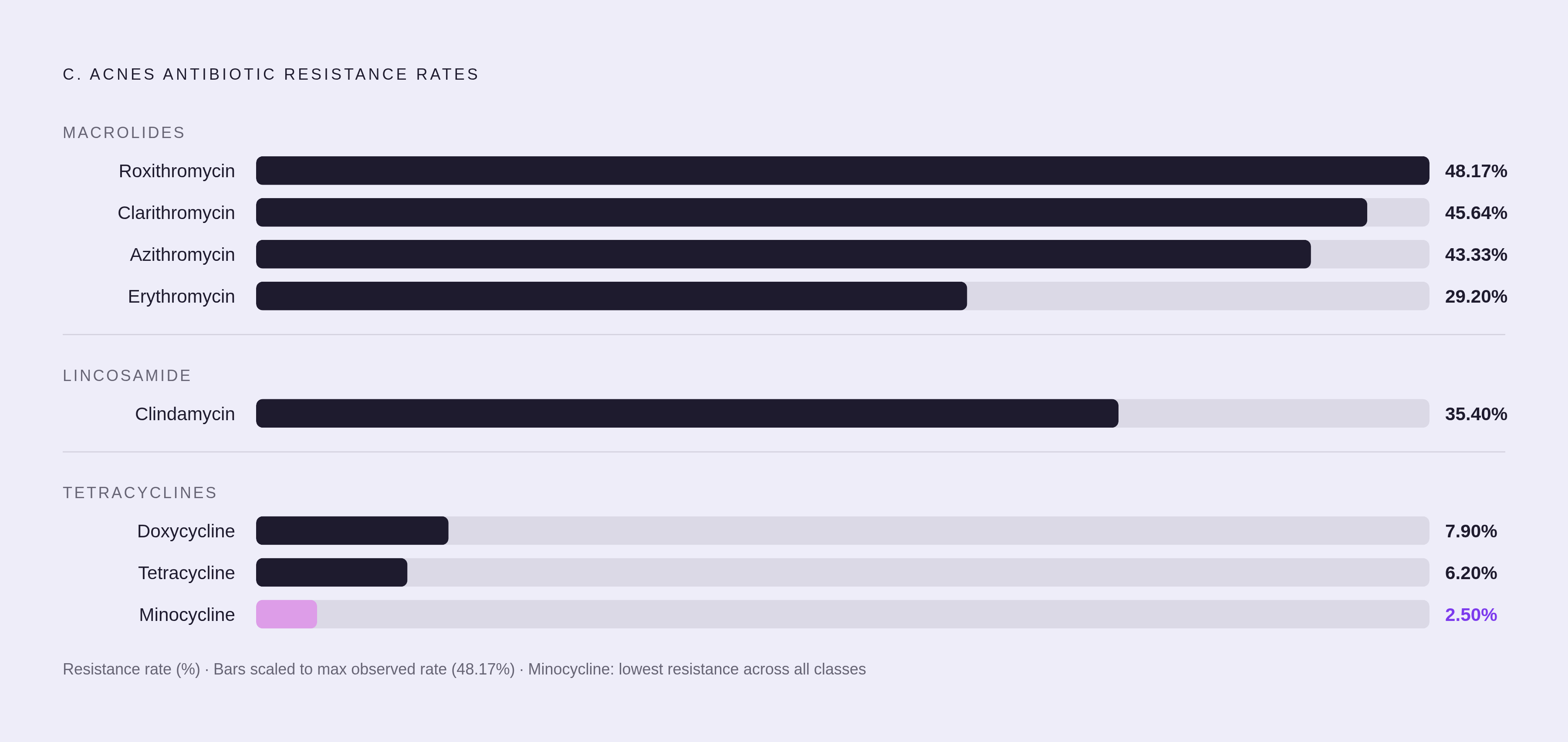
Breaking resistance down by drug class sharpens the picture; this is where the guidelines get their actual marching orders. Macrolides are under the most strain: a 2025 systematic review covering 2,046 isolates across 23 studies found roxithromycin resistance at 48.17%, clarithromycin at 45.64%, azithromycin at 43.33%, and erythromycin at 29.20%. Clindamycin is climbing too, from 25.5% in studies spanning 1983 to 2014, to 35.4% in studies from 2015 to 2023, according to a 2024 meta-analysis in the Journal of Global Antimicrobial Resistance.
Tetracyclines tell a different story, and this is the number worth remembering out of everything in this section: doxycycline resistance sits at 7.9%, tetracycline at 6.2%, minocycline at just 2.5%. That gap is why current guidelines lean on tetracyclines over macrolides and clindamycin, and it's the clearest signal in the entire resistance picture, arguably the one fact a patient should walk away with if nothing else sticks.
A harder problem sits underneath all of this. About 32.6% of acne-causing strains resist two antibiotic classes at once, and 9.3% resist multiple classes. The list of fallback options shrinks every time a first-choice drug fails, and it doesn't refill on its own.
Resistance isn't spread evenly around the globe, either. Carriage of resistant strains has hit as high as 94% in Spain and the UK, and 98% in India, while other regions report lower numbers that vary with local prescribing culture. Call it a worldwide pattern whose intensity depends on local prescribing culture, not on anything biologically different about the bacterium itself.
The risk that extends beyond the acne patient's own skin
Antibiotics prescribed for C. acnes don't know to leave the rest of the skin's bacteria alone. They knock out sensitive, harmless organisms right alongside the target, and what happens next is the part that gets skipped in most conversations about acne treatment. It's arguably a stronger argument for keeping antibiotic courses short than any resistance percentage.
When sensitive commensal strains die off, they leave open colonization niches, and opportunistic, often resistant bacteria move into the vacancy. That includes organisms like Staphylococcus aureus and Streptococcus pyogenes, both far more capable of causing real trouble than C. acnes ever was.
Research has documented exactly this kind of shift in progress. Target bacteria drop during treatment, as expected, but other microbial communities shift in ways that don't simply reverse once the course ends. The gap between the target organism recovering and the broader ecosystem recovering is the whole problem in miniature.
The disruption isn't limited to skin, either. Because antibiotics act systemically rather than only at the follicle, their effects extend beyond the skin — a separate cost from anything happening locally at the treatment site.
Zoom out further and there's a population-level concern worth sitting with. Resistance patterns that develop in commensal bacteria don't necessarily stay confined to the original host, connecting in a small but real way to the broader antimicrobial resistance picture. It connects, in a small but real way, to the broader antimicrobial resistance picture showing up everywhere from hospitals to farms.
The point here is narrower than a blanket caution against antibiotics: duration limits and combination strategies deserve treatment as load-bearing parts of the plan, not optional extras tacked on at the end.
What current clinical guidelines actually recommend to limit resistance
The 2024 American Academy of Dermatology guidelines represent the current US standard for acne care, and stewardship runs through them as a consistent thread rather than a side note.
Here's the rule most often ignored in practice: topical antibiotics alone, without anything layered in, aren't recommended. Used solo, they build resistance without giving back anything therapeutic in return. Benzoyl peroxide needs to run alongside topical or oral antibiotics specifically to blunt resistance development, and that's a mechanism-based requirement, with oral antibiotics running for as short a stretch as the case allows.
How short is short? Current stewardship guidance broadly supports early reassessment and limiting antibiotic duration before shifting to maintenance therapy. Other national guidelines similarly set time-limited initial courses with reassessment built in, capped rather than open-ended.
Among oral antibiotics, the tetracycline class — including doxycycline — is favored by current guidelines, given its lower resistance rates compared to macrolides and clindamycin. That hierarchy deserves pushback, since favoring broad-spectrum doxycycline over narrower-spectrum sarecycline cuts against the stewardship principle the guidelines claim to prioritize. Call it a real tension, not a settled question, because right now it isn't one.
Once the antibiotic course ends, the guidelines call for maintenance built around a topical retinoid paired with benzoyl peroxide or azelaic acid, meant to hold clear skin without ongoing antibiotic exposure. Retinoids are the structural backbone of long-term care here. Several topical retinoid options are available; they clear clogged follicles, calm inflammation, and carry the maintenance load over the long run. Dryness, peeling, and redness are real side effects, but manageable, usually by introducing the retinoid gradually instead of at full strength on day one.
Where non-antibiotic treatments fit into a resistance-aware plan
Acne runs on four separate mechanisms, not just bacteria, which means three of those four pathways can be treated without touching an antibiotic at all. That fact should be the default starting point for a treatment plan, not the fallback reached for once antibiotics stop working, and it's worth asking why it so rarely gets treated that way.
Benzoyl peroxide is the clearest example. It kills bacteria through an oxidative mechanism, distinct from how antibiotics work, and resistance to it hasn't been documented. That makes it unusually durable: useful standalone, and just as useful paired with an antibiotic to slow resistance from building in the first place. If a treatment plan doesn't include it somewhere, that's worth asking about directly.
Hormonal therapies matter for a specific subset of patients. Since androgen-driven oil production sits near the root of acne's cause, treatments that interrupt that hormonal signal address the disease earlier in its chain than any antibiotic ever could. Combined oral contraceptives and spironolactone are recognized treatment options for patients whose acne follows a hormonal pattern. Topical anti-androgen options that act directly at the skin level are also available and carry no systemic exposure.
Isotretinoin is recognized as appropriate for severe acne, acne taking a real psychological toll, or acne that hasn't responded to standard treatment. It works across several of acne's mechanisms at once, including suppressing oil gland activity, and carries no antibiotic resistance risk of its own.
Azelaic acid and salicylic acid round things out as additional options, useful for maintenance, comedonal acne, and the dark marks acne leaves behind, all without any resistance risk attached.
For a lot of patients, these belong at the front of the plan, not the back. Antibiotics work best in a narrower, time-limited supporting role, and a plan that starts there has already gotten the sequence backward.
How to have a productive conversation with a clinician about your acne treatment plan
All of the above only matters if it turns into sharper questions inside an actual appointment.
What's the severity grade, and does it genuinely call for an oral antibiotic? If one gets prescribed, what's the target end date, and what's the maintenance plan once it stops? Is benzoyl peroxide part of the regimen, and if not, why not? Are there hormonal factors worth checking, and how will progress get measured, so both sides know when it's time to reassess?
A clinician who can explain the reasoning behind a plan is one who can be held to it later, and that's really what these questions are for.
For everyday acne questions, particularly for patients already on a long antibiotic course with no reassessment date in sight, a message-based telehealth consult with a licensed clinician is a realistic, affordable place to start. It has limits, though, and won't cover every case that needs in-person or specialist attention. Nodular or cystic acne, significant scarring, a treatment that's clearly failing, or real psychological distress are the markers current guidance points to as reasons to consider escalating care or bringing in a specialist directly.
Strip it down and the goal is simple: good antibiotic stewardship and good acne care are pointed at the same outcome. A plan that uses antibiotics with a clear purpose, pairs them properly, and builds toward maintenance without them serves the patient in the room today. It also serves everyone else who's going to need these same antibiotics to still work tomorrow.