Determining Your Skin Type for Skincare Decisions

Skin type comes down to three mechanisms: how much oil your sebaceous glands make, how well your barrier holds together, and how well your skin retains water. Get a handle on those three, and "figuring out your skin type" stops being guesswork, and it starts looking like reading a lab report instead of picking an adjective off a bottle.
Your skin is an organ with layers, and each one does a specific job. The epidermis, dermis, and hypodermis all matter, but the part you actually live in day to day is the stratum corneum: the thin outer layer of the epidermis that keeps water in and everything else out. Ceramides make up about half its lipid content, holding the whole structure together the way mortar holds bricks. Below that sit the sebaceous glands, pumping out sebum, the oily substance that lubricates skin and slows evaporation. When people say "skin type," they're mostly describing how active those glands are. Before you take a quiz or run through a checklist, it's worth understanding what sebum is actually doing, and just as importantly, what it isn't.
What sebum production actually controls, and what slips past its job description
Sebum lubricates skin, helps it hold water, and does some antimicrobial work on the surface. Write it off as just an oily nuisance and you're missing two-thirds of its actual function.
Gland density isn't even across your body either. Face, upper back, and chest carry far more sebaceous glands than your forearms ever will. That's why every skin type conversation eventually circles back to the face, since the glands are concentrated there and that's where the visible evidence shows up.
Sebum output also rises with heat, and by a lot: over 10% for every single degree increase in ambient temperature. That's a measured mechanism, and it's why your skin runs oilier in July and tighter in January, which means one self-check done in one season can lie to you. Check your skin once in the dead of winter, decide you have "dry skin," and you might have just measured your thermostat.
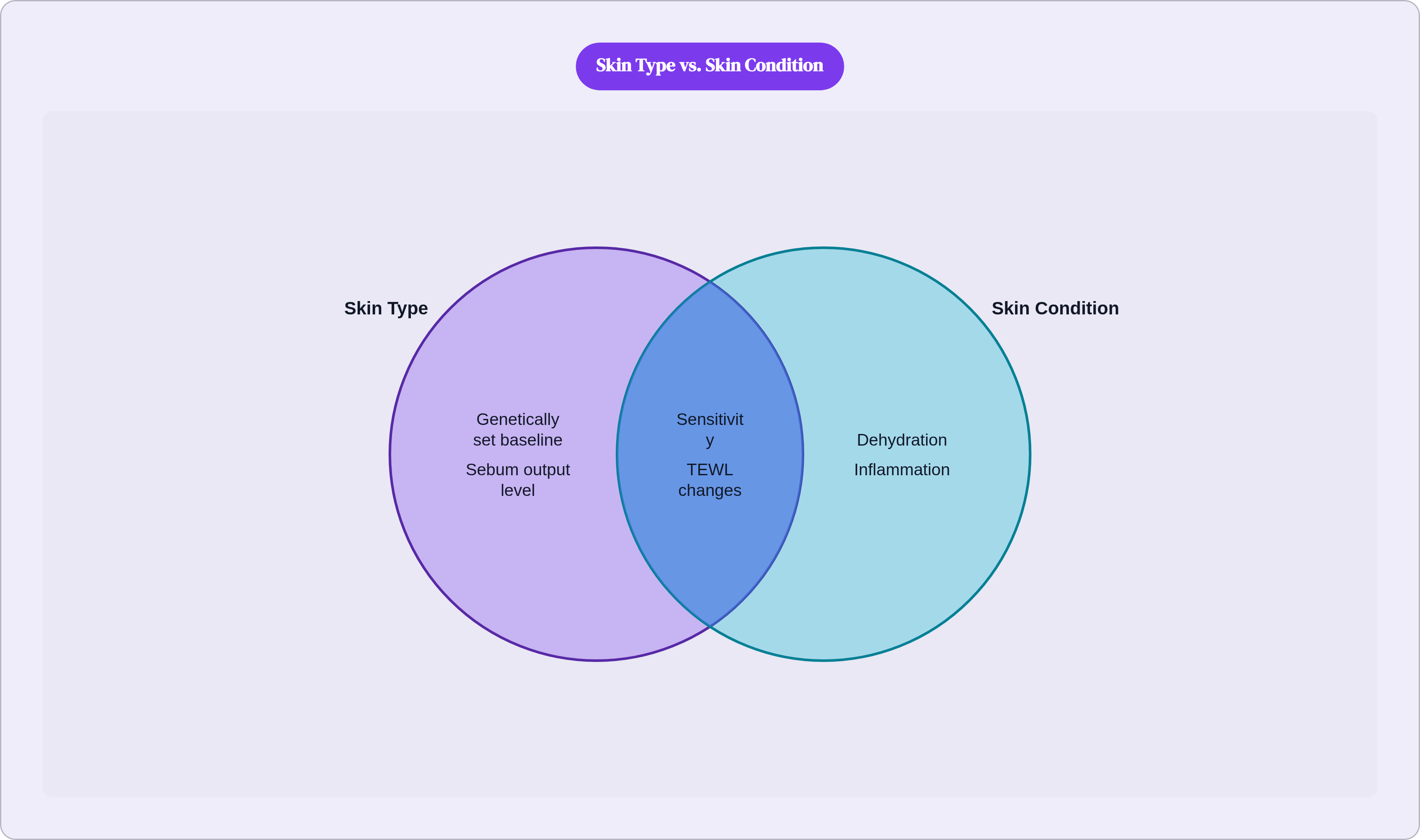
This is where type and condition get confused. Type is your baseline sebum output, genetically set: oily, dry, normal, combination. Condition is what's layered on top: sensitivity, dehydration, inflammation, and it can show up regardless of type. Oily skin with a wrecked barrier exists, so does dry skin with zero sensitivity, and so does normal sebum output paired with reactive redness that has nothing to do with oil at all. Mixing up type and condition is, I'd guess, the single biggest reason people end up treating a problem they don't actually have.
None of this holds still, either, since hormones move it, age moves it, and climate and diet move it too. Your skin type isn't something you determine once in your twenties and carry around for life. Think of it more like an eye prescription, something worth rechecking every so often, even when you're pretty sure your vision's fine.
The four classic types, and what's actually happening underneath each one
Oily skin means the glands are running above baseline, often pushed further by stress, humidity, hormones, or plain genetics. The shine, the visible pores, the acne tendency: all of that is downstream. The real action is happening at the gland, not on the surface where you can see it.
Dry skin is the mirror image, sebum production below baseline. Without enough oil, the barrier can't hold water the way it's supposed to, so transepidermal water loss (TEWL) speeds up and irritants get in more easily. Read tightness, dullness, and flaking as barrier failure signals rather than cosmetic inconveniences you can just powder over.
Combination skin runs two sebum patterns on one face at once, usually an oily T-zone (forehead, nose, chin) next to cheeks that are drier or normal. That's the uneven gland density from earlier, showing up directly on your face. Different zones are, quite literally, running different programs, which is why one product across the whole face rarely works.
Normal skin sits in the middle: no real excess or deficit, barrier intact. It's the reference point everything else gets defined against, though as a stable, permanent adult presentation, it's rarer than the marketing implies.
Then there's a variable that gets misread constantly: dehydration. Dry skin lacks oil, while dehydrated skin lacks water. Two separate deficits, two separate fixes, and skin can absolutely be oily and dehydrated at the same time. A study out of PMC in 2025 looked at 200 young women, measured over a hundred biophysical parameters, and found oily-dehydrated skin forming its own coherent subgroup rather than a measurement fluke. Reach for a heavy occlusive because that's what "dry-adjacent" skin supposedly needs, and you'll probably make the congestion worse. That skin wants humectants, not more oil sitting on top of oil.
Sensitive skin rounds out the classic five, though calling it a type is a stretch. It's a condition, barrier dysfunction that lets irritants through and sets off immune or nerve responses, and it can ride along with any of the four types above it. The biology is still being sorted out, too, and a 2024 paper in the Journal of the European Academy of Dermatology and Venereology treats the underlying mechanism as an open question, not settled science.
Why the standard five-type system only gets you partway there
Oily, dry, combination, normal, sensitive: it's a cosmetic convention, built as much for selling product as for describing biology, and it shows the seams.
A 2024 review in the Journal of the American Academy of Dermatology counted 17 distinct skin classification systems currently in active use across dermatology, covering everything from UV reactivity to pigmentation to ethnicity to sebum output. None of them has won out as the standard. A separate review spanning research from 2010 to 2024 landed on a similarly humbling conclusion: no single, perfect skin-typing method exists right now, and maybe that's fine.
The Fitzpatrick scale is the most widely used and validated system in clinical practice, but it measures something entirely different: phototype, meaning UV tolerance and pigmentation response, not sebum. It was built in the mid-1970s to calibrate UV dosing for phototherapy, then got repurposed for skin cancer risk and for guiding lasers, peels, and microneedling. Higher Fitzpatrick types carry more risk of pigmentation change or scarring from the wrong procedure; lower types burn faster. There's a real gap worth naming here too: dermatology teaching materials have historically shown conditions mostly on lighter skin, which has contributed to missed or delayed diagnoses in patients with darker skin. A 2025 JAAD consensus effort is working on a more universal framework to close that gap, though it's early.
Research-grade classification has already moved past all five categories. That same 2025 PMC study used its battery of parameters to sort skin into barrier-sensitive, neurosensitive, and inflammatory-sensitive subtypes, a level of resolution no at-home quiz can touch. Call it a preview of where clinical personalization is heading, even if it doesn't help you much standing at the bathroom mirror tonight.
So what do you do with all this? Treat the five-type system as a starting point, not scripture, since knowing exactly where it breaks keeps you from over-trusting a single quiz result you took on your phone once.
How to read your own skin without your current products lying to you
Here's the trap: people try to read their skin type while using products that are actively changing how their skin behaves. Exfoliating acids, retinoids, harsh cleansers, any of these can mask or fake your real baseline. You can't read a signal you're currently distorting, no matter how carefully you look.
So strip it back first: five to seven days, gentle cleanser, a basic barrier-supportive moisturizer, nothing else. No actives, nothing new. Let your skin settle back toward whatever it actually is before you try to measure it.
Then try the bare-face method. Cleanse with something gentle and non-stripping, pat dry, and leave your face completely bare for thirty to sixty minutes. Then check:
- Tightness or flaking points to dry skin; shine across the whole face points to oily.
- Shine confined to forehead, nose, and chin, with normal or dry cheeks, points to combination.
- No tightness and no grease at all lands closer to normal.
- Stinging, flushing, or reactive redness signals a sensitivity layer sitting on top, regardless of your base type.
If that read feels muddy, blotting paper works as a second opinion. Cleanse, wait two hours with nothing on your face, then press blotting paper against forehead, nose, cheeks, and chin separately. Oil from every zone points oily; barely any oil anywhere points dry or normal. This test earns its keep specifically when you're straddling two categories and the bare-face check left you unsure.
Keep in mind that since sebum rises with heat, a July reading and a January reading can both be true at once, since they're just describing different conditions. A summer "oily" result doesn't cancel out a winter "dry" one; your routine may genuinely need to shift with the season instead of locking into one label for good.
Self-assessment does have a ceiling, though. Persistent reactions, symptoms that won't respond to type-matched products after a real, sustained try, or presentations that blend signals in a way that's genuinely confusing: that's where a dermatologist tells you something a quiz never will.
Turning skin type into actual ingredient and formulation decisions
Here's something that gets overlooked constantly: the vehicle matters almost as much as the active sitting inside it. A genuinely good molecule in the wrong base can make the exact problem it's meant to fix worse. Gels and lightweight serums suit oily and combination skin because they deliver the active without adding occlusive weight that traps sebum underneath. Creams and ointments suit dry skin because the lipid-rich base fills in for what the skin isn't producing on its own, slowing water loss along the way.
For dry or barrier-compromised skin, the job is restoring structure and slowing water loss. Ceramides directly refill the stratum corneum's dominant lipid, and barrier research, including a 2024 paper in the Journal of Cosmetics, Dermatological Sciences and Applications, backs that mechanism specifically. Humectants like hyaluronic acid and glycerin pull water in, and they work best applied to damp skin, sealed afterward with an occlusive. Occlusives themselves (petrolatum, squalane, shea butter) form a physical layer that slows evaporation, which matters most at night when water loss peaks.
For oily and acne-prone skin, the job shifts to regulating sebum and clearing congestion without stripping the barrier in the process. Niacinamide reduces sebum secretion, carries anti-inflammatory properties, and is tolerated across nearly every skin type going. Salicylic acid, being oil-soluble, gets into the follicle itself to dissolve sebum plugs, making it the mechanism-matched pick for comedonal oily skin specifically. Benzoyl peroxide targets acne-causing bacteria and fits inflammatory breakouts better than it fits general oil control. And yes, even oily skin needs a lightweight, non-comedogenic moisturizer: strip out all the moisture and water loss climbs, which can push the glands to compensate by making even more sebum. The barrier needs support no matter what your oil level looks like.
Combination skin does best with zone-specific application rather than one product across the whole face: richer cream on drier cheeks, gel or lightweight fluid across the T-zone. Sensitive or reactive skin, whatever base type it's riding on top of, wants fragrance-free, minimal-ingredient formulas, one new active introduced at a time, with barrier-supportive ingredients like ceramides, panthenol, and allantoin coming in before any exfoliant or retinoid gets near it.
And for that oily-but-dehydrated combination from earlier: humectants are the fix, not more oil. A hyaluronic acid serum under a light, non-comedogenic moisturizer does what a heavy cream or occlusive would actively undo.
SPF applies no matter what type you are. UV exposure degrades barrier lipids and speeds up sebum-related changes regardless of your baseline. The vehicle choice, fluid for oily skin, cream for dry, matters mostly because it decides whether you'll actually put the thing on every single day.
When skin type points toward something a routine can't fix
Sebum output, barrier integrity, immune response: the same mechanisms defining skin type are also implicated in a handful of common skin conditions. That overlap means your skin type isn't just a shopping input, since it's a clinical signal too, and it pays to read it that way.
Seborrheic dermatitis, for one, involves chronic sebum overproduction paired with yeast colonization, showing up as red, scaly patches in oil-heavy zones like the scalp, face, and chest. People write it off as dry skin or dandruff constantly, and that delay costs real treatment time. Rosacea shows up as redness across the central face, visible vessels, sometimes acne-like bumps, and it's worsened by vasodilating triggers: heat, alcohol, sunlight, Demodex folliculorum. It gets misread as sensitive combination skin often enough, and left alone, it tends to progress rather than sit still.
Atopic dermatitis, or eczema, is barrier dysfunction driving chronic inflammation and itch. It's strongly tied to dry skin type, but immune and microbiome factors push it well past simple moisture loss. Treating it means restoring the barrier and calming inflammation at the same time; moisturizer by itself won't cut it. Acne comes from blocked follicles combined with excess sebum, bacteria, and dead cell buildup. Oily skin is a risk factor for it, not a diagnosis, and moderate to severe cases need prescription topicals or systemic treatment rather than another round of drugstore products piled on top of each other.
Underneath all of it sits one clinical principle: disrupted epidermal homeostasis plays a role in conditions including atopic dermatitis, psoriasis, and ichthyosis. Understanding your own barrier function puts you in a better position to notice when symptoms have moved past what any topical routine can fix alone. Dermatologists lean on the same vehicle logic from earlier when they prescribe: oily skin tolerates a gel vehicle better, dry or eczema-prone skin needs a cream or ointment base to actually deliver and hold the active.
So when do you stop adjusting your own routine and just call someone? Symptoms that don't respond to type-matched products after a real, consistent try, redness or barrier breakdown that's getting worse instead of better, or a presentation that shifts fast in ways that don't track with anything you've actually changed: any of those are reasonable triggers for a dermatology visit, and telehealth is a decent first step when in-person access is limited or a condition is still early and hard to pin down.
Skin type as a starting framework, never the final word
Skin type matters most when you treat it as a baseline, sebum output, barrier integrity, moisture retention, rather than a label a quiz handed you. That's the actual bridge between "I have oily skin" and picking a niacinamide serum over a heavy cream that'll just sit there making things worse.
But that baseline moves. Hormones move it, age moves it, and a new climate, a new medication, or a rough stretch of stress can all nudge your sebum output and barrier function somewhere different from where they sat last year. Treating your skin type as something you check once and file away is probably the single most common mistake in this whole conversation.
So check in periodically. Strip the routine back, read the signals without interference, and hold the five-type system loosely enough to notice when your skin has actually changed, instead of jamming it back into whatever box you picked years ago and calling it settled.