Dermatologist-Recommended Moisturizers for Dry Skin
The three ingredient categories dermatologists rely on to repair dry skin and why each one matters.

I've spent enough hours squinting at ingredient labels under bad drugstore lighting to know most people are guessing when they buy a moisturizer. Dermatologists keep recommending the same handful of products for real clinical reasons. Those products hit three ingredient categories that match how skin actually loses moisture, and once you know what those three things are, you can read almost any label in under a minute.
The clinical word for dry skin is xerosis, and that word tells you more than it looks like it should. Your skin is short on water and short on the fats that keep water where it belongs, a combo dermatologists call a hydrolipid deficiency. Roughness, tightness, flaking, and scaling get chalked up to sensitivity or aging way more often than they should. Xerosis usually traces back to one of two directions, and figuring out which one changes what you actually do about it.
External triggers are the obvious ones: harsh soap, hot showers, cold dry air, washing too often. Fix the habit and skin tends to follow. Internal triggers are stubborn in a different way: genetics, age, and conditions like diabetes, hypothyroidism, and chronic kidney disease can keep skin dry no matter how careful your routine gets. A 2024 paper in the Journal of the European Academy of Dermatology and Venereology found dry skin shows up alongside atopic dermatitis, psoriasis, and other chronic conditions more often than it shows up alone. So if you've stuck with a moisturizer for weeks and the dryness keeps circling back, that's worth paying attention to.
How the skin barrier works and what happens when it breaks down
Picture the outer layer of skin, the stratum corneum, as a brick wall. Skin cells are the bricks. A lipid mix made mostly of ceramides, cholesterol, and fatty acids acts as the mortar, and ceramides carry most of that load. Drop ceramide levels through aging, sun damage, or genetics, and the wall starts developing gaps: moisture leaks out, irritants get in. Dermatologists call this a "leaky" barrier. The name fits.
A second system runs alongside the lipids: natural moisturizing factors, or NMFs. These are small, water-loving molecules sitting inside the stratum corneum whose whole job is grabbing water and holding onto it. Lose either system, lipids or NMFs, and it shows up on your skin within days.
The fallout goes past how skin looks. Dr. Hadley King, a board-certified dermatologist at Weill Medical College of Cornell University, points out that a disrupted barrier means slower wound healing, more sensitivity to minor bumps and scrapes, and higher infection risk. That's a functional cost layered on top of the cosmetic one.
Hydration and moisturization get used like synonyms, but they're doing different jobs. Something sitting on the surface treats surface dryness without necessarily touching water levels deeper in the skin. Something that improves internal hydration can still feel dry to the touch if nothing's sealing it in. Dermatologist Sue Ellen Cox, MD, frames the real goal as finding a product, or a combination, that handles both at once. Check what the formula does under the skin rather than trusting the front of the jar.
Age complicates all of this further. Lipid production slows down, the barrier weakens, cell turnover drags. Mature skin looks drier and is also structurally worse at holding water and healing after damage. Worth keeping in mind, because every ingredient category below maps onto a specific point where this system tends to fail.
The three ingredient categories every moisturizer is built on
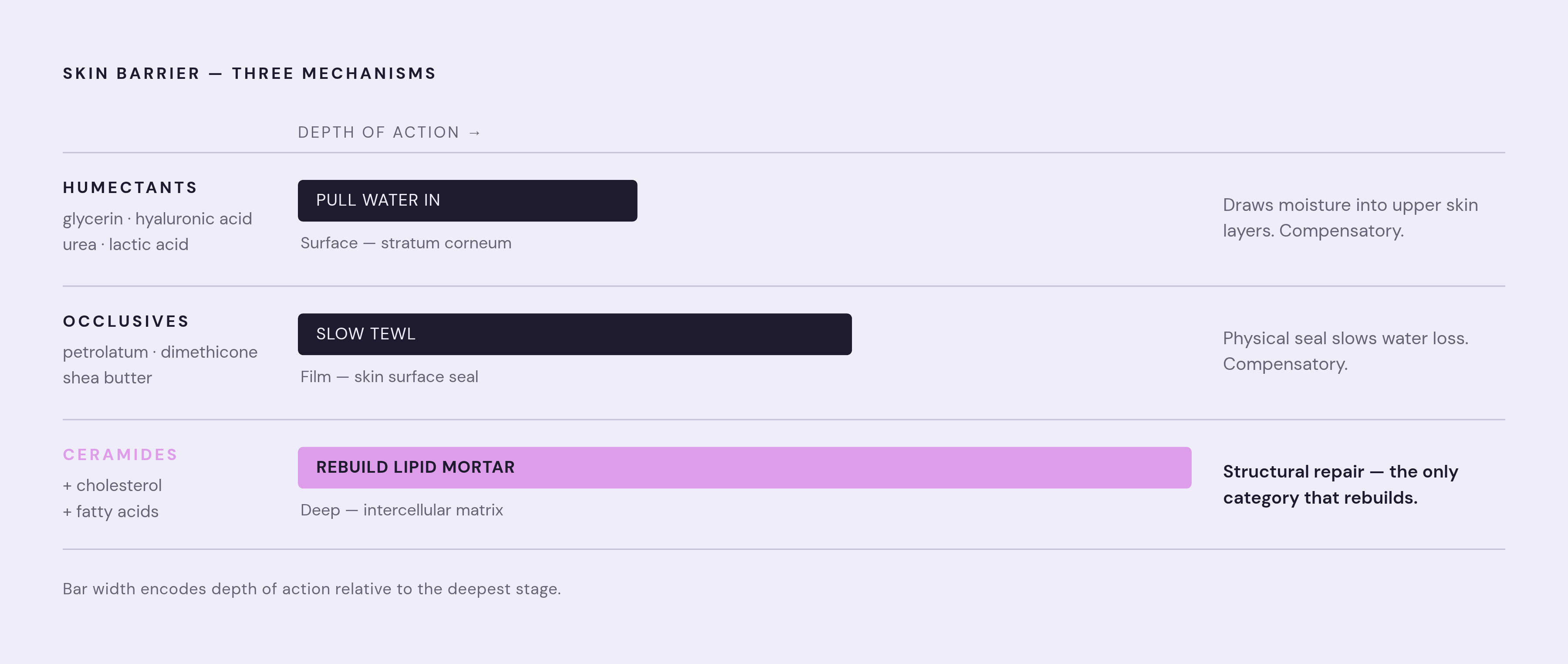
Humectants, emollients, and occlusives work as a team, not a checklist. Each one covers a different failure point in the barrier, and the moisturizers dermatologists reach for again and again tend to combine all three. Lean on just one, and you leave a gap the other two exist to close.
Humectants pull water into the skin. Glycerin, hyaluronic acid, urea, and lactic acid attract and bind water molecules in the stratum corneum. Here's the catch: in dry or low-humidity air, humectants can end up pulling water from the deeper dermis instead of the atmosphere, because there's nothing out there to grab. That's why they work so much better paired with an occlusive on top. Without a seal, a humectant just moves water around, adding little on its own.
Occlusives seal moisture in. They form a physical layer that slows transepidermal water loss (TEWL), which is just the term for water evaporating out through skin. Petrolatum is the gold standard here, and it's genuinely hard to beat on pure occlusive performance. Mineral oil, paraffin, lanolin, dimethicone, and shea butter work on the same principle at different weights. Heavier options like petrolatum make sense for very dry skin and body use, where thickness doesn't matter much. Lighter ones like dimethicone fit better on the face, or on skin that's already oily.
Ceramides work through repair. Instead of sitting on top of skin, they rebuild the actual mortar in the lipid layer. Formulas that mimic skin's natural lipid ratios, ceramides paired with cholesterol and fatty acids in the right proportions, do measurably better at structural repair than ceramides alone do. Dr. Alexis Stephens puts it simply: ceramides "act like glue by holding skin cells together, forming a barrier that prevents moisture from escaping." Products built on these ratios hold hydration and keep TEWL down longer than formulas that skip the ratio work entirely.
Urea deserves its own mention. It pulls double duty as a humectant and a mild keratolytic, meaning it softens rough, thickened skin while it moisturizes. A 2015 meta-analysis found urea-based moisturizers had strong clinical evidence for improving hydration, cutting TEWL, and reducing SCORAD measures in atopic dermatitis.
Niacinamide doesn't fit neatly into humectant or occlusive, but it's worth knowing about anyway; Dr. Stephens notes it supports the skin's own ceramide production over time, a slower, more upstream fix than a cream that just hands ceramides to your skin directly.
New York dermatologist Julie Russak, MD, points to squalane, essential fatty acids, multi-weight hyaluronic acid, peptides, and postbiotics as ingredients gaining ground. Multi-weight hyaluronic acid is the interesting one: different molecular weights sit at different depths in the skin, so combining them can hydrate at more than one level instead of just sitting on top.
Ingredients and formulations to avoid on dry skin
Fragrance is the most common irritant in moisturizers, and it's a bigger problem on dry skin specifically. A compromised barrier has less capacity to buffer against sensitizers, so fragrance gets through more easily and causes more trouble than it would on skin that's intact.
Drying alcohols, listed as denatured alcohol or alcohol denat., get added for fast absorption and a light feel. They also worsen TEWL, which works directly against what dry skin needs. A well-made dry-skin moisturizer either skips these alcohols or keeps them low enough on the ingredient list that the concentration barely registers.
Retinols and alpha-hydroxy acids strip natural oils and speed up water loss, so they don't belong as the main event in a dry-skin moisturizer. This isn't a case against retinoids generally, just a case for keeping them in their own step, which is where the sandwich method comes in later.
Formulation matters as much as the ingredients themselves, maybe more. A lotion with high water content and no occlusive can evaporate fast, leaving skin drier than before you applied it. That's a real risk with plenty of drugstore lotions marketed for hydration: a quick burst of water with nothing to lock it in does more harm than good.
There's a downstream problem too. More water in a formula means more preservatives needed to keep it stable, and for reactive skin, that's one more variable to manage. Dyes and common allergens like lanolin sit in similar territory. Lanolin works fine as an occlusive for most people, but some react to it, which is exactly why a brand like Vanicream leaves it out on purpose.
Choosing the right formulation type for where and how dry your skin is
Moisturizers run on a spectrum from lotion to cream to ointment, and the difference comes down to the ratio of water to oil. More water means a lighter texture that spreads easily and sinks in fast, but it evaporates fast too, which shortens your window of protection. More oil means heavier, slower to absorb, longer-lasting against water loss.
Dermatologists generally agree dry skin does better with creams than lotions. For the roughest spots, cracked heels, elbows, badly compromised patches, ointments win because they're almost pure oil with barely any water in them at all.
Face and body aren't interchangeable here. An ointment that works great on your feet is usually too heavy and pore-clogging for your face. A ceramide-rich cream tends to be the standard call for facial skin, balancing barrier repair against a texture that won't set off breakouts.
Timing matters as much as the product itself. Apply moisturizer within a few minutes of stepping out of the shower, while skin's still damp, and you trap residual water against the skin instead of letting it evaporate into the bathroom air. Most dermatologists recommend applying at least twice a day, including right after washing, to see real change over time.
Choosing a cream or ointment over a lotion also tends to mean fewer preservatives, simply because there's less water that needs stabilizing. For reactive skin, that's a quiet benefit that has nothing to do with texture.
What dermatologists actually recommend, and why each product earns its place
The products dermatologists mention most aren't arbitrary picks. Their ingredient lists map directly onto the science above, and that's a more reliable signal than price tag or shelf placement ever will be.
CeraVe Moisturizing Cream carries glycerin and hyaluronic acid for humectant power, plus three different ceramides for barrier repair, so the whole three-category framework sits in one jar. It was developed with dermatologists, carries the National Eczema Association's seal of acceptance, and runs at a modest price point, evidence that clinical performance and price don't move together the way marketing wants you to believe.
Vanicream Moisturizing Cream earns its spot mostly by what it leaves out: no fragrance, no dyes, no lanolin, no parabens. Solid choice for post-procedure skin, pediatric use, or anyone whose skin reacts to nearly everything. Sometimes a short ingredient list is its own kind of strength.
Cetaphil Moisturizing Cream keeps things simple too. Most formulas are fragrance-free, and glycerin paired with vitamin B5 gives humectant support without overwhelming reactive skin, which makes it a reliable baseline across a wide range of ages and skin types.
La Roche-Posay Lipikar gets a specific nod from Dr. Elyse Love for combining ceramide-3, shea butter, glycerin, and niacinamide, checking off humectant, occlusive, and ceramide-support boxes all at once. Works for dry skin and eczema-prone skin alike.
First Aid Beauty Ultra Repair Cream stands out for its colloidal oatmeal, which has solid evidence behind it for calming itch and irritation, particularly on eczema-adjacent dry skin. Usable on face and body, lighter than a traditional ointment while still moisturizing hard.
Using a retinoid and fighting the dryness that comes with it? Try the sandwich method: moisturizer, then retinoid, then moisturizer again on top. It helps skin tolerate the active ingredient without blunting the results you're using it for in the first place.
Drugstore versus luxury is worth unpacking here, because clinical performance tracks with ingredients, not shelf price. The International Society for Atopic Dermatitis has pushed to get registered moisturizer creams added to the WHO's essential medicines list. That's how seriously the people who study skin for a living take this category.
When dry skin stops responding to moisturizers and needs clinical attention
At some point, a moisturizer stops being the answer. How do you know you've crossed that line? Watch for flaking, redness, or cracking that won't budge despite consistent use of the right products. Watch for skin that's painful, weeping, or bleeding, dryness showing up in strange localized patches, or itch bad enough to wreck your sleep.
A better cream doesn't fix any of that. These signs can point to something underneath: untreated atopic dermatitis, psoriasis, hypothyroidism, diabetes, something driving the dryness from a place topical products just can't reach. A dermatologist can offer a confirmed diagnosis, prescription-strength formulas, and treatment aimed at the actual cause instead of the symptom sitting on top of it.
Getting that kind of care doesn't have to mean weeks on a waitlist, either. For plenty of cases, asynchronous teledermatology, where you send photos and a description of symptoms and get a diagnosis and treatment plan back, sometimes within a day, is a legitimate first move. It costs less, it works well for eczema, rashes, and persistent dry skin, and it beats waiting a month for something a few clear photos can often settle on the spot.
One caveat, and it matters: teledermatology has real limits. Not every situation can be assessed remotely, and some conditions require in-person clinical evaluation that photos simply can't substitute for.
For the far more common scenario, dryness that just won't quit no matter what you throw at it, getting a clinician's eyes on it has never been easier to arrange. Persistent dry skin deserves an actual look, not another trip down the drugstore aisle hoping the next jar does what the last one didn't.