Pore-Clogging Ingredients in Skincare Products

Dermatologists call this structure the pilosebaceous unit: a hair follicle sitting next to a sebaceous gland. That gland's whole job is to make sebum, an oily substance that travels up the follicle and onto the skin's surface. Sebum moisturizes, protects, keeps skin from drying out and cracking, and under normal conditions it flows up and out without a problem.
Skin sheds dead cells constantly, but in acne-prone skin, that shedding happens unevenly. Cells clump together instead of sloughing off cleanly, and when they mix with sebum inside the follicle, they form a plug. That plug blocks the drainage path, sebum backs up, and bacteria (a species called Cutibacterium acnes) start multiplying in that trapped, oxygen-poor pocket, so the follicle wall stretches and inflames. That's a comedone. It comes in two forms, and you'll see both terms constantly: an open comedone, or blackhead, is a plug that reached the surface and oxidized on contact with air, turning dark; a closed comedone, or whitehead, stays sealed below the skin as a small, flesh-colored bump.
For decades, dermatology explained acne through four classic drivers: too much sebum, abnormal shedding (the technical term is hyperkeratinization), C. acnes colonization, and inflammation. Newer research complicates that a bit, since broader shifts in the skin's whole microbial community seem to matter too, not just the one bacterial species. Acne is rarely one clean cause with one clean fix, in other words.
Why do the face, forehead, chest, back, and shoulders take the worst of it? Those spots carry the highest density of sebaceous glands on the body, and more glands means more sebum, which means more opportunity for the plug-and-block cycle to fire off.
Topical products can walk right into that same mechanism. Certain ingredients act like the plug itself: sitting in the follicle, trapping cells and oil, setting off the same chain reaction. It's documented, and it has a name.

Why product ingredients become a trigger: the concept of acne cosmetica
Acne cosmetica is a specific, well-documented pattern: breakouts caused or worsened by topical cosmetic products, on top of or separate from genetics and hormones. This isn't a fringe theory. In foundational testing decades ago, researchers found that a large share of popular cosmetic creams triggered comedones when applied experimentally, proof that what you put on your skin can drive acne on its own, no other cause required.
The category is bigger than most people assume. Skincare is the obvious suspect, but makeup, body lotion, haircare, even detergent residue left on a pillowcase can all play a part. Haircare gets overlooked constantly, and it shouldn't. Shampoos and conditioners almost never get tested for comedogenicity, and the oils in those formulas migrate down onto the forehead, along the jawline overnight. People spend months blaming their face wash for a breakout their conditioner caused.
This isn't a niche concern, either. Acne affects roughly a fifth of the global adult population over 16. The heaviest burden falls on people between 16 and 24, but adult-onset acne has been climbing, driven by hormonal shifts, diet, and environmental exposure. Ingredient literacy isn't something you age out of.
The human cost is real too. The Pierre Fabre ALL study, drawing on testimonials from more than 50,000 people across 20 countries, confirmed what anyone with persistent acne already knows in their gut: it affects quality of life and carries real social stigma, and that's true globally, not just anecdotally.
Internal triggers matter alongside external ones, too. Perimenopause, postpartum hormonal shifts, starting or stopping hormonal birth control: any of these can prime skin to react harder to a comedogenic ingredient it tolerated fine last year. Acne is rarely one cause acting alone; usually it's a few things stacking on top of each other.
The comedogenic scale: what it measures, where it came from, and what it was never designed to do
The comedogenic scale runs from 0 (won't clog pores) to 5 (highly likely to clog pores). Most people meet this scale through some chart floating around Pinterest or a skincare forum, rarely with any sense of where the numbers came from. It's worth tracing that history before trusting any number on it.
The story starts in 1972 with dermatologist Albert Kligman, who built something called the Rabbit Ear Assay. He applied undiluted ingredients directly to rabbit ear skin and counted comedones over several weeks. In 1989, dermatologist James Fulton published the most widely cited set of ingredient rankings built on that kind of testing. Here's the part that surprises people: nearly every comedogenic chart you've ever seen online traces back to that one study, and no full, standardized update has come out since. Most of what circulates today is decades-old data dressed up in a modern infographic.
The original methodology had real limits baked in. Rabbit ear skin doesn't behave like human facial skin; it's a different animal, literally. When researchers tested on humans, they used back skin, not face, sealed off from air, at high concentrations, for stretches of time that don't resemble how anyone actually wears a moisturizer. Ingredients were tested pure and undiluted, never as they'd appear in a finished product, and different labs testing the same ingredient sometimes landed on different results.
A 2025 review in JAAD Reviews, covering literature from 1972 to 2025, found that the lack of standardized testing and regulatory oversight lets companies print "noncomedogenic" on a label whether or not it's true. The review called for standardized, human-based testing on final formulations, not isolated ingredients.
There's an unresolved argument here worth being honest about. Cosmetic chemists say diluting an ingredient inside a full formula lowers its pore-clogging potential; critics counter that the ingredient's properties don't vanish just because it's now 2% of a bottle instead of 100%. Neither side has settled that one, and sitting with that ambiguity is more honest than picking a side just to have an answer.
One documented case makes the stakes concrete. Ceteareth-20 and cetearyl alcohol are each considered non-comedogenic on their own, but combine them, and the mixture turns comedogenic. That's a real finding, and it's exactly why checking ingredients one at a time, in isolation, misses things that matter.
So what's the scale good for, after all this? A starting-point signal, nothing more. It flags ingredients worth watching, but it doesn't predict, with any real precision, how one specific formula behaves on your specific skin.
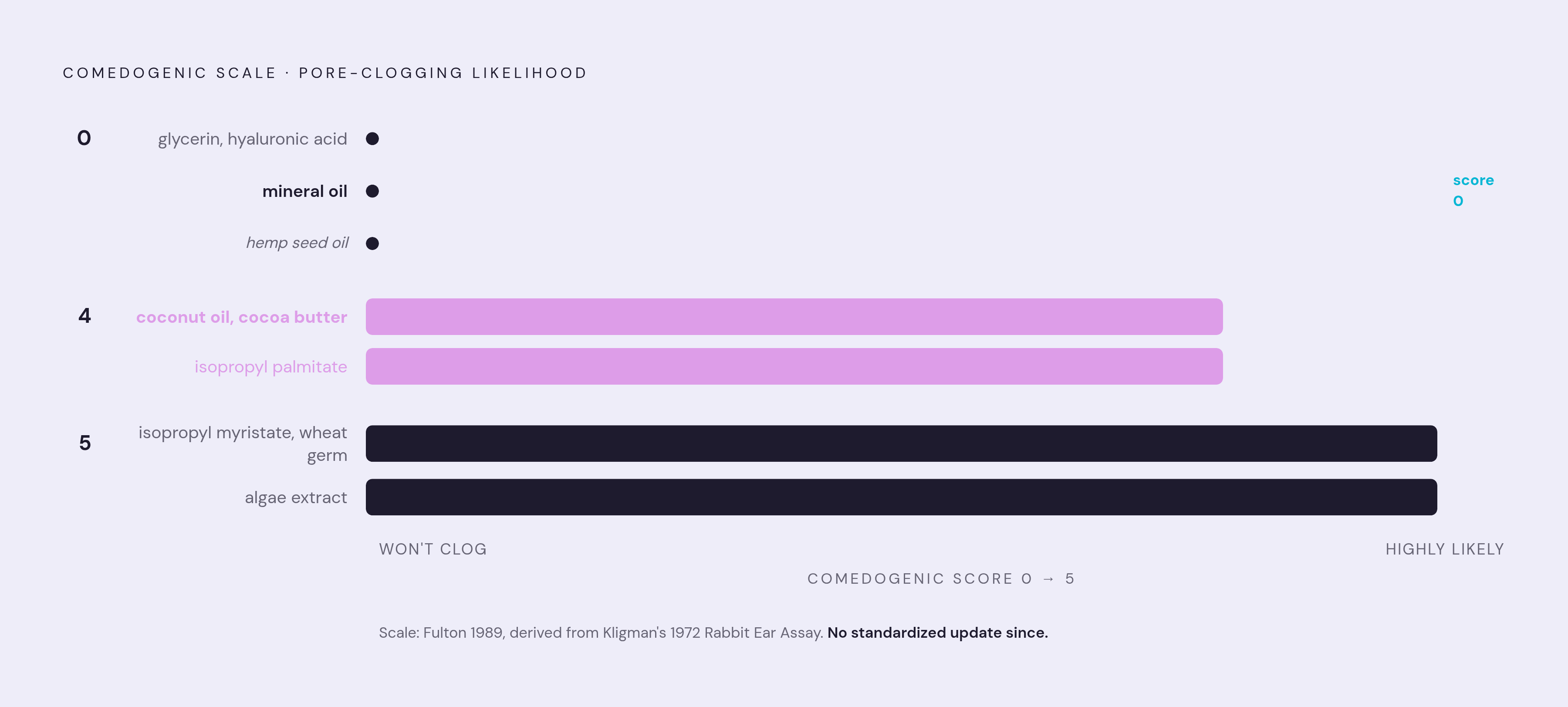
Ingredients with the strongest evidence for pore-clogging
At the top of the Fulton/Kligman scale, rated 5: isopropyl myristate, wheat germ oil, algae extract. Rated 4: coconut oil, cocoa butter, isopropyl palmitate.
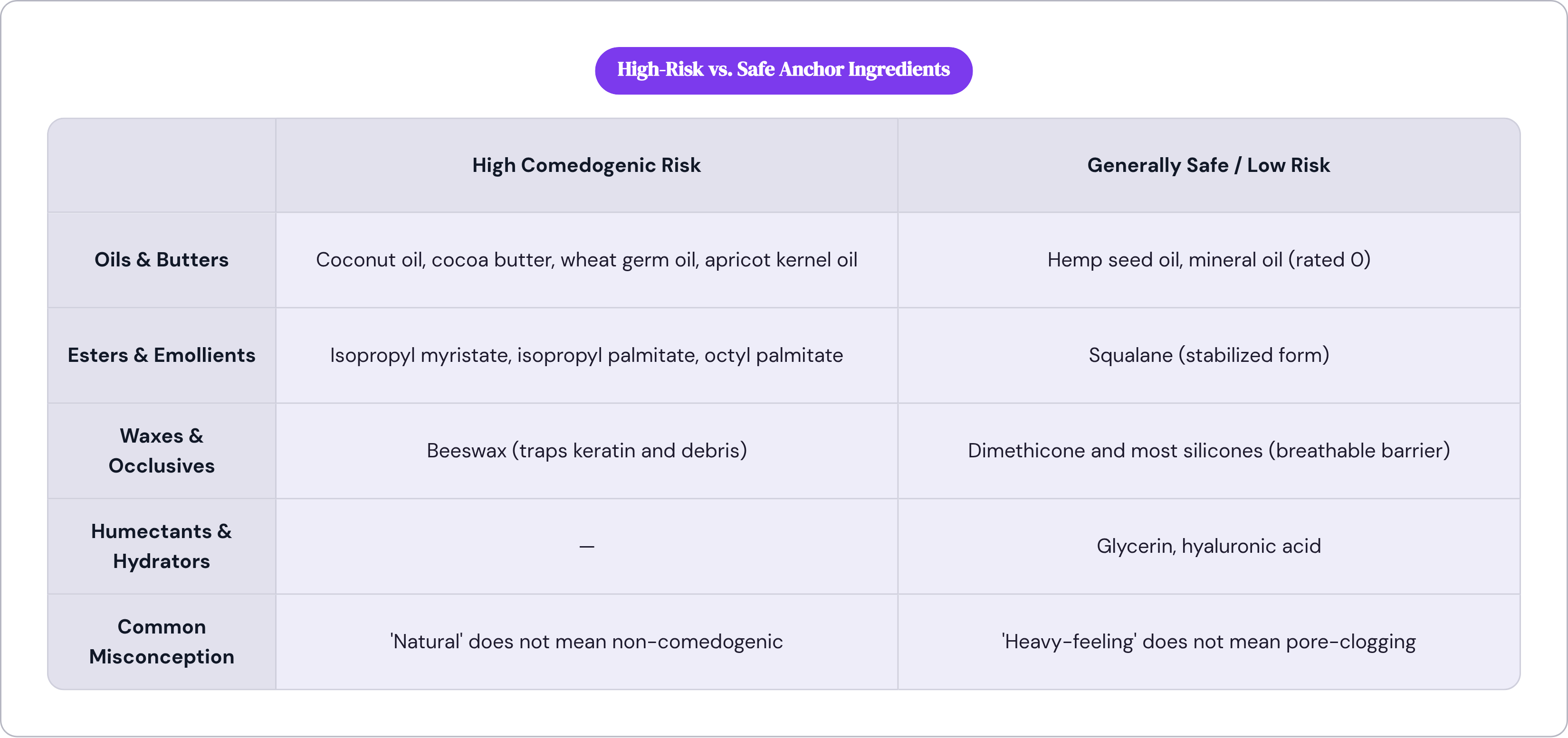
The fatty acid esters deserve their own mention. Isopropyl myristate, isopropyl palmitate, and octyl palmitate all consistently triggered heavy follicular keratinization in assay testing. Octyl palmitate in particular caused a big jump in microcomedone counts on actual human subjects, which makes it one of the sturdier data points to survive that whole research era.
Natural oils and butters don't get a pass just because they sound gentle. Cocoa butter, coconut oil, wheat germ oil, and apricot kernel oil all produced microcomedones in rabbit skin testing. "Natural" and "non-comedogenic" are two separate claims, and marketing loves to blur the line between them.
Coconut oil deserves a nuance, though. Lauric acid, a fatty acid found in coconut oil, shows some antimicrobial activity against acne-causing bacteria, and certain coconut extracts test as non-comedogenic even when the whole oil doesn't. An ingredient and its fractions can behave completely differently, so "coconut" on a label isn't automatically one thing.
Beeswax is thick and occlusive, meaning it forms a heavy seal on skin. That seal can trap keratin trying to exit the pore, oil and debris right along with it, and you'll find it constantly in lip products and makeup.
A few ingredients get mixed up so often they're worth untangling. Squalane, the stabilized form, is generally lightweight and non-comedogenic; squalene, its unstabilized cousin, gets tied to comedone formation once it oxidizes. One letter of difference, one meaningfully different outcome. Silicones like dimethicone take the blame for clogging pores constantly, yet most silicones are considered non-comedogenic; they sit on skin as a breathable barrier rather than sinking into the follicle. Mineral oil, despite feeling heavy and greasy, rates a 0 on the scale, counterintuitive, but that's what the testing shows.
For comparison, safe anchors at 0 include glycerin, hyaluronic acid, hemp seed oil, and mineral oil. Keep those in mind as a reference point when you're trying to gauge whether a new formula leans risky or leans safe.
One more thing worth sitting with: the same ingredient, at the same concentration, can behave differently from one person's skin to the next. Oily skin, a compromised barrier, hormonally active skin, these all shift how reactive a follicle is to begin with.
Why "noncomedogenic" on the label means less than it appears to
Here's something that surprises almost everyone the first time they hear it: the FDA doesn't regulate the term "noncomedogenic" in the United States. No legal definition exists, no required testing protocol, and no bar a product has to clear before a brand puts that word on the front of the bottle.
A 2017 study in JAMA Dermatology said this directly: there's no industry-wide standard for comedogenicity that determines whether a "noncomedogenic" claim is even true. The researchers grouped it right alongside "hypoallergenic" and "dermatologist recommended", marketing language with almost no regulatory teeth behind it.
That means a product launched in 2022, or 2024, can carry a "noncomedogenic" label while still holding ingredients that rate high on the classic comedogenic scale. The claim on the front and the ingredient list on the back can flatly contradict each other, and nothing stops that from happening.
Part of the problem is testing, or the lack of it. Brands may run minimal testing before making the claim, sometimes none at all, and that 2025 JAAD Reviews analysis mentioned above confirmed this regulatory gap is still wide open, not something that quietly got patched at some point. And the scale compounds the issue: a lot of the data used to "verify" a noncomedogenic claim traces back to 1970s rabbit ear testing on undiluted ingredients, now stretched to cover formulas built for 2024 skin.
So what do you do with the word "noncomedogenic" when you spot it on packaging? Treat it as a prompt, not an answer, and go check the label yourself.
How to read a skincare ingredient list for comedogenic risk
Ingredient lists run by concentration, highest to lowest. That one fact changes how you should read everything else, since a high-rated ingredient near the top of the list carries real weight while the same ingredient buried near the bottom is a different story.
Cocoa butter as ingredient 15 out of 20 is a trace amount doing very little. Cocoa butter as ingredient 2 is a different product altogether, and concentration context changes the whole risk calculation, skipping that step is probably the most common mistake people make when they start reading labels.
Combination effects matter too, and they're genuinely hard to catch on your own. Remember ceteareth-20 and cetearyl alcohol: fine alone, comedogenic together. Checking ingredients one at a time in isolation misses interactions like that completely.
Don't stop at face products, either. Hair conditioners and styling oils applied near the hairline, or rinsed down over the face in the shower, don't get tested for comedogenicity as standard practice. Body lotions on the chest or back matter for anyone breaking out in those zones. Makeup, foundation, primer, concealer often sits on skin longer than anything else worn all day, and sunscreen deserves its own look: some chemical filters carry higher comedogenic ratings, while mineral formulas built on zinc oxide or titanium dioxide generally rate lower.
A practical way to work through a new product: pull out the top five to eight ingredients by concentration, then check any oils, butters, esters, or waxes in that range against what you now know about the scale. Weigh the full formula rather than fixating on one ingredient in isolation; a single high-rated ingredient sitting at position 18 doesn't doom a product. Patch-test anything new on a small patch of acne-prone skin before committing your whole face to it.
There are real limits here, worth naming. Ingredient lists don't show exact percentages, so you're often guessing at concentration from position alone, and combination effects are hard to predict without lab data. Individual skin response varies enough that label reading works as a filter, not a diagnosis.
If breakouts keep happening despite careful ingredient choices, pay attention to that. It usually points toward something internal: hormonal shifts, diet, microbiome changes, a compromised skin barrier. A clinical assessment can tell acne cosmetica apart from those other causes in a way a label never will, and that doesn't have to mean a traditional office visit anymore, either; Nolla, one service in this space, combines AI-assisted skin assessment with review from licensed clinicians, offering a first step toward a professional read on skin and routine without the cost or hassle of booking an appointment.
Evidence-based treatments that work alongside smarter ingredient choices
Avoiding comedogenic ingredients removes one input from the acne cycle. It doesn't treat comedones that already exist, and it doesn't calm inflammation already underway. Prevention and treatment are two separate jobs, and mixing them up is where a lot of skincare routines go wrong.
The 2024 AAD acne guidelines back strong evidence for benzoyl peroxide, topical retinoids, topical antibiotics, and oral doxycycline for active acne. In current clinical practice, combining adapalene with benzoyl peroxide (sold as Epiduo, among other formulations) is considered the gold-standard first-line approach.
Comedonal acne and inflammatory acne aren't the same problem, and they don't answer to the same tools. Blackheads and whiteheads come from that hyperkeratinization process we started with, so retinoids go after the shedding issue directly, while salicylic acid clears buildup that's already formed. Papules, pustules, and nodules are inflammatory, and those respond better to benzoyl peroxide and antibiotics, which target bacterial load and inflammation instead.
A 2025 Delphi consensus published in JAAD, built from 62 dermatologists across 43 centers reviewing hundreds of ingredients, landed on a short list with strong evidence behind it: azelaic acid, benzoyl peroxide, glycolic acid, niacinamide, retinoids among them. That list cuts through a lot of noise, and it's worth keeping close.
One documented mistake: piling on too many actives at once. Layering a retinoid, benzoyl peroxide, salicylic acid, and a vitamin C serum in the same routine doesn't multiply the benefit; it disrupts the skin barrier, and a disrupted barrier can make both comedone formation and inflammation worse. More isn't better here; more is often worse.
For women whose acne tracks with hormonal shifts, perimenopause, postpartum, changes in contraceptive use, ingredient management alone probably won't be enough. Combined oral contraceptives are the only FDA-approved birth control option that also treats acne, and the specific progestin in the formulation matters quite a bit. That makes it a conversation worth having with a clinician, not something to sort out through trial and error on your own.
Ingredient literacy handles one category of trigger: the stuff you put on your skin every day. Clinical treatment handles what's already formed. Knowing which is which, and knowing when a breakout has moved from "check the label" territory into "call a dermatologist" territory, is most of the job.