Stratum Corneum Function and Skin Barrier Health
Balanced lipid ratios, not single ceramides, restore skin's barrier structure.

The mortar in that brick-and-mortar analogy is not generic fat. It is a precisely stratified lamellar structure, organized into repeating bilayers, composed of three classes of lipids: ceramides, cholesterol, and fatty acids. Remove or deplete any one of them and the structure does not simply become weaker. At a molecular level, it becomes disorganized. The more interesting problem, though, is not total absence. It is imbalance in proportion.
Ceramides are the most abundant lipid in the stratum corneum, but they cannot form stable lamellar bilayers on their own. Cholesterol provides the fluidity that keeps those bilayers from becoming too rigid, particularly in colder conditions. Fatty acids complete the structural integrity of the whole assembly. All three must be present, in roughly the right proportions, for the matrix to behave the way healthy skin's matrix behaves.
Most formulation discussions skip one detail entirely. Each corneocyte carries a monolayer of lipid covalently bonded to its outer surface, not floating in the surrounding space. This lipid shell acts as an anchor point for the lamellar structure. The matrix does not simply fill gaps between cells. It attaches to them.
Where do these lipids originate? Specialized secretory organelles called lamellar granules, derived from the Golgi apparatus in the granular layer, release lipid precursors as keratinocytes approach the stratum corneum. This secretory step is a real upstream vulnerability. Harsh surfactants can disrupt this mechanism, interfering with lipid delivery before the matrix has even finished assembling. The damage starts earlier than the dryness appears.
A review published in 2024 in Experimental Dermatology found that multi-lipid formulations outperform single-ceramide products in barrier recovery trials. Given what we know about lamellar organization, that finding makes complete structural sense. A single lipid component cannot reconstitute a system that requires three working in concert.
How the SC renews itself: the cornification and desquamation cycle
The stratum corneum is continuously being built from below and shed from above, and the balance between those two processes determines its thickness, integrity, and function. It is not a fixed structure. It is a moving equilibrium.
Cornification is the process by which living keratinocytes become corneocytes. Three coordinated events define it: the formation of an intracellular keratin network, the assembly of a protein-rich cornified envelope that replaces the cell membrane, and the secretion of the intercellular lipids described above. Keratinocytes begin this journey at the stratum basale and complete it at the surface in approximately 14 days.
Desquamation, the controlled shedding of corneocytes from the surface, is the complementary process, and "controlled" is doing real work in that sentence. Serine proteases degrade corneodesmosomes, the protein bridges that hold neighboring corneocytes together, in a graduated, spatially organized fashion. When those bridges loosen at the right rate, cells shed invisibly. When they loosen too fast, or fail to loosen at all, the consequences become visible and symptomatic.
The master regulator of this process is pH. The surface of a healthy stratum corneum maintains a mildly acidic pH, and that acidity governs protease and protease-inhibitor activity. Shift the pH upward, as alkaline cleansers reliably do, and the enzymatic balance tilts. Shedding becomes dysregulated. This is a measurable, reproducible consequence of a very common product behavior, which makes it worth asking why pH is so rarely listed as a specification on consumer packaging.
When the equation between proliferation from below and shedding from above breaks down, the stratum corneum either thickens abnormally, as in psoriasis, or thins and becomes structurally compromised. Both outcomes represent the same fundamental failure: the cycle stops being self-correcting.
How barrier failure produces measurable consequences — and precedes visible disease
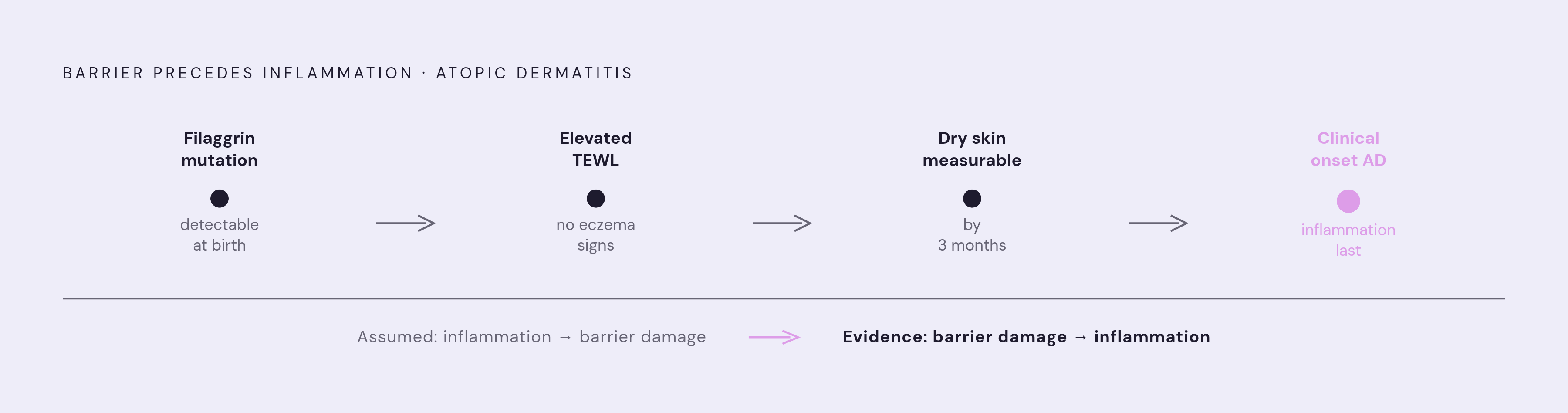
Transepidermal water loss, abbreviated TEWL, is the key metric here. When the lipid matrix is compromised, water escapes through the stratum corneum at an elevated rate. That rate is objectively measurable, and alongside skin temperature, it gives clinicians a practical tool for evaluating barrier integrity before, during, and after treatment.
What makes TEWL worth taking seriously is its temporal relationship to disease. Barrier impairment is not simply a consequence of skin conditions. In several well-documented cases, it precedes them.
Elevated TEWL has been measured in carriers of filaggrin gene mutations who show no clinical signs of eczema. Barrier impairment detected at birth and at two months of age has been shown to precede the clinical onset of atopic dermatitis, and by three months, filaggrin mutations are already associated with measurably dry skin. The structural compromise comes first. The inflammation follows. This does not simply complicate the standard narrative that inflammation drives these conditions; it partly reverses it.
The mechanism connecting those two events is not complicated, but it matters. When the lipid matrix is compromised, the stratum corneum becomes permeable to antigens and irritants that would otherwise be excluded. Those materials access the deeper, immunologically active layers of the epidermis and trigger inflammatory responses. Removing lipids from intact skin is sufficient on its own to provoke that cascade. The barrier does not need to be clinically diseased to become a site of immune activation.
Structural compromise, water loss, antigen penetration, inflammation. Hold that sequence; it runs through everything below.
What barrier breakdown looks like in atopic dermatitis and psoriasis
Atopic dermatitis affects up to 20% of children and approximately 10% of adults globally. For years the condition was understood primarily as an immune dysfunction, with the skin barrier as collateral damage. That framing has largely been reversed. Barrier failure is now understood to be upstream of the inflammation, not downstream from it.
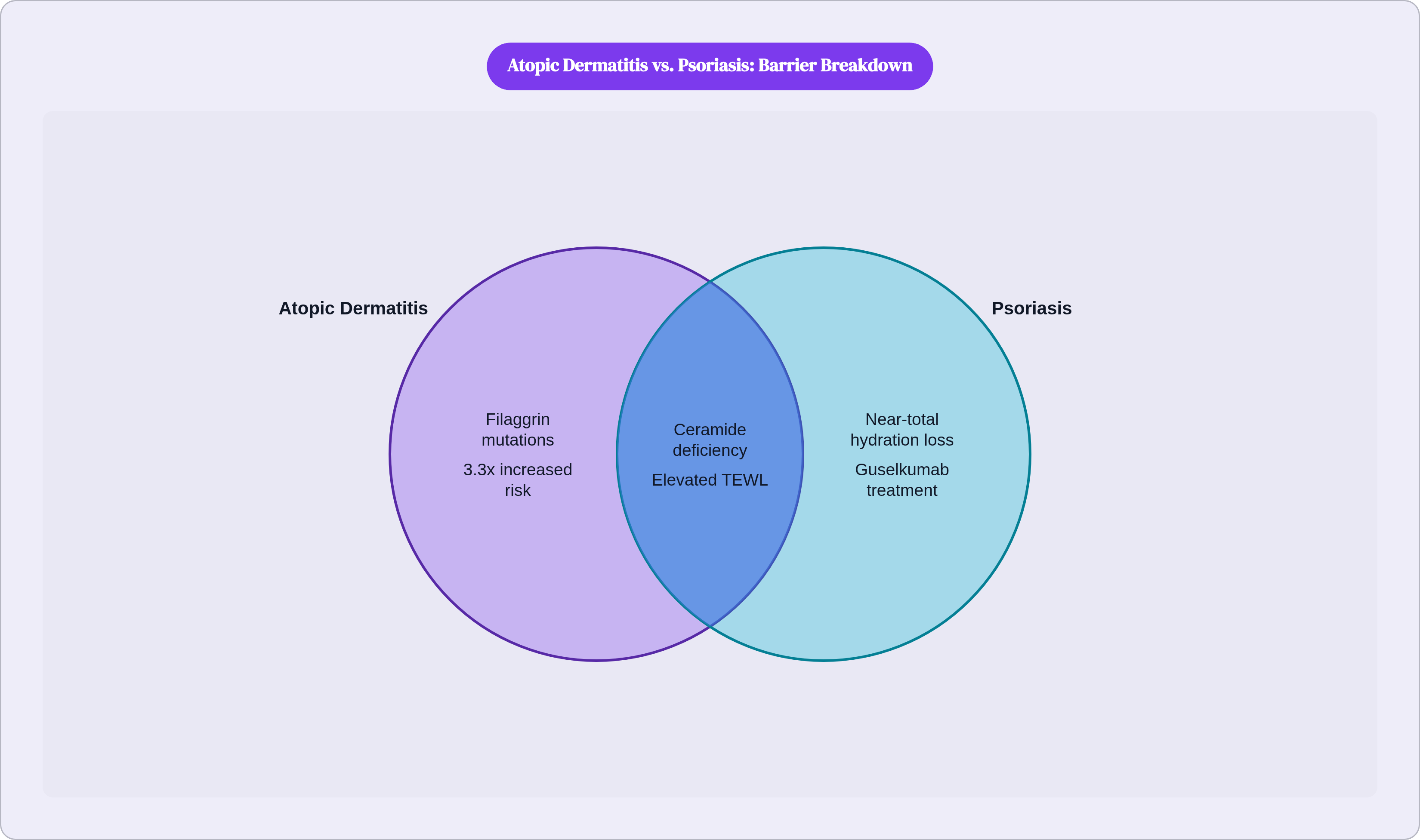
Filaggrin loss-of-function mutations are central to that understanding. These mutations occur in roughly 10% of people of European descent, and a single such mutation confers approximately a 3.3-fold increased risk of developing atopic dermatitis. Filaggrin is a structural protein essential to corneocyte integrity and natural moisturizing factor production; its absence disrupts the barrier at a foundational level. Ceramide deficiency in atopic dermatitis compounds the problem, connecting directly back to the lamellar architecture described earlier.
Psoriasis tells a related story with different specifics, and the numbers are striking. A 2024 assessment measured stratum corneum hydration in lesional psoriatic skin at 8.71 arbitrary units, compared to 38.43 in uninvolved psoriatic skin and 44.39 in healthy controls. That is not a marginal difference. It represents a near-total collapse of hydration in the lesional tissue.
It is also worth considering how reversible this can be. A 2024 randomized controlled trial found that guselkumab, a targeted biologic therapy, normalizes the stratum corneum ceramide profile and measurably alleviates barrier dysfunction. The stratum corneum is responsive when the underlying mechanism is addressed at the right level.
Both conditions point toward the same conclusion: the stratum corneum is not a passive casualty of inflammation. Its structural breakdown is frequently where the disease begins.
How rosacea fits the barrier-disruption pattern differently
Rosacea does not map cleanly onto the filaggrin-ceramide-TEWL narrative, and treating it as though it does is one of the ways it gets mismanaged. It involves barrier compromise, but also vascular dysregulation and aberrant immune signaling, and those mechanisms are entangled in ways that resist simple categorization.
Epidermal barrier dysfunction in rosacea is not incidental. Burning, stinging, dryness, and edema are recognized secondary diagnostic criteria of the condition. And at least one mechanism distinguishes rosacea from atopic dermatitis or psoriasis: elevated cathelicidins, antimicrobial peptides produced in abnormally high concentrations in rosacea-affected skin, directly disrupt lipid synthesis and stratum corneum formation. The immune dysregulation is not merely responding to a compromised barrier. It is, in part, producing one.
In a pooled dataset of 915 untreated adults with papulopustular rosacea, dryness and scaling were reported by 51 to 69% of participants, burning and stinging by 29 to 36%, and pruritus by 49 to 52%. Those are structural complaints, not vascular ones.
Rosacea also illustrates a subtler consequence of compromised barrier function: heightened ingredient sensitivity. Certain preservatives and reactive ingredients can activate specific inflammatory pathways through the TRPA1 receptor and the NLRP3 inflammasome. A healthy stratum corneum limits that exposure. A compromised one does not. Patients with rosacea often react to products that would leave intact skin unaffected, which means formulating for them requires treating barrier support as a baseline condition, not an optional enhancement.
The 2024 FDA approval of a dual-release minocycline formulation targeting both erythema and inflammatory lesions suggests that barrier-adjacent inflammation in rosacea is increasingly recognized as a primary treatment target, not a secondary concern.
What external factors damage the SC — and how
pH is the most underappreciated lever in everyday skincare behavior. The stratum corneum surface maintains a mildly acidic pH, not for cosmetic reasons but because that acidity regulates the serine protease activity governing desquamation. High-pH cleansers shift the surface environment away from that range, destabilizing the enzymatic balance and creating conditions for dysregulated shedding. Most people treat this as a negligible inconvenience. It is a pharmacological effect.
Harsh sulfate surfactants operate upstream of that. As discussed, they can disrupt the lamellar granule secretory step, interfering with lipid precursor delivery before the matrix assembles. The damage is invisible until it manifests as dryness or sensitivity, sometimes weeks later.
Denaturing alcohols strip lipids directly from the matrix. Physical scrubs with irregular particles physically fracture the stratum corneum surface, creating entry points for irritants and allergens. Over-washing and over-exfoliating are frequently described as excessive enthusiasm, but that framing understates what is actually happening. The renewal cycle operates on roughly a 14-day timeline. Mechanical or chemical interference that outpaces that cycle does not accelerate healthy turnover; it removes stratum corneum faster than it can be replaced.
Environmental stressors, including heat, low humidity, and UV exposure, each accelerate water loss or deplete lipids through distinct mechanisms, which is why seasonal flares in eczema and rosacea are predictable physiological responses, not coincidences.
All of these triggers converge on the same failure modes: removing the lipid matrix, altering the pH that governs its enzymes, or disrupting the lamellar granule delivery system that builds it.
How barrier repair works at the ingredient level — and why ingredient ratios matter
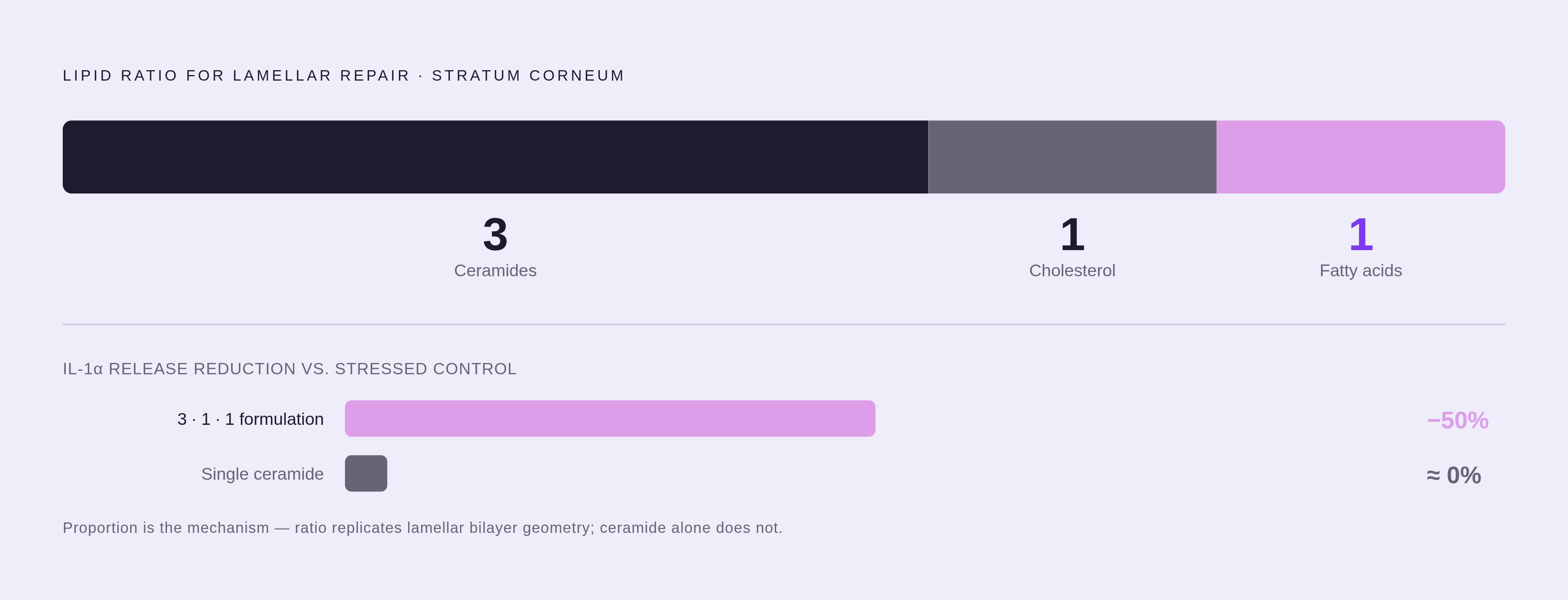
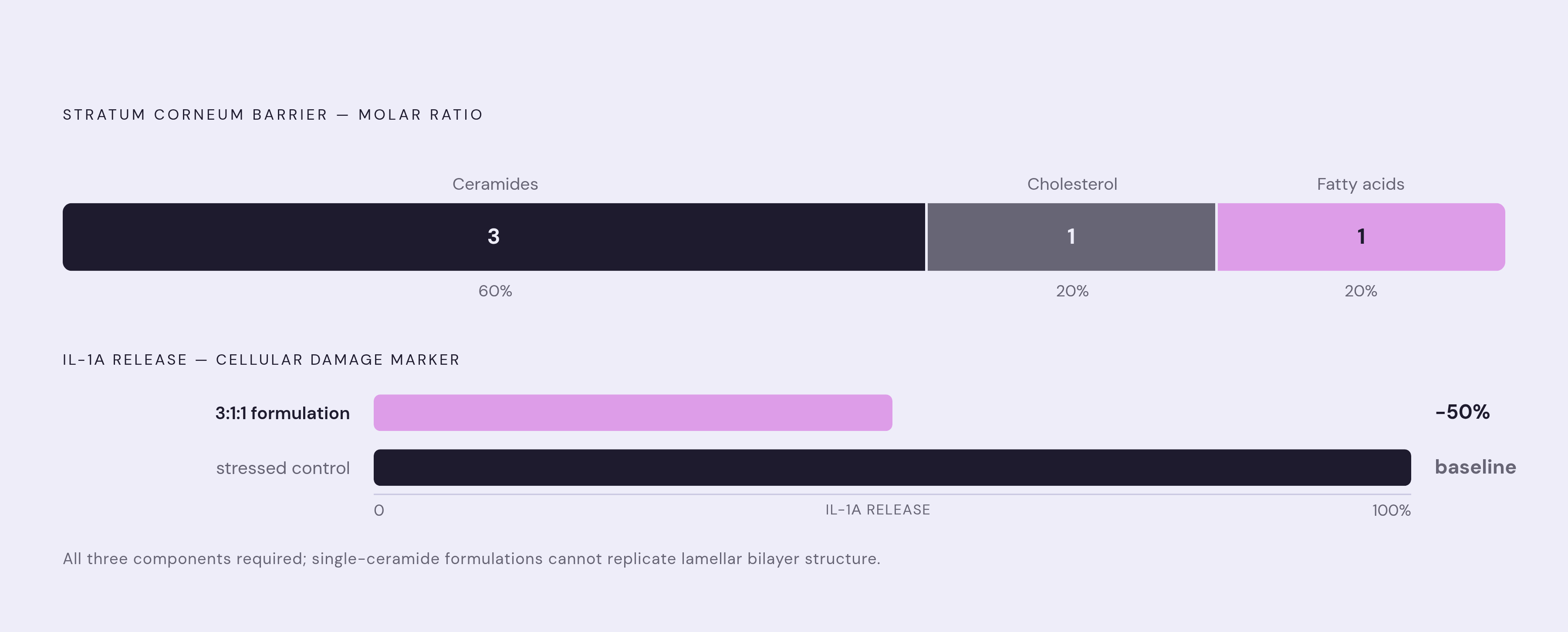
Barrier repair is not hydration. Hydration is one component of barrier function, not its structural basis. Rebuilding a compromised stratum corneum means rebuilding the lipid matrix, and that requires supplying the right lipids in proportions that replicate natural lamellar organization.
The research here is fairly consistent. Ceramides, cholesterol, and fatty acids in approximately a 3:1:1 ratio reconstitute the lamellar structure in a way that single-ceramide formulations cannot. In studies using human-reconstituted epidermis stressed with sodium dodecyl sulfate, a ceramide-cholesterol-fatty acid lamellar formulation reduced cellular damage markers and interleukin-1 alpha release by 50% compared to stressed control. That is a structural outcome, not a moisturization outcome.
Niacinamide, vitamin B3, works at a different level and on a different timeline. It upregulates serine palmitoyltransferase, the rate-limiting enzyme in the skin's own ceramide synthesis pathway, increasing endogenous production of ceramides, glucosylceramides, and sphingomyelins. Clinical trials using concentrations of 2 to 5% niacinamide have demonstrated TEWL reductions of 20 to 30% within four to six weeks, with measurable barrier benefits beginning at just 2%.
Ceramides and niacinamide address different time horizons, which is why they consistently outperform either ingredient alone. Ceramides provide immediate lamellar reinforcement. Niacinamide scales up the skin's internal lipid-synthesis capacity over weeks. One fills the structural gaps; the other gradually improves the skin's capacity to fill them itself. Someone might reasonably point out that niacinamide's slower timeline makes it less useful in acute barrier compromise, but that misses how the mechanisms interact: one is not a substitute for the other.
Humectants, emollients, and occlusives each play supporting roles, but layering order matters. Draw water into the tissue, fill lipid gaps in the matrix, then seal the surface to slow evaporative loss. Applying these out of sequence reduces the efficacy of each step, because each is designed to act on a specific structural substrate.
What is newly possible, and meaningfully changes what formulation data can tell us, is molecular-level confirmation of repair. Tape-strip analysis using mass spectrometry can now document restored ceramide chain length, ceramide subclass distribution, upregulation of filaggrin and its associated proteins, and reduction in inflammatory markers. For the first time, we can connect the biology directly to what products are or are not accomplishing at a structural level. That is not a small development.
When understanding your barrier should prompt a clinical assessment rather than a product adjustment
There is a point at which changing products is not the answer. Persistent elevated TEWL, chronic flares that cycle without resolution, dryness that does not respond to well-formulated barrier support: these are not failures of a skincare routine. They are signals of a diagnosable condition operating at a level that topical ingredients cannot address on their own.
Filaggrin mutations, ceramide profile abnormalities, and dysregulated protease activity are not correctable with moisturizer. Guselkumab can normalize the stratum corneum ceramide profile at a structural level that even a well-formulated topical cannot reach, because biologics and targeted therapies work upstream. When the problem is upstream, the solution needs to match.
Access to that level of assessment has meaningfully improved. Asynchronous teledermatology now achieves diagnostic accuracy in the range of 80 to 95% for common conditions like eczema, with evaluations typically completed within 24 to 48 hours of image submission. A 2025 cross-sectional survey of 130 patients found that nearly three-quarters trusted dermatologist-guided AI, while almost none trusted AI alone. The combination of algorithmic triage and clinical review is both what the data supports and what patients actually want. Teledermatology is a threshold, not a destination; direct examination still matters when physical findings are required.
In 2025, the International Society for Atopic Dermatitis applied to have moisturizer creams included on the WHO Essential Medicines List. That is a formal recognition that barrier repair is medical treatment, and that the gap between knowing what the stratum corneum needs and being able to access it has real clinical consequences for real populations. Some people are still on the wrong side of that gap.
Understanding the biology of the stratum corneum does not require a laboratory. But it changes what you notice, what you reach for, and when you recognize that what you are experiencing is not something a better cleanser is going to fix.