Environmental Factors That Affect Skin Health
UV radiation and pollution damage skin through distinct pathways that accumulate over time.

UV Radiation and Why It Remains the Most Consequential Skin Stressor
When the International Agency for Research on Cancer classified solar UV radiation as a Group 1 carcinogen in 2012, it placed it alongside tobacco. More than a decade later, most people still treat sunscreen as optional. That gap between evidence and behavior is strange to sit with.
The scale is worth confronting directly. WHO data for 2020 attributed approximately 1.2 million new non-melanoma skin cancers and 325,000 melanoma diagnoses to solar UV exposure globally, with over 120,000 deaths in that single year. In the United States, around 6.1 million adults are treated for basal cell and squamous cell carcinomas annually, at a cost of roughly $8.9 billion. UV is not a peripheral concern. It is the dominant one, by a significant margin.
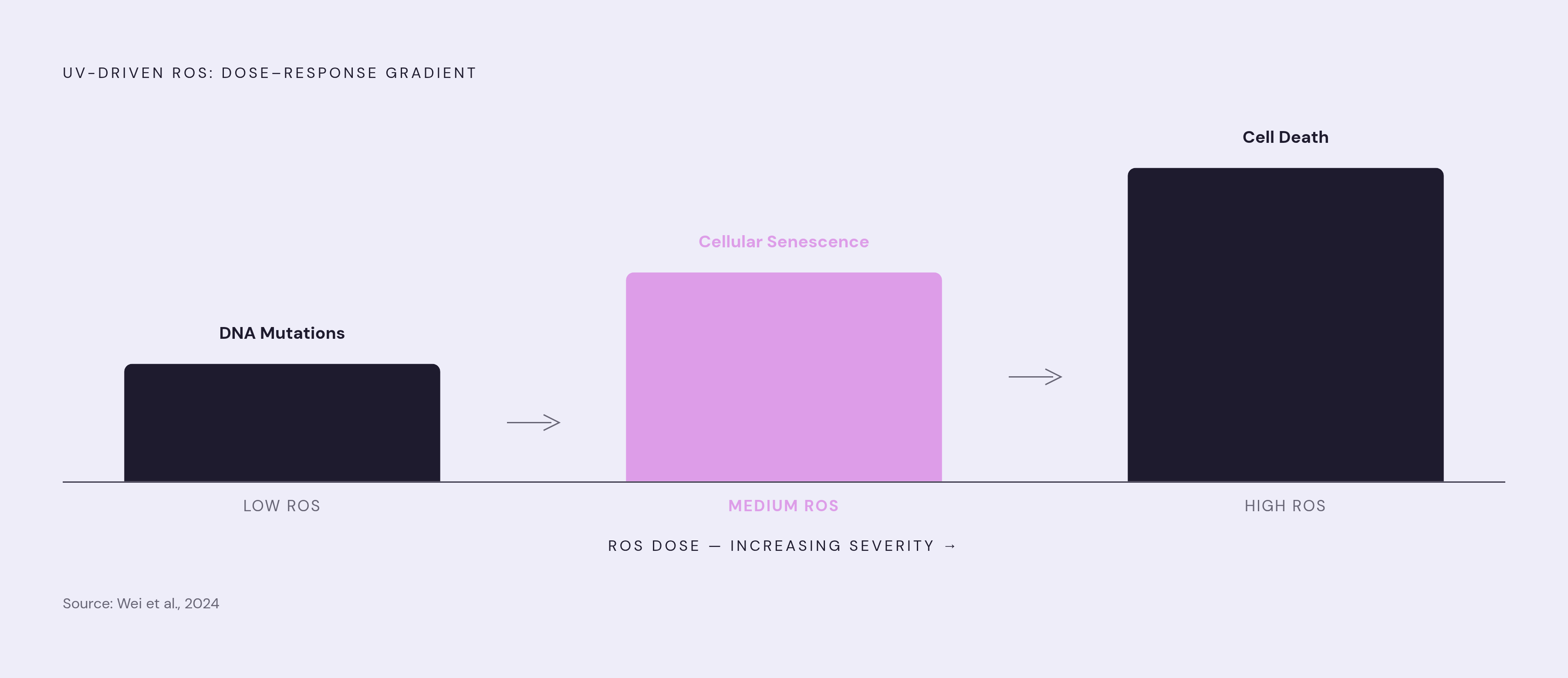
The mechanism is dose-dependent in ways that matter practically. Research published in Environment International (Wei et al., 2024) maps a clear gradient: low levels of reactive oxygen species drive mutations, medium levels push cells toward senescence, high levels trigger outright cell death. The skin isn't simply taking hits. It's navigating a gradient of harm, and where it lands depends on how much UV arrives and how often.
A few variables rarely make it into conversation. UV intensity climbs roughly 10 to 12 percent for every 1,000 meters of altitude gained. Snow reflects up to 80 percent of UV radiation, meaning a winter ski day delivers far more exposure than most people account for. The relationship between UV and the ozone layer is direct and documented: a 1 percent decrease in ozone thickness corresponds to a 2 percent rise in melanoma incidence, per WHO data cited in a 2025 PMC/NIH review. Climate change is not a future concern for skin health. It is an active one.
What UVA and UVB Each Do to the Skin Over Time
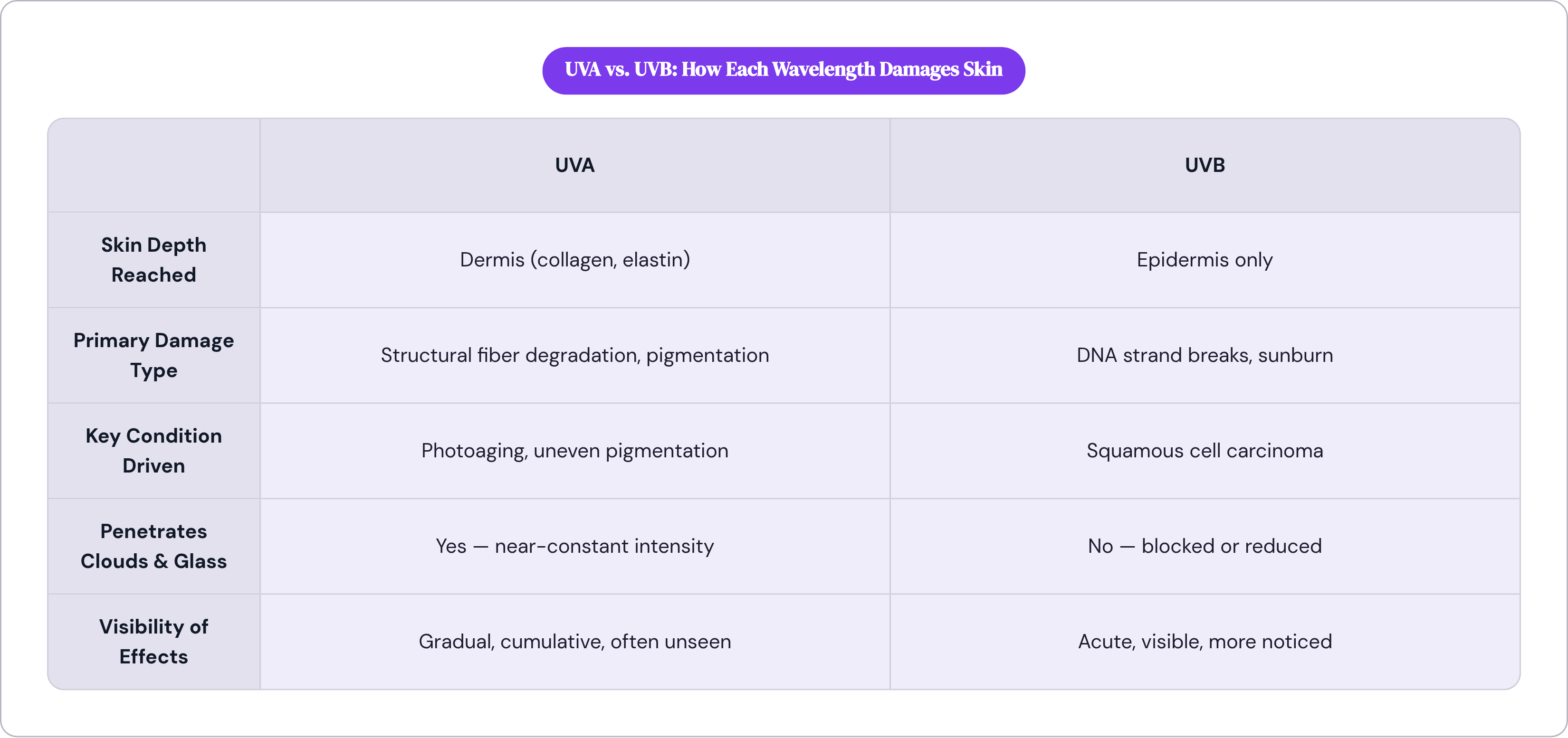
The UVA/UVB distinction is not just labeling on a sunscreen bottle. The two wavelengths behave differently, reach different depths, and produce distinct kinds of damage over years of accumulated exposure.
UVB is absorbed primarily by the epidermis. It causes sunburn, photoallergic reactions, direct DNA strand breaks, and it drives squamous cell carcinoma. Its effects are visible and acute, which is partly why it commands more public attention. But visibility is misleading here. The damage accumulates with each event, and the skin does not fully reset between exposures. Every sunburn is a deposit into an account you cannot withdraw from.
UVA penetrates deeper, reaching the dermis where collagen and elastin live. It degrades those structural fibers over time, impairs wound healing, damages blood vessels, and acts on melanocytes in ways that produce uneven pigmentation. This is the mechanism behind photoaging: deepened lines, loss of resilience, skin that looks measurably older than the person wearing it. UVA also operates more continuously than most people realize. Unlike UVB, it passes through clouds and glass at relatively consistent intensity throughout the day. It works on you even when you don't think you're getting sun.
Addressing only one wavelength while ignoring the other leaves half the problem unmanaged. Broad-spectrum SPF covers both. Clothing, shade, and timing of outdoor activity adjust the total exposure budget across the day. These strategies aren't redundant; they address distinct parts of the same problem.
Air Pollution as a Systemic Threat to the Skin Barrier
Here is something the pollution literature surfaced that shifted how I think about this: the skin barrier can be damaged by pollution not only through direct surface contact but also through systemic circulation. Airborne pollutants, including particulate matter, nitrogen dioxide, ozone, polycyclic aromatic hydrocarbons, and volatile organic compounds, reach the skin both topically and from the inside out, via the bloodstream. The exposure doesn't stop at the surface.
The core mechanism mirrors the UV story. Pollutants disrupt the epidermal barrier, generate reactive oxygen species, and activate inflammatory pathways. A 2025 review in the Annals of Dermatology documented associations between air pollution exposure and exacerbated atopic dermatitis, psoriasis, and acne, alongside accelerated skin aging, hair loss, and skin cancer.
The geographic evidence is particularly telling because it controls for the obvious confounds. Researchers have found multiyear gaps in wrinkle appearance and even larger disparities in facial hyperpigmentation between populations living in cities of comparable latitude and sun exposure but different pollution loads. Genetics and UV don't account for the difference. Pollution does.
The indoor dimension also matters more than most people assume. Cigarette smoke is the most rigorously studied indoor pollutant: even secondhand exposure is associated with coarse wrinkling, solar elastosis, and pigmentary changes in nonsmokers. Staying inside does not reliably mitigate exposure. Indoor air is not necessarily cleaner than outdoor air, and the skin doesn't distinguish between sources.
How Pollution Specifically Worsens Atopic Dermatitis and Other Inflammatory Conditions
Atopic dermatitis is the clearest case study in pollution-driven skin disease, partly because the pathway is well understood mechanistically and partly because it's been studied most rigorously. Urbanization, elevated particulate matter and ozone, low humidity: these factors correlate with both prevalence and severity, and they don't operate in isolation. They stack.
Airborne particles degrade the skin barrier, which triggers an inflammatory response mediated by signaling molecules associated with allergic inflammation. Simultaneously, pollution alters the cutaneous microbiome in ways that further destabilize the skin's immune regulation. That microbiome piece is easy to overlook because it isn't visible, but it carries real clinical weight. The skin is colonized by microbial communities that help regulate immune responses. When those communities are disrupted by environmental stressors, the resulting imbalance becomes a trigger for flares in its own right, independent of whatever initiated the disruption.
Acne connects through a related but distinct pathway: pollution-driven oxidative stress increases sebum oxidation and drives inflammatory signaling. Acne is not purely a hygiene issue. It is partly a chemistry problem, and environmental chemistry is a legitimate input into that equation.
Psoriasis follows a similar logic, with pollutant-driven inflammatory pathway activation capable of triggering or worsening flares, though the mechanistic picture there is less complete than it is for atopic dermatitis.
The practical implication worth sitting with: these conditions are not predetermined by genetics alone. Environment modulates their expression and severity. Air filtration, barrier-repair skincare, and thoughtful timing of outdoor activity during high-pollution periods are legitimate management tools, not peripheral ones.
Temperature Extremes and Humidity Shifts as Underestimated Skin Stressors
DermNet NZ, updated as recently as March 2026, frames climate change specifically as a "risk-multiplier" for skin disease. The language is deliberate. It doesn't create new conditions so much as worsen existing ones and shift their geographic distribution. Not "will there be new diseases?" but "who will be sicker, and where?" That's the more useful question.
Cold temperatures and low humidity affect the skin barrier at a structural level. Ceramides, the lipid molecules central to barrier function, can fall substantially in cold conditions; research has documented reductions significant enough to meaningfully impair the barrier's ability to retain water. A barrier that loses water faster cracks more readily and becomes more permeable to irritants, which is why skin in cold climates trends toward dryness, redness, and sensitivity even in people who have never carried a diagnosed skin condition.
High humidity creates a different set of problems entirely. It decreases skin elasticity, raises sebum production, and lowers skin pH, generating conditions favorable to acne and fungal infections. This isn't a contradiction; humidity is simply a different stressor than dryness, producing different downstream effects on different physiological targets.
Heat and sweating add another layer. A 2024 review from the International Eczema Council found that severe heat and increased sweating intensify itch-scratch cycles and aggravate eczema symptoms. For people managing eczema, summer is not just uncomfortable. It is a clinical variable worth actively planning around.
Beneath all of this sits the microbiome dimension. Temperature and humidity shifts alter the microbial environment on the skin's surface, and disrupted microbiome balance is a recognized trigger for acne, eczema, and rosacea. The skin isn't responding only to physical conditions directly; it's responding to the ecosystem those conditions shape.
Visible Light, Blue Light, and What Screen Exposure Actually Does to Skin
Blue light has attracted marketing attention that has significantly outpaced the science behind it. Calibration is the most useful place to start.
Visible light comprises roughly half of total solar radiation, and approximately 20 percent of it reaches the subcutis, the deepest layer of the skin, according to research presented by Harvard dermatologist Arianne Shadi Kourosh at the 2024 American Academy of Dermatology Annual Meeting. Visible light causes DNA oxidation and degrades collagen and elastin. The structural consequences resemble those of UV exposure, though the acute effects are less dramatic and slower to accumulate.
Blue light, the high-energy visible portion of the spectrum, penetrates more deeply than UVA or UVB. Emerging evidence published in the Journal of Cosmetic Dermatology in 2023 (Kumari et al.) links it to DNA damage, fine lines, and premature aging. A 2024 paper in Aesthetic Surgery Journal Open Forum proposed epigenetic modifications as a mechanism for blue-light-driven aging, which is an interesting frontier, though not yet clinical consensus.
Electronic devices emit blue light at intensities roughly 100 to 1,000 times lower than sunlight. That sounds immediately reassuring. But many people spend eight to twelve hours daily in front of screens. Duration is what makes screen exposure relevant, not intensity per session. That distinction tends to get lost in how the conversation is framed.
Observed effects include changes in pigmentation, increased redness, and slower recovery from damage. These are real but not equivalent to UV or pollution damage in kind or severity, and long-term human studies remain limited. Blue light concern is legitimate. The evidential weight behind it, however, does not yet belong in the same category as UV or air pollution, and that distinction should guide priorities rather than the marketing copy on serums.
Hard Water and What Mineral-Heavy Tap Water Does to the Skin Barrier
This is the most underappreciated stressor on this list. The exposure is so mundane it barely registers as exposure at all. Water from the tap, every morning, every night, unremarkable enough to be completely invisible.
Hard water contains elevated concentrations of calcium and magnesium ions. These ions interact with surfactants in soap and cleanser to form insoluble salts that remain on the skin after rinsing. Those residues disrupt the lipid layers of the skin barrier, leaving the surface drier, more irritated, and more permeable to whatever else encounters it during the day.
A systematic review and meta-analysis from the University of Nottingham, published in Clinical & Experimental Allergy in 2020, found a positive association between living in a hard water area and atopic eczema risk in children. Adult studies show reduced hydration, increased redness, and elevated inflammatory protein levels associated with hard water exposure. The mechanism is unglamorous, but the effect is real.
Hard water geography varies considerably by region, so this isn't a universal problem. Where it is a problem, though, it's entirely addressable. Water softeners change the ion content at the source. Fragrance-free, pH-balanced cleansers reduce residue at the product level. Moisturizing immediately after washing supports barrier recovery before transepidermal water loss accelerates. These are low-effort interventions with direct mechanistic rationale, not general wellness advice dressed up in scientific language.
Building a Practical Environmental Protection Strategy
What makes the exposome framing useful is that it reveals why seemingly unrelated stressors converge on the same endpoint: a compromised skin barrier. Whether the culprit is UV, pollution, hard water, or cold dry air, the result is a barrier that retains less moisture, admits more irritants, and mounts a more inflamed response to the world around it. That shared endpoint makes the protection logic more coherent than it might otherwise appear when you're looking at each stressor separately.
UV remains the priority. Broad-spectrum SPF 30 or higher applied daily, not only at the beach, covers both UVA and UVB pathways. Reapplication matters because photodegradation is real. UPF-rated clothing, shade, and adjusted timing add layers that sunscreen alone cannot provide.
For pollution, the intervention logic has two prongs. Prevention: antioxidant-containing skincare, particularly vitamin C and niacinamide, helps neutralize the reactive oxygen species that pollutant exposure generates. Repair: thorough cleansing at the end of the day removes particulate matter from the skin surface, which is underappreciated as a daily necessity rather than an occasional practice.
Humidity management is contextual. In dry or cold conditions, a humidifier supports barrier function and ceramide stability. In high-humidity environments, lightweight noncomedogenic products reduce the congestion that heat and moisture together encourage.
Blue light does not currently warrant the same urgency as sunscreen. For people specifically managing hyperpigmentation, tinted sunscreens containing iron oxide offer some visible-light protection alongside UV coverage. Reducing screen time has the most direct evidence behind it.
For hard water, local geography determines relevance. Fragrance-free, pH-balanced cleansers and immediate post-wash moisturizing are practical starting points. A water softener is the structural solution for households where the problem is significant enough to warrant it.
Running underneath all of this is barrier repair as a common thread. Ceramide-containing moisturizers address multiple exposures simultaneously because they target the endpoint those exposures share. That follows directly from the mechanism: if a compromised barrier is what UV, pollution, temperature, and mineral water all produce, then restoring its lipid structure addresses the underlying vulnerability regardless of which stressor created it.
Environmental modification has real limits, though. Persistent or worsening skin conditions despite adjustments to UV exposure, pollution avoidance, and product choices warrant professional evaluation. The same stressors that damage otherwise healthy skin also exacerbate underlying conditions that respond to diagnosis and treatment. Understanding the mechanisms is the first step. Recognizing when those mechanisms have crossed into pathology is the next one.