Genetics and Inherited Skin Conditions
How three inheritance patterns explain which relatives develop genetic skin disease.
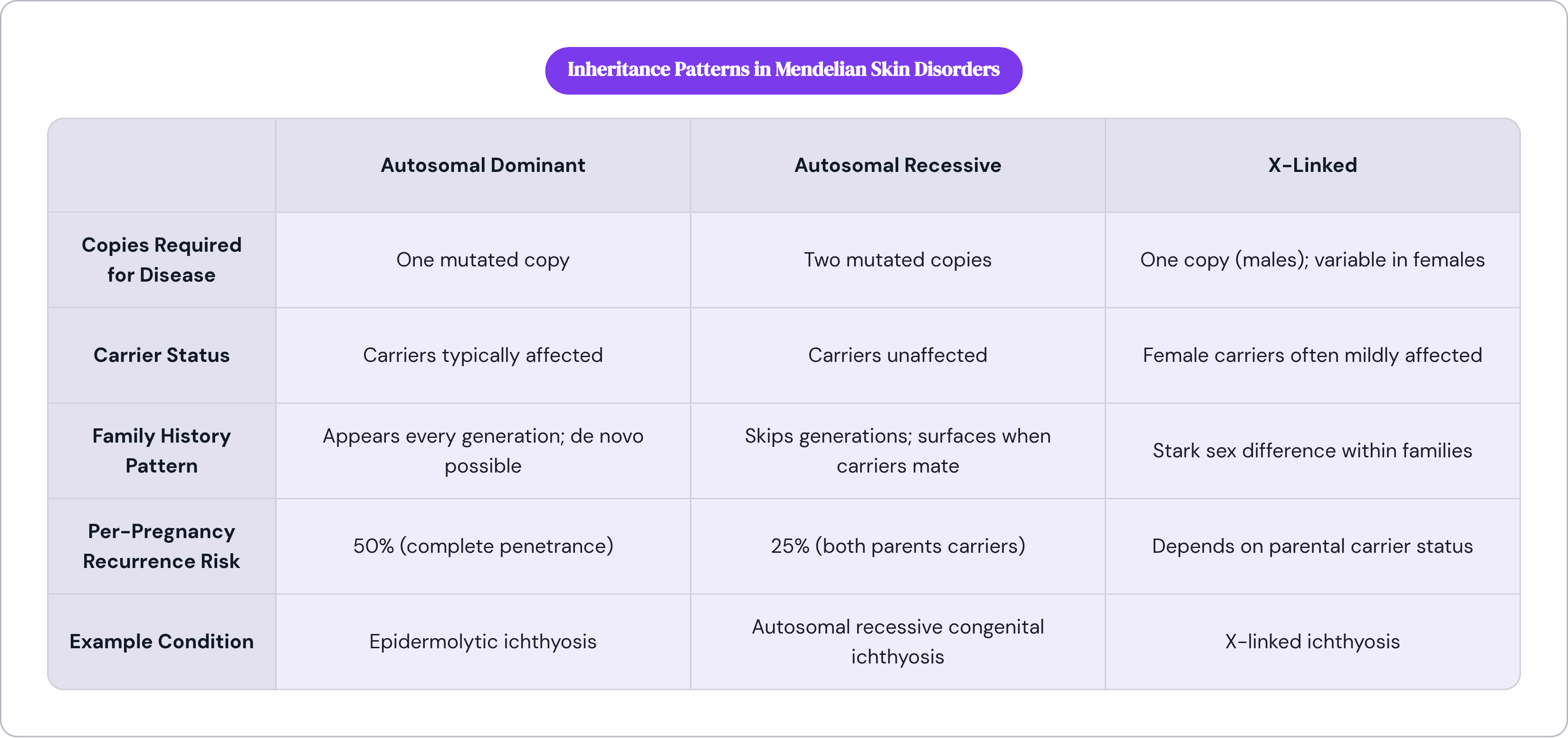
Mendelian skin disorders, those driven primarily by a single gene, fall into three main patterns: autosomal dominant, autosomal recessive, and X-linked. Each pattern carries distinct implications for who in a family is affected, how severely, and what recurrence looks like across generations. The frustrating part is that the pattern doesn't always announce itself cleanly in the family history.
Autosomal dominant conditions require only one mutated copy of a gene to produce disease, so the condition appears in every generation. But what if there's no family history at all? That's the thing that trips people up: you don't need a family history to see a dominant condition. Epidermolytic ichthyosis is the clearest example. Roughly half of all cases arise from de novo mutations, meaning the mutation wasn't present in either parent. It formed during the development of that specific egg or sperm. A child is born with a condition the parents have no history of and no reason to have anticipated.
Autosomal recessive conditions require two mutated copies, one from each parent. Carriers holding a single copy are typically unaffected, so the condition can stay invisible across multiple generations and only surface when two carriers happen to have children together. Recessive conditions are rarer and more severe than dominant ones, in part because there's no functional backup copy doing compensatory work.
X-linked conditions involve genes on the X chromosome. Males have only one X, so a single mutation produces full disease. Females have two; a mutation on one is often partially offset by the other, leaving them as carriers with mild or absent symptoms. When you see a stark clinical difference between sexes within the same family, X-linked inheritance is usually the first place to look.
Two concepts complicate this framework in ways that matter clinically: penetrance and expressivity. Penetrance is whether a mutation produces any disease at all in someone who carries it. Expressivity is how severe that disease is when it does appear. Both vary, sometimes considerably, even within the same family among people sharing an identical mutation. Environment, modifier genes, and stochastic factors all intervene. Carrying a mutation is not a guarantee of any particular outcome, and sitting with that uncertainty is part of what genetic counseling actually involves, not a deficiency in the science.
It is also worth considering a broader category: genetic polymorphisms, sequence variations that don't cause disease outright but shift traits and risks in meaningful ways. Variation in the MC1R gene associates with red hair, reduced pigmentation, and heightened UV sensitivity. Not a pathological mutation, but population-level variation with real medical relevance.
Conditions Where a Single Gene Does Most of the Work
Epidermolysis bullosa is the most instructive case in this category, not because it's the most common, but because the chain from gene to protein to structure to symptom is unusually legible. It's the kind of condition that, once you've spent time with it, clarifies how single-gene disorders work conceptually.
EB is caused by mutations in any of 16 different genes, each encoding a protein that anchors the skin's structural layers to one another. When that protein is absent or nonfunctional, the layers separate under minimal mechanical stress. Blistering and erosions form not just on the skin but on mucous membranes: the mouth, the esophagus, the eyes. More than 30 clinical subtypes exist, grouped into four main types, and which type a patient has depends not just on which gene is mutated but on which structural layer that gene's protein normally maintains.
Severity tracks with mutation type in a way that's clinically useful. Null variants, those that eliminate gene function entirely, produce the most severe phenotypes. Variants that preserve partial function allow milder disease. This is a direct expression of how much functional protein the skin has available to do its structural work.
U.S. prevalence sits at approximately eight per million, so EB is rare. But the logical structure it demonstrates generalizes to less exotic conditions.
Epidermolytic ichthyosis illustrates dominant inheritance with high penetrance. Caused by variants in KRT1 or KRT10, genes encoding keratin proteins essential to structural integrity, it presents at birth as widespread redness and blistering, then transitions over time to thickened, scaled skin. Everyone who carries the mutation develops disease. What varies is severity and distribution, not whether disease occurs at all.
Autosomal recessive congenital ichthyosis, affecting roughly one in 100,000 people, presents at birth and persists for life. Chronic inflammation and infection risk are ongoing concerns. The recessive pattern means parents are typically unaffected carriers who had no clinical reason to anticipate this diagnosis in their child.
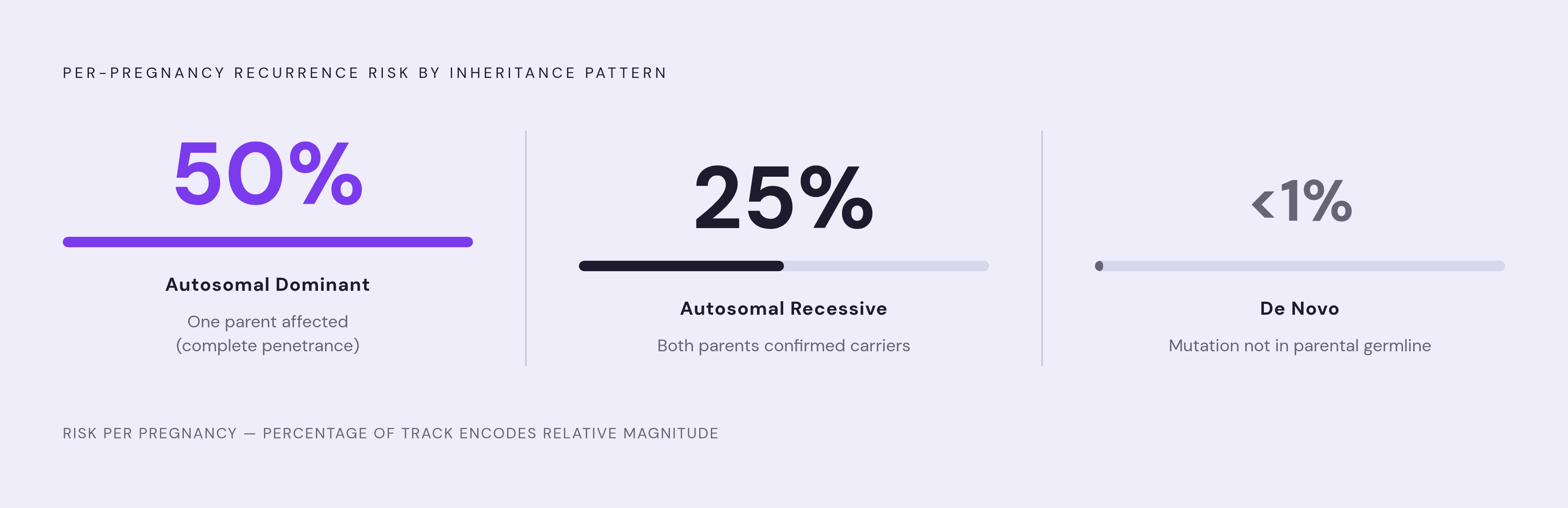
Knowing the specific gene and inheritance pattern changes recurrence-risk counseling in concrete terms. A dominant condition with complete penetrance carries a fifty percent per-pregnancy risk. A recessive condition, when both parents are confirmed carriers, carries twenty-five percent. Those numbers are meaningfully different for a family in the middle of making decisions, and delivering the wrong one has real consequences.
How Filaggrin Mutations Explain Atopic Dermatitis and Some of Its Complications
Atopic dermatitis affects somewhere between ten and twenty percent of people in industrialized countries. That prevalence alone repositions the conversation: we are not talking about a rare disorder. We are talking about one of the most common chronic diseases in the developed world, with a significant genetic component, which makes the FLG story worth understanding carefully.
The filaggrin gene encodes a protein central to building the skin barrier. Around 40 loss-of-function mutations in FLG have been identified in atopic dermatitis patients. These mutations produce a truncated profilaggrin protein that can't be cleaved into functional filaggrin, so the barrier fails to form properly, moisture escapes, and allergens and irritants penetrate more easily than they should.
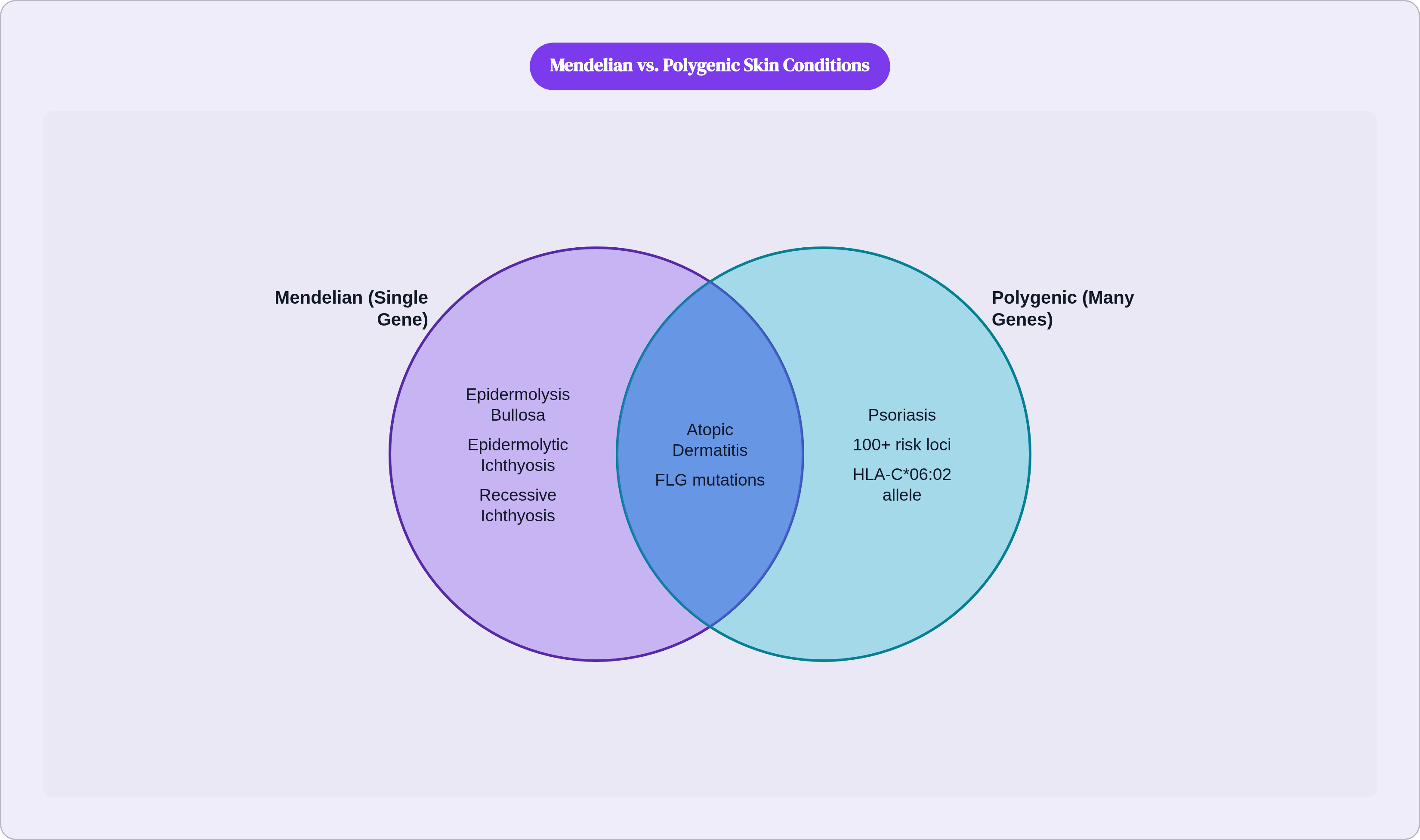
Between twenty and thirty percent of atopic dermatitis patients carry an FLG mutation, compared to somewhere between eight and ten percent of the general population. That enrichment is real. But it also means that most atopic dermatitis patients don't carry this mutation. FLG is the strongest known genetic risk factor for the condition, and it still doesn't explain the majority of cases. That gap points toward a polygenic background, risk distributed across many genes rather than concentrated in one, which shapes how we interpret family histories and communicate risk.
A 2024 meta-analysis in Experimental Dermatology found that FLG mutation prevalence in atopic dermatitis patients increases with northern latitude. One hypothesis: thinner skin barriers facilitate greater UV penetration and more efficient vitamin D synthesis in low-sunlight environments, so there was a historical fitness advantage to carrying this variant in northern populations despite its cost to barrier function. The geographic gradient is documented even if the mechanism isn't fully settled.
The most striking finding in the FLG literature is this: a maternal FLG mutation raises a child's risk of atopic dermatitis even when the child doesn't inherit the mutation. The mechanism is believed to involve the in-utero environment, specifically the role of the maternal skin barrier in immune modulation during pregnancy. That raises an important question: if the child never inherits the mutation, how exactly does maternal genetics still shape disease risk? It's the first documented instance of a maternal genetic variant influencing offspring risk for a common disease independently of transmission. That reframes something we thought we understood about how genetic risk actually propagates through families.
FLG mutations also associate with allergen sensitization, allergic rhinitis, food allergy, and asthma. When the skin fails to keep allergens out, sensitization occurs through the skin itself, and that sensitization generalizes systemically. The co-occurrence of atopic dermatitis with other atopic conditions is not coincidental; it's a mechanistic consequence of the same underlying mutation playing out across organ systems.
Conditions Where Many Genes Each Contribute a Small Amount of Risk
Psoriasis sits at the other end of the genetic architecture spectrum. Twin studies estimate heritability at between seventy and ninety percent, establishing that genes matter enormously here. Between forty and fifty percent of patients report a positive family history, and that figure climbs toward seventy-five percent in patients whose disease began before age thirty. And yet no single gene causes psoriasis.
I think this is counterintuitive the first time you encounter it. High heritability with no identifiable single culprit feels like a contradiction. It isn't. It means risk is distributed.
A 2025 genome-wide association study meta-analysis in Nature Communications, drawing on tens of thousands of cases and hundreds of thousands of controls, identified over a hundred distinct psoriasis susceptibility loci, nearly half previously unreported. The largest concentration of genetic risk sits in the major histocompatibility complex, specifically around HLA-C*06:02, an immune allele that implicates antigen presentation as a central mechanism in disease pathogenesis.
The immune pathways implicated, including the IL-23/IL-17 axis, type I interferons, and NF-κB signaling, are not theoretical constructs. They are the mechanistic targets of the biologic therapies that define modern psoriasis treatment. GWAS findings didn't just explain why psoriasis runs in families; they identified which proteins to block, which is a different kind of clinical utility than most people associate with genetic research.
Psoriasis-associated genes also show meaningful genetic correlation with ulcerative colitis, Crohn's disease, and inflammatory bowel disease. Systemic comorbidities in psoriasis patients are common not by coincidence but because they share underlying genetic architecture with the skin disease itself.
What polygenic structure means practically: no single genetic test will identify "the psoriasis gene," because no such gene exists. Risk is distributed across hundreds of variants. Environment modulates expression. Severity varies even among relatives who share many of the same risk alleles. The same logic applies to vitiligo, where the prevalence gradient between the general population, siblings of affected individuals, and identical twins tells a clear story about strong genetic contribution combined with incomplete penetrance.
What Next-Generation Sequencing Changed About Diagnosing Inherited Skin Conditions
Because most disease-causing mutations in Mendelian skin disorders occur in protein-coding regions of the genome, whole exome sequencing has become the primary diagnostic tool for conditions with unusual or atypical presentations. Reading every protein-coding sequence simultaneously changed what was clinically achievable, and the change was not incremental.
Before NGS, diagnosis depended on matching clinical features to known patterns, a process that was slow, expert-dependent, and prone to failure in rare or overlapping conditions. Somatic mosaic mutations in IDH1 and IDH2 were identified in Maffucci syndrome through sequencing. Germline mutations in CHST8 were found in autosomal recessive peeling skin syndrome. A clinician looking at the skin could not have arrived at either of those findings through clinical examination alone.
A 2025 study of patients with suspected genodermatoses found that neurofibromatosis type 1, epidermolysis bullosa, ichthyosis, and oculocutaneous albinism were among the most common diagnoses reached through molecular workup. The mix reflects the reality of referral-based practice: presentations are varied, overlapping, and rarely cooperative with narrow diagnostic frameworks.
Precise diagnosis matters downstream in ways that extend well beyond naming a condition. It determines the inheritance pattern for counseling, the recurrence risk for family members, and, increasingly, the eligibility for gene therapies that are specific to a single causal gene.
One risk in this pipeline gets less attention than it deserves. A variant of uncertain significance, something identified in a relevant gene but not yet established as disease-causing, can be communicated as a diagnosis when it isn't one. This happens. The clinical utility of sequencing depends entirely on the genetic literacy of whoever is interpreting the results and communicating them to patients. Without that interpretive layer, a laboratory finding can cause harm rather than clarity, and that failure mode is worth taking seriously.
How the First Approved Skin Gene Therapy Works, and What It Signals About the Field
In April 2025, the FDA approved Zevaskyn, the first autologous cell-based gene therapy for recessive dystrophic epidermolysis bullosa. The condition is caused by mutations in COL7A1, encoding collagen VII, the protein that anchors the epidermis to the dermis. Without it, the layers separate under ordinary friction.
To understand why this works, we must first look at the underlying logic of the approach. Clinicians harvest the patient's own skin cells, correct the COL7A1 gene in those cells using gene therapy vectors, culture the corrected cells into large sheets, then apply those sheets surgically to wound sites. One-time treatment rather than lifelong systemic therapy.
Long-term data showed that seventy percent of patients achieved at least fifty percent wound healing five years after transplant, with significant pain reduction. The durability is the more important number. An acute response that degrades over time produces a very different risk-benefit calculation than one that holds across years, and five-year data showing maintained wound closure is not what most people expected from a gene therapy in its early iterations.
Skin is a tractable target for gene therapy for reasons that aren't immediately obvious. Biopsy is a minor procedure. You can see whether wounds are closing. Cell turnover is rapid, which facilitates engraftment of corrected cells. Localized treatment limits systemic exposure and reduces off-target risk. These advantages aren't trivial when you're asking regulators and patients to accept a novel therapeutic modality.
A parallel development from 2025, pre-clinical and moving toward first-in-human trials, takes a different approach entirely: using a laser to create microscopic openings in the skin, then delivering gene-editing machinery via lipid nanoparticles to reach skin stem cells in situ. In human skin models for the most common autosomal recessive congenital ichthyosis mutation, this approach restored up to thirty percent of normal function. Thirty percent isn't a cure. But it's proof that non-surgical delivery of gene-editing machinery to skin stem cells is physically achievable, which was not obvious before these results.
Neither Zevaskyn nor the topical approach would be possible without knowing precisely which gene is mutated. A therapy that corrects COL7A1 is useless in a patient whose disease stems from a different gene entirely. Precise molecular diagnosis isn't preliminary paperwork before treatment begins; it's a prerequisite for treatment to be possible at all.
What Knowing the Genetic Pattern Means for a Person Managing an Inherited Skin Condition
Inheritance pattern shapes family planning conversations in concrete terms. Autosomal dominant conditions with complete penetrance carry a fifty percent per-pregnancy risk. Autosomal recessive conditions, when both parents are confirmed carriers, carry twenty-five percent. De novo mutations change the calculus again, since the mutation isn't present in either parent's germline, generally reducing recurrence risk for future pregnancies. These are not abstract statistics; they're the numbers people carry with them when they're deciding whether and how to have children.
Severity prediction remains imperfect, and that's worth being honest about. Two relatives carrying the same mutation can have meaningfully different disease courses, because penetrance and expressivity are real variables rather than statistical noise. A patient who learns they carry the same variant as an affected relative cannot assume they'll experience the same degree of disease. Some people find this uncertainty frustrating; it can feel like the genetic information stopped short of actually answering the question. But that uncertainty reflects something true about how disease actually works, and calibrating expectations to reality is more useful than calibrating them to a false precision.
For common polygenic conditions like psoriasis and atopic dermatitis, genetic risk is probabilistic rather than deterministic. Family history raises prior probability. Most people with a family history will not develop severe disease. Genetic information doesn't eliminate uncertainty here; it refines it, which serves a different purpose than ruling things in or out.
The systemic implications of genetic skin conditions are regularly underappreciated, sometimes by patients and sometimes by clinicians working within narrow specialty contexts. FLG mutations link to asthma and allergic disease through a shared barrier mechanism. Psoriasis genetics correlate with inflammatory bowel disease through shared immune pathways. But how does this affect our original promise of genetic clarity improving patient outcomes? A patient who understands the genetic background of their skin condition is better positioned to make sense of comorbidities that would otherwise seem unrelated, and to pursue appropriate monitoring before those comorbidities become symptomatic, rather than after. That connection only becomes visible when the genetic picture is legible in the first place.
Genetic clarity also informs treatment selection in ways that are becoming increasingly practical. Psoriasis genetics already show some predictive value for biologic response. That's not routine clinical practice yet. But the trajectory is toward genetic understanding shaping individual treatment decisions rather than just population-level research findings, and that shift is already underway in ways that will be ordinary practice within a decade.