How the Skin Microbiome Affects Skin Health
Trillions of skin bacteria actively maintain your barrier, fight pathogens, and prevent disease.

You've probably heard this version of the story: the skin is a barrier, full stop. Keep it clean, keep it moisturized, don't pick at it. What that version leaves out is the several million microbial residents already doing the actual work. Bacteria, fungi, archaea, viruses. Not a sign of poor hygiene, not a problem to be solved. A population. And like any population, what it does, and what happens when it falls apart, depends enormously on who's in the room.
The skin is not uniform territory. Sebaceous (oil-producing) areas, the kind that cluster around the face and upper chest, favor lipid-loving organisms like Cutibacterium and Malassezia yeast. Moist folds and eccrine-rich (sweat-gland-dense) zones lean toward Staphylococcus. Dry patches host their own distinct communities. One study of the facial microbiome alone identified roughly a thousand genera. A thousand. The density in areas like the armpit can reach tens of millions of aerobic cells per square centimeter. This is not background noise. This is an active, site-specific, compositionally complex ecosystem, and its makeup directly determines what comes next for your skin.
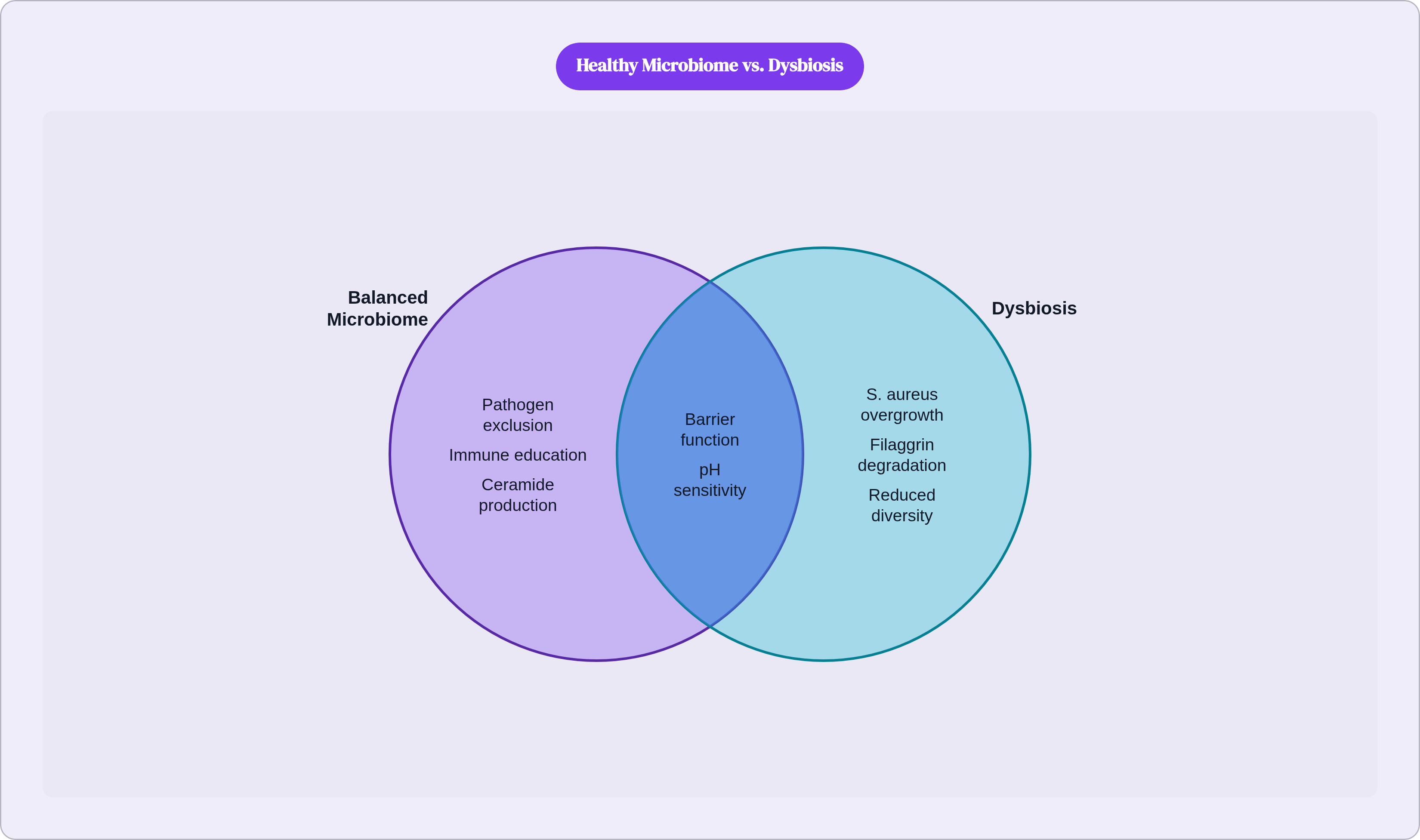
What a balanced microbiome actively does for the skin
Let's start with what a healthy community is actually doing, because the phrase "balanced microbiome" can sound like wellness marketing if you don't get specific.
Three jobs. First, pathogen exclusion. Commensal organisms, the bacteria that naturally live on your skin without harming you, compete for colonization sites and nutrients, which means opportunistic invaders simply have less room and fewer resources. This isn't a sophisticated defense mechanism; it's competitive ecology operating in your favor.
Second, immune education. The immune system doesn't arrive at the skin pre-calibrated. Commensal bacteria train both innate and adaptive immune cells, teaching them to tolerate beneficial microbes and stay appropriately alert to actual threats. Disrupt that training environment and you compromise both functions simultaneously.
Third, barrier maintenance. This is where it gets granular. Staphylococcus epidermidis, one of the skin's most abundant commensals, secretes lipopeptides that strengthen the connections between keratinocytes (the cells that make up most of your outer skin layer) and support barrier repair when damage occurs. Its sphingomyelinase activity also facilitates the host's own production of ceramides, which are structural lipids essential to a functioning barrier. The microbiome isn't just living on the barrier. It's helping construct and maintain it.
Wound healing follows the same logic. Your skin microbiota participates across all four phases of repair: hemostasis (clotting), inflammation, proliferation, and remodeling. The causal direction here matters. A healthy microbial composition enables these protective functions. Disruption doesn't just remove the benefit; it degrades the function itself.
To be clear, your microbiome is not a therapeutic agent. It doesn't cure conditions. Its role is modulatory and supportive, which is precisely why understanding it matters for prevention and management rather than treatment.
What dysbiosis means and how it differs from normal variation
The word dysbiosis gets used loosely, so it's worth being precise. We're talking about a reduction in microbial diversity, meaningful shifts in species proportions, and the proliferation of pathogenic or opportunistic organisms. That's different from natural variation. Every person's skin microbiome is shaped by age, sex, genetics, climate, hygiene habits, and local environment. Different is not automatically dysfunctional.
Dysbiosis is a departure from functional balance, not just a departure from someone else's profile.
A 2025 review in the Journal of Clinical Medicine found that most skin conditions, acne being the notable exception, are associated with decreased microbiome diversity in diseased skin. More diversity generally correlates with resilience. Less diversity means the community has lost some of its functional redundancy, the capacity to absorb disruption without tipping into a state that amplifies symptoms.
The acne exception deserves a pause, because it complicates the simple narrative. Acne doesn't follow the same pattern. Its connection to the microbiome is more about disrupted microbial ecology than about any one organism dominating. The disruption is subtler, and we'll come back to it.
What genomic sequencing has started to reveal is that lesional skin can be distinguished from healthy skin by its microbial signature alone. That has diagnostic implications worth watching. For now, the foundational point is that dysbiosis has identifiable causes, both internal (stress, hormones, aging, genetics) and external (skincare ingredients, antibiotics, UV exposure, pollution), and that the tipping points are real, even if they vary between individuals.
How S. aureus overgrowth drives atopic dermatitis flares
Atopic dermatitis affects over 20% of children and roughly 10% of adults worldwide. Between 1990 and 2019, its global prevalence rose 28.6%, according to Global Burden of Disease data. Those numbers establish scale. The microbiome data explains mechanism.
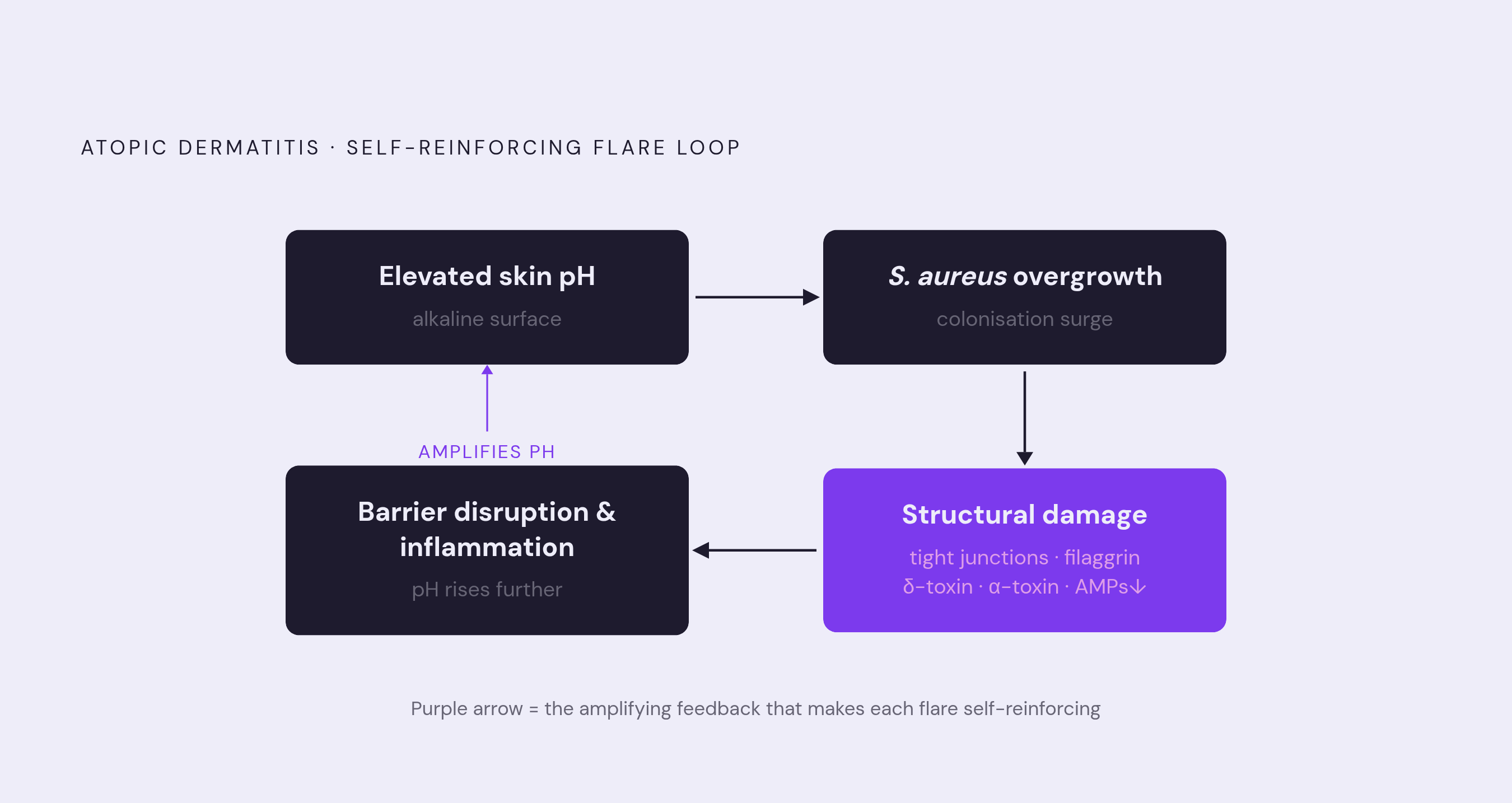
The defining microbial signature of atopic dermatitis is reduced diversity in lesional skin alongside overgrowth of Staphylococcus aureus. And S. aureus doesn't just colonize passively. It does specific structural damage. It compromises the tight junctions between keratinocytes, degrades filaggrin (a barrier protein critical to maintaining the skin's protective matrix), induces keratinocyte apoptosis, and suppresses the skin's own antimicrobial peptides through toxins including δ-toxin and α-toxin.
Then there's the pH feedback loop. Elevated skin pH in atopic dermatitis creates a microenvironment that actively favors S. aureus proliferation. The bacterium is not just a consequence of the disrupted barrier; it's an amplifier of it. That bidirectional relationship is what makes atopic dermatitis so difficult to break once a flare is established.
It's also worth noting that S. aureus strains found in atopic dermatitis differ genomically from those found in healthy individuals, carrying different virulence factors, adhesion proteins, and pro-inflammatory molecules. This helps explain why S. aureus exposure doesn't produce the same outcomes in everyone. The organism matters, but so does which version of the organism is present.
In atopic dermatitis, the microbiome shift precedes and amplifies symptoms. It's not just accompanying the disease; it's participating in its escalation.
How psoriasis and acne reflect different patterns of microbial disruption
Psoriasis affects roughly 3% of people globally. In psoriatic skin, research documents significant decreases in both alpha-diversity (the variety within a single sample) and beta-diversity (the variation between samples). Staphylococcus is more prevalent in diseased psoriatic skin; Kocuria and Cutibacterium are more abundant in healthy controls. That's a directionally opposite pattern from a balanced community, and it's distinct from the S. aureus-dominated picture in atopic dermatitis.
Acne is a more instructive counterexample. Here, Cutibacterium acnes and other anaerobic bacteria in the pilosebaceous unit (the hair follicle and its attached oil gland) are implicated, but the mechanism is ecological disruption, not straightforward overgrowth. Microbial diversity in acne doesn't necessarily decrease the way it does in most other inflammatory skin conditions. The disruption is more about community composition and the local microenvironment of the follicle than about one organism flooding the zone.
That distinction actually clarifies something useful. Dysbiosis is not a monolith. What it looks like in psoriasis is different from what it looks like in atopic dermatitis, which is different from what it looks like in acne. The research has also linked dysbiosis to vitiligo, alopecia, and certain skin cancers, extending the conversation well beyond the most familiar inflammatory conditions.
The specific organisms and diversity patterns matter. Lumping all microbial disruption into a single category obscures the mechanisms and, eventually, the interventions.
How the skin microbiome shifts across a lifetime
Two organisms tell the aging story with unusual clarity.
Cutibacterium acnes, the same bacterium associated with adolescent acne, actually declines with age. Its presence is associated with delayed aging because it maintains barrier integrity through lipid hydrolysis and skin acidification. When Cutibacterium retreats, you lose a functional contributor to the acidic, lipid-rich environment that supports a healthy microbiome.
Meanwhile, Moraxella osloensis expands. A 2026 study in The EMBO Journal identified it as a microbial marker of premature aging and linked it experimentally to collagen catabolism and cellular senescence. That's a meaningful finding: an organism associated not just with the presence of aging skin, but with an active biological mechanism driving it.
More broadly, aging is associated with reduced microbial diversity and increased temporal instability of the skin microbiota. Coagulase-negative staphylococci and other pathobionts, microbes that can become harmful under certain conditions, expand as Cutibacterium and Lactobacillus deplete. The community-level shift is toward a less protective profile.
The physical changes in aging skin, reduced sebum, lower hydration, increased transepidermal water loss (moisture escaping through the skin), elevated pH, flattening of the dermo-epidermal junction, alter the habitat itself. Those structural changes compound the microbial shift. UV exposure, pollution, and harsh skincare products layer on top, and can hasten the same microbial changes seen in chronologically older skin, even in younger individuals with significant environmental exposure.
It's also worth flagging, briefly, that persistent dysbiosis has been associated with anxiety and depression. The downstream consequences extend beyond the skin's surface, which isn't surprising given how closely the skin and nervous system interact during development, but it reframes the stakes.
What disrupts microbial balance and what the research says about protecting it
The list of external disruptors is probably longer than you'd expect. UV radiation, air pollution, harsh surfactants, certain preservatives, antimicrobial ingredients like triclosan and benzalkonium chloride (both documented to reduce beneficial bacterial abundance), and antibiotic use. Each of these has a research basis; none of them is hypothetical.
pH is one of the most concrete levers available. A slightly acidic skin pH between 4.5 and 5.5 supports beneficial microbial communities. More alkaline conditions favor dysbiosis. That's directly relevant to product selection and cleansing habits, because many conventional soaps and cleansers skew alkaline. The implication isn't to never wash your face; it's to pay attention to what you're washing it with.
On the internal side, stress activates the HPA axis (the body's central stress-response system), elevating cortisol. Chronic dysregulation of that pathway can promote systemic inflammation and exacerbate psoriasis, eczema, and acne. Hormonal fluctuations and genetic predisposition shape the baseline microbial environment as well, which is why two people can use identical products and have dramatically different outcomes.
Diet, clothing type, hygiene frequency, and local environment all appear in the research as contributing factors. The evidence base for each varies in rigor, and overstating it doesn't serve anyone, but directionally, they're real variables.
Chronic or repeated antibiotic exposure deserves particular attention. It can produce persistent dysbiosis, compromise barrier integrity, and trigger lasting inflammatory responses. The short-term rationale for antibiotic treatment of skin conditions often makes clinical sense; the long-term microbial cost is something the field is increasingly tracking.
The research direction here is worth sitting with. If researchers can identify which inputs shift microbial balance, it opens the possibility of more targeted interventions, ones that address the microbial conditions underlying your symptoms rather than the symptoms alone. That's a different orientation than most conventional skincare or dermatology has historically taken, but the data is accumulating in that direction.
The skin microbiome is active, not passive. The organisms on your skin are doing things, competing for space, training your immune system, maintaining your barrier, shifting across decades and in response to what you put on your skin and how you live. The factors that shape those communities are consequential, not just cosmetically, but for the immune and barrier functions that determine how your skin behaves when it's under pressure. That's the part of the story worth understanding.