Melanoma Prevention Strategies With Evidence Ratings
Research reveals which melanoma prevention tactics actually work versus sound intuitive.

Melanoma prevention has no shortage of advice. What it lacks is an honest accounting of which pieces of that advice actually hold up under clinical scrutiny, and which ones are repeated because they sound reasonable rather than because the evidence supports them. This piece sorts the major prevention strategies, from sun avoidance to clinical screening, by the strength of the research behind each one.
Why melanoma incidence keeps rising
Melanoma makes up fewer than 5% of all skin cancer diagnoses, yet it accounts for most skin cancer deaths. That mismatch between how often it occurs and how often it kills is the reason prevention carries such weight here: a cancer this lethal, driven largely by a single modifiable exposure, is exactly the kind of disease where getting prevention right should move the numbers.
So has it? The NSW Skin Cancer Prevention Strategy 2016–2022 found melanoma remained the third most common cancer in New South Wales across two consecutive five-year periods, with overall incidence rates unchanged over the decade. That finding matters because it came during a period of sustained public education, not an absence of effort. Awareness, on its own, did not bend the curve.
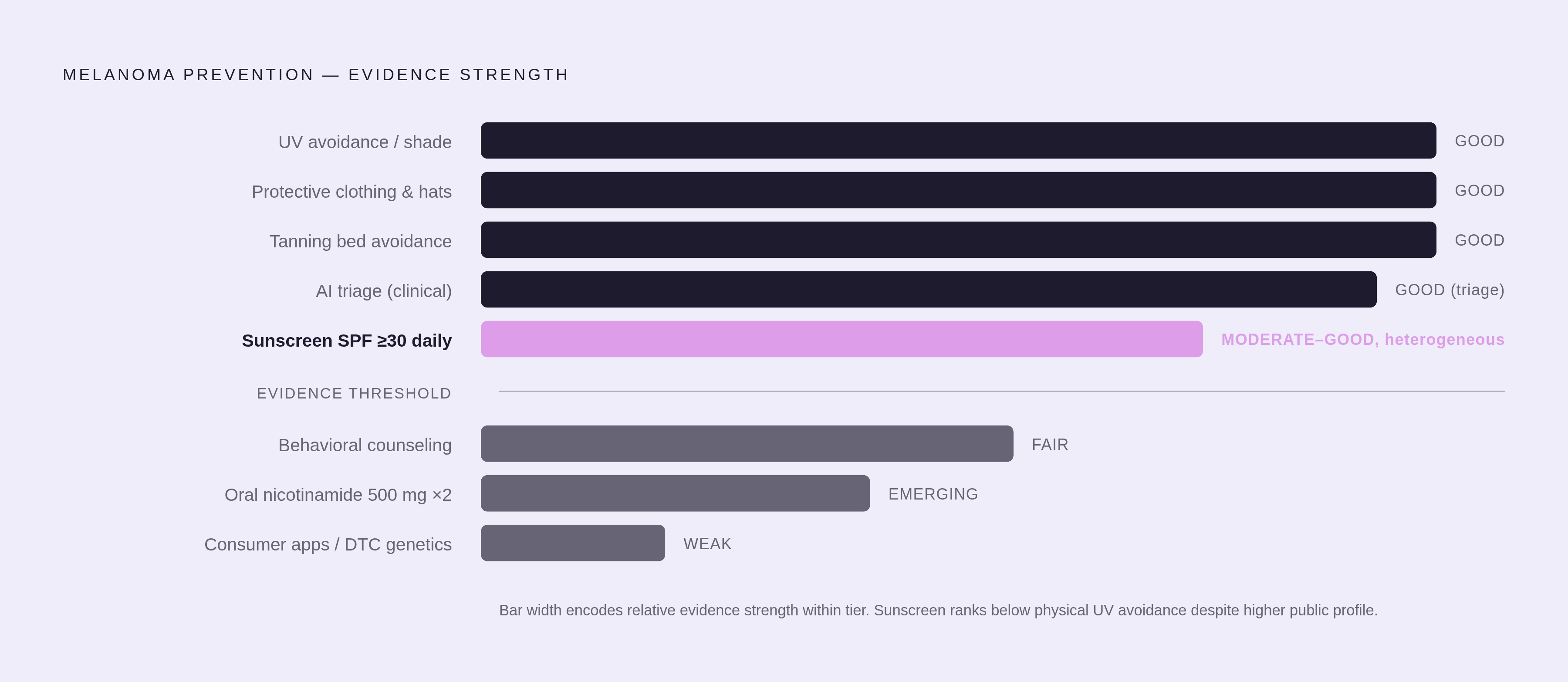
Part of the explanation sits in the biology. Melanocytes, the pigment-producing cells in the lower layer of the epidermis, absorb ultraviolet radiation through melanin, but that absorption isn't complete. DNA damage accumulates underneath the surface, repeated exposure compounds it, and by the time a visible lesion appears, the cellular path toward malignancy was often set years earlier. The rise shows up fastest in men over 40 and in populations that adopted fewer sun-protective habits as adolescents, because the exposure driving today's diagnoses often happened decades ago. Daily broad-spectrum sunscreen (SPF ≥30) has moderate-to-good evidence for melanoma prevention, but the evidence is more heterogeneous than for UV avoidance strategies, and the distinction matters for high-risk individuals deciding where to focus effort. Knowing which strategies are actually backed by evidence now matters, rather than waiting to find out the hard way later.
UV exposure as the modifiable cause
Melanoma prevention strategies trace back to one variable: ultraviolet exposure. The large majority of melanomas are attributed to ultraviolet radiation exposure, though this relationship is less clearly established for melanoma than for other skin cancers, and the type of exposure that matters most for melanoma differs from what drives other skin cancers. That caveat isn't a minor technicality. It shapes which prevention strategies deserve the strongest confidence and which ones are built on a shakier evidentiary floor.
The NCI rates the connection between intermittent, acute sun exposure that leads to sunburn and elevated melanoma risk as "fair evidence". Fair evidence isn't the strongest category, but it points to something specific. Melanoma risk seems to track more closely with sudden, intense exposure than with total cumulative dose over a lifetime. That's a different risk profile than the one driving basal cell or squamous cell carcinoma, where lifetime sun exposure is the clearer culprit. A single bad sunburn may matter more for melanoma risk than years of moderate exposure that never burns.
A review in the journal Cancers (Basel) backs this framing, confirming UV radiation as the primary driver of melanoma while also noting that genetic phenotype interacts with sun exposure. Fair skin, light hair, and light eyes raise baseline risk, but none of that changes what's modifiable. Genetics set the starting line, not the finish. UV exposure remains the lever available to everyone. People with higher genetic risk stand to gain the most from the interventions with the best evidence behind them.
Strategies with strong evidence: UV avoidance, protective clothing, and indoor tanning bans
Removing or blocking UV exposure directly carries the strongest combined evidence base of any melanoma prevention category. Three approaches fall under this umbrella, and they work best understood as one strategy with three expressions rather than three separate recommendations.
The first is behavioral: reducing time outdoors during peak UV hours and seeking shade. This is rated as good evidence, observational in nature, and it's one of the more consistently supported prevention behaviors in the literature, whether the UV source is the sun or a tanning bed.
The second is physical. Clothing made from UV-protective fabric, wide-brim hats, and UV-protective sunglasses carry a good evidence rating, and the NCCN Guidelines for Patients: Melanoma (Version 1.2026, dated February 17, 2026) list these as first-line prevention recommendations. Physical barriers have a practical advantage that behavioral strategies don't: they don't depend on remembering to reapply or checking coverage throughout the day. A UV-protective shirt protects the same at 2 p.m. as it did at 10 a.m., with no maintenance required. Anyone trying to build a prevention routine that survives a busy day should weigh that consistency heavily.
The third is tanning bed avoidance, also rated good evidence and observational. Tanning beds deliver concentrated UV doses in a short window, which makes them a direct and fully controllable risk. Policy bans restricting minors from using them extend that evidence into regulation, treating a known risk as a public health matter rather than leaving it to individual choice alone.
Taken together, these three strategies share a logic: reduce or block the UV dose itself. That's the most direct way to intervene on the one variable every strategy in this article has to contend with.
Sunscreen's evidence and its coverage limits
Sunscreen is usually the first thing people mention when asked how to prevent melanoma. The evidence supports its use, but with more nuance than the conventional wisdom suggests. Daily broad-spectrum sunscreen with SPF 30 or higher carries a moderate-to-good evidence rating, yet that evidence is considerably more mixed than what backs UV avoidance strategies.
A long-term randomized trial following daily sunscreen users over ten years found a reduction in melanoma incidence that was only borderline significant overall, though the reduction specifically in invasive melanomas was larger. The melanoma evidence base, taken as a whole, stays heterogeneous across studies. That inconsistency has a plausible explanation rooted in the UV mechanism already discussed: daily sunscreen is most effective at reducing cumulative dose, and cumulative dose matters more for keratinocyte cancers like basal and squamous cell carcinoma than it does for melanoma. Melanoma tracks more closely with acute, episodic exposure, the kind that causes sunburn. Daily sunscreen helps, but avoiding a severe sunburn even once may do more for melanoma risk specifically than consistent reapplication over years.
Melanoma accounts for most skin cancer–related deaths despite representing fewer than 5% of all skin cancer cases, and it describes the sunscreen evidence for melanoma as lower in both consistency and external validity compared to the evidence for keratinocyte cancers. Sunscreen remains a necessary part of prevention. It performs best layered alongside shade-seeking and protective clothing.
Oral nicotinamide for high-risk patients: emerging evidence
Oral nicotinamide, taken at 500 mg twice daily, has moved from an early hypothesis into a genuine secondary prevention option for people with a history of skin cancer, and a newer signal suggests it may extend to melanoma specifically. This one is less familiar to most readers than sunscreen or shade-seeking, and the evidence is still developing, so it deserves to be understood as a distinct category rather than folded in with established daily habits.
The strongest data comes from non-melanoma skin cancer reduction. A large retrospective study published in JAMA Dermatology in 2025, drawing on Veterans Affairs data from the VA Corporate Data Warehouse, found a meaningful reduction in overall skin cancer risk among patients taking nicotinamide 500 mg twice daily beyond a short initial period. The corresponding author is affiliated with the Tennessee Valley Healthcare System. The effect was substantially larger among patients who started nicotinamide after already being diagnosed with a first skin cancer, which points toward its clearest use case: people who've already had one skin cancer and are trying to prevent the next.
The melanoma-specific signal comes from a study presented at the American Academy of Dermatology's Annual Meeting, which won a first-prize poster award. It found that nicotinamide could help with primary melanoma prevention among patients who'd previously had a non-melanoma skin cancer. At 500 mg twice daily, the effect reached statistical significance for invasive melanoma, though not for melanoma in situ, and it held consistent across both sun-exposed and sun-protected areas of the body.
Is this enough to recommend nicotinamide the way sunscreen or shade-seeking gets recommended? Not quite yet. The melanoma finding hasn't come from a prospective randomized trial built specifically to test it. But the VA dataset behind the non-melanoma finding is large, and the AAD result points in the same direction. For high-risk patients who've already had a skin cancer, there's a reasonable case for weighing this emerging evidence alongside nicotinamide's well-established non-melanoma track record, particularly given how accessible, affordable, and well-tolerated it is.
Behavioral counseling and education: real effects on knowledge, limited effects on outcomes
Counseling patients on sun protection and educating the public about melanoma risk clearly changes what people know. Whether it changes what actually happens to melanoma incidence is a separate question, and the evidence rating reflects that gap. The Cancers (Basel) review identified eight studies focused on behavioral counseling and education alone, with additional studies layering in technology, online tools, and mobile apps, and it rated the overall evidence as fair. That volume of research signals genuine interest in the approach. It doesn't signal consistent effectiveness against clinical endpoints.
A systematic review of high school melanoma prevention curricula found that school-based programs can shift attitudes and knowledge among adolescents, a group that already shows lower adoption of protective behaviors. But the review stopped short of establishing whether those shifts hold up over time or translate into fewer melanoma cases down the road. The NSW experience from earlier in this article reinforces the same ceiling: a decade-long strategy that included extensive public education still left overall incidence unchanged.
Why the gap? Knowing something and acting on it in the moment aren't the same thing. Sun exposure decisions happen at the beach, on a job site, at a weekend sports game, settings where knowledge has to compete with immediate comfort, convenience, and social norms. None of that makes education worthless. These programs build the foundation that other, higher-evidence strategies depend on. Someone who's never been taught why sunburn matters is unlikely to reach for a wide-brim hat on their own. Education sets up the behaviors that avoidance, clothing, and sunscreen then have to carry across the finish line.
Digital tools and consumer apps: where evidence is weakest
Consumer-facing tools, mobile apps marketed for skin self-checks, direct-to-consumer genetic testing for melanoma risk, are at the bottom of this evidence hierarchy. The Cancers (Basel) review rates this category as weak, stating explicitly that the effectiveness of mobile applications and direct-to-consumer genetic testing for primary prevention is questionable, with limited evidence on actual benefit or cost-effectiveness.
Part of the reason is technical, and it comes down to image quality. Clinical accuracy for skin lesion images captured on smartphone cameras runs meaningfully below what dermoscopic images achieve in clinical settings. Dermoscopy uses specialized, magnified imaging designed for lesion assessment, and a phone camera simply isn't built for that task. On top of that, only about half of patient-submitted photos meet the standard needed for reliable assessment, so the limitation is the input the algorithm has to work with, not just the algorithm behind the app. No amount of software sophistication fixes a blurry, poorly lit photo taken in a bathroom mirror.
The real risk is what happens after a reassuring result. A low-validity tool that tells someone a lesion looks fine may be enough to delay the clinical visit that would have caught something early. That delay, layered onto a disease where early detection changes outcomes substantially, is the actual cost of weak evidence in this category.
Clinically deployed AI triage: what it can and cannot do
Consumer apps and clinically deployed AI often get lumped together in public conversation, but they don't belong in the same evidence category. The underlying image-recognition technology may be similar. The oversight structure around it is not, and that difference is what separates a weak-evidence consumer tool from a good-evidence clinical one.
When AI systems are deployed inside a clinical workflow, with trained staff involved and clear protocols for what happens next, the evidence looks considerably stronger. Top-performing systems match or exceed the average dermatologist's sensitivity for melanoma detection when used in a triage role. That's rated as good evidence for triage specifically, with the clear caveat that it's limited for stand-alone diagnosis: these tools still cannot replace a biopsy, clinical judgment, or the broader context a trained clinician brings to an exam.
Two deployed systems illustrate how this works in practice. DERM, developed by Skin Analytics, received a conditional recommendation from NICE in May 2025 for use in the NHS over a 3-year period. It reached that status after demonstrating high sensitivity for detecting cancerous lesions and a strong negative predictive value for melanoma, assessed across a large patient population between April 2020 and November 2023. NICE's approval doesn't hand the system a blank check: it specifically defines when an autonomous decision is permitted and when a clinician has to step in.
In May 2025, NICE issued a conditional recommendation for NHS use of DERM (Skin Analytics).
A 2025 umbrella review covering 11 separate meta-analyses confirmed high diagnostic accuracy for AI tools across this category, but it stopped short of examining equity in training data, how ready these systems are for real-world implementation, or whether performance holds steady across different stages of clinical screening. That gap matters, because performance isn't evenly distributed. These systems show inconsistent accuracy across different skin tones and underrepresented populations, and common non-melanoma skin cancers remain understudied in the datasets used to train them.
What ties the strongest examples together is the oversight model built around the algorithm. NICE's framework for DERM, specifying precisely when a system can act alone and when it can't, represents where clinical AI regulation is heading. A clinically supervised AI tool, built into a workflow with defined boundaries, is a fundamentally different proposition from a self-screening app downloaded onto a phone with no clinician in the loop at all.
How teledermatology extends clinical reach
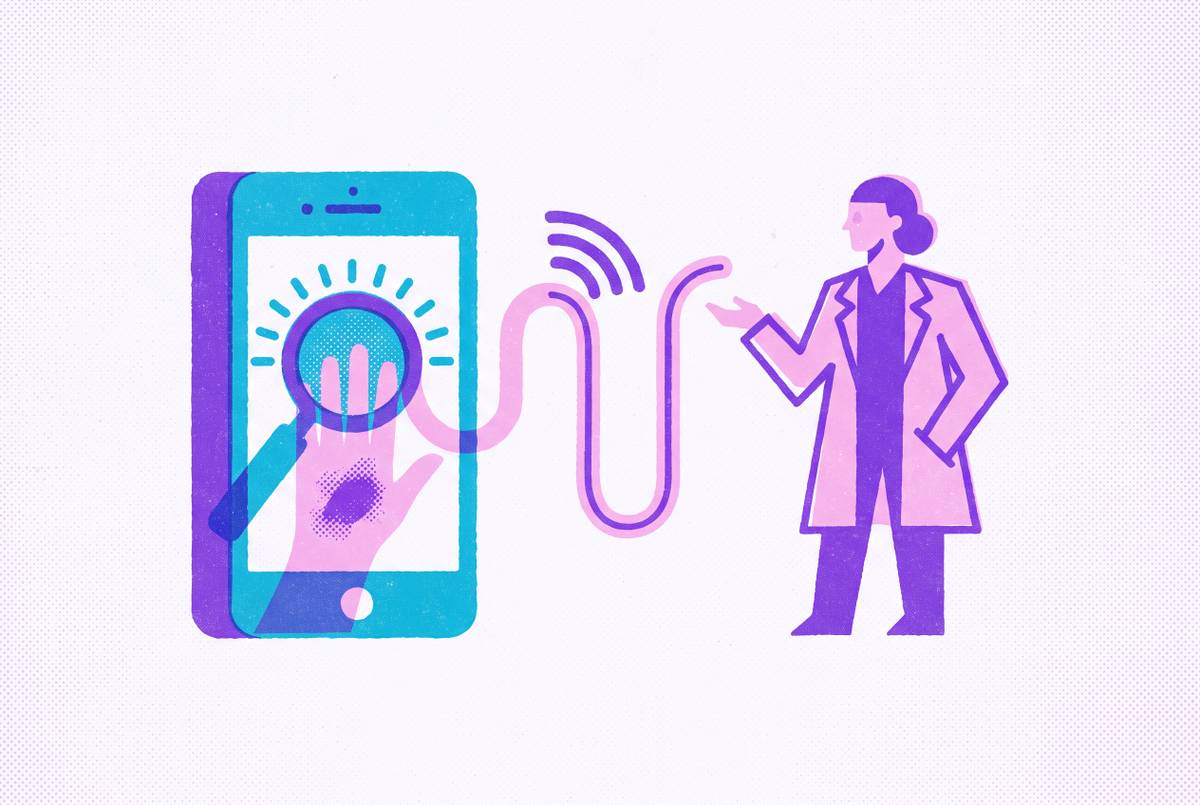
Teledermatology sits in a different spot in this chain than either consumer apps or AI triage tools. It's a delivery mechanism, a way of connecting a patient to an actual dermatologist without requiring an in-person visit as the first step. That distinction matters for where it belongs in a prevention strategy.
The weakness identified in consumer apps, unreliable smartphone image quality and the risk that a reassuring automated result delays real care, points toward what teledermatology is positioned to fix. A photo captured for a teledermatology consult still faces the same image-quality ceiling as a photo captured for a consumer app. What happens to that photo next determines the outcome. Instead of an algorithm delivering a static verdict, a clinician reviews it, asks follow-up questions, and makes a judgment call about whether an in-person exam or biopsy is warranted. That's a meaningfully different safety net than an app with no clinician attached.
Where does that leave teledermatology relative to the AI triage systems described above? The two aren't competitors so much as complements. A triage system can be built into a workflow where a remote or in-person clinician still makes the final call. Teledermatology extends how far that clinical judgment can reach, into rural areas, into schedules that can't accommodate an in-office visit, into situations where the first available dermatology appointment is months away. It doesn't replace the strategies with the strongest evidence, avoiding UV exposure, wearing protective clothing, staying out of tanning beds. It extends the reach of the clinical system that catches what those strategies miss, giving more patients access to the kind of professional judgment that no app, consumer or clinical, is designed to replace on its own.
Sources
- Skin Cancer Prevention (PDQ®) - NCI
- A Systematic Review of Evidence-Based High School Melanoma Prevention Curricula
- Effectiveness of cross‐sector collaboration in strategy implementation and impact: Evaluation of the NSW Skin Cancer Prevention Strategy 2016–2022
- 2026 Melanoma Presented with support from FOUNDATION
- Etiologies of Melanoma Development and Prevention Measures: A Review of the Current Evidence
- Primary prevention strategies for melanoma - Portuguese Journal of Dermatology and Venereology
- How is Artificial Intelligence Transforming the Skin Cancer Screening Pathway? An Umbrella Review - PMC