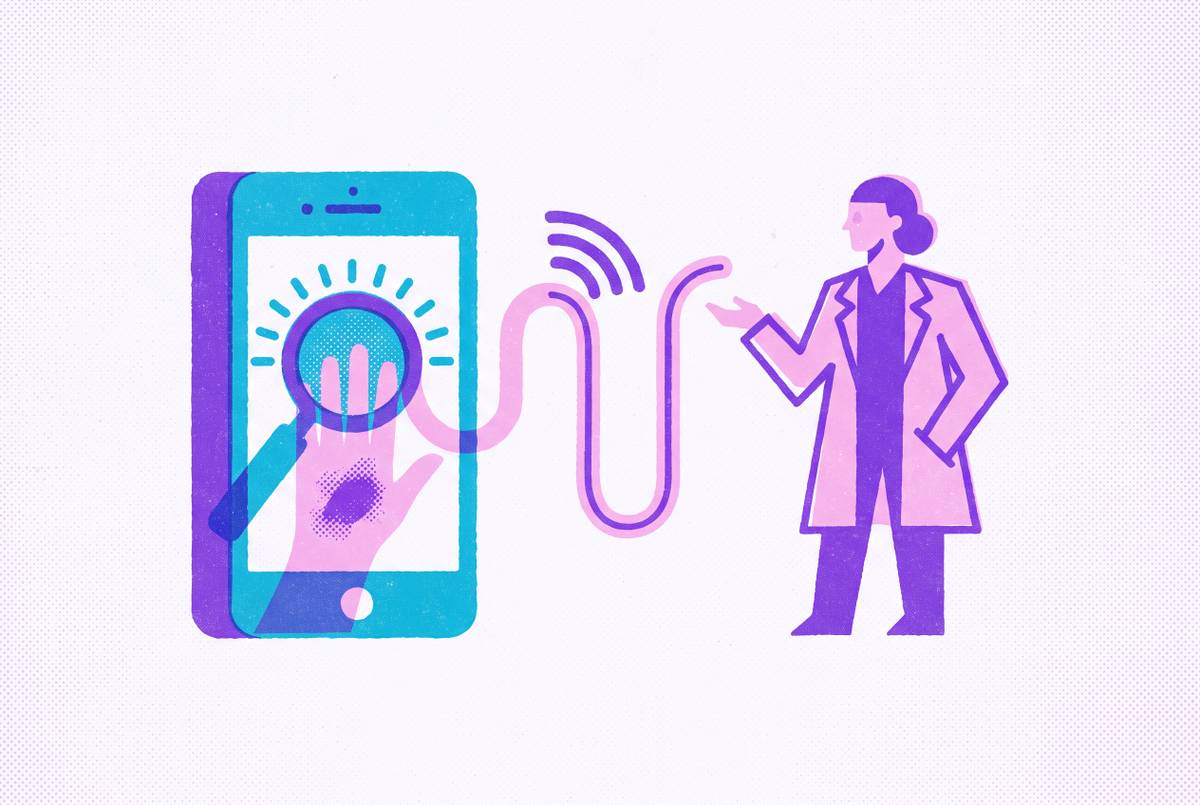
Apps That Send Acne Prescriptions Directly to Your Pharmacy
Telehealth apps diagnose acne from photos and send prescriptions directly to pharmacies.
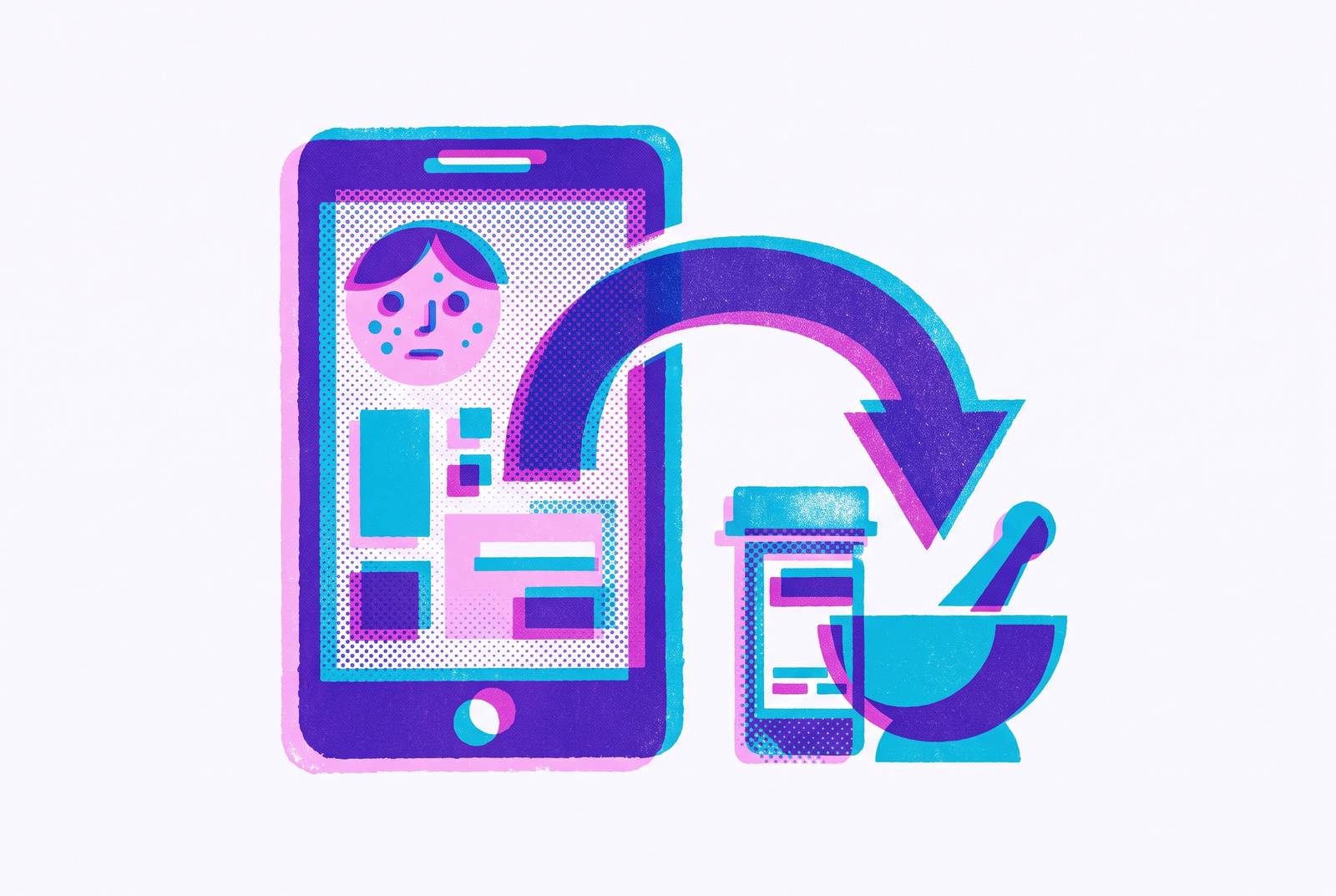
The supply of dermatologists has not kept pace with the number of patients who need one, and that gap is why prescription-by-app services for acne exist. Research in teledermatology points to a straightforward structural driver behind long wait times and the clinical risk that comes with them: fewer dermatologists, more patients, in country after country across the West.
Acne is exactly the condition where that delay costs the most. The disease is highly treatable with first-line agents that have been studied for decades, but it does not wait around for an open appointment slot. Inflammation builds, the risk of permanent scarring climbs, and the toll on a patient's confidence and mental health stacks up with every week spent on a waitlist. What makes acne different from a lot of other reasons people see a dermatologist is that its entire mechanism plays out on the surface of the skin: more sebum, clogged follicles, colonization by the bacterium Cutibacterium acnes, and the inflammatory response that follows. A clinician doesn't need to touch the skin or run a biopsy to see any of that. High prevalence, visible pathology, and treatment protocols that are already well established make acne one of the strongest cases for remote prescribing in all of dermatology, and that combination is what opened the door for a specific clinical pipeline: photo intake, licensed review, e-prescription. The rest of this piece walks through how that pipeline works.
Why store-and-forward intake dominates acne telehealth
Most acne telehealth platforms run on something called store-and-forward teledermatology, which won out over live video for specific structural reasons. Store-and-forward means images and patient information move asynchronously: the clinician and the patient never have to be online at the same time. That one design choice removes the scheduling friction that makes traditional dermatology appointments so hard to book, and it lets a clinician use their time far more efficiently since there's no such thing as a no-show on an async review queue.
The patient side of this looks simple. Fill out a structured intake form, upload clear photos of the affected skin, answer a set of focused clinical questions. That packet then travels through a secure, HIPAA-compliant platform to a clinician, who reviews it and sends back a diagnosis, a treatment plan, and, when it's appropriate, an electronic prescription. Live video exists too, and so do hybrid models that start with async intake and escalate to a video visit if the clinician needs more to go on. Those options tend to earn their keep in more complicated or ambiguous cases. Acne mostly isn't one of those cases. Diagnosis and severity grading happen by looking, and a well-lit photo carries close to the same information a dermatologist would use sitting across from a patient in an exam room. None of that means every photo is good enough to work with, and how much photo quality matters gets a full answer a little further on.
Steps from photo upload to pharmacy receipt
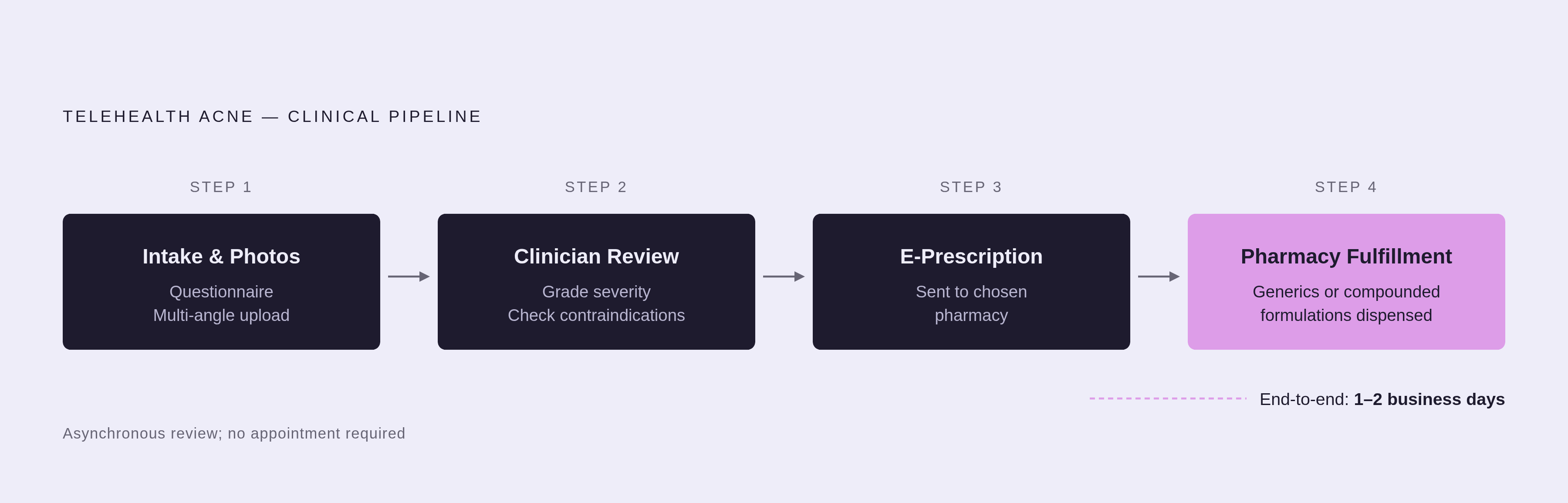
The path from a photo on a patient's phone to a filled prescription at the pharmacy runs through four steps. Knowing what happens at each one tells a patient what they need to prepare, what qualifies for a prescription, and where a case is most likely to stall.
Step one is intake and photo submission. The patient fills out a medical questionnaire covering current medications, birth control status, known allergies, and any acne treatments already tried. Then come the photos, and this is the step where patients have the most control over how smoothly everything moves. Clear, well-lit images taken from multiple angles give a reviewing clinician the most to work with. Photos of skin that looks clear matter too. They give the clinician a baseline for comparison and help confirm which areas are and aren't affected. Natural light, a steady hand, and a few different angles do more for a case than almost anything else a patient can control.
Step two is licensed clinician review. A board-certified dermatologist, a primary care physician, a nurse practitioner, or a physician assistant, depending on the platform, reviews the full intake packet asynchronously. American Academy of Dermatology standards call for the reviewing clinician to hold the right license in the state where the patient actually receives care. Platforms vary in who does this review: some use only board-certified dermatologists, others rely on NPs or PAs working under collaborative agreements. That distinction affects what can be prescribed and how comfortable the reviewer is handling a complicated case, so it's a fair question to ask before signing up with any platform. Whoever is reviewing the case grades severity, identifies the type of acne involved (comedonal, inflammatory, cystic), checks for contraindications, and picks a treatment tier.
Step three is the e-prescribe. Once a clinician decides a prescription makes sense, it goes electronically to whatever pharmacy the patient chooses. No paper, no trip to pick up a slip first. Most platforms pair the prescription with a treatment plan that explains what was prescribed and why, so patients know how to use the medication, what side effects to watch for, and when to follow up. A prescription with no context leaves a patient guessing about how to use it, what side effects to expect, or when to follow up, and that gap in understanding is where a lot of acne treatment quietly fails even when the medication itself is right.
Step four is pharmacy fulfillment. Patients can usually send the prescription to a local retail pharmacy, and on platforms that support it, to a compounding pharmacy for a custom formulation. Standard generics like tretinoin, clindamycin, and doxycycline are widely stocked and often cheap through discount programs. Compounded combinations that mix several active ingredients into one product are available through some platforms, but they depend on a specific pharmacy relationship behind the scenes. Turnaround time from submission to pharmacy receipt depends on the platform, though a straightforward case often clears the whole pipeline in one to two business days.
A model built around asking the right clinical questions before a plan gets written does this well. Platforms like Nolla run on asynchronous intake and photo review: a patient fills out a structured questionnaire and uploads photos, a licensed clinician reviews the packet, and a diagnosis and prescription come back without either side needing to be online at the same time. That's the store-and-forward model in practice, built around getting enough information up front that the clinician doesn't have to guess.
Which acne medications these platforms can and cannot prescribe
Telehealth platforms can legally prescribe most of the first-line arsenal for mild-to-moderate acne. One major medication falls outside what any telehealth-only platform can manage on its own, and patients with severe acne need to know that going in.
Topical retinoids, tretinoin, adapalene, tazarotene, are the backbone of most regimens. They clear clogged pores, slow excess cell turnover, and calm inflammation. Topical antibiotics like clindamycin work well against inflammatory lesions, but the AAD is explicit on this point: clindamycin should always be paired with benzoyl peroxide, and topical antibiotic monotherapy is not recommended, because using it alone raises the risk of antibiotic resistance. Benzoyl peroxide itself kills C. acnes and adds a mild comedolytic and anti-inflammatory effect. That's why it's the standard partner for clindamycin rather than an afterthought. Oral antibiotics such as doxycycline and minocycline cover moderate inflammatory acne; some platforms, including Nurx, prescribe doxycycline directly through their service. Spironolactone gets prescribed off-label fairly often for adult women dealing with hormonal acne patterns, and combined oral contraceptives come into play when a patient's broader hormonal picture calls for it.
Isotretinoin sits outside all of this. It's strongly recommended for severe, scarring, or treatment-resistant acne, but the FDA's iPLEDGE REMS program governs how it can be prescribed, requiring monthly check-ins and pregnancy testing for anyone who can become pregnant, along with lab work as the clinical standard of care. As of 2026, patients who cannot get pregnant no longer need monthly counseling documentation, and at-home pregnancy testing is now allowed during and after treatment at the prescriber's discretion. Even with those changes, the monitoring requirements mean isotretinoin can't be managed through telehealth alone. Some platforms run a hybrid model, with virtual follow-ups layered around an in-person initial evaluation and lab monitoring. Clear Health specializes specifically in isotretinoin management, staffs only board-certified dermatologists, and has moved toward a compounded topical isotretinoin model that sidesteps the iPLEDGE logistics. That's the exception that proves the rule: managing isotretinoin well requires a more hands-on relationship with a patient than a standard async visit is built for.
None of this is a failure of the telehealth model. It's a limit, and a sensible one. Multimodal therapy, combining a retinoid, benzoyl peroxide, and an antibiotic through different mechanisms at once, is the approach most likely to work and least likely to breed resistance. A telehealth treatment plan built around that kind of combination, rather than a single medication, reflects good clinical practice. Understanding what each ingredient actually does for the skin helps a patient follow the plan and notice early if something isn't working the way it should.
How well photo-based diagnosis holds up for acne
A photo can stand in for an in-person exam for acne specifically, though with some real caveats attached. Acne severity grading and type classification, comedonal versus inflammatory versus cystic, rely on what the eye can see, which puts acne in a stronger position for remote evaluation than conditions that need a hands-on exam or a biopsy to sort out.
Systematic reviews of telemedicine-based acne management describe the approach as reliable and well accepted by patients, especially those who'd rather not take time off work or school for an appointment. Acne patients, as a group, are among the most willing to go the virtual route. Patients dealing with a lesion that might be something more serious tend to prefer seeing someone in person, and that preference functions as a useful signal for self-triage: people seem to sense, on some level, which problems need a hands-on look and which don't.
The objection to photo-based diagnosis holds up in exactly the cases where it should. Ambiguous or potentially malignant lesions, the kind where an in-person biopsy is what actually settles the question, don't belong in an async app, and no credible platform claims otherwise. The model fits acne well. It was never meant to replace in-person dermatology across the board, and treating it that way would be a mistake no serious platform makes.
What human oversight provides in the AI pipeline
AI appears throughout this pipeline, mostly in triage, intake structuring, and pattern recognition in photos. Prescribing authority and clinical judgment stay with licensed humans, and that line matters. AI has a solid track record scoring acne severity from images. Newer uses are showing up too: patient education, over-the-counter product suggestions, tracking whether someone is sticking with their regimen, and watching how a case changes over time through repeated photos. Language models can help with clinical documentation, sorting cases for review, and tailoring counseling to a specific patient.
What AI can't do yet is take over for a dermatologist's judgment. The limits are concrete: ethical boundaries around autonomous decisions, a disease spectrum that's narrower than what a trained dermatologist sees day to day, technical gaps, models that are hard to interpret even when they're accurate, and dataset bias that includes underrepresentation of skin of color in training data, which raises real equity concerns. The professional consensus treats AI as a decision-support tool that assists a clinician, not a replacement for one, and that oversight is what keeps the system equitable and accountable.
Nolla's approach reflects that balance directly. Its platform runs on Vision Transformers and large multimodal models trained on labeled clinical cases, built to spot patterns in images and in whatever else a patient reports. The platform frames technology and doctors as working alongside each other rather than one replacing the other, which lines up with where the field as a whole seems to be headed: AI narrows down and organizes the information, and a licensed clinician makes the call.
Where access gaps close and persist
Prescription acne apps close a real access gap for most people who need treatment, though not for everyone equally. The gains are concrete: same-day or next-day access at a price a patient can plan for, no travel, no missed work or school, encrypted HIPAA-compliant platforms, and a path to prescription-strength medication that would otherwise mean waiting weeks for a specialist. Consultation fees on these platforms tend to be manageable out of pocket. Nolla's message-based consultation with a licensed clinician is one example of a cost low enough that it opens the door for patients who would otherwise skip care.
Not everyone can walk through that door. Patients without a smartphone camera good enough to capture a diagnostically useful image are stuck before the process even starts. Limited or unreliable internet access, a real problem across many rural and low-income communities, is a barrier no app can design its way around. Medicaid populations who don't own a device that can run these platforms, or who can't afford enough data to use one, remain hard to reach through this channel no matter how well the technology works.
The gap these apps close is partial. For a patient with a decent smartphone and a stable internet connection, the barrier to getting that first acne prescription has come down substantially. For a patient without either of those things, the underlying inequity in who gets timely dermatologic care hasn't moved much.
Sources
- Full article: A Telemedicine-Based Approach for Acne Management: Method Overview and Demographic Profile of Early Participants
- Comment on Marasca et al. Teledermatology and Inflammatory Skin Conditions during COVID-19 Era: New Perspectives and Applications. J. Clin. Med. 2022, 11, 1511
- JMIR Dermatology - Store-and-Forward Images in Teledermatology: Narrative Literature Review
- A network-based cross-sectional study of geographic access disparities to Medicare-participating dermatologists in the United States
- Limited Access to Dermatology Specialty Care: Barriers and Teledermatology - PMC
- Teledermatology: Comparison of Store-and-Forward Versus Live Interactive Video Conferencing
- In-Depth Analysis of Automated Acne Disease Recognition and Classification
- Teledermatology and Virtual Visits for Acne Management: A Review - PMC