AI Symptom Checkers That Connect You to a Licensed Clinician
The two-tier model routes you to a clinician, not just a list of maybes.
A list of possible conditions is not the same as a plan. That gap, between finishing an AI symptom checker and knowing what to do next, is the subject of this piece: how a well-built two-tier system closes it, and how to tell when a tool actually gets you to a clinician instead of leaving you with a printout of maybes.
Why AI symptom checkers differ from AI diagnosis tools
Most people open a symptom checker expecting an answer. Type in a headache and a stiff neck, and the instinct is to want the app to say what's wrong, the way a doctor might after an exam. That's not what these tools are built to do, and treating them as if they were sets up the wrong expectation from the first tap.
The honest way to describe an AI symptom checker's job: organize what someone is experiencing, then flag how urgently it needs attention. That's a narrower task than diagnosis, but it's also a real one. Before a clinician ever sees a patient, someone has to collect the symptom history, the duration, the severity, the associated factors, and the risk context, things like age, medications, prior conditions. Doing that from scratch takes a clinician time. An AI layer that gathers it up front hands the clinician a head start.
The split between triage and diagnosis reflects an actual division of labor. AI platforms can surface probable conditions and sort urgency into tiers. Diagnosis, prescribing, and the legal responsibility that comes with both belong to a licensed clinician. Once that distinction is clear, the real question stops being "is this AI accurate?" and becomes "does this tool get me to the person who can act on what it found?"
How the two-tier handoff works, step by step
A two-tier system only works if the AI session and the clinician visit feel like one experience, and picturing what that looks like end to end shows why.
A patient reaches out at any hour, through a web browser or an app, no waiting room involved. The platform collects basic demographic and history information first: age, sex, current medications, any relevant prior conditions. Then comes the actual complaint, described in plain language, followed by AI-guided questions that dig into duration, severity, associated symptoms, and risk factors the patient might not think to mention on their own.
From there, the system sorts the case into an urgency tier: emergency, urgent care, a standard appointment, or self-care. Each tier carries its own recommended action, calling emergency services, booking a same-day visit, scheduling a telehealth session, or following home-care guidance. None of these outcomes is better than the others in the abstract. A rash that needs nothing but moisturizer and time is not a failure of the system; a chest pain case that gets routed to emergency services immediately is the system working as it should. The measure of a good triage flow is whether it sends each patient to the right next step, not whether it always sends them somewhere dramatic.
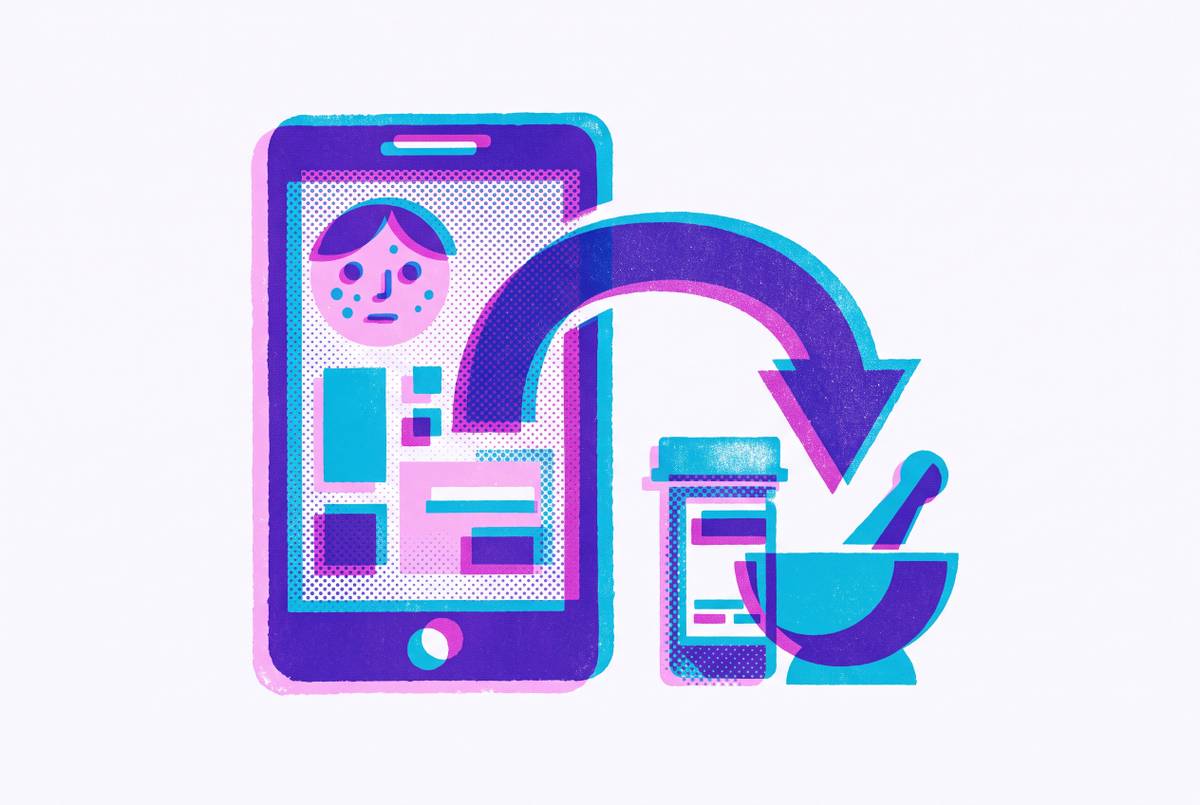
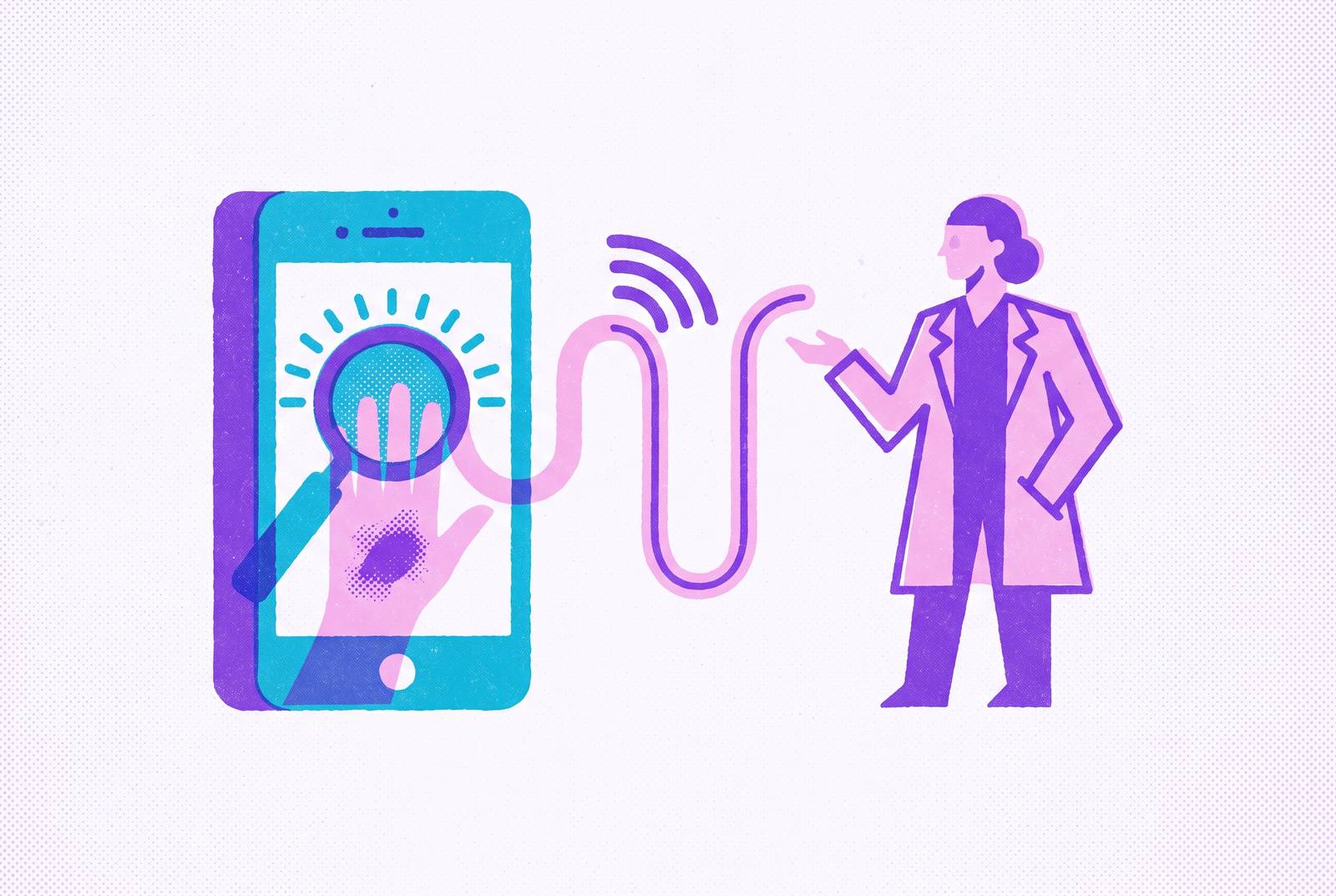
The step that separates a real two-tier system from a glorified quiz is what happens after triage. The structured assessment, the symptom history, the urgency classification, travels with the patient into the clinician session. Clinicians receive patients through one of two modes: synchronous, meaning live video or audio that feels close to an in-office visit, or asynchronous, meaning store-and-forward, where a patient submits symptoms, photos, and history, and a clinician reviews and responds, often within hours. Asynchronous care is the dominant model in teledermatology and is spreading into other specialties.
Platforms that keep a patient's medical history, medications, and past symptoms on file across visits can offer something a one-off checker can't: a risk assessment built around that specific person's health profile, rather than a generic answer pulled from population averages. That continuity, remembering the patient from one session to the next, is what separates a real care tool from a single-use quiz.
What makes the AI layer trustworthy
Asking whether an AI symptom checker is accurate is a fair question. Trust is not measured by one number. Trust here comes from three things working together: the quality of the medical knowledge base behind the tool, physician oversight of what it outputs, and honesty about what it can't do. None of those is a claim of perfect accuracy, and none should be.
Accuracy also isn't flat across conditions. For routine and chronic conditions, the correct diagnosis appears somewhere in the top three suggestions most of the time, though the tool's very first guess is right less often than that. Mental health conditions and dermatological conditions score in a more modest range, one that improves as image analysis gets paired with text-based triage. Anyone comparing tools should ask what condition category they're asking about, because a platform strong on chronic disease triage and a platform strong on skin conditions aren't being tested on the same thing.
The knowledge base matters as much as the algorithm sitting on top of it. Platforms built on peer-reviewed medical research produce materially better assessments than ones built on generic health databases or static symptom lists pulled together without ongoing clinical input. And accuracy numbers mean little without a human checking the machine's work. Physician review, whether through clinical decision trees developed by doctors, ongoing medical oversight of outputs, or guidance explicitly labeled as physician-reviewed, is what turns an AI tool from a convenience into something a patient can act on.
Regulation is starting to catch up to this, unevenly. On January 6, 2026, the FDA issued revised guidance that loosened oversight for certain AI-enabled clinical decision support software. The agency said it would exercise enforcement discretion for tools that give a single clinically appropriate recommendation, when only one recommendation is in fact clinically appropriate, and the tool meets the other non-device criteria, including letting the clinician independently check the basis for that recommendation. That last part is sometimes called the "glass box" requirement: the clinician has to be able to see how the tool got to its answer, not just accept it on faith.
That guidance mostly addresses tools clinicians use inside a workflow. It says little about consumer-facing symptom checkers and health chatbots, the tools that shape a patient's expectations before any clinician is in the room. Those fall outside the clarified framework for now. Patients choosing between symptom checkers are, for the moment, doing a fair amount of that evaluation themselves.
The two-tier model in clinical practice: skin conditions as the clearest case
Dermatology has more clinical evidence behind the asynchronous two-tier model than any other specialty, which makes it the clearest place to see the handoff actually working.
A study at a German university hospital, published in JDDG, looked at the store-and-forward model in day-to-day use. The most common diagnoses handled this way were acne, atopic dermatitis, and hand eczema, with inflammatory skin conditions making up nearly half of all cases. Clinicians responded in well under a day on average. Most patients received a prescription through the asynchronous channel itself, and when checked again at three weeks, most reported their symptoms had fully or partially resolved.
A meta-analysis covering research from 2003 to 2025 adds the diagnostic performance picture. In controlled settings, AI reaches dermatologist-level accuracy on its own. But the strongest result in the whole analysis is what happens when a dermatologist uses AI as a second opinion rather than working alone: AI-assisted dermatologists outperformed both AI working alone and dermatologists working unaided, and the clinicians who gained the most from the AI assist were the least experienced ones. Neither the algorithm by itself nor the clinician by themselves matched what the two produced together. That result is close to the whole argument for a two-tier system in miniature.
Asynchronous care depends on the patient submitting a usable photo, and that turns out to be a real bottleneck, not a minor detail. A 2025 randomized cohort study at the American University of Beirut Medical Center measured diagnostic concordance across three groups: unassisted patient-taken photos, photos taken after a short standardized training session, and photos taken by a resident physician. Concordance was 79% for unassisted patient photos, 84% for assisted photos, and 87% for resident-taken photos. Acne produced the highest match across all three groups. Even without any training, most patient-submitted photos still reached diagnostic concordance, which says platforms that spend effort teaching patients how to take a usable photo are doing work that affects diagnosis, not just making the app easier to use.
The access gain from this model is concrete: AI-assisted teledermatology triage can take a dermatology wait that would otherwise run weeks and compress it into days.
None of this erases a real limitation. The same 2025 meta-analysis found that AI dermatology models trained on datasets underrepresenting darker skin tones showed meaningfully lower accuracy for those patients, with reduced AUROC and sensitivity. The researchers described fixing this, through prospective validation and reporting performance across skin tones, as a prerequisite for safe, equitable use of these tools in practice, not a footnote to mention once and move past. Patients with darker skin have good reason to ask, before trusting a platform's triage output, whether its model has been validated across the full range of skin phototypes.
How the model extends to reproductive and contraceptive care
Dermatology isn't the only place this architecture holds up. Contraceptive care is now a setting where major clinical bodies have formally endorsed remote-first, asynchronous consultation as standard practice for a defined set of methods, not an improvised workaround.
The Society of Family Planning issued a 2025 clinical recommendation stating that providers should offer contraceptive services through telemedicine, covering counseling, starting a method, renewing prescriptions for methods that don't require a procedure to place, and follow-up for symptoms or complications that don't need a physical exam. That recommendation carries a Grade 1B rating. It also says patients should get to choose how they're seen: video, audio-only, or asynchronous message-based care.
The same guidance goes further for progestin-only methods, giving telemedicine delivery its highest evidence grade, and recommends combined hormonal contraceptives be prescribed for a full year without a required follow-up visit during that year unless the patient asks for one, a Grade 1A recommendation.
There's a clear line drawn here too. Long-acting reversible contraceptives, IUDs and implants, still require an in-person visit for insertion. What can move to a screen is the consultation beforehand and the monitoring afterward, a hybrid approach the recommendation explicitly supports. One might argue this boundary is a weakness in the model. It's closer to the opposite: a system that's honest about what still needs a hand in the room is more trustworthy than one that claims everything can be done remotely.
Safety screening doesn't disappear just because the visit is asynchronous. Providers still check blood pressure history, smoking status, and family history of blood clots before deciding whether a hormonal method is appropriate for a given patient. The AI layer's role here mirrors its role in dermatology: it collects the structured history, flags the risk factors, and lets the clinician spend their time on judgment.
A genuine clinician handoff versus a dead end
What matters about any symptom checker is not whether the AI is any good, but whether what it produces actually goes somewhere, since the AI layer itself rarely explains why one tool leads to care and another leads to a dead end. The handoff does.
A few things mark a tool that gets a patient somewhere real. The urgency tier should point to a specific next step, emergency care, urgent care, telehealth, or self-care guidance, not a vague "see a doctor" that leaves the patient to figure out logistics alone. A clinician should be reachable inside the same platform, within a stated and short window, not through a separate sign-up that starts the whole process over. The symptom history and urgency assessment gathered during triage should carry over to that clinician. The cost of seeing a clinician should be stated and be realistic for most patients, since a transparently priced, message-based consultation is often the only follow-up step someone will actually take. And data privacy protections under HIPAA should be assumed, not offered as a premium feature.
Some tools stop short of that. A session that ends with a list of possible conditions and nothing else leaves the patient exactly where they started, just with more words for it. Others connect to a clinician, but only through a different platform, forcing patients to re-enter the same history a second time. Some restrict clinician access to certain states or to a higher-priced tier, so most users never leave the AI-only layer.
A few named tools illustrate where this line falls in practice. Ada Health is a well-established, CE-marked app with published accuracy data and coverage across a wide range of conditions. It doesn't connect users to a US physician inside the app itself, so anyone who needs a prescription or a follow-up visit has to go find a separate telehealth service, a real limitation for someone expecting one continuous path from symptom to treatment. Isabel takes natural-language symptom entry and covers an especially broad range of conditions, including rare and complex presentations, built on a clinical decision-support tool that's been used in hospitals for roughly two decades. It's particularly useful when symptoms don't fit a common pattern, oriented toward generating a differential list. Nolla runs on the same architecture this piece has been describing throughout: AI-organized symptom assessment reviewed by licensed clinicians, paired with a transparently priced, message-based consultation built specifically so the process doesn't end at a list of possibilities.
Using these tools in a way that gets you to actual care
None of this works if a patient treats the AI session as the finish line. The honest way to use one of these tools is as a first step that assumes a second one is coming.
A little preparation changes what the system can do. Having a medication list on hand, along with relevant medical history and any earlier diagnosis tied to the same symptom, gives the AI layer something to work with. Platforms that use that information produce sharper triage than ones treating every visit as a first encounter with a stranger.
That's the whole shape of the two-tier model, really: a triage layer that organizes the problem and sorts its urgency, handing off to a clinician who carries it the rest of the way, and the tools worth using are the ones built so that handoff actually happens.