Ringworm Healing Stages and Timeline
Understand how the infection clears visually and when treatment actually works.

Ringworm is a fungal infection, not a parasite, caused by a group of fungi called dermatophytes. The name sticks around for historical reasons, but there's no worm involved at any point in the process. What matters for understanding how it heals is what these fungi actually eat: keratin, the tough protein that makes up the outer layer of skin, along with hair and nails. Because dermatophytes feed on keratin specifically, the infection tends to stay confined to the skin's surface rather than digging deeper, and it spreads outward as the fungus consumes fresh keratin at the edges while the center, already consumed, starts to calm down. That outward-eating pattern is what produces the ring: active, inflamed border, clearer center.
This same mechanism explains the healing process in reverse. As antifungal treatment interrupts the fungus's ability to feed and multiply, the advancing border stops expanding, then starts shrinking and flattening. Watching that shift, from active edge to quiet skin, is the entire basis for the stage-by-stage framework later in this piece. Ringworm spreads through contact with infected people, animals, soil, or contaminated surfaces, and the spores can survive on fabric and furniture for a long stretch. Reinfection during treatment is a real possibility, which is part of why consistency matters as much as the medication itself.
The incubation window before any rash appears
Ringworm's clock starts before anyone can see it. After exposure to the fungus, it typically takes one to two weeks for a visible rash to show up, and during that incubation period, the fungus is already active on the skin, and it can already spread to other people.
The first visible sign is usually a small patch that's pink, red, or brown, sometimes slightly raised, sometimes a little scaly. At this stage, it rarely looks like "ringworm" in anyone's mind. It can easily be mistaken for contact dermatitis, a bug bite, or some other garden-variety skin irritation. That resemblance is exactly the problem: by the time the classic ring shape becomes obvious, the fungus has already been active on the skin for days, feeding and spreading outward the whole time.
This incubation period deserves attention precisely because it's invisible. Anyone who knows they've had contact with an infected person, a pet showing patchy fur loss, or a shared surface like a gym mat or locker room bench should start watching their skin for small changes rather than waiting for a textbook ring to appear. Catching the infection during this quiet window, before it has fully declared itself, gives treatment a head start.
Stage by stage: what the skin looks like as ringworm heals
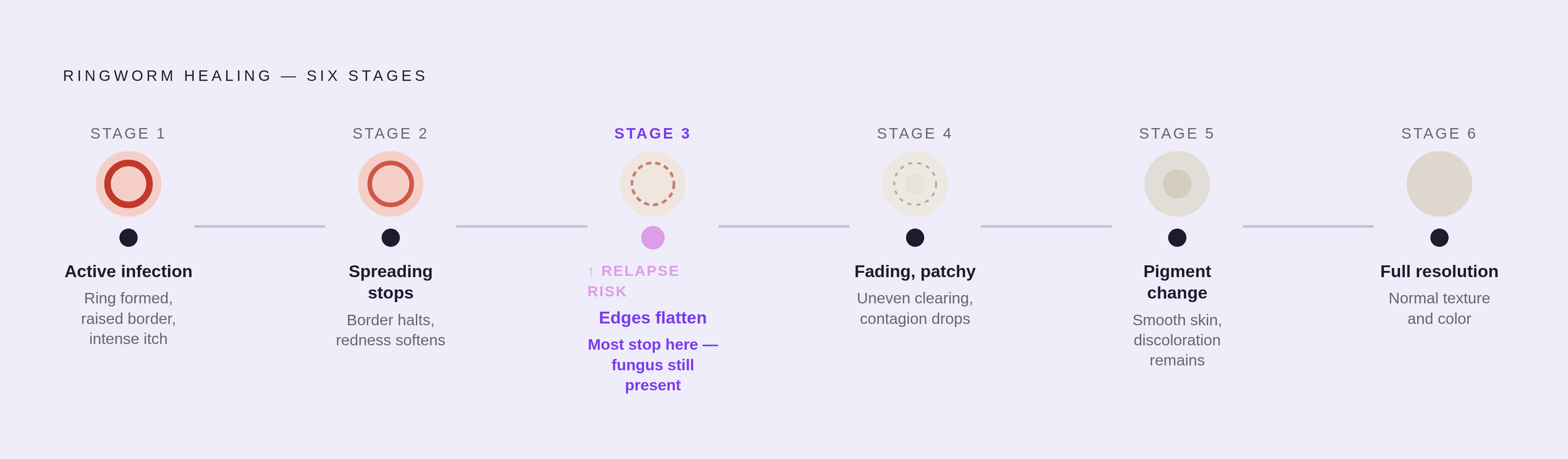
Once the rash becomes visible, ringworm moves through a fairly consistent sequence of visual changes as it runs its course, whether untreated or, more usefully, as it responds to treatment. Knowing what each stage actually looks like on the skin lets someone tell genuine progress from a stall that only looks like one.
Stage 1: Active infection, ring fully formed
At this point, the lesion looks like what most people picture when they hear "ringworm": a well-defined, roughly circular patch, pink or red, with a raised, scaly, slightly bumpy border and a center that looks noticeably clearer than the edge. Itching tends to be intense here, and the border itself may feel warm or tender to the touch. Left untreated, the ring keeps growing outward, and the infection is most contagious to others at this stage. In areas with hair, like the scalp or beard, the presentation shifts: instead of a clean ring, hair becomes brittle and starts falling out in patches. The biology driving it is the same fungus consuming the same protein, just working through a different kind of tissue.
Stage 2: Treatment begins, spreading stops
Within a few days of starting antifungal treatment and using it consistently, the ring stops expanding. That halt, more than any dramatic visual change, is the first real evidence that the treatment is working. Itching starts to ease, redness softens, and the scaly edges begin to flatten out. Oddly, the border can sometimes look a little angrier for a day or two before it settles. That's a normal inflammatory response to the fungus dying off. The skin is still contagious at this point, so precautions around shared towels, bedding, and skin contact should continue.
Stage 3: Inflammation recedes, edges flatten
The raised border starts losing its definition. Redness shifts from a bright, angry red toward pink or a brownish tone, and the scaling that defined the edge starts to decrease. The skin may look dry and begin peeling slightly as the damaged outer layer sheds, which is a normal part of recovery and shouldn't be scrubbed or picked at. Itching continues fading, often disappearing altogether by the end of this stage, and the center of the ring starts blending into the surrounding skin tone.
People often stop treatment at this stage because the rash looks nearly gone. That's the most common point at which ringworm relapses. The fungus is still present in smaller quantities in the outer skin layers even after the visible rash has mostly faded, and stopping the medication early gives it room to rebound. Full-course completion matters most right here, at the exact moment the skin starts to look convincingly better.
Stage 4: Fading and patchy appearance
The rash starts clearing unevenly: some areas resolve fully while others linger, giving the skin a patchy, uneven look rather than a clean, uniform ring. The overall shape may still be faintly visible, but it's much lighter than before. Scaling resolves and skin texture starts returning to something closer to normal. Contagion risk drops significantly by this point, since the fungus is mostly cleared from the active lesions.
Stage 5: Post-inflammatory pigment change
After the active infection clears, the skin at the site can look temporarily lighter (hypopigmentation) or darker (hyperpigmentation) than the skin around it. The pigment change is a consequence of the inflammation that disrupted pigment-producing cells in that area of skin, not a sign that the fungus is still there. By this stage, the skin should be smooth, not scaly or raised, and itching should be gone. These pigment changes are harmless, but they can take weeks to months to fully fade, especially for people with darker skin tones. This stage gets misread as incomplete healing more than any other, but the distinction is texture: if the skin is smooth and flat with no active, raised border, the infection itself has resolved, even if the color hasn't caught up yet.
Stage 6: Complete resolution
The skin returns to its baseline texture and color. No ring pattern, no itching, no scaling, normal sensation across the area. Ringworm generally doesn't leave permanent scarring, though the pigment changes from Stage 5 can take their own separate timeline to fully fade.
How location on the body changes the timeline
The six stages above hold true regardless of where ringworm shows up on the body. What changes dramatically is how long each stage takes, and that depends heavily on the location's biology, moisture level, and how accessible it is to topical medication.
| Location | Typical timeline | Oral medication typically needed? | |---|---|---| | Arms and torso (tinea corporis) | 2 to 4 weeks with consistent topical treatment | Usually not | | Face | Roughly 3 to 4 weeks | Usually not, but formulations must be gentler | | Feet (tinea pedis / athlete's foot) | 4 or more weeks | Sometimes, if topical treatment stalls | | Scalp (tinea capitis) | Several weeks of treatment, plus additional time for hair regrowth | Yes, almost always |
Arms and torso infections are the reference case most people picture, clearing in two to four weeks with consistent use of a topical antifungal. The face follows a similar pattern but runs a bit longer, around three to four weeks, and calls for gentler formulations given how sensitive facial skin tends to be. The feet take longer still, often a month or more, because the environment that antifungals need to work, dry skin, is hard to maintain on feet that sweat inside shoes all day.
Scalp infections are a different category. Topical creams can't penetrate deep enough to reach the hair follicles where the fungus actually lives, so treatment requires oral medication and runs for several weeks, with full hair regrowth sometimes trailing behind the point where the infection itself is cleared. The general rule holds across all of these: the deeper the fungus sits and the harder an area is to keep dry and medicated, the longer each stage described above will stretch out.
What Treats Ringworm
Antifungal medication is what actually drives the infection through the stages described earlier. Without it, ringworm can still eventually resolve on its own in some cases, but treatment speeds the process and reduces both discomfort and the window of contagiousness. The most common mistake is stopping the right medication too early, once the rash looks better rather than once the fungus is actually gone.
For ringworm on the body, first-line topical options include terbinafine, miconazole, clotrimazole, tolnaftate, and ciclopirox. Among these, the allylamine and benzylamine classes, which include terbinafine and butenafine, tend to produce higher cure rates than azole-class antifungals like miconazole and clotrimazole, and they also work well for athlete's foot and jock itch.
Oral antifungals come into play under more specific circumstances: when the infection is widespread, when topical treatment hasn't worked within the expected window, when the patient is immunocompromised, or when the infection has reached hair follicles. Scalp and nail infections fall into this last category almost without exception, since topical creams simply can't reach the fungus where it lives in those tissues.
Drug choice matters even within the oral category. For children with tinea capitis, oral terbinafine, itraconazole, and fluconazole generally perform as well as griseofulvin for most infections. But for infections caused specifically by Microsporum species, griseofulvin appears to outperform terbinafine. The right drug depends on which fungus is actually involved rather than treating "ringworm" as a single uniform target.
One detail explains why finishing treatment matters so much: the skin can look completely normal before the fungus is fully cleared from the outer skin layers. Clinical appearance improves faster than the underlying infection resolves, so a rash that looks healed at two weeks may still harbor enough fungus to cause a relapse if treatment stops right there.
A related mistake is applying a topical steroid cream to an undiagnosed rash rather than seeking a clinician's diagnosis. Steroids suppress the visible inflammation, redness, itching, swelling, while doing nothing to stop the fungus, which continues spreading unchecked underneath. Steroid use can mask a ringworm infection into a condition called tinea incognito, which is considerably harder to treat as a result. Anyone whose "stubborn rash" has already been treated with a steroid cream should mention that history specifically when seeking care, since it changes both the diagnosis and the treatment plan.
Signs That Healing Is Not Going as Expected
Most ringworm infections move through the stages described above in a fairly predictable way. But a handful of specific patterns suggest the infection has strayed off that path, and they call for professional reassessment rather than more aggressive self-treatment.
No improvement after two to four weeks of consistent topical treatment is one of the clearest signals. At that point, a few different things could be going on: the infection might need oral medication, it might not be ringworm at all (nummular eczema, pityriasis rosea, and psoriasis can all mimic the ring-shaped rash closely enough to fool the eye), or prior steroid use may have masked it into tinea incognito.
A few other patterns call for a clinician visit rather than switching to a different over-the-counter product: rapid spread despite active treatment, several lesions appearing at once, or any involvement of the scalp or nails from the start. These aren't situations to manage by escalating self-treatment.
Watch also for signs that the skin has picked up a secondary bacterial infection on top of the fungal one, things like pus, honey-colored crusting, or increasing warmth and swelling around the lesion. When that happens, antifungal treatment alone won't be enough, since the scratched or irritated skin has given bacteria an opening that needs its own treatment.
One emerging concern deserves mention, though it applies to a specific subset of cases rather than the average reader. Trichophyton indotineae is a drug-resistant dermatophyte that originated in South Asia and has since spread to Europe and North America. Lab testing shows it resists terbinafine at a striking rate, 78.9 to 82.5 percent, consistent across both CLSI and EUCAST testing protocols. This matters most for infections that simply refuse to respond to standard treatment, particularly in patients with recent travel to or family origin in South Asia. Those cases warrant evaluation by a clinician who can order fungal culture or resistance testing rather than cycling through more over-the-counter creams.
For most ringworm that isn't responding as expected, getting that evaluation doesn't require a long wait for an in-person dermatology appointment. Telehealth and asynchronous care are well suited to this particular problem: a clinician can review photos of the lesion, go through what's already been tried, and decide whether a prescription-strength antifungal or a different drug entirely makes more sense. For the kind of ringworm that's stalled, spreading despite treatment, or showing up somewhere oral medication would normally be needed, that's often a faster and more practical path than waiting weeks for an in-person visit.
Sources
- Antifungal medicines for treating children with ringworm
- Therapeutic Class Reviews ANTIFUNGALS TOPICAL
- Ringworm (tinea)
- Ringworm Basics
- What Causes Ringworm
- Clinical Overview of Ringworm
- In-vitro Activity of 10 Antifungal Agents against 320 Dermatophyte Strains Using Microdilution Method in Tehran
- Ringworm: Diagnosis and treatment