Spider Bite Progression and What Each Stage Looks Like
Most spider bites are harmless, but brown recluse and black widow bites progress very differently.
Spider bites follow patterns, and most of those patterns are boring in the best possible way. Nearly all of the thousands of known spider species have fangs too short or too fragile to break human skin, so the bite most people fear never actually happens. The exceptions that matter clinically are narrow: medically significant systemic reactions occur mainly with brown spiders (Loxosceles species, including the brown recluse) and widow spiders (Latrodectus species, including the black widow and the brown widow, whose range has spread from Florida to every Gulf Coast state). These two groups cause harm through different mechanisms entirely, one destroys tissue and the other disrupts the nervous system, and that split is why a single mental checklist for "spider bite" does more harm than good. Tarantulas, sometimes kept as pets, tend to be more aggressive and can be venomous when native to certain regions abroad, while tarantulas native to this continent are generally harmless to people but can flick irritating hairs that cause local reactions or, in sensitized individuals, something closer to an allergic response. Knowing which of these tracks a bite falls on, cytotoxic or neurotoxic, shapes every decision that follows: whether to watch, treat at home, or head to a clinic.
How the two venoms work
To understand why these two bites look nothing alike, look at what the venom actually does once it's under the skin. Brown recluse venom carries an enzyme called sphingomyelinase D, which turns the body's own immune response against itself. That enzyme triggers a cascade that damages small blood vessels and starves the surrounding tissue of blood flow, which is what eventually leads to necrosis. One detail matters for anyone treating a bite in real time: this enzyme's activity is temperature-sensitive. Cool compresses are not a comfort measure layered on top of treatment. They slow the chemical process doing the damage, which makes them a central part of care rather than an afterthought.
Black widow venom plays by different rules. Its main toxic component, alpha-latrotoxin, doesn't destroy tissue. It interferes with how nerves signal muscles, flooding the junction with neurotransmitters and throwing the nervous system into overdrive. That's why a black widow bite can leave skin that looks almost untouched while the person bitten is dealing with intense muscle pain, cramping, and other signs the body is in distress. For a brown recluse bite, the wound itself tells the story, its appearance over hours and days is the signal to track. For a black widow bite, the skin can mislead entirely, and the real signal comes from what's happening systemically: pain out of proportion to what's visible, sweating, cramping, changes in heart rate and blood pressure.
Brown recluse bites in the first hours
The first few hours after a brown recluse bite are, paradoxically, the most dangerous stretch for decision-making, precisely because nothing looks dangerous yet. The bite is often painless or barely noticeable at first, sometimes resembling nothing more than a mosquito bite. There's no visual cue at this stage that reliably signals anything serious is underway. Pain, when it comes, can start later rather than at the moment of the bite. It can start later and, in some cases, grow severe enough to spread through the entire limb. The area around the bite typically turns red and bruised-looking and may itch, sometimes along with itching elsewhere on the body.
So many of these bites go unrecognized until later. The spider is rarely caught in the act, let alone identified afterward, and a wound that looks like a bug bite in hour one looks like a hundred other bug bites. What if the bite you're looking at right now doesn't look alarming at all, absence of alarm in this window isn't reassurance, it's the window in which attention should start. Clean the area gently, apply a cool compress, and note the time the bite happened. Watching how the wound changes over the next day reveals the progression that a single snapshot cannot show.
The distinctive middle stage: the bull's-eye lesion
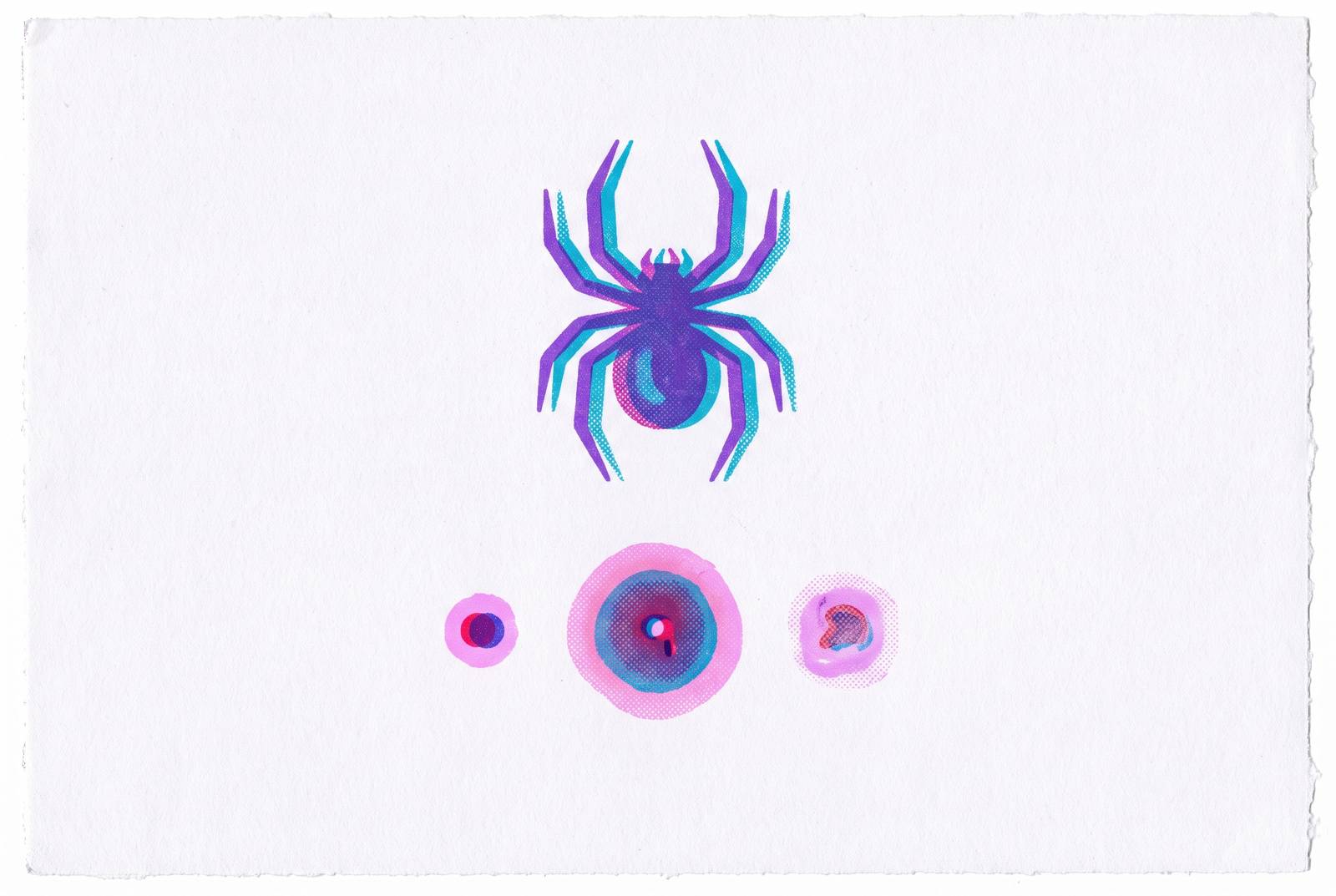
As the venom's effects build, the wound starts to take a shape that sets it apart from an ordinary bite. A blister forms at the center, surrounded by an irregular ring of bruising, producing what's often called a bull's-eye lesion: a pale or whitish center ringed by red, inflamed skin. That central blister tends to grow, fill with blood, and eventually rupture, leaving an open ulcer behind. A black scab, or eschar, forms over that ulcer and sloughs off later in the healing process. The skin around the wound may take on a blue, purple, or gray cast as blood flow to the area is choked off, a visible marker of the small-vessel damage happening beneath it.
Clinicians watching this stage unfold also have to rule out pyoderma gangrenosum, a separate inflammatory condition that produces a strikingly similar ulcer without any spider involvement. Not every bite reaches this point. How far it progresses depends on how much venom was delivered and on the age and general health of the person bitten. Still, reaching this stage means active tissue damage is already underway, and the earlier a clinician evaluates it, the narrower the risk of the ulcer deepening further.
Systemic loxoscelism and who is most at risk
Everything described so far is local, confined to the skin and the tissue immediately around the bite. A smaller subset of brown recluse bites produces something far more serious: systemic loxoscelism, a body-wide reaction that can take a day or more to appear and occurs more often in children and adolescents than in adults. When it does appear, the list of possible effects is long and serious: fever, chills, nausea, vomiting, joint and muscle pain, a rash that spreads beyond the bite site, seizures, dangerously low blood pressure, disrupted blood clotting, low platelet counts, destruction of red blood cells, and kidney failure. These systemic effects, not the local wound itself, account for every fatality linked to brown recluse bites.
Fever showing up alongside a spreading wound is a signal that the reaction may have moved beyond the skin, and it changes where that person needs to be: not an urgent care visit scheduled for tomorrow, but an emergency room today. Children, older adults, and anyone with underlying health conditions carry a higher risk of this progression, even when the wound at the bite site still looks mild. That mismatch, a calm-looking wound paired with a body moving toward crisis, is the exact reason this section exists as its own warning rather than a footnote to the last one.
Black widow bite progression
Unlike the recluse, where the wound is the story, the black widow's damage is almost entirely systemic. The bite itself often announces itself immediately: a sharp, stinging sensation at the moment of contact. What follows can be pain far out of proportion to what the skin shows, because the skin may show almost nothing.
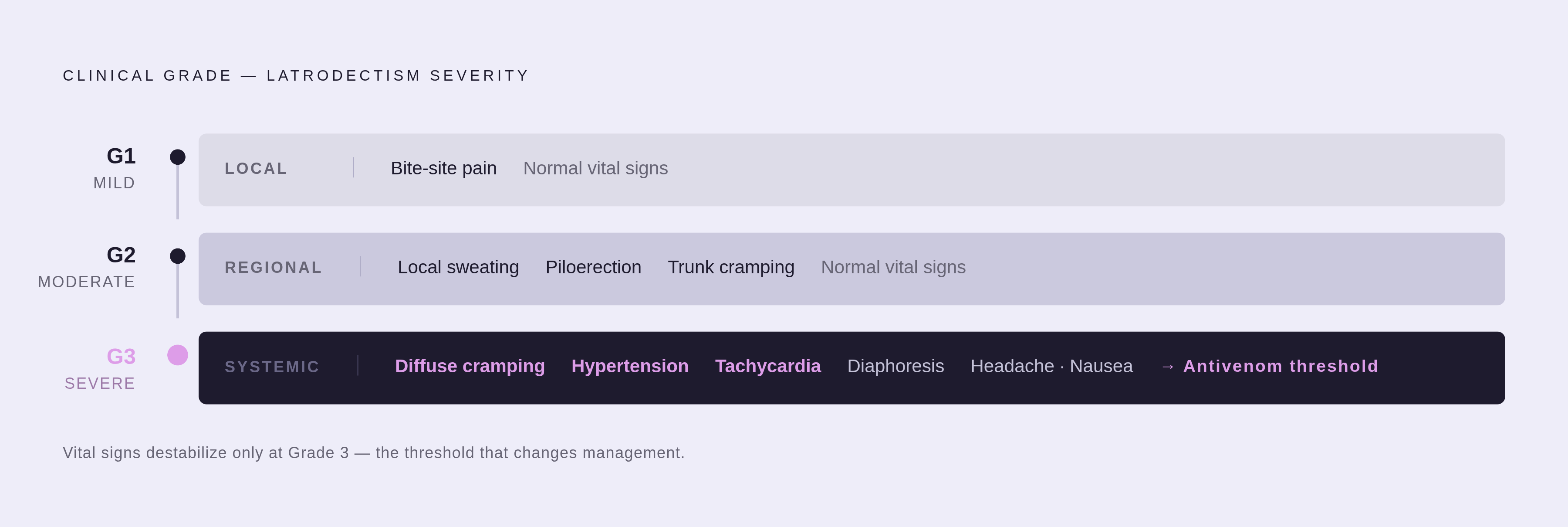
Within the first hour, that initial pain can develop into persistent discomfort at the bite site along with sweating, redness, and the skin's hair standing on end. In more serious cases, this progresses into cramping pain across the large muscles of the trunk, along with elevated blood pressure, a faster heart rate, headache, nausea, and vomiting. Together, this cluster of symptoms is known as latrodectism. Clinicians grade the severity in three tiers: mild cases involve pain confined to the bite site with normal vital signs; moderate cases add sweating and goosebumps near the bite along with trunk muscle cramping, still with normal vital signs; severe cases, true latrodectism, bring sweating at sites far from the bite, intense cramping throughout the body, high blood pressure, rapid heart rate, and often headache, nausea, and vomiting.
One complication deserves particular attention: the abdominal pain that comes with severe latrodectism can look enough like a surgical abdominal emergency, rabies, or tetanus that it sends the diagnosis in the wrong direction entirely, delaying the treatment that would actually help. Most cases resolve within one to three days, though residual spasms, tingling, agitation, and weakness can linger for weeks or even months afterward. Prompt treatment matters most for children and older adults, and in severe cases, a doctor may prescribe antivenom.
Spider bite misdiagnosis
A confirmed spider bite is rare. Confirming one requires someone to have witnessed the bite happen, the spider to be identified (which almost never occurs, since it's rarely recovered intact), and other causes to be ruled out. Without all three, what gets called a spider bite is a presumption, not a confirmed fact. That doesn't make the staged descriptions above useless; they function as a guide to pattern recognition under uncertainty, not a diagnostic test anyone can run at home.
The most important wound to rule out is a common bacterial skin infection acquired outside hospital settings, which produces necrotic, ulcerating lesions that can look remarkably similar to a brown recluse bite but need an entirely different course of treatment. In fact, outside areas where brown recluse spiders are known to live, a brown spider bite shouldn't be diagnosed at all without the spider itself being identified, a bar that real-world cases almost never clear. One distinction that sometimes helps: brown recluse wounds tend to stay dry at the necrotic center, while bacterial infections more often produce pus and spread faster. That pattern isn't reliable enough to settle the question on its own. A wound that matches the textbook description of a recluse bite is a strong reason to get it looked at, not a green light to treat it yourself, because the treatment for an infection and the treatment for envenomation diverge, and choosing wrong delays the right one.
Treatment by stage
Treatment for the local wound, regardless of which spider is responsible, follows a fairly consistent first-line approach: clean the wound, apply cool compresses to ease pain and slow the enzymatic damage described earlier, elevate the affected limb, make sure tetanus protection is current, and watch closely. Most local reactions improve with nothing more than that.
One treatment question comes up often enough to settle directly: dapsone. Some clinicians have used it on the theory that calming immune cell activity might limit how much tissue dies. No treatment has been shown to reduce complications or improve outcomes after a brown spider bite, and dapsone carries real risks of its own, including agranulocytosis, aplastic anemia, and methemoglobinemia. Those risks are why it isn't recommended, even though the underlying theory sounds reasonable on paper.
For black widow bites, the severity grading described earlier isn't just descriptive, it determines what treatment looks like. Mild cases, with pain confined to the bite site and normal vital signs, can typically be managed with supportive care and close observation. As symptoms climb toward the moderate and severe end of that scale, especially in children and older adults, the threshold for seeking emergency care drops accordingly, and antivenom becomes part of the conversation a doctor will have in severe cases. Across both spider types, the throughline is the same one that's run through every stage of this guide: the stage a bite is in, not just what it looks like at any one moment, is what should drive the decision to watch, treat, or go.
Sources
- Spider Bites - Injuries; Poisoning - Merck Manual Professional Edition
- Stages Of Brown Recluse Bite - Face Surgery
- Spider Bites (Venomous spider bites) - Dermatology Advisor
- Systemic Loxoscelism, Less Frequent but More Deadly: The Involvement of Phospholipases D in the Pathophysiology of Envenomation
- Systemic Loxoscelism: Brown Recluse Bites & Symptoms - Missouri Poison Center
- Clinical characteristics of patients with black widow spider bites: A report of 59 patients and single-center experience - PMC
- Abdominal Rigidity and Lower Extremity Weakness due to a Latrodectus Bite in Greece: A Case Report
- Brown Recluse Bite: Symptoms, Treatment & Stages