Antifungal Cream Selection for Ringworm by Severity
Terbinafine kills ringworm faster than azoles, but both work for mild to moderate cases.
Ringworm has nothing to do with worms. It's a fungal infection, and the ring-shaped rash it produces on smooth skin is what earned it the wrong name in the first place. The fungi responsible, Trichophyton, Microsporum, and Epidermophyton, don't burrow or bite. They eat keratin, the protein that makes up skin, hair, and nails. That's the entire mechanism: a surface-level infection that feeds on dead structural protein, not living tissue underneath.
Where it appears on the body determines what it's called, even though it's the same family of organisms doing the same thing. On the body it's tinea corporis. In the groin, tinea cruris, or jock itch. On the feet, tinea pedis, athlete's foot. On the scalp, tinea capitis. Under the nails, onychomycosis. Same fungus, different address, different name, and as this piece walks through later, sometimes a very different treatment path depending on which address it picks.
How common is this really? Cleveland Clinic puts the number at 20% to 25% of the world's population infected at any given time, a fifth to a quarter of everyone alive carrying some form of dermatophyte infection. That's a common condition, affecting a substantial share of the population. That's a fifth to a quarter of everyone alive, right now, carrying some form of dermatophyte infection. A number that large should make anyone pause on how often it gets mismanaged, misdiagnosed as something else, or treated halfway and left to come back.
Signs appear 4 to 14 days after contact, and the infection spreads through skin-to-skin contact, contaminated surfaces, infected animals, and shared objects like towels or gym mats Cleveland Clinic. A person stays contagious until roughly 24 to 48 hours after starting antifungal treatment hhs.texas.gov. That's a short window, practically speaking, but it means the days before treatment starts carry real risk for whoever shares a bathroom, a locker room, or a bed.
How antifungal creams work on the fungal cell to determine which cream to reach for
Every topical antifungal cream on the market goes after the same target: the fungal cell membrane. Where the classes split is in how they get there and what happens once they arrive. Understanding that split is what turns cream selection from guesswork into something closer to logic.
Terbinafine, the allylamine, blocks an enzyme called squalene epoxidase. That enzyme is needed to build ergosterol, which the fungal cell membrane depends on to hold together. Block the enzyme, and squalene builds up inside the cell to toxic levels. The fungus dies. That's what makes terbinafine fungicidal, and it's the reason it's considered the drug of choice against Trichophyton species specifically.
Azoles, clotrimazole, miconazole, ketoconazole, work on a different enzyme in the same ergosterol pathway, called sterol 14-alpha-demethylase. Blocking it starves the fungus of ergosterol too, but the effect is different: growth stops rather than the cell dying outright. That makes azoles fungistatic. The immune system has to finish the job the cream started. Azoles cover a broader range of fungal species, which matters when the diagnosis isn't a slam-dunk and more than one organism might be in play.
So what does fungicidal versus fungistatic actually mean for someone standing in a pharmacy aisle? Terbinafine tends to clear infections faster, with shorter courses, because it's killing rather than pausing. Azoles need longer, more consistent application to give the immune system time to mop up. Neither is universally "better," but the mechanism dictates the math on how long a person needs to keep applying the cream.
One more wrinkle: ketoconazole carries anti-inflammatory properties on top of its antifungal action, which counts for something when a lesion is angry, red, and clearly inflamed, not just scaly. And for context, before any of these topicals existed, griseofulvin, an oral drug introduced into clinical practice in 1958, worked through an entirely different route, interfering with microtubule formation rather than the cell membrane hhs.texas.gov. It's still around, and it's still the historical baseline newer oral agents get measured against.
Mild ringworm: when OTC creams are the right and sufficient choice
If that's the picture, an over-the-counter cream is the correct first move. It's the correct first move.
Terbinafine 1% (Lamisil AT), applied once daily for one week for tinea corporis and cruris, is the shortest course available and it's fungicidal drkothiwalaskineva.com. Cleveland Clinic also lists miconazole (Desenex) and tolnaftate (Tinactin) as confirmed OTC options, so there's real choice on the shelf, not just one brand.
Do these actually work? OTC treatments hit 70% to 90% cure rates for superficial tinea infections when used correctly getmystride.com.
Timelines vary a bit by location.
The fungus persists beyond where the rash is visible, so stopping treatment when things look clear lets the infection come back.
What if three or four weeks go by with no real improvement Cleveland Clinic? That's the signal to stop and reassess, according to GoodRx, not to keep rotating through different OTC products indefinitely. Switching brands without switching strategy rarely fixes anything. Mild ringworm is defined as 1–2 localized patches on the body, groin, or feet, with no scalp, nail, or extensive skin involvement, and no immunocompromise. First-line per AAD guidelines:. Clotrimazole 1% (Lotrimin® or Mycelex®) is applied twice daily for 2–4 weeks as a fungistatic alternative that is widely available neodermatologist.com drkothiwalaskineva.com. Mild body/groin cases typically clear within a few weeks, while tinea pedis (feet) may take 2–4 weeks depending on the agent used, with mild cases often clearing in around 2 weeks. For jock itch, the AAD recommends a topical antifungal twice daily for 10 to 14 days, along with cool compresses 2–6 times daily for itch relief. For a mild case of athlete's foot, an OTC cream or spray usually clears the infection in 2 weeks per the AAD. The key rule is to apply cream to the lesion and for at least 2 cm beyond its visible border, continuing for several days after the rash clears to prevent recurrence. The transition covers what changes when more patches appear, the location shifts, or the first OTC course fails.
Moderate ringworm: when OTC ingredients may still work but selection and duration must sharpen
Moderate cases look different from mild ones in a few specific ways: multiple lesions or an infection that's visibly spreading, groin or foot symptoms that persist or worsen, or a "mild" case that went through a full OTC course and simply didn't clear. The ingredients don't necessarily change here. What changes is precision, both in which agent gets picked and how long it runs.
Application is still mostly twice daily. That gap alone should reset expectations: feet are slower to respond than groin or body, regardless of how good the technique is.
Ketoconazole 2% enters more seriously at this tier, applied once daily (twice daily if the issue is seborrheic dermatitis), prescription-only, and particularly useful when inflammation is a dominant feature or other azoles haven't pulled their weight. This is also the point where a dermatologist's judgment starts earning its keep. Multiple lesions are simply harder to treat with consistency than a single patch, and picking the wrong cream, or stopping the right one too soon, risks spreading the infection further rather than resolving it.
And if a case hasn't responded to topicals Cleveland Clinic hhs.texas.gov drkothiwalaskineva.com? Oral itraconazole starts to come up as an option, according to Dr. Donna A. Zeide, cited in GoodRx. It's taken once daily, and results can appear in as little as a week, a meaningfully faster timeline than most topical courses at this stage. Per the Texas HHS October 2025 Therapeutic Class Review, first-line agents at this tier for tinea cruris/corporis are miconazole, clotrimazole, tolnaftate, or ciclopirox, with ketoconazole, terbinafine, econazole, naftifine, luliconazole, butenafine, oxiconazole, and sulconazole appropriate for age, according to the Journal of Dermatologic Treatment. Most of these are applied as a cream or lotion twice daily, with tinea cruris usually improving within 2 weeks and tinea pedis not showing clear improvement until around 4 weeks.
Severe ringworm: the infections where a cream alone cannot reach
Some ringworm infections are structurally out of reach for any cream, no matter how potent or how long it's applied. Scalp infections, tinea capitis, are the clearest example: the fungus lives inside the hair follicle, and topical antifungals simply cannot penetrate down to it. Systemic treatment is a structural requirement here. It's a structural requirement.
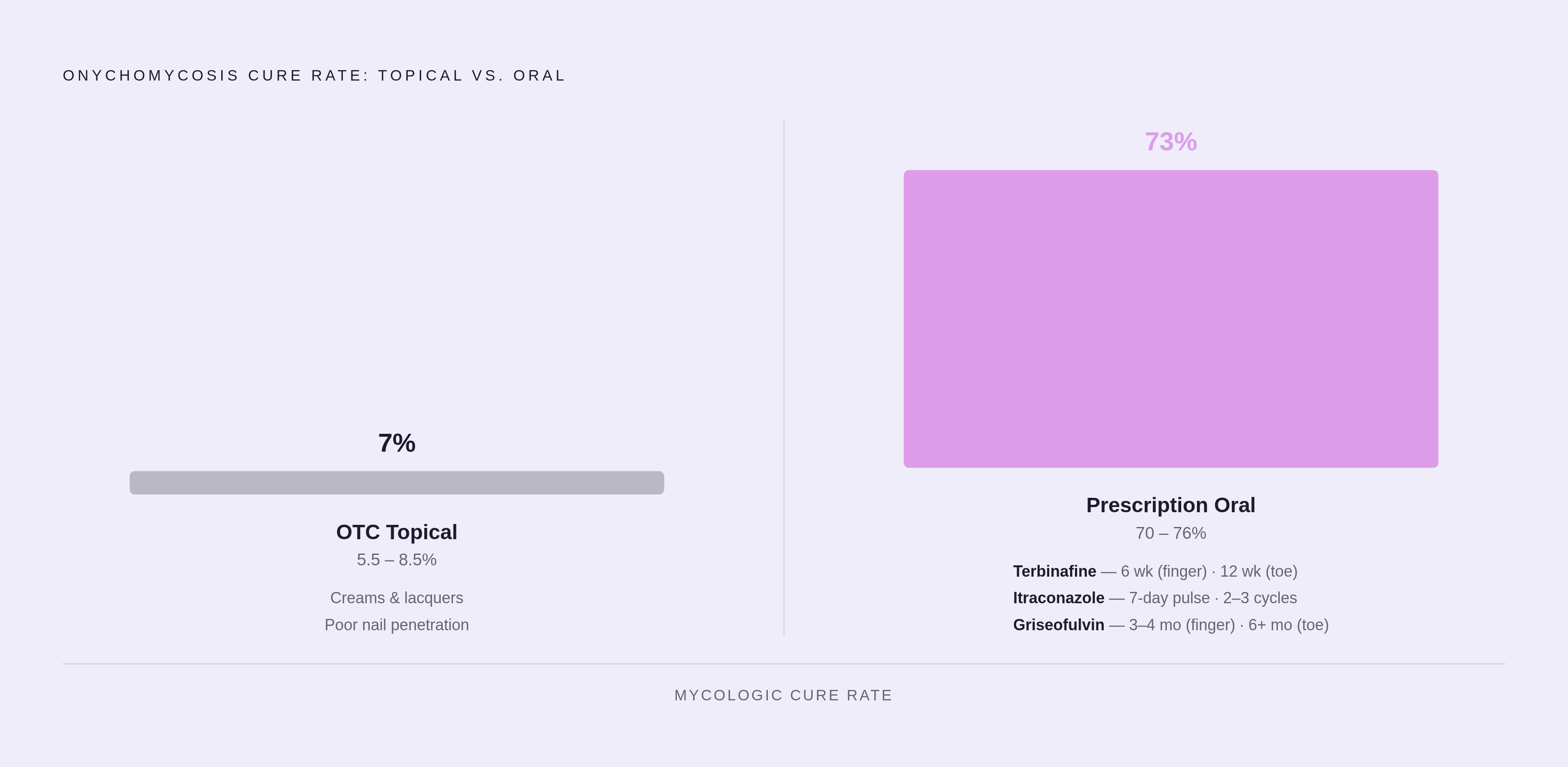
Nail infections make the same point with numbers attached. OTC antifungals achieve cure rates of only 5.5% to 8.5% for nail fungus, compared to 70% to 76% for prescription oral medications getmystride.com. That's not a marginal difference, it's close to a tenfold gap, and it explains exactly why rubbing cream on a discolored, thickened nail for months rarely does much of anything. Other triggers for systemic therapy include large areas of affected skin, immunocompromised status, and chronic infections that keep relapsing despite topical treatment Journal of Dermatologic Treatment.
Antifungal shampoo often gets used alongside it, and given how contagious this infection is, other people in the same household are often advised to use antifungal shampoo too. Left untreated, scalp ringworm can progress to kerion, painful, pus-filled swellings crusted yellow, and in some cases, permanent bald patches. That's a real cost of delay.
Nail treatment runs long, because nails themselves grow slowly. Oral terbinafine takes 6 weeks for fingernails and 12 weeks for toenails AAD WebMD drkothiwalaskineva.com. Griseofulvin needs 3 to 4 months for fingernails and at least 6 months for toenails AAD WebMD drkothiwalaskineva.com. Itraconazole uses a 7-day pulse-dosing schedule, repeated over 2 to 3 monthly cycles AAD WebMD drkothiwalaskineva.com. None of these are quick fixes, and follow-up visits matter simply because clearance takes so long that it's easy to lose track of progress otherwise.
For severe or widespread cases generally, oral treatment runs 1 to 3 months, with the more serious infections stretching to 6 to 12 weeks hhs.texas.gov drkothiwalaskineva.com. These aren't drugs to take casually, either. Griseofulvin isn't recommended during pregnancy, for those planning pregnancy, or while breastfeeding, and it interacts with oral contraceptives and alcohol; side effects can include nausea, headache, and indigestion. Oral terbinafine is contraindicated in liver disease or lupus. Itraconazole needs caution in elderly patients, who may need dose adjustments, and it's strongly discouraged in anyone with active liver disease or elevated liver enzymes, with limited safety data in children requiring close monitoring. Griseofulvin is the standard agent for children, taken orally for 4 to 8 weeks per the AAD, since cream alone does not work.
The emerging resistance problem: Trichophyton indotineae and standard first-line treatment failure
A newer complication has entered the picture, and it can look, at first glance, like a treatment that simply isn't working. Trichophyton indotineae is an emerging dermatophyte species causing severe, hard-to-treat, frequently relapsing infections, even in people with perfectly normal immune systems. Major outbreaks began in South Asia and have spread across continents since 2014, according to the AAD aad.org.
Why does this matter for someone reading about creams and OTC courses? Because T. indotineae is often resistant to terbinafine, the standard first-line oral therapy, due to genetic mutations that reduce the drug's effectiveness against it. A 2026 retrospective case series in the Journal of Dermatologic Treatment documented recalcitrant cases in the U.S. through 2025 and 2026, identified using real-time PCR testing. Standard fungal cultures used in most clinical labs misidentify this species as something else entirely, usually T. mentagrophytes or T. interdigitale. Correct identification needs genomic sequencing.
Clinically, it can look like ordinary, if extensive, ringworm: widespread, scaly, ring-shaped plaques that are intensely itchy and inflamed. That resemblance is exactly the problem. Visual diagnosis alone isn't enough to catch it.
A few red flags should prompt someone to think beyond standard treatment: widespread tinea that isn't responding to topical antifungals, an infection that persists or worsens despite a proper course of oral terbinafine, or travel history to South Asia, or contact with someone who has that history. If a full, correctly-used course of OTC or prescription treatment fails, that's a cue to see a clinician rather than try harder with the same cream. It's a cue to see a clinician who can order culture testing, consider sequencing, and weigh alternative systemic agents. Itraconazole has shown some usefulness in these resistant cases specifically where terbinafine has already failed.
Treatment mistakes that cause ringworm to persist or return regardless of severity
Stopping treatment early is, by a wide margin, the most common reason ringworm comes back. The rash almost always looks better before the fungus is actually gone, and that visual improvement tricks people into quitting too soon.
Steroid creams make things worse, not better, and that's a genuinely common mistake. Plain hydrocortisone suppresses the inflammatory response that's actually helping fight the fungus off, and doing that while the fungus keeps spreading underneath is close to counterproductive. Sometimes this produces what's called tinea incognito: the inflammation gets masked by the steroid, so the rash looks calmer while the infection quietly spreads. Standard clinical guidance doesn't recommend topical corticosteroids for tinea corporis or tinea cruris, for exactly this reason.
Home remedies deserve a skeptical look too. Apple cider vinegar shows some antifungal activity in lab dishes, but on actual skin it can cause open sores and inflammation. Tea tree oil has some antifungal properties as well, but the clinical evidence behind it isn't solid enough to lean on. Neither one replaces a proven antifungal agent, and treating either as a substitute usually just buys time for the infection to spread further.
Surfaces play a bigger role in transmission and reinfection than most people assume. It's part of the treatment, not separate from it.
Delaying professional care creates its own tangle. Cycling through OTC products or home remedies can dull the itch temporarily without curing anything, and that pattern often produces a steroid-modified or partially-treated infection that's genuinely harder to identify and treat later. Co-infection gets missed constantly: the AAD notes that athlete's foot and ringworm on the hand frequently occur together, and treating only one site while ignoring the other just reinfects the skin that was cleared. Stopping early is the most common cause of recurrence, since the rash typically looks better before the fungus is eradicated, so therapy should continue for at least a week beyond visible clearing (lesions usually resolve within 2 weeks but therapy should run longer to ensure complete eradication).
When to move from self-treatment to a clinician
Add it up and the case for professional evaluation gets clear fast: a mild case that didn't respond to a full OTC course, a moderate case with multiple lesions spreading despite treatment, any scalp or nail involvement, immune compromise, or red flags pointing toward resistant infection. None of these are edge cases that will resolve if you simply wait them out. Each one is a specific, recognizable signal that a cream alone has run out of runway.
What does that evaluation actually look like? A clinician can examine the lesion directly, take a scraping for microscopy or culture, and, where standard culture keeps coming back inconclusive or the infection keeps recurring despite treatment, order the kind of PCR or genomic testing that catches something like resistant T. indotineae Journal of Dermatologic Treatment. That's simply not available over the counter, and it's the difference between guessing at the next cream to try and knowing, with actual lab confirmation, what's being treated and which drug has a real shot at treating it.
Sources
- 9 Best OTC Ringworm Treatments and Creams - GoodRx
- Ringworm: Diagnosis and treatment
- Ringworm Treatment
- Ringworm (Tinea Corporis): What It Looks Like, Causes & Treatment
- Therapeutic Class Reviews ANTIFUNGALS TOPICAL
- Best Medicines for Ringworm -
- Recalcitrant tinea infections due to Trichophyton indotineae in the United States (2025-2026): a retrospective case series identified by real-time PCR - PubMed
- Ringworm Medicine: Best Tablets & Creams | Dermatologist Verified