Acne Versus Perioral Dermatitis Visual Identification
Knowing where the rash spares skin reveals which condition you're actually facing.
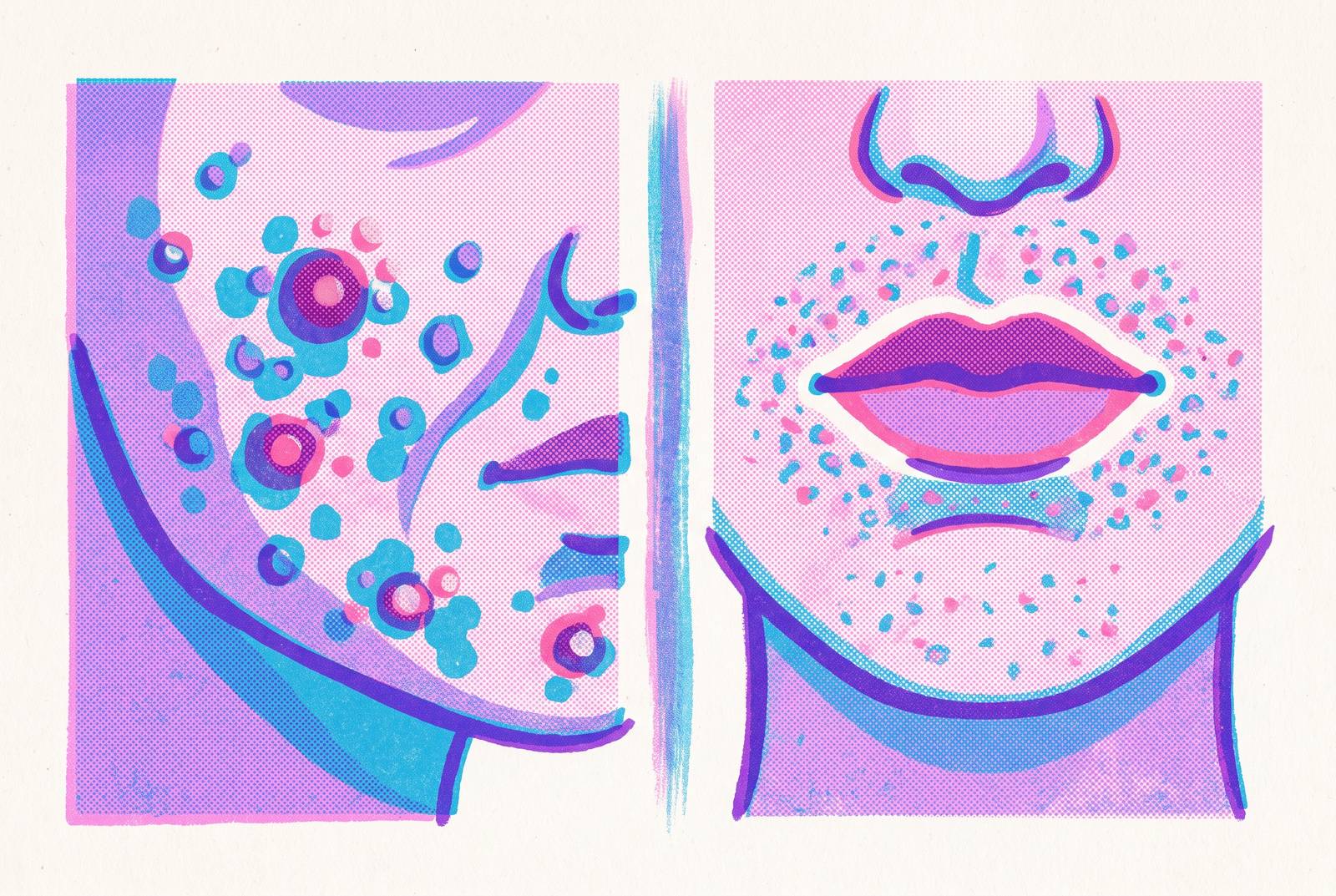
Acne and perioral dermatitis are two different diseases that happen to produce the same surface picture: small red bumps clustered on the lower face. That overlap is why perioral dermatitis ranks among the most consistently misdiagnosed skin conditions seen in clinical practice. A patient notices a rash near the mouth, reaches for benzoyl peroxide or a salicylic acid cleanser, applies it for weeks, and watches it spread across the chin and mouth area. That sequence is the single most common version of this mistake.
The confusion isn't a failure of attention. Both conditions genuinely produce erythematous papules, pustules, and clusters of irritation in the same general territory, so two people looking at the same patch of skin could reasonably land on either diagnosis. The biology underneath is what they can't see just by looking. Acne comes from excess oil production, blocked follicles, and bacterial overgrowth inside the pore. Perioral dermatitis comes from a disrupted skin barrier, inflammation, and a shift in the skin's microbiome. Those are two separate disease processes, and they only resemble each other on the surface.
That gap matters because the standard response to one makes the other worse. Benzoyl peroxide, retinoids, and exfoliating acids are built to clear blocked pores and reduce oil, which is useful against acne and actively irritating to a barrier that's already compromised. Applying acne treatment to perioral dermatitis typically makes the rash expand. Getting the distinction right before choosing a product determines whether treatment helps or actively deepens the problem.
The one visual marker that settles most cases: the lip border
One feature does more diagnostic work than any other: the thin strip of skin that borders the lips themselves. In perioral dermatitis, that strip stays clear. The Merck Manual, in its September 2026 review, calls this the Grenz zone. The eruption classically starts at the nasolabial folds, the creases running from the nose to the corners of the mouth, and spreads outward from there, but it characteristically spares a narrow band around the vermilion border, the edge where the lip's skin meets its colored tissue.
Picture the pattern: papules and pustules scattered around the mouth, the nose, and sometimes the cheeks, with a clean, untouched ring immediately surrounding the lips. That sparing is consistent enough to function as a clinical marker, not a loose rule of thumb. It shows up because perioral dermatitis behaves like a reaction centered on facial orifices and the skin just beyond them, rather than a uniform rash that covers everything indiscriminately.
Acne doesn't follow that pattern. Lesions can appear directly on and across the lip border along with everywhere else on the lower face, because acne arises wherever sebaceous glands are dense and follicles get blocked, regardless of proximity to the mouth. There's no biological reason for acne to spare that strip of skin, and it generally doesn't.
This marker is worth starting with because it requires nothing. No magnifying glass, no dermatoscope, no training. A reader can check a mirror and ask one question: is the skin right next to the lips clear, while the bumps cluster just beyond it? A yes points toward perioral dermatitis before any other feature gets evaluated.
The full visual checklist: five features that separate one condition from the other
The lip border is the fastest signal, but five features together build a far more reliable picture. Each one adds independent evidence, and reading them together builds a solid, reliable picture.
Comedones, the blackheads and whiteheads that define acne at a structural level, are the first checkpoint. The Merck Manual's September 2026 review states that perioral dermatitis is distinguished from acne by the absence of comedones. If blackheads or whiteheads show up anywhere in the affected area, perioral dermatitis becomes less likely. Their complete absence is one of the strongest signals pointing away from acne, and it's the feature clinicians check first for good reason: comedones form through a blocked follicle, a mechanism perioral dermatitis doesn't share.
Distribution across the face is the second checkpoint. Acne spreads wherever sebaceous glands cluster densely: jawline, cheeks, forehead, chest, back. Perioral dermatitis stays tight around facial orifices, the mouth, the nasolabial folds, the chin, sometimes the area around the eyes, and rarely appears on the chest or back. A breakout confined entirely to the area around the mouth and nose, with clear skin everywhere else including the torso, fits the perioral dermatitis pattern far better than it fits acne.
Lesion character is the third. Perioral dermatitis bumps tend to run small and uniform, roughly 1 to 2 millimeters, appearing in tight clusters that look similar to one another. Acne produces mixed morphology: blackheads next to deep cysts next to surface pustules, varying in size and depth across the same breakout. A 2026 Zensa Skincare resource makes the same observation, noting that perioral dermatitis bumps tend to appear in uniform clusters, while acne shows varied forms. Deep, painful nodules are an acne feature; perioral dermatitis doesn't typically produce that kind of depth.
Sensation is the fourth, and it's one most people overlook because they expect a rash to itch. Perioral dermatitis commonly causes burning, tightness, or itching, driven by barrier disruption, rather than the tenderness and pain that come with inflamed or cystic acne. The surrounding skin often feels dry or flaky, a contrast to the oilier texture typical of acne-affected skin. Stinging when a skincare product gets applied is a meaningful clue, since barrier breakdown is part of how perioral dermatitis works.
Skin tone changes how the whole picture reads. On lighter skin, perioral dermatitis appears as a visibly red rash. On darker skin tones, the same lesions can appear skin-colored instead of red, making the bumps much harder to flag as inflammatory at a glance. When redness isn't a reliable cue, the other markers carry more weight: the clustering pattern around the mouth and nose, the clear strip at the lip border, and the absence of comedones all become more important checkpoints precisely because color alone won't settle the question.
How the response to common treatments reveals the diagnosis
A rash that gets worse under treatment is giving information, not just failing to respond. How skin reacts to common products often confirms a diagnosis the visual checklist only suggested.
Standard acne treatments, benzoyl peroxide, retinoids, exfoliating acids, harsh cleansers, tend to irritate perioral dermatitis and can spread the rash outward, because they add inflammation and further disrupt an already compromised barrier. A rash that expands after a week of benzoyl peroxide is behaving exactly as perioral dermatitis behaves under that kind of pressure.
Topical corticosteroids complicate the picture in a more dangerous way. Over-the-counter hydrocortisone, often applied by patients who assume they're calming inflammation, does calm perioral dermatitis at first. The rash improves, sometimes dramatically, for as long as the steroid is used. Then it worsens significantly once the steroid stops. The Merck Manual's September 2026 review identifies glucocorticoid exposure, whether topical, intranasal, or systemic, as the most notable external factor associated with perioral dermatitis developing. Using a steroid cream on the condition doesn't just fail to treat it. It can be the very exposure that caused or worsened it.
This rebound cycle is the most consequential pattern in the whole comparison. A treatment that appears to be working is actually deepening the underlying problem and setting up a flare that arrives worse than the original rash once the cream is stopped. A rash around the mouth that clears under steroid cream and then returns with more bumps, more redness, or more spread is a strong signal pointing toward perioral dermatitis.
One short, isolated use of a steroid cream may not trigger the full rebound cycle. Repeated use reliably does cause the rebound, which explains why the pattern shows up so often in people who've been managing a stubborn rash for weeks or months with whatever is in the medicine cabinet.
The confusion here is understandable since both conditions start out looking like similar surface inflammation, but the mechanistic difference between them is absolute, and treating one as the other for months only deepens the misdiagnosis. A licensed clinician can usually spot the distinction within minutes of reviewing the pattern and the treatment history, while a patient working from appearance alone risks making perioral dermatitis worse with the very products that would help acne. Pairing AI-guided symptom intake with fast clinician review, as Nolla's platform does, can catch that distinction before a patient commits to months of the wrong regimen.
What triggers perioral dermatitis that would never trigger acne
Perioral dermatitis has its own set of causes, and none of them explain acne. Tracing a recent trigger often confirms the diagnosis on its own, independent of the visual checklist.
The Merck Manual's September 2026 review lists glucocorticoid exposure through multiple routes, fluoride exposure from water and toothpaste, occlusive emollient use, and environmental triggers like UV light, wind, and heat as established contributing factors. Proposed hormonal contributors include pregnancy, contraception, and the menstrual cycle. Fluorinated toothpaste in particular gets overlooked constantly: it sits in direct contact with the exact skin perioral dermatitis affects, a route of exposure acne biology has no equivalent for. Heavy occlusive moisturizers and foundation applied around the mouth have also been implicated in cases where corticosteroids weren't the primary driver.
The hormonal angle is worth a brief note for anyone who's changed contraceptive methods recently. Perioral dermatitis primarily affects women of childbearing age, and hormonal shifts tied to oral contraceptive use, pregnancy, and premenstrual cycles have been observed as risk factors. A patient switching from a combined oral contraceptive to a progestogen-only method, for instance, may notice new bumps around the mouth and assume it's hormonal acne. The mechanism driving that flare can be entirely different.
The sharpest example of how distinct these two conditions are comes from a 2025 case report in JAAD Case Reports, which documented perioral dermatitis developing as a side effect of clascoterone 1% topical cream, sold as Winlevi by Cassiopea S.p.A., a subsidiary of Cosmo Pharmaceuticals N.V. Clascoterone is an antiandrogenic therapy approved to treat acne vulgaris. It works by competitively blocking dihydrotestosterone from binding to androgen receptors in the skin. In this case, a medication prescribed specifically to treat acne triggered the condition most often mistaken for acne. The report's authors note that perioral dermatitis developing from clascoterone use remains rarely described in the literature, but the case is a clear reminder that even a prescription acne treatment can, in rare instances, produce the look-alike condition it was meant to prevent. That possibility shows why the visual checklist matters even for patients already on a dermatologist-prescribed regimen.
Where visual self-assessment reaches its limit
The checklist covered here narrows the field reliably for most people. It doesn't close every case. Perioral dermatitis shares features with rosacea, contact dermatitis, seborrheic dermatitis, and demodicosis (a mite-related skin condition), and separating it from each of those takes more than a mirror check.
The Merck Manual's September 2026 review draws the line this way: perioral dermatitis is distinguished from acne by the absence of comedones, and from rosacea by rosacea's tendency to spare the area immediately around the mouth and eyes, the opposite of where perioral dermatitis concentrates. Rosacea produces inflammatory papules, redness, and visible blood vessels across the central face, but it typically doesn't cluster tightly around the mouth and lips the way perioral dermatitis does. Distribution is what separates the two there. Seborrheic dermatitis and contact dermatitis also need to be ruled out in a full clinical picture, since both can produce overlapping redness and flaking in similar territory.
The checklist works best as a convergence test. No comedones, a clear lip border, tight clustering around the mouth and nose, a burning or itching sensation, and a history of getting worse on acne products, when several of these line up together, the pattern becomes close to unmistakable. When only one or two show up in isolation, a clinician's confirmation adds real certainty beyond reassurance.
Confirmed perioral dermatitis is treated by stopping all topical steroids, using a structured taper rather than abrupt withdrawal if steroids have been used heavily, identifying and removing whatever triggered it, and typically adding a prescription topical: metronidazole or erythromycin, or topical pimecrolimus, with oral tetracyclines reserved for cases that don't respond to topical treatment. None of these are available over the counter. The actual treatment for this condition can't be picked up at a pharmacy without a prescription, which is part of why self-treating with whatever's already in the bathroom cabinet tends to go on for so long before anyone reconsiders the diagnosis.
Stopping corticosteroids and removing an identified trigger can begin the moment the pattern is recognized, well before a clinician confirms anything, and doing so carries no real risk. That makes this a condition where acting on the visual pattern early is reasonable, while getting the prescription piece right still requires a professional.
Self-assessment using the lip-border marker is something any reader can do without help. Confirming it, particularly in borderline cases or on skin tones where redness doesn't register as clearly, is where a licensed clinician's review still matters most. Asynchronous telehealth fits this kind of evaluation well: a clinician looking at photos alongside a product and medication history can apply the same criteria laid out here and prescribe the right topical without requiring an office visit, provided the presentation isn't severe or spreading rapidly, in which case in-person care remains the right call. Nolla's message-based consultation connects a patient with a licensed clinician who reviews photos, checks product and treatment history, and builds a care plan from there, with an AI-assisted intake, trained on labeled clinical cases, structuring the symptom and exposure history beforehand so the clinician reviewing it sees both the visual pattern and the trigger history that actually drive a perioral dermatitis diagnosis.