How Hormonal Changes Alter Skin Type and Behavior
Your skin converts hormones locally, so normal bloodwork doesn't rule out hormone-driven breakouts.
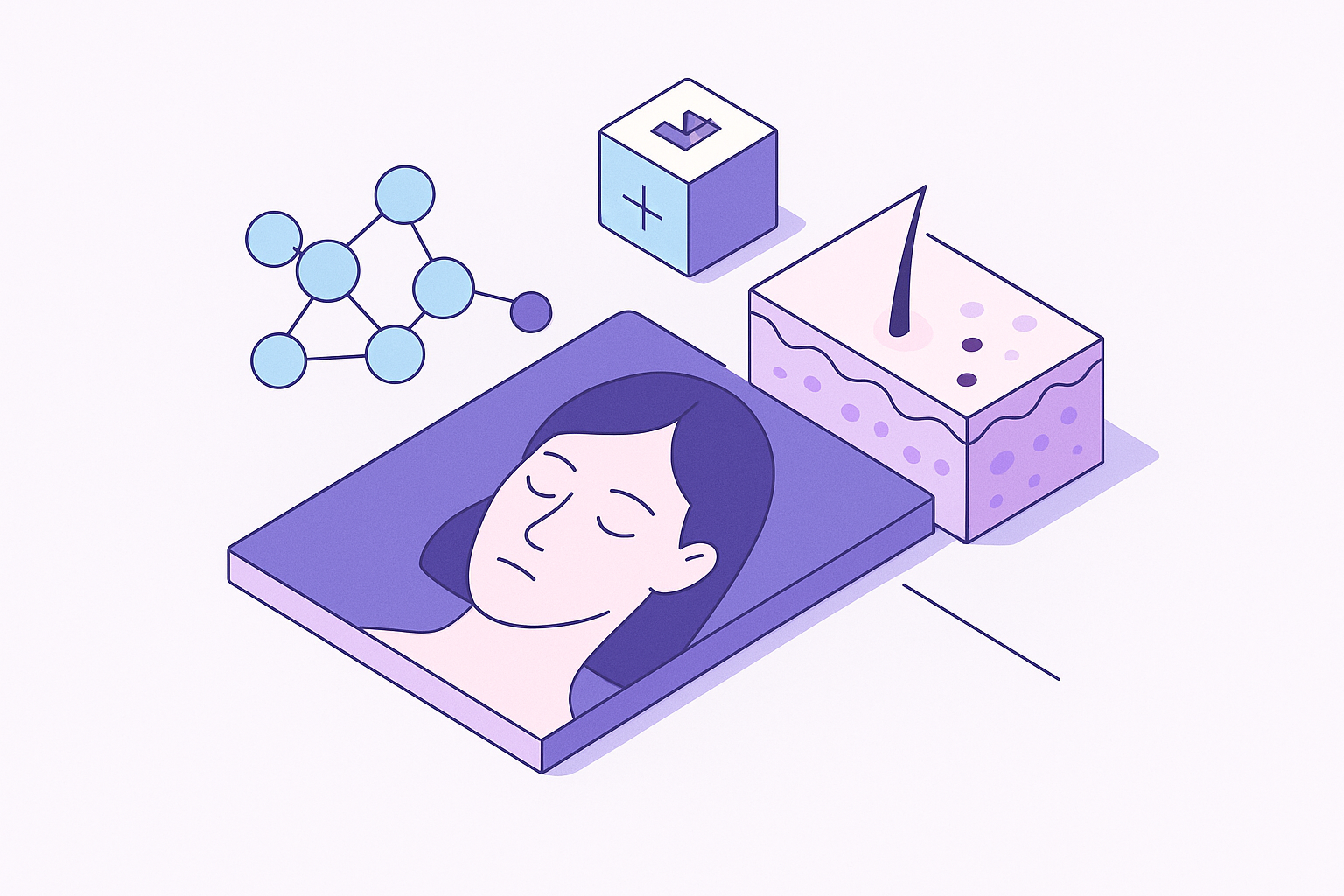
Skin is an endocrine organ, full stop. It reads estrogen, androgens, and progesterone the same way your ovaries or thyroid do, and once you take that seriously, acne and dryness and aging stop looking like surface problems. Fibroblasts, sebocytes, melanocytes: these cells listen to your hormones all day long, and what they hear decides how much oil you make, how well you hold water, how your pigment behaves.
I keep running into the same misdiagnosis, in dermatology offices and in casual conversation. Someone treats a breakout as a cleanser problem or a diet problem when it's actually a hormone problem that happens to be showing up on the face. Three pathways carry almost all the weight here. Androgens act on sebaceous glands and drive oil. Estrogen acts on fibroblasts and governs collagen, elasticity, barrier function. Estrogen and progesterone together act on melanocytes and control pigment.
Cortisol deserves a mention, even though it's not the main character here. As the body's chief stress hormone, it raises inflammation and can worsen eczema and psoriasis. Thyroid hormones tell a similar story from a different angle: hypothyroid skin runs dry and thin, hyperthyroid skin runs warm and moist. Neither is the focus of this piece, but both point at the same rule: hormones running skin behavior isn't the exception, it's the default.
And here's the detail that reframes a lot of what follows. Skin converts testosterone and DHEAS into DHT locally, right there in the tissue, and that local conversion matters more, in a lot of cases, than whatever number comes back on a blood panel. I've sat across from people whose labs read completely normal while their skin behaves like it's swimming in androgens. Skin builds its own hormone environment, fairly independent of what's circulating everywhere else in the body. So "your bloodwork is fine" and "your skin is breaking out from hormones" can both be true at the same time.
How androgens drive oil production and set up the conditions for acne
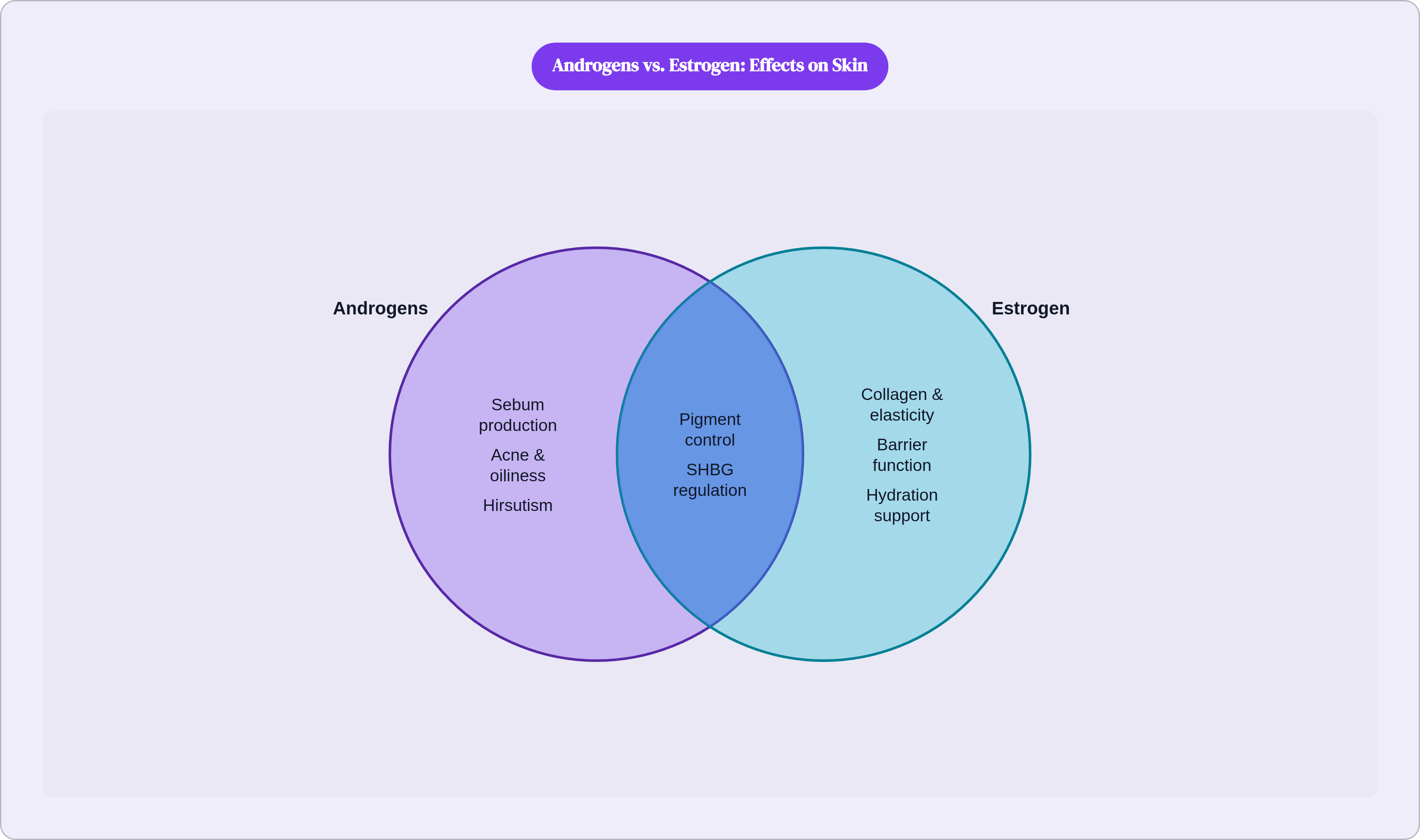
Sebum starts inside acinar cells in the sebaceous glands. As those cells mature, they rupture and dump their contents into the duct, and every step of that runs on androgen signaling from start to finish.
What comes out is a specific cocktail: triglycerides, wax esters, fatty acids, sterol esters, squalene. Cutibacterium acnes (formerly Propionibacterium acnes) eats that mix as its main food source. Excess sebum builds the environment where acne becomes far more likely, and most skincare marketing flattens that into something simpler than it actually is.
Two sources feed the androgen side: the gonads, which make testosterone, and the adrenal glands, which make DHEA. Among the androgens involved, DHT is the most biologically active form, and it gets converted locally within skin tissue rather than arriving pre-made from the blood. Why does that matter so much? Because it's the reason someone with a completely normal testosterone lab value can still be dealing with textbook androgen-driven breakouts.
Estrogen pulls the other direction. It raises sex hormone binding globulin (SHBG), which mops up free testosterone and leaves less of it around to act on skin. Less free testosterone means smaller oil glands and less sebum. That's the mechanism behind why certain oral contraceptives clear acne, and it's the same androgen-sebum loop that resurfaces in puberty, across the menstrual cycle, in PCOS, and during pregnancy.
What happens to skin across the menstrual cycle, week by week
During the follicular phase, as estrogen climbs, oil gland activity tends to drop and skin often looks clearer. That's estrogen's anti-androgenic effect, playing out in real time on your face.
Sebum production usually bottoms out around ovulation. For a lot of people this is genuinely the best skin week of the month, lining up with the estrogen peak almost exactly.
Then progesterone takes over through the luteal phase and does the opposite: it enlarges pores and increases oiliness. This is the actual mechanism behind premenstrual breakouts. Inflammatory lesion counts climb measurably in the days before a period, for people who track this closely enough to notice. If the cleanser that worked fine two weeks ago suddenly isn't cutting it, that's why, not a bad batch of product.
It's not only about oil, either. Transepidermal water loss and hydration shift across the cycle too, so hormones move your moisture barrier around as much as your oil glands. Map your own cycle for a month or two and you can start timing product choices instead of guessing: lighter moisturizers mid-cycle, barrier-supporting formulas in the days before your period.
Individual variation runs large here. People who run naturally oily tend to see sharper luteal-phase surges than people with drier skin, though not everyone moves through all four phases the same way.
Puberty and the first major androgen surge
Puberty brings the first big androgen spike, and sebaceous glands respond with a real step-change in activity. Sebum production during adolescence tends to hit its lifetime peak right here, which is worth remembering next time someone blames a teenager's face full of breakouts on what they ate for lunch.
None of this is new. The link between pubertal hormone changes and acne vulgaris has been recognized clinically for close to a century. Sweat glands ramp up around the same time, hair gets coarser, and both trace back to the same androgen signal acting on different structures throughout the body.
Teen acne is a predictable biological response to a hormonal environment the body is meeting for the first time. It has little to do with hygiene or diet, however tempting that explanation feels at the dinner table.
One detail catches a lot of parents off guard: both the gonads and the adrenal glands contribute androgens during puberty, with DHEA from the adrenals playing a real role alongside gonadal testosterone. Skin changes can appear early in this process, which often surprises families when they encounter them alongside other signs of development.
Puberty is the cleanest version of this mechanism anywhere in this piece: one hormone family, one pathway, one predictable outcome. PCOS and pregnancy come with more moving parts, and more weight riding on getting the diagnosis right.
PCOS as a chronic version of androgen excess and what it does to skin
PCOS produces androgen excess that doesn't rise and fall with a cycle. It just stays elevated. Persistent oily skin, ongoing acne, hirsutism, scalp thinning: these all point to a sebaceous-androgen pathway left switched on continuously instead of cycling through highs and lows the way it does for most people.
Insulin resistance makes it worse. It suppresses SHBG and raises free testosterone, which intensifies androgen-driven skin symptoms, so severity in PCOS is shaped by metabolic factors alongside what's happening in the ovaries themselves.
One sign worth knowing on sight: acanthosis nigricans, those velvety, darkened patches that show up at the neck or underarms. It's a visible marker of insulin resistance sitting underneath the surface, often before anyone's ordered a fasting glucose test.
There's a popular idea that jawline acne equals hormonal acne, and clinically, that pattern does get described as characteristic of PCOS. But observational data tells a messier story. Most adult women with acne break out across multiple facial zones, not just the jaw, so location is a clue at best, not a diagnosis. Be careful of anyone who tells you otherwise with total confidence.
That distinction matters because PCOS needs a real workup, labs and imaging both, and no single test settles it on its own. If pieces of this section sound like your own skin, that's worth a conversation with a doctor, not a self-diagnosis based on where your breakouts happen to sit.
Treatment isn't one-size-fits-all here either. Spironolactone and retinoids both show up commonly for PCOS-related acne, but both need to come off the table if pregnancy is a near-term goal. Which gets at the bigger idea running under this whole section: PCOS runs on the same androgen pathway active everywhere else in this piece. It's just turned up, and left on, month after month.
Pregnancy: when multiple hormonal systems change at once
The first trimester brings a hormone surge strong enough to trigger acne in people who've never broken out in their life. The androgen-sebum mechanism shows up in a brand-new context, and for a lot of people that's an unwelcome surprise around week eight or nine, right when everything else about the body already feels unfamiliar.
The pattern across pregnancy isn't a straight line. Acne often improves in the middle trimester as hormones settle, then flares again for some people in the third. There's no predictable course to plan around here, which is frustrating for anyone who wants a clean answer.
Melasma, sometimes called the "mask of pregnancy," is another major piece of this. Rising estrogen and progesterone push melanin production up, and the result is darkening, especially across the face. It affects a substantial share of pregnant people, making it one of the more common skin changes of pregnancy.
UV exposure makes melasma worse, so mineral sunscreens, zinc oxide and titanium dioxide, are the recommended choice during pregnancy. Stretch marks are the other big structural change: rapid stretching combined with hormonally reduced elasticity leaves a large majority of pregnant people with them by the third trimester. Johns Hopkins Medicine notes that no treatment has been proven to prevent or erase them, so managing expectations matters here as much as managing the skin itself.
Ingredient safety is where this section stops being conceptual and starts being urgent. All retinoids, retinol, retinal, retinyl palmitate, prescription forms, should be avoided under ACOG guidance. That holds even though topical retinol hasn't been definitively proven harmful in humans; the recommendation is precautionary, not punitive. Oral isotretinoin sits in a different category entirely. Its teratogenicity risk is severe and well established, not a gray area anyone should debate over coffee. For acne during pregnancy, gentle cleansers, azelaic acid, and low-dose benzoyl peroxide are the safer road.
Pregnancy might be the clearest example in this piece of hormonal skin change demanding an actual decision, not just an explanation you nod along to.
What estrogen decline does to skin structure during perimenopause and menopause
Estrogen starts tapering in the mid-40s for most people, sometimes earlier during perimenopause, and collagen and elasticity decline right alongside it. Research published in Cosmetics found a 30% reduction in collagen within the first five years after menopause. That's a steep drop for a five-year window, and it surprises most people the first time they hear it.
Estrogen's role runs through the extracellular matrix, the structural scaffold that gives skin its strength and bounce. Without enough estrogen signaling, that matrix breaks down faster than the body can rebuild it, and the mismatch shows up on the surface as sagging and thinning.
Perimenopause brings its own list on top of that: dryness, itching, deeper wrinkles, unwanted hair in new places. The dryness isn't only about collagen loss, either. Estrogen also supports barrier function and helps regulate transepidermal water loss, so its decline hits hydration directly, not just structure. Pigmentation irregularities tend to increase here too, looping back to the same melanocyte pathway that showed up earlier during pregnancy.
Hormone replacement therapy offers a partial answer. Research on HRT suggests it can partially restore collagen, elasticity, and hydration lost to estrogen decline. But there's a gap here. HRT is approved for treating menopausal symptoms generally, not specifically for estrogen-deficient skin, and the data showing a clearly favorable benefit-risk balance for skin alone, as a standalone reason to start HRT, isn't strong enough yet.
For people who aren't candidates for HRT, or aren't interested, topical approaches fill part of the gap. Retinoids, peptides, and hyaluronic acid offer a partial, more modest complement to what estrogen does system-wide. Nobody should mistake them for a replacement.
How masculinizing hormone therapy changes skin — a parallel to puberty, in adults
Trans men and others starting masculinizing hormone therapy often see increased oiliness and acne, especially in the first year. Sound familiar? It's the same androgen-sebum mechanism driving adolescent acne, just triggered in an adult body meeting that hormonal environment for the first time instead of a teenage one.
For many people, these effects settle as the body adjusts over time, more of an adjustment period than a permanent state.
Treatment-wise, the same tools used for other androgen-driven acne apply: topical retinoids, azelaic acid, and in some cases oral options. One clear exception: spironolactone, an anti-androgen that works directly against the goals of masculinizing therapy, has no place here even though it's a go-to elsewhere in this piece for hormonal acne.
The bigger point is about anticipation, not treatment. Understanding this mechanism means someone starting testosterone therapy can expect the skin changes, seek care early, and recognize a predictable hormonal effect for what it is rather than something going wrong. The evidence base here runs thinner than for the other life stages covered in this piece.
Clinical treatments that address the hormonal root, not just the surface symptom
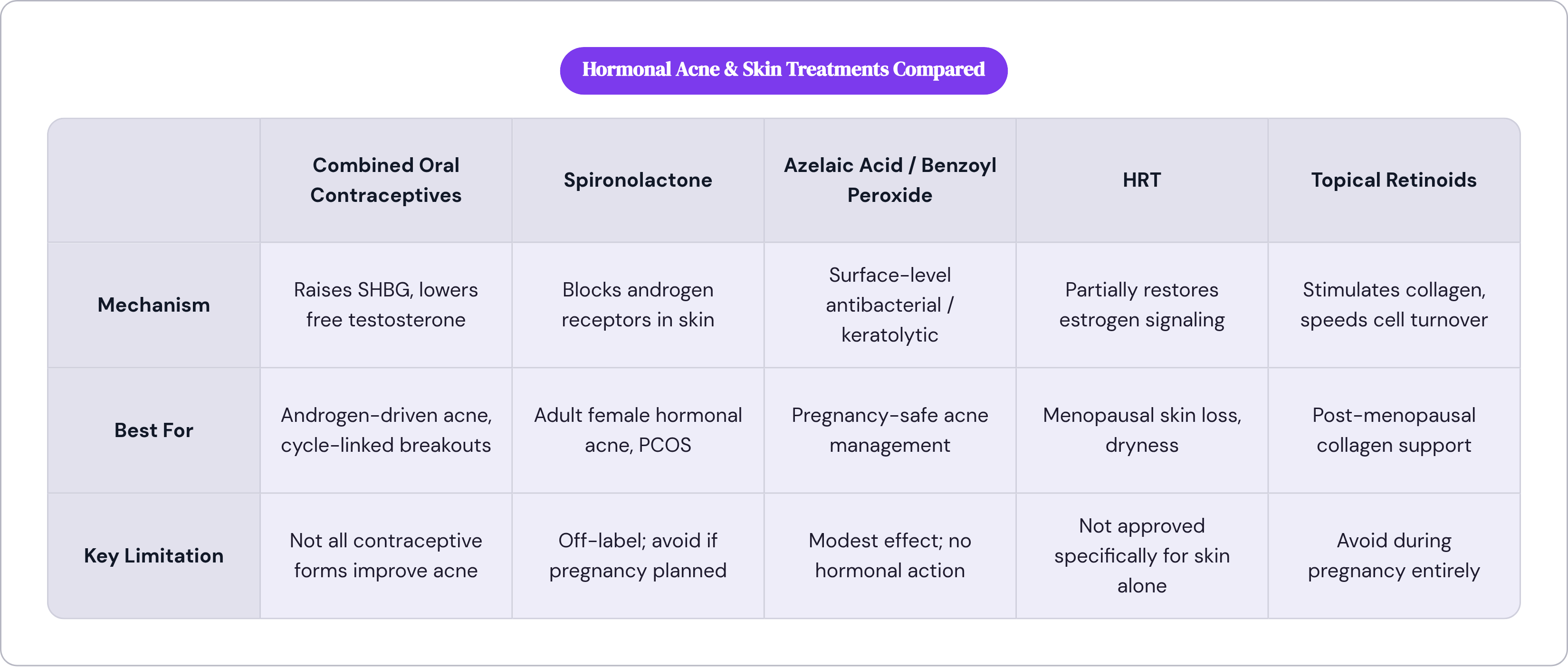
Combined oral contraceptives work through the mechanism already laid out: raise SHBG, lower free testosterone, shrink sebum output. A Cochrane review covering 31 trials and thousands of women found COCs consistently reduced both inflammatory and non-inflammatory acne compared to placebo. That's a substantial body of evidence, not a hunch someone's running with.
Here's the catch worth knowing before talking to a prescriber: most COCs aren't specifically approved for acne treatment, even with that evidence behind them, and not all hormonal contraceptives behave the same way on skin. A large retrospective analysis found that depot injections, subdermal implants, and hormonal IUDs tended to worsen acne on average, while the vaginal ring and combined oral contraceptives performed better. Worth knowing if you're choosing birth control for reasons that have nothing to do with acne but would still rather not make your skin worse along the way.
Spironolactone works through a different route entirely. It blocks androgen receptors in the skin directly, cutting sebum and acne at the source rather than adjusting hormone levels upstream. A 2025 evidence review in JAAD Reviews identified 16 randomized controlled trials and 52 nonrandomized studies, with two well-designed placebo-controlled trials confirming effectiveness at daily doses of 50 to 100 mg in adult women. It's used off-label, but at this point it's close to standard for adult female hormonal acne, with the same caveat as the PCOS section: avoid it if pregnancy is planned.
For pregnancy specifically, azelaic acid, low-dose benzoyl peroxide, and gentle cleansers fill the space left when retinoids and spironolactone are off the table. None carry much hormonal mechanism of their own, but they're appropriate exactly where the stronger options aren't safe. For menopause, HRT offers partial structural restoration where it fits someone's broader health picture, and topical retinoids support collagen for people who aren't on HRT or don't want to be.
Treatment has to match the actual hormonal mechanism driving what shows up on the skin, not just the symptom sitting in the mirror. That means knowing which phase or condition is really behind it, and that's rarely obvious from a photo. It usually takes bloodwork, a real history, and someone willing to look at the whole picture with you.