Perioral Dermatitis Treatment and Steroid Withdrawal
Steroid creams worsen this mouth rash and create a difficult withdrawal cycle.

Perioral dermatitis is a rash around the mouth that gets worse, almost paradoxically, from the very treatment most people reach for first: topical steroids. Understanding why that happens, and how to get out of the cycle once it starts, is the actual challenge here. Everything else in treatment follows from that one fact.
What perioral dermatitis is and why it is frequently mismanaged from the start
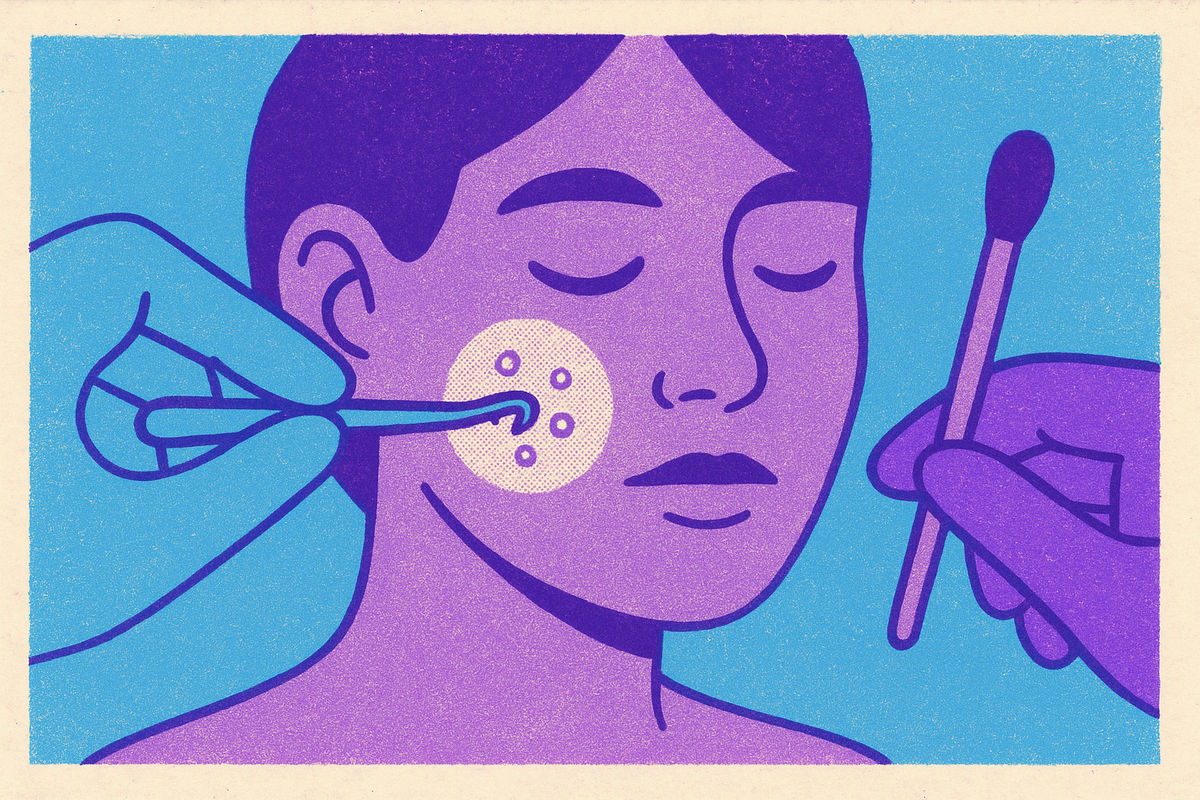
Perioral dermatitis (POD) is estimated to occur in 0.1% to 1% of people, mostly women between 20 and 45, though it isn't limited to that group by any means. The rash presents as small red bumps, sometimes with pustules, sometimes as pink scaly patches, clustered tight around the mouth. One detail matters a lot for diagnosis: the skin right at the lip line, the vermilion border, tends to stay clear. The same pattern can also show up around the eyes and beside the nose.
It's not dangerous. But anyone who has dealt with a rash on their face for weeks knows it doesn't need to be dangerous to be distressing. It's visible, it recurs, and it wears on people, which is exactly why so many reach for a steroid cream the moment it appears. That reflex is where the trouble usually starts.
Getting the diagnosis right matters too, because the wrong read leads straight to the wrong treatment. POD lacks the comedones (blackheads and whiteheads) that mark acne vulgaris. Rosacea tends to bring more central facial flushing. Seborrheic dermatitis appears with greasy scale, often in the scalp and eyebrows. Contact dermatitis has its own pattern tied to a specific exposure. Mix these up, and a clinician or patient can end up treating the wrong condition.
The skin biology that makes topical steroids a trap on the face
POD is a multifactorial condition where the skin's barrier, the outermost structural layer that keeps moisture in and irritants out, breaks down. It's a multifactorial condition where the skin's barrier, the outermost structural layer that keeps moisture in and irritants out, breaks down. Once that barrier is compromised, everything downstream gets harder to manage.
The skin's microbial population shifts too. In milder cases, more benign bacteria like S. epidermidis and S. hominis dominate. In more severe presentations, S. aureus and S. haemolyticus increase. Research from Ferček and colleagues found statistically significant differences in microbial diversity between periocular dermatitis patients and healthy controls. Separate work by Mochizuki and colleagues found that POD's microbial makeup differs meaningfully from both rosacea and healthy skin, and identified an uncultivated bacterium from the order Neisseriales that dominated in steroid-induced rosacea and POD cases, then disappeared after antibiotic treatment. That disappearance is a clue, not proof, but it points toward steroids doing something specific to the skin's bacterial ecosystem, not just suppressing visible redness.
So what do steroids actually do here? They thin the epidermis over time (atrophy), they cause rebound inflammation once stopped, they dilate blood vessels, and they trigger the release of proinflammatory cytokines, the signaling molecules that drive redness and swelling. Those four mechanisms, together, are the same ones behind steroid-induced rosacea. And facial skin is uniquely vulnerable to this because it's thin and absorbs topical medication more readily than skin on the arms or legs. A dependency that might take a long time to build on the forearm can develop much faster on the face.
The full range of triggers, with steroids at the center
Topical corticosteroids sit at the center of the trigger list, and the evidence tying them to POD is the strongest and best documented of any cause. Prolonged use is the common thread, and higher-potency steroids carry the most risk.
But steroids aren't the only trigger. In cases where corticosteroids weren't the primary cause, cosmetic and skincare products accounted for up to 63% of triggers, a share too large to treat as an afterthought. Facial mineral sunscreens, whitening toothpaste, moisturizers, and foundation have all been implicated. Fluoride toothpaste specifically has been suspected for a long time, and given how close the mouth sits to the area affected, a direct irritant effect is plausible.
It's not just topical steroids that matter. Inhaled steroids (for asthma), intranasal sprays (for allergies), and oral corticosteroids can all contribute to POD. Anyone tracking down a trigger needs to think beyond the medicine cabinet shelf of creams.
How the steroid rebound cycle works
Here's the mechanism in plain terms. A steroid cream reduces redness, temporarily. That relief feels like progress. Then the cream stops, and inflammation comes back, often worse than before. The patient, understandably, reapplies the steroid to make it go away again. Each cycle through this loop deepens the dependency, and getting out becomes progressively harder the longer it runs.
This isn't a hypothetical warning. In one documented case, a patient was advised to stop steroid use and switch to plain moisturizers only. Within four weeks, the disease got worse, with considerable crusting. That's what a real rebound flare looks like, not a theoretical worst case dreamed up to scare people into caution.
This pattern has been recognized for decades, not years. A paper indexed in a medical research database back in 1993 described two cases illustrating what the authors called an "addictive cycle" tied to long-term topical steroid use on the face. That's over 30 years of documented awareness, and mismanagement still happens routinely. Why does it persist? Partly because the short-term payoff of a steroid, visible redness reduction within days, is so immediate that it overrides the slower, harder path of addressing the actual cause.
What makes withdrawal so hard to sit through is that the skin doesn't return to its pre-steroid baseline when the cream stops. It temporarily gets worse, sometimes considerably worse, before any improvement occurs. That gap between stopping and getting better is exactly where most people give up and reach for the tube again.
Managing steroid withdrawal: what tapering looks like in practice
Quitting cold turkey isn't usually the right call. Abrupt cessation risks a severe flare, and a gradual taper is the standard way to bring the risk down. In practice, that means slowly weaning off the steroid over a period of weeks, sometimes slowly reducing use over a period of weeks rather than stopping abruptly.
On the prescribing side, there's a clear prevention playbook:
- Avoid long-term topical corticosteroid prescriptions on facial skin in the first place
- Rule out superpotent steroid agents on the face entirely
- Topical corticosteroid refills on facial skin warrant careful prescriber oversight
During the actual withdrawal window, less is more. Skincare gets stripped down to topical moisturizers, full stop. This is not the moment to introduce a new active ingredient, a fresh retinoid, or a trendy serum, because the skin is already inflamed and irritable, and adding variables just muddies the picture of what's actually helping or hurting.
The treatment ladder once steroids are out of the picture
Once steroids are off the table, the very first option to consider is doing almost nothing. This gets called "zero therapy," and it means stopping cosmetics and topical corticosteroids and letting the skin recover on its own. Most cases of POD are self-limited once the triggers are actually gone. That's a real finding, not a lesser fallback for people who don't want "real" treatment. Removing the trigger is often sufficient by itself.
For mild-to-moderate disease that needs more than trigger removal, topical options come next:
Topical calcineurin inhibitors, with pimecrolimus 1% cream commonly recommended as first-line for mild-to-moderate POD. The logic here is specific: since corticosteroids can trigger POD and cause rebound flares on discontinuation, using a steroid-free option isn't a marketing detail, it's the entire clinical rationale. Long-term and postmarketing data haven't linked pimecrolimus to steroid rosacea or POD. Topical antibiotics, metronidazole (0.75% to 1%, once or twice daily), erythromycin, clindamycin, used as adjunctive options alongside the above. Azelaic acid (15% to 20%), used as an adjuvant for its combined anti-inflammatory and antimicrobial effects. Topical retinoids have been considered in some cases, though already-compromised skin can react poorly to an irritating ingredient.
For moderate-to-severe cases that don't respond to topicals within four to eight weeks, systemic therapy moves up the ladder. Oral tetracyclines are the standard next step, and doxycycline is a commonly used option in this class. Sarecycline is an emerging option in this same class. Oral tetracyclines are supported as the first-line systemic choice for more severe cases. Macrolides like erythromycin serve as the alternative when tetracyclines aren't appropriate for a given patient.
Roflumilast cream at 0.3% strength, a corticosteroid-free topical that works as a phosphodiesterase 4 inhibitor (blocking an enzyme involved in inflammatory signaling), is an emerging option to watch. The drug has a track record in adjacent conditions. It was FDA-approved for plaque psoriasis in 2022, a foam version was approved for seborrheic dermatitis in 2023, a 0.15% strength was approved for atopic dermatitis in 2024, and a 0.05% pediatric strength followed for atopic dermatitis in children aged 2 to 5 in 2025. In a single case report, a 30-year-old woman with a one-month history of moderate POD achieved complete clearance in five days using once-daily 0.3% roflumilast cream, with no adverse events and no recurrence at 11 months. That's a striking result. But it's one case report, not a clinical trial, and the manuscript support for that case report came from Arcutis Biotherapeutics, the drug's manufacturer. The speed and durability of that result deserve attention. The evidence base behind it is still early, and one case doesn't establish a pattern the way a controlled trial would.
What "zero therapy" and barrier repair mean for everyday skincare
Zero therapy gets misread sometimes as doing nothing. Zero therapy means stripping the routine down to bare minimum and giving the barrier room to rebuild, which is an active choice, not neglect. It means stripping the routine down to bare minimum and giving the barrier room to rebuild, which is an active choice, not neglect.
Part of that active choice is a genuine trigger audit. Remember that facial mineral sunscreens, whitening toothpaste, foundation, and moisturizer collectively appeared in up to 63% of non-steroid trigger cases. Finding the specific product responsible affects how effectively the trigger can be eliminated, compared with vaguely avoiding a whole category of skincare. Swapping out fluoride toothpaste is a low-cost, easy first move worth trying, given its proximity to the affected skin and the plausible direct-irritant mechanism behind it.
Barrier repair moisturizers have a place both during and after treatment, especially alongside topical antibiotics or pimecrolimus. But the specific moisturizer matters. Heavy, occlusive formulations, the kind that seal the skin under a thick film, can trap microorganisms underneath and further disrupt the skin's microbial balance rather than help it settle. Lighter, breathable options tend to serve the barrier better while it's recovering.
When to seek clinical care
POD isn't an emergency. Nobody needs to treat it like one. But it's also not something to assume will resolve on its own without action, because the self-limited outcome only holds when the actual triggers, steroid or otherwise, get identified and removed. Left unaddressed, or worse, treated with more steroids, the cycle just continues.
That's really the fork in the road. One might argue that a rash this common and this well understood shouldn't still be causing years-long flare cycles for so many people. But the mismanagement pattern traces back to a single, understandable mistake: reaching for the fast fix that makes things worse over time. Clinical care exists to interrupt that mistake, first by getting the diagnosis right, then by mapping out triggers, and finally by walking through a taper instead of a cliff-edge stop. Anyone who has been stuck in the reapply-and-relapse loop for more than a few weeks has good reason to bring it to a dermatologist rather than keep managing it solo.
Sources
- Periorificial dermatitis: An updated scoping review of therapeutic evidence - ScienceDirect
- The Treatment of Perioral (Periorificial) Dermatitis With Topical Roflumilast 0.3% Cream: An Illustrative Case Study With Rapid Onset and Prolonged Remission | JCAD - The Journal of Clinical and Aesthetic Dermatology
- Perioral Dermatitis | Treatment & Management | Point of Care - StatPearls
- emedicine.medscape.com
- Perioral Dermatitis
- dermnetnz.org
- pubmed.ncbi.nlm.nih.gov
- ncbi.nlm.nih.gov