Children Skin Conditions That Need Pediatric Evaluation (New)
Learn which childhood skin rashes need immediate medical attention beyond home care.

What Separates a "Watch and Wait" Skin Issue from One That Needs a Doctor
Most parents arrive at this question carrying some version of low-grade dread: is this fine, or is it not fine? That's an honest question. It's also, functionally, the wrong one, because "fine" does most of the work while telling you nothing. The more useful question is whether this presentation has features that change what needs to happen next.
A few signals reliably shift the calculation. Persistence past what you'd expect is one. A rash that looks viral and clears in a week is a completely different clinical story from the same rash sitting unchanged at week three. Spread or worsening while on a reasonable home regimen is another. Secondary infection signals, increasing warmth, visible pus, swelling that wasn't there yesterday, should move things along faster. And systemic signs, fever, swollen lymph nodes, a child who just looks off alongside a skin finding, shorten the timeline considerably.
Here's where it gets counterintuitive: some presentations look cosmetically mild and still need a clinical eye. A small, unremarkable rash in a two-month-old carries a fundamentally different risk profile than the same rash in a healthy seven-year-old. Age and immune status reweight the whole picture.
There's also a category of unusual features that triggers specialist referral regardless of apparent severity: discoloration patterns that don't fit a familiar inflammatory picture, blistering, visible burrow tracks, a mole that looks different than it did six months ago. Not emergencies in every case. Signals that the visual story requires expert pattern recognition, because some pediatric skin diseases simply cannot be diagnosed on appearance alone. Histopathological confirmation changes the diagnosis in a meaningful percentage of cases, which means even experienced clinicians get misled by what they see. Most rashes are fine. The skill is in knowing which ones aren't, and that's a harder skill than it sounds.
Eczema: Why the Most Common Chronic Childhood Skin Condition Still Gets Undertreated
Atopic dermatitis is the condition parents most frequently encounter and most consistently underestimate. It affects 12.7% of U.S. children as of 2024, up from 10.7% in 2021 per the National Health Interview Survey. Globally it ranks first among skin diseases by disability-adjusted life-years. This is not a minor inconvenience dressed in clinical language.
The classic presentation is intensely itchy, dry, red patches on the face, hands, and skin folds. Parents recognize this pattern reasonably well. What they and even clinicians often miss is the more papular variant common in children with darker skin, where severity scoring systems built around erythema systematically underestimate disease burden. Black children in the U.S. carry a higher eczema prevalence than White children per NHANES data. The diagnostic gap falls hardest on the population with the greatest burden. That's a documented, consequential, underacknowledged disparity, and it's worth naming plainly.
Management spans an enormous therapeutic range, from fragrance-free moisturizers and trigger avoidance to prescription topicals and systemic agents. Getting the severity right is what determines which tier of treatment is actually appropriate. A family managing moderate eczema as if it were mild isn't undertreating out of negligence; they're operating with incomplete information. The clinical visit is the mechanism that corrects that. The frustrating part is how structurally difficult that visit can be to access for the families who need it most.
Impetigo and Scabies: Two Highly Contagious Infections That Look Manageable but Carry Real Risks
These two conditions share a deceptive quality: to a non-clinical eye, they look like something you handle at home. Often, you cannot. The reasons are worth spelling out, not to alarm, but because the gap between appearance and consequence is wide here.
Impetigo, caused by Staphylococcus aureus or Streptococcus pyogenes, presents as red sores that rupture and crust with that characteristic honey-colored appearance. Common in toddlers. It can resolve without treatment in some cases, but untreated impetigo carries a real risk of complications including glomerulonephritis and invasive bacterial infection. The complication trajectory is not theoretical, even in settings where effective treatment is accessible and the presentation looks mild.
Scabies is a different animal entirely: a mite infestation producing blisters, pimple-like bumps, and the distinctive hallmark of visible burrow tracks, with intense nocturnal itching that has a way of making everyone in the household miserable simultaneously. The clinical picture is quite recognizable once you know what you're looking at. Which is exactly what makes the misdiagnosis rate surprising. It's underdiagnosed at the individual level and undertreated at the household level, and that's precisely where the transmission dynamics become a public health problem rather than a personal inconvenience. Pediatric dosing for newer agents requires careful clinical judgment; it's not something to approximate.
Both conditions spread fast in household and school environments. Getting evaluated for suspected impetigo or scabies isn't just an individual medical decision. It's a containment decision.
Molluscum Contagiosum and Warts: When "It'll Resolve on Its Own" Becomes the Wrong Answer
The standard pediatric guidance on molluscum contagiosum, benign dome-shaped papules caused by a poxvirus affecting roughly 12 to 14 per 1,000 children annually, has historically been: leave it alone, it will clear. That guidance isn't wrong for mild, stable cases. The trouble is how frequently it gets applied as a blanket posture rather than a conditional one.
Most immunocompetent children do clear molluscum spontaneously, average resolution around 13 months. One in four still has active disease at 18 months. The timeline is unpredictable for any individual child, and when lesions spread, when scratching drives autoinoculation or opens the door to secondary bacterial infection, watchful waiting stops being the right call. The treatment landscape has also expanded meaningfully. A cantharidin drug-device combination and berdazimer gel are now FDA-approved topical options. Candida antigen intralesional injections have been described at recent dermatologic conferences as both easy and effective for molluscum and warts alike. The "leave it alone" reflex made more sense when treatment alternatives were limited or poorly tolerated. The clinical reality has shifted; the reflex is slower to follow.
Warts follow similar logic. Not dangerous, slow to resolve, and in children who scratch or pick, the spread risk is real. The evaluation trigger for both conditions is an unusual appearance that mimics other lesions, immunocompromised status, or a degree of spread that has moved beyond what a family can reasonably observe and manage on their own.
Ringworm, Hives, and Diaper Dermatitis: Common Presentations Where Misidentification Drives the Problem
These three conditions share a specific failure mode: they look simple and familiar, families treat them as such, and the atypical presentation persists because the home approach was aimed at the wrong diagnosis.
Ringworm in its textbook form, a ring-shaped rash with a clear center, is recognizable enough. Tinea capitis, scalp ringworm, can look exactly like dandruff or seborrheic dermatitis. Parents treat it with dandruff shampoo for weeks. It doesn't respond, because tinea capitis requires systemic oral antifungal therapy; topical treatment alone is insufficient. The Society for Pediatric Dermatology updated its tinea patient guidance as recently as 2026, which reflects both the condition's continued clinical relevance and the persistent gap in parent and clinician education around it.
Hives appear suddenly as red, itchy welts from allergic, infectious, or idiopathic triggers and are managed effectively with antihistamines in most cases. The evaluation trigger is persistence, severity, or the addition of angioedema, which can signal a more serious allergic or systemic process.
Diaper dermatitis resolves readily in the majority of cases with frequent changes and zinc oxide barrier cream. When satellite lesions appear at the margins of the rash, that pattern indicates Candida superinfection, which doesn't respond to barrier cream and requires antifungal treatment. Continuing to apply OTC products to a Candida-complicated diaper rash is a completely understandable mistake that prolongs the child's discomfort without moving toward resolution. Each of these conditions has a standard presentation and a near-identical variant requiring a different treatment. Without evaluation, you're guessing. And the cost of guessing wrong compounds over every day you continue with the wrong approach.
Psoriasis and Vitiligo in Children: Conditions Where a Correct Diagnosis Changes Far More Than the Skin Treatment
This is where dermatology becomes something closer to systemic medicine, and where the stakes of getting the diagnosis right extend well past the surface.
Pediatric psoriasis presents differently from the adult version and is frequently underrecognized as a result. Children with psoriasis carry a significantly higher risk of metabolic syndrome than the general pediatric population. Screening for metabolic risk alongside skin management is a clinical imperative, not an optional adjunct. The fact that it's often treated as the latter is one of the more consequential gaps in how pediatric psoriasis care is structured.
Vitiligo, an autoimmune depigmenting condition, carries its own constellation of systemic associations. Per a JAAD Reviews analysis from January 2025, pediatric vitiligo is associated with elevated risk of atopic dermatitis, alopecia areata, autoimmune thyroid disease, and psychiatric illness. A diagnosis of vitiligo in a child should open a conversation about screening and multidisciplinary referral, not simply generate a prescription for a topical agent.
Both conditions are frequently managed in dermatologic isolation, which is how the broader picture gets missed. Children with darker skin tones face additional complexity: hypopigmentation in vitiligo is more visually pronounced and carries heavier social weight, and inflammatory conditions like psoriasis often present with the papular pattern rather than the erythematous presentation that most diagnostic tools were built to detect. Getting the diagnosis right, at the right level of clinical rigor, is the difference between skin-only management and care that actually accounts for the whole child.
Alopecia Areata and Suspicious Pigmented Lesions: The Presentations Parents Are Most Likely to Delay On
There is a specific quality to the hesitation parents feel with these two presentations. The visual cue doesn't feel urgent enough to act on. A bald patch. A mole that looks "a little different." Neither screams emergency. That perceptual gap is exactly where delays accumulate, and it's worth being direct about why the gap exists rather than simply urging parents to close it.
Alopecia areata is autoimmune, nonscarring hair loss, and approximately 60% of affected individuals develop their first patch before age 20. U.S. incidence in children and adolescents ranges from roughly 13.6 to 33.5 per 100,000 person-years. Before a family reaches evaluation, they've usually cycled through explanations: stress, nutritional deficiency, rough hair handling, a growth phase. These are entirely human attributions. They also delay evaluation, and delay matters because extensive untreated alopecia areata is harder to manage. The condition also carries associated autoimmune risks that warrant clinical attention beyond the scalp.
Pigmented lesions are a category where the math of early evaluation is clearly one-sided. A mole that has changed in size, shape, or color warrants dermatologic review. The assessment threshold is intentionally low because early review carries minimal cost and the cost of missing a concerning lesion is high. Parents don't need to diagnose the lesion. They need to lower their internal threshold for bringing it in. Both presentations share the same underlying dynamic: the absence of acute alarm does not mean the absence of clinical significance, and that disconnect is where the most consequential delays happen.
The Psychosocial Weight That Clinical Visits Frequently Fail to Carry
A 2024 cross-sectional study published in JAMA Dermatology, involving 1,671 children aged 8 to 17 across 32 pediatric dermatology centers in the U.S. and Canada, found that stigma from skin conditions correlates with depression, anxiety, and impaired peer relationships. It also found that no clear clinical guidelines currently exist for managing these psychosocial comorbidities. I find that second finding difficult to sit with. Not as an abstraction, but as a practical reality: we have the data, and we don't have the protocol.
Children with psoriasis have significantly higher rates of psychiatric disorder, frequently unrecognized and rarely resulting in mental health referrals. Conditions affecting appearance broadly, eczema, acne, psoriasis, increase bullying risk. Poor body image, difficulty maintaining friendships, impaired quality of life: the literature documents these consistently. The clinical system responds inconsistently, which is a polite way of saying it often doesn't respond at all.
The burden doesn't stop at the child. Caregiver fatigue from managing a child's chronic skin condition is real and well documented and almost never comes up during the dermatology appointment. The family is managing laundry protocols, wet wrap therapy, trigger avoidance, school communication, and the sustained emotional labor of watching their child struggle in ways that peers and teachers often cannot see. That load accumulates. It rarely makes it into the clinical record.
A dermatologist who treats the rash but misses the depression has completed half a visit. That's not an indictment of individual clinicians operating under relentless time pressure; it's an observation about what the appointment is currently designed to accomplish, and what it consistently leaves on the table.
What Parents Can Reasonably Do at Home, and Where That Stops Being Enough
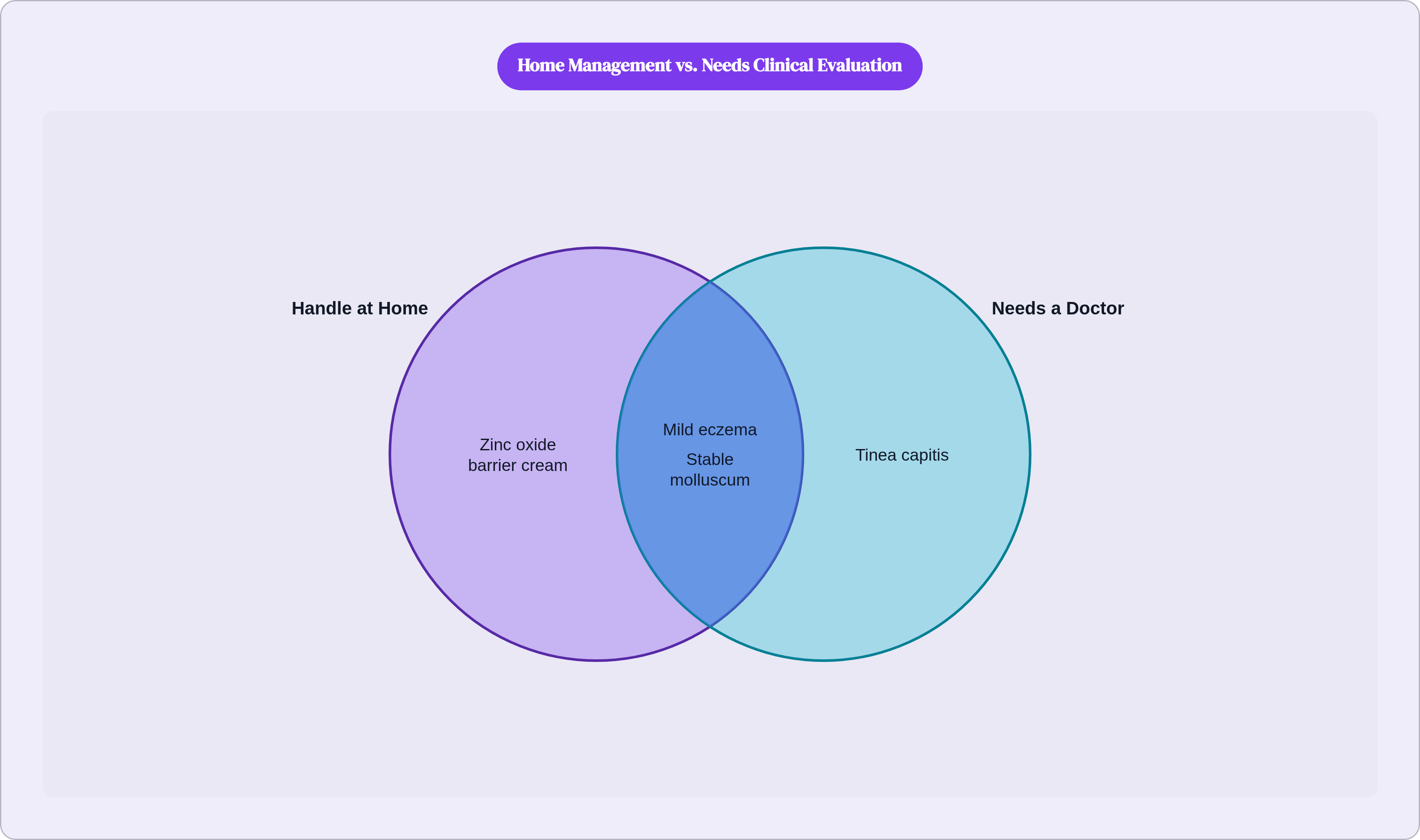
Home management is appropriate and effective for a real proportion of common presentations. Gentle, fragrance-free moisturizers for mild eczema. Frequent diaper changes and zinc oxide for diaper rash. Antihistamines for acute, mild hives. Leaving stable, few-lesion molluscum alone while monitoring. These are defensible, well-supported approaches, and treating them as such is not negligence; it's proportionate.
The line gets crossed in specific circumstances: no improvement after a reasonable OTC trial, visible spread or worsening on that regimen, any sign of secondary infection, systemic symptoms alongside a skin finding, a rash in a newborn or very young infant, any lesion with changing features. At any of those points, home observation has exceeded its appropriate scope.
There's a separate category that should go to evaluation before home treatment is even attempted: unexplained hair loss, scalp changes, new skin growths that don't fit a familiar benign pattern, any pigmented lesion that has evolved. A two-week OTC trial doesn't clarify the picture in these cases. The picture needs expert interpretation first, and the trial just delays that.
Children with known chronic conditions, eczema, psoriasis, vitiligo, benefit from periodic specialist review even during quiet periods. Flare management isn't the only reason to see a dermatologist; ongoing assessment catches disease progression, adjusts treatment tiers, and monitors for comorbidities that are easy to miss when the skin looks relatively calm. Recognizing when visual assessment alone is insufficient is itself a clinical skill, and most parents are operating without it through no fault of their own. The question worth asking is not whether your concern feels serious enough to justify a visit. It's whether the presentation has features that home observation was never designed to resolve — and platforms like Nolla, an online skin clinic with AI-guided intake where licensed US clinicians review symptoms and can issue prescriptions in as little as 10 minutes, are built around that distinction.