Persistent Rashes That Are Not Self-Resolving (New)
Untreated rashes often signal different underlying conditions requiring specific diagnoses.

How Common Non-Resolving Rashes Actually Are
One in four Americans, roughly 84.5 million people, are affected by skin disease. Globally, skin disorders rank as the fourth most common cause of nonfatal disease burden. Atopic dermatitis alone affects 7.6% of adults and 12.7% of children in the United States, according to a 2025 analysis of the National Health Interview Survey. Patient volume for atopic dermatitis grew nearly 8% between 2021 and 2023. Psoriasis globally climbed from roughly 23 million prevalent cases in 1990 to nearly 43 million by 2021, an 86% increase, with disability-adjusted life years rising at a comparable rate.
That last figure is the one that stopped me when I first encountered it. Disability-adjusted life years measure real impact on people's lives, not just case counts. An 85% increase over three decades is not explained away by better detection. It reflects something substantial and growing.
So why do so many people cycle through over-the-counter options for months, sometimes years, before seeking evaluation? The conditions driving that burden are not rare outliers. They represent a substantial share of ongoing dermatologic disease, and most of that burden goes undertreated because the available consumer options feel like they should be enough. They are often not.
The Conditions Most Commonly Behind a Rash That Won't Clear
Here is where self-diagnosis starts to run into real limits, and where things get complicated.
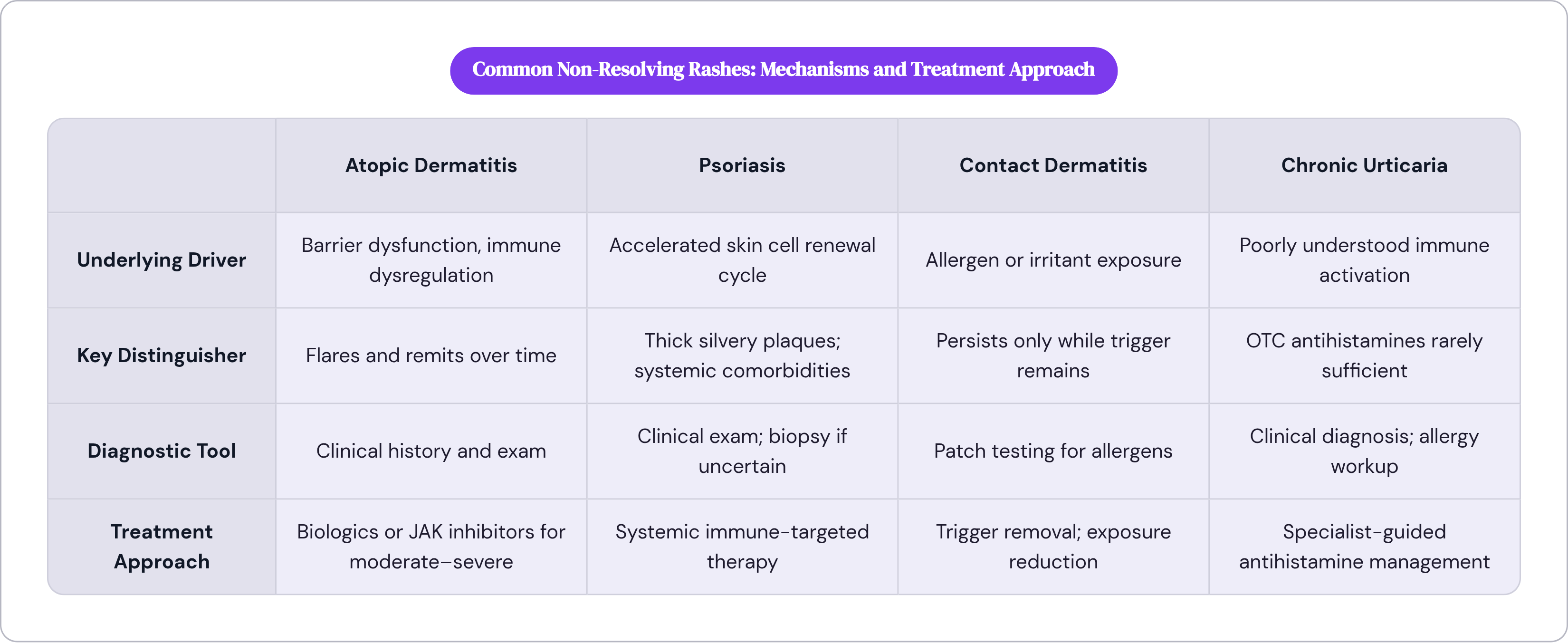
The conditions most commonly responsible for a non-resolving rash look superficially similar to each other: red, itchy, inflamed skin. Their underlying mechanisms, though, are entirely different. That difference is what determines whether any given treatment does anything useful.
Atopic dermatitis involves an interplay of genetic predisposition, impaired skin barrier function, immune dysregulation, and microbial imbalance. It flares and remits, but without addressing those drivers, it does not resolve. The skin is not the problem so much as the place the problem becomes visible.
Psoriasis is immune-mediated, characterized by a dramatic acceleration of the skin cell renewal cycle. Normal skin renews roughly every 28 to 40 days. In psoriasis, that cycle speeds up dramatically, producing the thick, silvery-scale plaques the condition is known for. It also carries associated systemic comorbidities, including cardiovascular disease, that make it more than a dermatologic issue.
Contact dermatitis is perhaps the clearest illustration of the root-cause principle. It persists indefinitely if the allergen or irritant remains in your environment. Remove the trigger and it resolves. Leave the trigger in place and no topical treatment provides lasting relief. The diagnostic tool, patch testing, can identify the specific cause, but only about 20% of patients referred for allergy workups have true allergic contact dermatitis. The other 80% are reacting to irritants rather than allergens, a distinction that changes management entirely.
Chronic spontaneous urticaria, hives and sometimes angioedema persisting beyond six weeks, achieves complete disease control with second-generation antihistamines in fewer than 10% of patients. That number explains why it feels so unmanageable without specialist input. It is not patient failure. The available over-the-counter tools are simply not built for the underlying mechanism.
Autoimmune presentations add another layer. Lupus produces a characteristic butterfly facial rash with significant sun sensitivity; it is a systemic autoimmune disease that happens to be visible on the skin. Dermatitis herpetiformis is directly linked to celiac disease, affecting roughly 10 to 15% of celiac patients, typically presenting in the 40s and 50s with intensely itchy, symmetrical eruptions on the elbows, knees, and back. The skin is the indicator, not the source.
Fungal infections like tinea mimic other conditions well enough to delay correct treatment by months. They spread if left alone.
Lichen planus has a variable course: some cases resolve spontaneously, others persist or recur over years. A case documented in a 2025 Journal of the American Academy of Dermatology (JAAD) Case Reports publication described a rash lasting two years before lichen planus was confirmed, with an associated hepatitis C finding at diagnosis. Two years.
These conditions are superficially similar and mechanistically distinct. The right treatment depends entirely on knowing which one you are dealing with, and there is no shortcut around that.
When a Persistent Rash Is Signaling Something Beyond the Skin
Some rashes are not skin problems. They are cutaneous manifestations of systemic illness, the body making visible something happening elsewhere.
Cutaneous T-cell lymphoma, including presentations known as mycosis fungoides and Sézary syndrome, can present for years as what looks like ordinary eczema or psoriasis. Clinicians are advised to maintain a low threshold for dermatology referral when a rash of uncertain cause fails to respond as expected. The resemblance to benign conditions is precisely why it gets missed. The stakes are why it shouldn't be.
In pediatric patients, Langerhans cell histiocytosis can mimic a persistent diaper rash. That "it looks like something common" conclusion is not reassuring when the condition it resembles is not what is actually present.
The vast majority of persistent rashes will turn out to be atopic dermatitis, contact dermatitis, psoriasis, or another manageable condition. But the assumption that a non-resolving rash is probably just eczema becomes costly when the rash doesn't fit the expected pattern, doesn't respond as expected, or comes with systemic symptoms that don't belong in a straightforward dermatologic picture. When a rash doesn't behave the way your assumed diagnosis would predict, that mismatch is information. It deserves attention rather than another round of hydrocortisone.
Warning Signs That Change the Urgency of Getting Evaluated
Most of what's covered here exists in the space of "warrants evaluation, not emergency." There is a smaller category of presentations where that calculus changes.
The American Academy of Dermatology identifies criteria for prompt medical attention: a rash covering most of the body, blistering or open sores, fever appearing alongside a rash, rapid spreading, pain, and involvement of the eyes, lips, mouth, or genitals. Any of these shifts the appropriate response from "schedule a dermatology appointment" to "be seen today."
Systemic symptoms, specifically fever, significant fatigue, and joint pain accompanying a rash, indicate the process is not confined to the skin. They escalate urgency regardless of how the rash itself looks.
One presentation deserves direct mention: a dark red or purple rash that does not fade when pressed. That non-blanching characteristic is associated with meningitis and septicemia. This is not a dermatology referral situation. It is an emergency room situation.
Life-threatening presentations like Stevens-Johnson syndrome, toxic epidermal necrolysis, meningococcemia, and vasculitis are rare. They are worth knowing exist, not as a source of daily anxiety, but so that if you encounter a rapidly progressing rash combined with systemic illness, you recognize the category you are in.
What a Proper Evaluation Actually Involves
The path from "persistent rash" to correct diagnosis is not guesswork. There are specific tools for each category of cause, and using the right one early shortens the cycle of failed treatment considerably.
It starts with a thorough history: duration, pattern, known triggers, treatments already tried, and any systemic symptoms. Combined with a careful physical examination, a good history often narrows the field significantly before any testing is ordered.
Patch testing is the appropriate tool when allergic contact dermatitis is suspected. It identifies specific allergens by exposing skin to a standardized panel and reading results over several days. The caveat applies here: most patients referred for allergy workups turn out to have irritant rather than allergic reactions. The distinction shapes treatment, so patch testing is most valuable when the clinical picture suggests a true allergy.
Blood work enters the picture when systemic involvement is possible: antibody panels for lupus, celiac markers when dermatitis herpetiformis is being considered as a possible diagnosis, and other labs as the clinical story warrants.
Skin biopsy is the definitive tool for rashes that are persistent, unusual in presentation, or unresponsive to initial treatment. A small sample, examined by a dermatopathologist, can distinguish between psoriasis, tinea, cutaneous lymphoma, and other conditions that look nearly identical on examination. It is a modest procedure with significant diagnostic payoff.
What matters most here is sequencing: form a working hypothesis about what category of problem you are dealing with, then apply the appropriate tool. Skipping that step, applying a treatment before a diagnosis, is how you can end up two years into a rash that was never correctly identified.
How Treatment Differs Once a Cause Is Identified
Over-the-counter antihistamines and hydrocortisone manage symptoms. For short-duration rashes with a self-limiting cause, that is exactly what is needed. For chronic, immune-driven conditions, symptomatic management at the surface is insufficient because the mechanism driving the rash is not at the surface.
For moderate-to-severe atopic dermatitis, the treatment landscape has expanded substantially. Biologics, including dupilumab, tralokinumab, lebrikizumab, and nemolizumab, target specific components of the immune dysfunction driving the condition rather than suppressing surface inflammation broadly. Oral JAK inhibitors (drugs that block specific immune-signaling enzymes) like upadacitinib and abrocitinib interrupt the signaling pathways involved in the inflammatory cascade. Delgocitinib received FDA approval as the first topical JAK inhibitor for moderate-to-severe chronic hand eczema in adults; roflumilast, a topical anti-inflammatory (PDE4 inhibitor), received FDA approval for mild-to-moderate eczema with expanded indications following in 2025. These are targeted interventions for specific mechanisms. They require a diagnosis to be useful at all.
For contact dermatitis, the effective treatment is trigger removal. No topical agent resolves contact dermatitis if the allergen or irritant remains present. When avoidance is not feasible, particularly in occupational contexts, immune-modulating medications have a role; but reduction of exposure remains the central strategy regardless.
For psoriasis and autoimmune conditions, appropriate systemic treatments exist and are specific to the diagnosis. There is no unified protocol because the underlying mechanisms differ.
After multiple rounds of over-the-counter treatment that didn't quite work, you might feel like your options are exhausted. They are not. The treatment landscape for persistent rashes has grown considerably more sophisticated. None of it functions without knowing what is actually being treated, which is the argument for getting evaluated: not alarm, but the recognition that persistence is information, and that the tools available to you are better than they have ever been. Platforms like Nolla, an AI-assisted skincare telehealth service where licensed US clinicians review symptoms and issue prescriptions in as little as 10 minutes, are one example of how that access is changing.