Personalized Skincare Routines Based on Skin Concern
Fixing your skin means treating what's actually wrong, not just what you see.
A skincare routine works when it's built around a specific problem your skin has, not a checklist someone handed you. Cleanser, toner, serum, moisturizer, SPF: that's a sequence, not a strategy, and it only does something useful once you know what you're treating. An ingredient that clears one person's clogged pores can strip away what little barrier protection another person has left. The ingredient wasn't wrong; the diagnosis was.
So what's actually happening under there? Skin runs several systems at once: physical, chemical, immune, microbial. Whatever shows up on the surface, a breakout, a patch of flaking, usually traces back to one of those breaking down.
Start with the barrier. Its job is simple on paper: keep water in, keep irritants out. When it fails, sensitivity shows up, inflammation shows up, and whatever else is going on tends to get worse. Someone dealing with acne and a damaged barrier at the same time isn't juggling two problems; one is feeding the other.
Then there's the microbiome, skin's resident community of microorganisms. It keeps immune response in check and pathogens out. Disrupt it and you see the fallout in acne, atopic dermatitis, rosacea, psoriasis, none of which lives purely on the surface, no matter how surface-level the symptom looks.
Skin pH normally sits between 4.5 and 6.0. Harsh cleansers, over-exfoliating, alkaline formulas: all of it pushes pH outside that range, and once that happens, everything applied afterward behaves differently than the label promises. That's why "barrier-first" routines caught on. Years of stacking actives on actives had left a lot of people's skin too fried to respond to anything, so the fix wasn't a new ingredient but undoing the damage first, then starting over.
Before adding anything active, check whether the barrier's intact. An active on healthy skin and the same active on compromised skin aren't doing the same thing, whatever the label claims.
How to identify your primary skin concern (and why most people are working from the wrong one)
The mistake I see most isn't picking a bad product. It's treating the symptom you can see instead of the mechanism underneath it.
Take dryness. Someone sees flaking, grabs a heavier moisturizer, and can't figure out why it never quite fixes things. Often the real issue is barrier damage, and no occlusive cream repairs a barrier on its own; it just masks the discomfort for a while. Or take redness, labeled "sensitive skin" by default when it might be rosacea, a condition with specific triggers that needs a completely different set of ingredients. Mislabel the concern and the treatment misses.
How do you actually pin down what's happening? A few questions do most of the work. Is it constant, or does it come and go? Hormonal acne flares on a cycle, while comedonal acne just sits there. Where does it show up? Oiliness in the T-zone reads differently than dryness on the cheeks or flushing across the whole face. What makes it worse: heat, certain foods, stress, a new product, sun? And how long has this actually been going on?
Most skin has more than one thing happening at once, and that's normal. Building a routine that tries to fix everything at the same time usually fixes nothing, because the ingredients end up competing instead of cooperating. Pick whatever's most chronic or most disruptive, and build around that first.
A few misreadings come up constantly. Dehydration gets mistaken for oiliness, when skin often pumps out more sebum specifically to compensate for water loss; the "oily" skin in front of you might just be thirsty. Purging from a new retinoid gets mistaken for a breakout the product caused, when it's usually just faster turnover pushing existing congestion to the surface sooner than it would've shown up anyway. Contact dermatitis from a fragrance or preservative gets mistaken for rosacea, and someone ends up treating a condition they don't actually have.
Some of this needs a professional set of eyes, plainly. Rosacea subtypes, psoriasis, cystic acne, anything involving lesions call for a clinician, because the look-alikes are convincing and the treatments diverge sharply. Acne affects an estimated 50 million Americans, rosacea around 16 million, and the average wait for a new dermatology appointment runs about a month. That gap is exactly why telehealth has become a real front door for people who'd otherwise spend weeks guessing at home before getting an answer.
Building a routine around acne (the ingredients with the clearest evidence and how to sequence them)
Acne isn't one process. It's C. acnes overgrowing, dead skin clogging follicles, excess sebum, and inflammation, stacked on top of each other, which is exactly why a routine built around a single ingredient tends to fall flat.
Current dermatology guidelines put topical retinoids at the center: tretinoin, adapalene, tazarotene, trifarotene. They unclog pores, calm inflammation, and they're the only topical category that also fades the dark marks acne leaves behind. Benzoyl peroxide comes next; it kills C. acnes directly, offers a modest assist on inflammation and clogged pores, and paired with a topical antibiotic, cuts the risk of that bacteria developing resistance. The strongest combinations for inflammatory acne pair benzoyl peroxide with either a topical retinoid or a topical antibiotic. For non-inflammatory acne, benzoyl peroxide alone often carries the load on its own, and antibiotics without a partner ingredient aren't recommended anymore, not with how fast resistance builds.
Access matters here too. Some retinoids are available over the counter while tretinoin and stronger retinoids need a prescription, worth knowing before assuming a dermatology visit is required just to get started.
Azelaic acid, at prescription strengths of higher prescription strengths (lower over the counter), does double duty: treats active acne and the hyperpigmentation left in its wake. That makes it especially useful for skin of color, where post-acne marks tend to stick around longer than the breakout itself. Salicylic acid is oil-soluble, so it actually gets into the follicle, a solid fit for congested, blackhead-heavy skin at a low-concentration leave-on.
One more thing worth flagging: some research has found lower levels of zinc, selenium, and vitamin D in acne patients. That's not a reason to swap topical treatment for a supplement, but for anyone whose acne resists everything above, it's a thread worth raising with a doctor.
Sequencing keeps this from turning into a mess: gentle, non-stripping cleanser, then the treatment active, then a ceramide moisturizer for barrier support, then SPF. Retinoids raise photosensitivity, so skipping sunscreen stops being optional once one's in the mix. What you leave out matters as much as what you add, too: over-cleansing, physical scrubs on active breakouts, skipping moisturizer entirely. All three strip the barrier further and often push skin to produce even more oil in response.
Building a routine around hyperpigmentation (why the cause of the dark spot determines the fix)
Not all dark spots come from the same place, and that difference changes everything about what works.
Post-inflammatory hyperpigmentation follows acne, eczema, or any injury to the skin. Excess melanin gets dumped during the inflammatory response, and it responds well to ingredients that block melanin production. Melasma is a different animal entirely: driven by hormones (pregnancy, oral contraceptives) and sun exposure, sitting deeper in the skin, more diffuse, stubbornly prone to relapsing even after it fades. Solar lentigines, the classic sun spot, come from cumulative UV damage and need ingredients aimed at that specific kind of photodamage.
Retinoids speed up epidermal turnover, pushing pigmented cells to the surface faster, and they work across all three categories, though they move slowest against melasma on their own. Niacinamide blocks the transfer of melanin-containing melanosomes into skin cells; in randomized trials, 5% niacinamide used for 12 weeks improved texture, and it's gentle enough for sensitive skin. Azelaic acid inhibits tyrosinase, the enzyme driving melanin production, with anti-inflammatory properties layered on top, making it a strong option for post-inflammatory hyperpigmentation on skin of color since it skips the irritation risk that comes with stronger actives. Vitamin C works as an antioxidant while also blocking melanin synthesis, and it pairs naturally with SPF layered on top of it.
Speaking of which: broad-spectrum SPF isn't optional in any hyperpigmentation routine. UV exposure is the main trigger behind melasma relapse, and it slows how fast post-inflammatory marks fade. Skip the SPF and every active above it is fighting a current that never lets up.
A workable rhythm: antioxidant serum in the morning under sunscreen, retinoid or azelaic acid at night, never two strong actives stacked in the same step. Melasma deserves a note of humility, honestly, since it's one of the harder conditions to manage without professional input; prescription-strength hydroquinone or combination therapies sometimes make more sense than anything on a drugstore shelf, and a clinician is the one equipped to make that call.
Building a routine around sensitivity and redness (distinguishing reactive skin from rosacea)
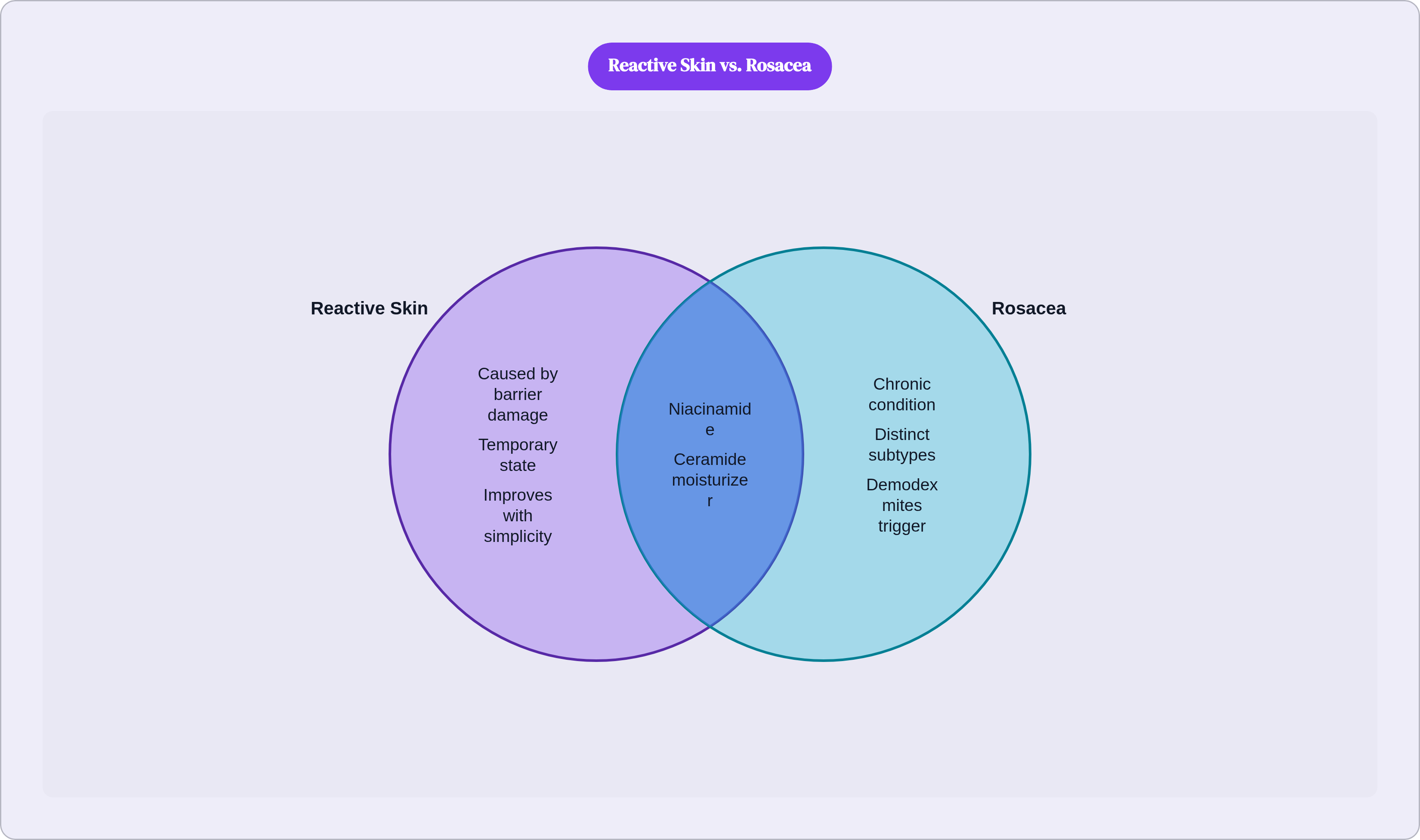
Here's the distinction that changes the whole approach. Reactive or sensitive skin is a state, usually caused by barrier damage, and it tends to improve once the barrier heals and the routine gets simpler. Rosacea is a chronic condition, with distinct subtypes (erythematotelangiectatic, papulopustular, phymatous, ocular) and known triggers, and it needs targeted treatment, not just a gentler moisturizer.
The rosacea trigger list is fairly well mapped: UV exposure, heat, spicy food, alcohol, demodex mites, shifts in the skin's microbiome. Each one sets off its own vascular and inflammatory response. Avoiding those triggers sits alongside actual treatment as a first-line strategy, not something to get to later.
Niacinamide shows up here again, for good reason. It inhibits NF-κB and inflammatory signals including IL-6 and IL-8, and a formulation using 0.25% N-methylnicotinamide has shown improvement in rosacea symptoms within four weeks. At the more common 2 to 5% concentration, it works for sensitive and rosacea-prone skin without the irritation risk that comes with most other actives.
Ceramide-dominant moisturizers do more than sit on top of skin. Clinical research shows they improve hydration and restore barrier function better than non-physiological emollients, which makes them the starting move for reactive skin before anything else gets introduced. On the flip side, high-concentration acids, physical scrubs, alcohol-based toners, and fragrance are worth cutting outright on sensitive and rosacea-prone skin. The routine that tends to work is minimal by design: few steps, fragrance-free, non-comedogenic, one new thing at a time, and two to four weeks of waiting before judging whether it helped.
Some of this sits past the DIY line, though. Papulopustular rosacea can look a lot like acne but calls for different treatment, and ocular rosacea needs an ophthalmologist in the loop. Emerging evidence even points to low-dose isotretinoin helping certain rosacea presentations. None of that is over-the-counter territory, and pretending otherwise usually costs more time than it saves.
Building a routine around visible aging (what "anti-aging" ingredients are actually doing and what the evidence supports)
Visible aging isn't one mechanism either. Collagen breaks down, epidermal turnover slows, ceramide production declines, UV damage piles up over decades, moisture retention drops off. Five distinct processes, and no single ingredient touches all five.
Retinoids carry the strongest evidence of anything available without a prescription. They bind retinoic acid receptors and regulate collagen synthesis, how skin cells differentiate, how fast the epidermis turns over. Prescription tretinoin has the deepest research behind it for fine lines, hyperpigmentation, and photodamage, but over-the-counter retinol and retinaldehyde get similar effects, just slower, which makes them a reasonable starting point if you're not ready for a prescription yet.
Peptides are newer to the evidence base but promising. Certain formulations have shown collagen increases of up to 18% after eight weeks of consistent use in lab research, though results seem to hinge heavily on the specific peptide and formulation rather than holding up across the category broadly. Hyaluronic acid works differently altogether: it draws in and holds water, and newer complex formulations used in professional treatments have shown moisture improvements of around 35% within 24 hours. Worth being precise here: that's a hydration ingredient, not a collagen rebuilder, and it changes how plump skin looks, not the structural aging happening underneath.
Niacinamide earns another mention. At 5%, randomized trials show smoother texture, fewer wrinkles, better elasticity after 12 weeks, and it layers well next to a retinoid without piling on irritation.
None of it matters as much as sunscreen, though. Photoaging accounts for most of the visible age-related change people are trying to treat, and no topical active reverses UV damage as well as simply not accumulating it in the first place. A sensible sequence: retinoid at night, since it raises photosensitivity, niacinamide and antioxidants in the morning, barrier support running underneath all of it. This is one concern where "slow and steady" isn't just a nice phrase; visible results from retinoids and peptides take weeks, not days, and that's the pace the evidence actually supports.
Worth tempering expectations against the market itself, too. Anti-aging skincare is a massive, fast-growing category, and most of what's sold outpaces the evidence behind it by a wide margin. An ingredient matched to the right mechanism, used at a studied concentration, tends to beat an expensive proprietary blend with no published data behind it.
The ingredients that appear across multiple concerns (and how to stack them without conflict)
A handful of ingredients earn a spot in nearly any routine, because their mechanisms are broad enough to help without stepping on other actives.
Niacinamide, at 2 to 5%, might be the most versatile active out there: anti-inflammatory, barrier-supporting, melanin-inhibiting, and well tolerated across acne, sensitivity, hyperpigmentation, and aging alike. Ceramide moisturizer belongs in any routine touching barrier compromise, which realistically covers acne treatment (especially for retinoid users), eczema, rosacea, general sensitivity, most of what we've covered here. Broad-spectrum SPF isn't a nice-to-have for hyperpigmentation, aging, retinoid users, or rosacea, either, since UV exposure feeds directly into every one of those.
That overlap makes sense once you see what these three are actually doing: inflammation, barrier integrity, photoprotection, the stuff sitting underneath nearly every concern this piece has touched on. Get the barrier intact and UV exposure under control, and whatever concern-specific active gets added next finally has a fair shot at doing what it's supposed to do.