Sensitive Skin Versus Sensitized Skin Distinction
Most people with reactive skin have the wrong diagnosis—and the wrong routine.
Somewhere between half and two-thirds of adults call their skin "sensitive," according to a 2025 Aesthetic Medicine study. Most have never heard the term "sensitized skin," which is a different problem with a different cause and a different fix entirely, and mixing the two up is one of the more expensive mistakes I've watched people make with their skin. I mean that literally: hundreds of dollars, months of trial and error, sometimes a face that's worse off than when they started.
Dr. Shamsa Kanwal, a consultant dermatologist, put it to me plainly once: most patients who walk in saying "I have sensitive skin" actually have sensitized skin. Get that label wrong and you'll do one of two things. You'll either buy products for a trait you were born with and never actually had, or keep running the exact routine that's hurting you because you've decided your skin is "just like this." Let's pull these apart.
The defining difference: one is a skin type, the other is a skin condition
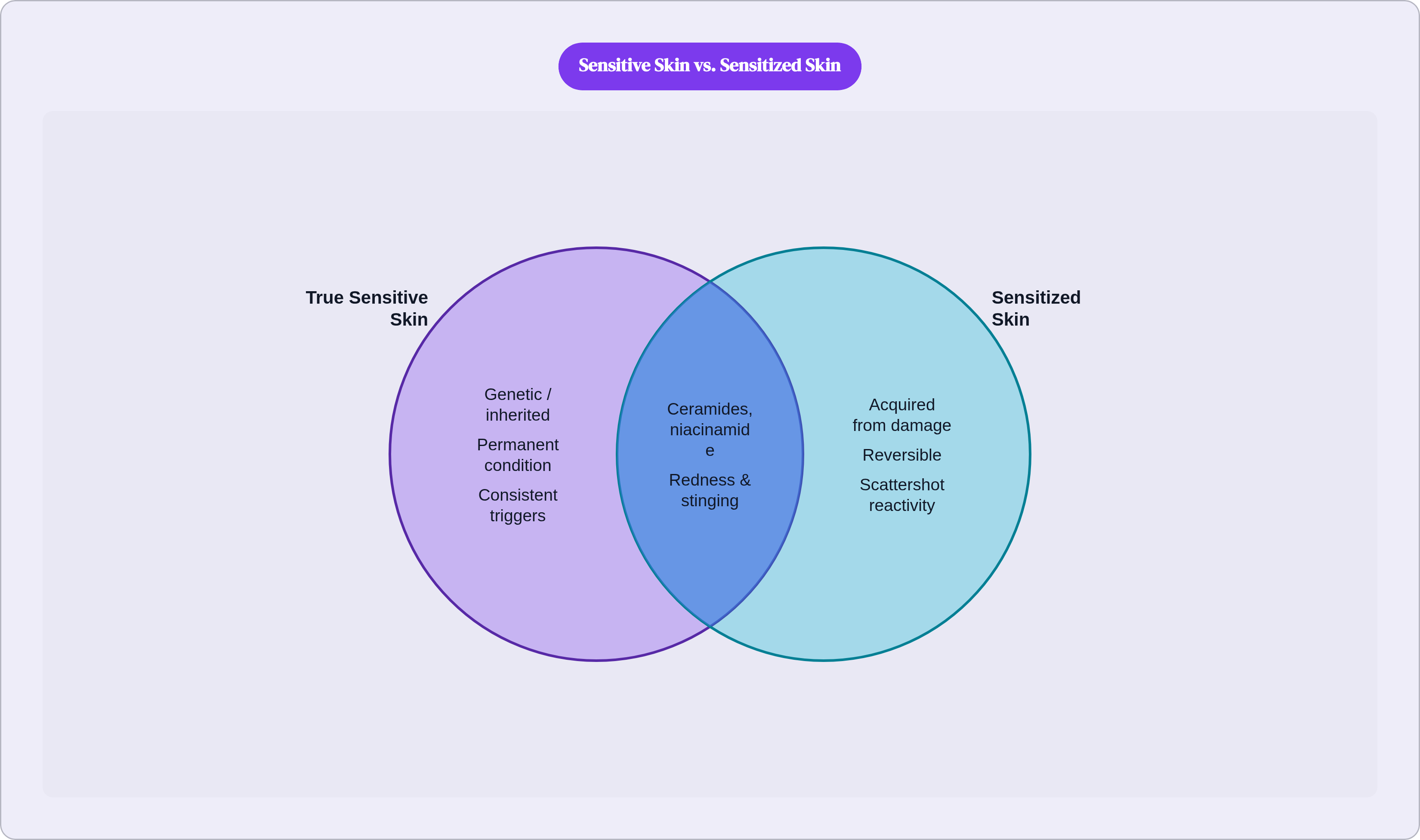
Sensitive skin is a skin type, and you're born with it. It's genetic, and it stays with you for as long as you have skin.
Sensitized skin is acquired. Skin that tolerated products and weather and daily wear just fine turns reactive because something external did damage to it. Board-certified dermatologist Jessica Weiser, MD, draws the line cleanly: sensitive skin comes from genetic predisposition, sensitized skin does not.
Clinically, true sensitive skin shows an exaggerated response, itching, burning, redness, stinging, to things that shouldn't provoke much of anything: a fragrance, a shift in temperature, mild friction from a towel. That reactivity is built into the skin's architecture. Sensitized skin can produce the identical symptom list for a completely different reason: the barrier's been damaged and it's failing at its one job.
Here's the part that actually matters for what you do next. Sensitized skin can return to normal once you repair the barrier and stop whatever's been damaging it, while true sensitive skin doesn't get cured, only managed. Type versus condition. Keep that distinction in your back pocket, because it's the lens for everything below.
How healthy skin actually keeps reactivity out: the barrier biology that makes this distinction possible
Why can one kind of reactive skin heal while the other can't? You have to look at what the barrier is doing, mechanically, day to day.
The outermost layer, the stratum corneum, stands between you and the outside world. It holds water in and keeps chemicals and grime out. Dermatologists describe it with a brick-and-mortar model: skin cells called corneocytes are the bricks, and a matrix of lipids, mainly cholesterol, ceramides, and fatty acids, is the mortar holding everything together in layered sheets.
Ceramides do most of the heavy lifting. They form dense, layered structures between skin cells that block water from evaporating and keep foreign substances out. A 2024 review in the International Journal of Cosmetic Science found that when ceramide levels drop, skin gets dry, and that same shortfall turns up across a wide range of skin conditions, not just one.
A 2025 review in the Journal of Dermatological Science points to two other factors that carry real weight: the pH of the stratum corneum, and ceramide levels themselves. When surface pH climbs too high, it sets off a chain reaction. Enzymes called serine proteases ramp up, lipid production gets thrown off, the skin's microbiome shifts out of balance, and all three feed into each other until things get worse, not better.
When the barrier breaks down, whatever sits underneath gets exposed, and the skin answers with inflammation. That mechanism is shared by both true sensitive skin and sensitized skin. What differs is why the barrier is struggling in the first place: one is how it was built, the other is what happened to it.
What true sensitive skin looks like, and what it's often connected to
Genetically sensitive skin starts out with a thinner margin for error. The barrier was never as strong to begin with, nerve endings sit closer to the surface, the immune system tends to run a little hot, and the lipid makeup leaves less room for tolerating irritants.
It also tends to travel with company. Rosacea, atopic dermatitis (eczema), and contact dermatitis aren't the same thing as sensitive skin, but they show up alongside it often enough that dermatologists watch for the pattern. A 2025 review in Exploration of Asthma & Allergy describes atopic dermatitis as a chronic inflammatory condition driven by immune dysregulation, barrier dysfunction, and specific inflammatory signals called IL-4 and IL-13. Rosacea shares some of the same barrier traits, lower hydration and higher water loss through the skin, per a 2025 study in the Journal of Cosmetic Dermatology.
Contact dermatitis splits into two separate mechanisms, and this is where people get confused. Primary irritation is a surface-level reaction that shows up fast, while true sensitization is an immune response that builds slowly, after repeated exposure to an allergen. Easy to mix the two up if you're not looking closely, and most people aren't.
What does "permanent" actually look like day to day? A standing commitment, really: gentle products, steady barrier support, and knowing your triggers well enough to route around them, with no end date on the calendar for this one. That ongoing need for care is what separates it most clearly from something that can eventually heal.
There's a nervous system piece here too, easy to miss. Heightened neurological signaling contributes to the exaggerated reactions in true sensitive skin, and a receptor called TRPV1 is implicated in that itching-burning-stinging cascade. It's wiring as much as chemistry.
How skin becomes sensitized, and why modern skincare culture is a significant driver
Sensitized skin is usually made, and mostly by us. Over-exfoliation does it, retinoid misuse does it, and so does layering five active ingredients at once because a routine got built around a trend instead of around what the skin could actually handle. Reporting from The Zoe Report points to a pattern that's hard to miss: content-driven routines stacking acids, retinoids, and alcohols have outpaced basic skin literacy. People are doing more to their skin than they understand.
A few culprits show up again and again. Fragrance is a big one, responsible for an estimated 30 to 45% of allergic contact dermatitis reactions tied to cosmetic products, according to Dermatology Times. Chemical exfoliants, glycolic, lactic, salicylic, citric, work fine on skin that's already stable, but they do real damage when overused or applied to skin that's already compromised. Retinol earns its reputation for cell turnover and collagen production, sure, but introduce it while the barrier's struggling and it makes reactivity worse, not better. High concentrations of alcohol just dry things out further.
None of this happens in a vacuum, either. Rising pollution and thinner ozone protection hit skin from the outside while overloaded routines hit it from within. Stress plays a role too, and it's not just a throwaway lifestyle line: a 2024 review in MDPI Cosmetics found emotional stress drives skin hyperreactivity through nervous system pathways.
Every cause on this list is external, though, and external means changeable.
Telling them apart: how to read your own skin's signals accurately
So how do you actually know which one you've got? Start with history. When did the reactivity begin? Has your skin always behaved this way, or did something shift, a new product, a stretch of high stress, a move to a drier climate? Sensitized skin usually has a traceable starting point, while true sensitive skin tends to go back as far as you can remember, and it often runs in the family.
Look at what sets it off, and how broadly. True sensitive skin reacts to a narrow, fairly consistent list: certain fragrances, heat, specific plant extracts. Sensitized skin tends to react to almost everything, including products that never bothered you before. That scattershot reactivity usually signals a barrier that's compromised across the board, not a sign you've suddenly developed a dozen new allergies overnight.
If rosacea, eczema, or ongoing contact dermatitis is part of your picture, that tilts things toward true sensitive skin as the underlying type. Dermatologists also look for visual tells, flaking, visibly dilated capillaries, uneven texture, the kind that suggests the damage was acquired rather than built into the skin's original architecture.
Patch testing helps narrow things down. It can identify specific allergens in true sensitive skin, where the trigger list tends to stay consistent and defined, whereas sensitized skin often reacts broadly to almost anything until the barrier's had time to heal, which makes patch testing a lot messier in the short term.
Here's the honest limit, though: on the surface, both conditions can look nearly identical. Redness, stinging, general reactivity, they show up in both, and self-assessment can only take you so far before you're guessing. A clinician's eye matters here, especially when rosacea or eczema might be sitting quietly underneath the surface symptoms.
Repairing sensitized skin: what the evidence supports, and in what order
If your skin is sensitized, the first move is simplification, full stop. Strip the routine down to three steps: a gentle cleanser, a barrier-repair moisturizer, sunscreen, and add nothing else until the reactivity actually settles.
Dermatologist guidance generally points to four to eight weeks of this bare-bones approach before reintroducing any active ingredients. That's not a stretch to rush past, and most people quit around week two, right before things start to turn.
A few ingredients do specific, well-documented jobs during this window. Ceramides go straight to the source, replacing the lipids lost when the barrier broke down; the 2024 International Journal of Cosmetic Science review found topical ceramide formulas help rebuild that damaged lipid structure and restore barrier function. Niacinamide, or Vitamin B3, works differently. It stimulates the skin's own ceramide production, supports healthy cell turnover, cuts water loss, and calms inflammatory signaling. It holds up across rosacea, eczema, and general barrier repair. Hyaluronic acid pulls water into the skin, giving it something to work with while the deeper repair happens underneath.
A 2025 study in the British Journal of Dermatology found that topical supplementation with physiological lipids rebalanced the ceramide profile in the stratum corneum and strengthened the barrier in adults genetically predisposed to atopic dermatitis. Worth sitting with that for a second: ceramide-based repair can work even in skin that's genetically wired toward reactivity, not only skin damaged from the outside.
During recovery, steer clear of chemical exfoliants, retinoids, fragranced products, anything high in alcohol. These are often the exact things that caused the sensitization in the first place, so bringing them back too early undoes whatever ground you've gained.
That same 2024 MDPI Cosmetics review flags reduced activity at the TRPV1 receptor as an emerging target for calming burning and itching, and ingredients aimed at that pathway are starting to show up in barrier-repair formulas. Progress here is gradual, with no overnight fix, and expecting one just sets you up to bail right when the process starts working.
Managing true sensitive skin: the difference between repair and long-term stewardship
True sensitive skin can't be repaired, because there's nothing broken to fix. The goal shifts from repair to stewardship: keeping a stable, low-irritation environment for skin that's simply more reactive by nature, for good.
The core principle is restraint. Fewer products, gentler formulas, steady barrier support, a smaller routine acting as protection in its own right. A 2025 review in Aesthetic Medicine backs this up, recommending trigger avoidance, gentle products, moisturizers rich in ceramides and niacinamide, and keeping the total product count as low as you can manage to limit cumulative irritation. For rosacea specifically, a 2024 narrative review in the Dermis Journal recommends gentle cleansing, consistent moisturizing, daily sunscreen, and lifestyle adjustments running alongside whatever medical treatment is already in place.
This isn't resignation, though. Managed well, people with true sensitive skin can still use plenty of active ingredients, just introduced slowly, at lower strength, with more patience built into the timeline than you'd use on non-reactive skin. Sunscreen matters here too, since UV exposure worsens barrier fragility and inflammation in both sensitive and sensitized skin, and especially in rosacea and atopic conditions.
The ingredient list overlaps a lot between the two paths, and that's what trips people up. Ceramides, niacinamide, hyaluronic acid: all three show up in both regimens. What changes is the role they play. For sensitized skin, they're a temporary fix, something you'll eventually taper off as the barrier heals, while for true sensitive skin, they're permanent fixtures of the routine.
When the skin picture is more complicated than a routine change can address
Some cases that look like straightforward sensitized skin turn out to be undiagnosed rosacea, atopic dermatitis, or allergic contact dermatitis, and those need an actual clinical diagnosis, not another product swap.
A few signs it's time to get a professional involved: reactivity that hasn't budged after several weeks of a proper barrier-repair routine, ongoing flushing or visible blood vessels, weeping or crusting, or reactions to products that don't contain any of the usual suspects.
Hormones muddy the picture too. Shifts in estrogen and progestin, including from hormonal birth control, can change how reactive skin is and can worsen conditions like eczema and acne, which makes the real trigger a lot harder to trace without a clinician involved. Patch testing for contact allergens is a clinical procedure, a step beyond home elimination trials with your product shelf, and it catches immune-mediated sensitivities that trial and error tends to miss entirely.
A telehealth visit is a reasonable, low-friction place to start if an in-person appointment feels like too big a first step. Walking a clinician through the history, the onset, the pattern of reactivity, even asynchronously, can sort out type from condition faster than months of guessing on your own.
Reactive skin that's disrupting your daily life, or that isn't responding to a sensible, well-run routine, deserves the same attention you'd give any other medical concern. Skin health is medical health, whether it shows up on the surface or somewhere you can't see.