Over-the-Counter Versus Prescription Skin Treatments
Some over-the-counter actives have real evidence; most trendy ones don't.
Some OTC actives have real clinical support behind them. Not marketing language, not "inspired by science" positioning, actual replicated human trial data. Topical retinol, benzoyl peroxide, azelaic acid, niacinamide in the 4% to 10% range, glycolic acid around 10% for home use. These have accumulated credibility over years, not launch cycles.
Retinol is worth understanding precisely because it explains both why it works and where it stops working. It binds to skin cell receptors after conversion to retinoic acid, driving cell turnover, stimulating collagen, fading pigmentation. That conversion step is the whole story. Retinol has to be metabolized in the skin before it becomes biologically active, and that process is inefficient, variable, and affected by formulation. OTC concentration caps are not arbitrary conservatism. Instead, they reflect a compound with a narrow therapeutic window where very low concentrations accomplish little and high ones cause irritation before improvement.
Move into the trendier corners of the shelf and you'll find the evidence gets thin fast. Peptides are theoretically interesting; however, the clinical data in humans is weak. Penetration and bioavailability remain contested, which matters because a peptide that cannot reach its target tissue is expensive moisturizer. Bakuchiol gets positioned as a gentler retinol alternative, particularly for pregnancy, and the evidence has not caught up to that positioning. When a product category scales faster than the research that would validate it, that gap widens quietly.
The straightforward version: the OTC cosmeceutical space has expanded much faster than the science supporting it. Most products lean on small, open-label studies. Placebo-controlled randomized trials are scarce, particularly for retinol esters, retinaldehyde, and nano-carrier formulations. When a brand says "clinically proven," ask yourself: proven how, in how many people, and compared against what control. "Evidence-backed" is not binary. Even within the OTC tier, the distance between a well-studied active and a trendy one is enormous, and the price tag tells you nothing about which you're holding.
How Prescription Actives Differ From Their OTC Counterparts, Not Just in Strength but in Mechanism Access
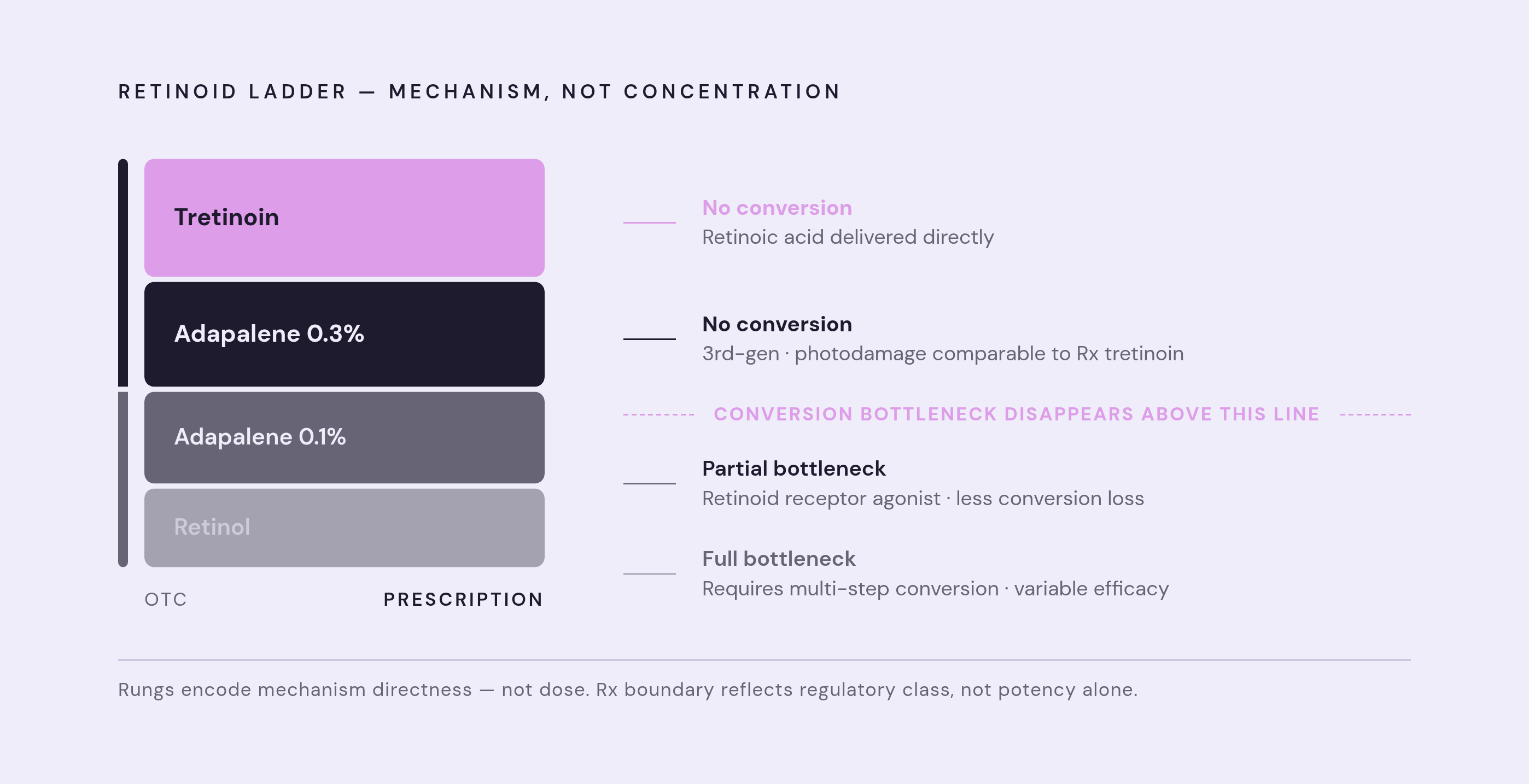
The retinoid ladder is the clearest way to see how this actually works. OTC retinol at one end. OTC adapalene 0.1% one rung up. Prescription adapalene 0.3%. Prescription tretinoin. Each step is not simply a concentration increase; it is a more direct or more potent mechanism.
Tretinoin delivers retinoic acid directly. There is no conversion step. It normalizes follicular keratinization, reduces microcomedone formation, stimulates collagen, and enhances the penetration of co-prescribed agents. Prescription adapalene 0.3%, a third-generation retinoid, offers better stability and lower irritation than tretinoin; trials from the last several years showed long-term use producing statistically significant improvements in photodamage comparable to tretinoin, at substantially lower irritation rates. Both do something OTC retinol cannot, not because they are stronger versions of the same thing, but because the mechanism is more direct: for these prescription retinoids, the conversion bottleneck simply doesn't exist.
Hydroquinone is a different kind of example. The only FDA-approved hydroquinone product is prescription-only, approved specifically for moderate-to-severe melasma under clinician supervision. It was effectively regulated out of the OTC tier because managing it safely requires clinical oversight, not because it stopped working.
Combination prescription therapies are where the gap becomes hardest to bridge. A fixed-dose triple combination of clindamycin 1.2%, adapalene 0.15%, and benzoyl peroxide 3.1% achieved clear or almost clear skin in roughly 50% of participants at 12 weeks, compared to 22.6% in the vehicle group, with inflammatory and non-inflammatory lesions reduced by over 70%, in a Phase 3 trial published in 2024. Layering OTC products cannot replicate that outcome. The combination is engineered for synergistic action at concentrations OTC monographs simply do not permit.
And then there is the monitoring piece. For isotretinoin, the oversight is not regulatory friction. It is the therapeutic protocol.
Condition Severity as the First Decision Filter, When OTC Is Appropriate and When It Isn't
Acne is the most instructive case because it spans both tiers and the research reflects that. A 2024 randomized controlled trial found a novel OTC salicylic acid regimen produced comparable efficacy to prescription adapalene 0.1%/benzoyl peroxide 2.5% in adults with mild-to-moderate acne over the study window. That finding is real and worth sitting with, but notice the qualifier embedded in it: mild to moderate. The same trial found the prescription regimen caused significantly more tightness and dryness at week four, a clinically relevant finding because tolerability determines whether someone actually keeps using a treatment. Even when prescription is the right call, sticking with it isn't guaranteed.
Melasma, psoriasis, seborrheic dermatitis, rosacea. These conditions can resemble each other, sometimes closely. OTC maintenance has a legitimate role across all of them, but initial treatment tends to benefit from a diagnosis first. Applying an active optimized for one mechanism to a condition driven by a different one does nothing. Sometimes it worsens the presentation. Misidentifying your condition carries a cost that rarely gets counted when you compare the two tiers.
Conditions with systemic drivers are a separate category entirely. Hormonal acne, widespread eczema, suspected contact dermatitis. OTC alone will likely fail to address the underlying mechanism regardless of which actives you choose or how consistently you apply them.
The most useful question for figuring out where you sit on this spectrum isn't just how bad it looks. Ask yourself how long it has persisted, whether it has changed in character, and whether a consistent OTC trial has already failed. Duration and treatment history are as diagnostically relevant as appearance, sometimes more.
The Real Cost and Access Calculation, What "More Expensive" Actually Means
The default assumption runs like this: OTC is affordable and accessible; prescription is better but harder to get and more expensive. Both halves of that assumption are shakier than they look.
On the OTC side, a price analysis published in the Journal of Cosmetic Dermatology in 2025 by researchers at Robert Wood Johnson Medical School and Temple University found that OTC retinol product pricing varies widely and is unrelated to actual retinol concentration in the product. You can pay a premium price for less active ingredient than a budget alternative sitting on the same shelf. So, the price signal in this market is essentially noise.
On the prescription side, the calculus has shifted considerably. Generic tretinoin is cheap and widely available. Telehealth prescription services have compressed the access gap for conditions clear enough to evaluate without an in-person visit. Where insurance applies, the upfront cost comparison changes further.
What has not shifted is the wait. A 2024 study of New York City dermatology practices found a mean appointment wait of 50 days. For a condition that is worsening, causing distress, or putting someone at risk of scarring, 50 days is not a neutral interval. Telehealth platforms have begun closing this gap, and clinical AI tools are starting to enable asynchronous assessment and faster pathways to prescription options — Nolla, for instance, is an AI-assisted skincare telehealth service where licensed US clinicians review symptoms and can issue prescriptions in as little as 10 minutes.
There is one access disparity that rarely enters these conversations. In underserved areas and lower-income markets, OTC options are not economically accessible either. The framing that treats both tiers as available starting points for everyone doesn't reflect reality for a significant portion of the population.
Signals That Mean It's Time to Stop Self-Treating and Involve a Clinician
The clearest signal is OTC failure after a consistent 8 to 12 week trial. Most well-supported actives show measurable change within that window if they're going to show anything. If you've been consistent, using a credible active at an effective concentration, and nothing has moved, that's telling you something about the mechanism, the diagnosis, or both. It's not a cue to try a different product in the same category.
Some presentations should not be self-treated at any stage. A lesion changing in size, color, or shape. A rash that spreads, blisters, or arrives with systemic symptoms. Anything that plausibly involves infection. These are situations where waiting another week is an unreasonable response.
Skin that worsens on a product that should help is its own signal. It points toward contact sensitization, an allergic skin reaction that develops with extended topical use and is more common than most people realize, or it means you're targeting a mechanism the condition doesn't actually involve. Continuing is not the right response to either scenario.
Scarring risk changes the entire calculation. Nodular acne left undertreated increases the probability of permanent scarring. When the downside of delay is irreversible, earlier prescription intervention becomes the better option even if OTC would eventually make a dent.
Pregnancy changes what is safe. Tretinoin, high-dose salicylic acid, and hydroquinone are contraindicated. Bakuchiol and certain niacinamide formulations sit in a safer tier for this context, but clinician guidance matters more precisely because the stakes of error are higher.
People with deeper skin tones, Fitzpatrick types IV through VI, face elevated risk of post-inflammatory hyperpigmentation. Conditions manageable with OTC actives at lighter skin type classifications often require prescription-level intervention earlier in the course for this population. Standard OTC packaging was not written with them centrally in mind, and that gap has real consequences.
Underneath all of these specific signals is one issue that often gets buried: a trained clinician changes not just what gets prescribed but what gets diagnosed. Misdiagnosis is the underappreciated cost of extended self-treatment. An active that works well for one condition does nothing for a condition it was never designed to address, and every week you spend on the wrong mechanism is a week the right one is delayed.