Topical Corticosteroids for Skin Inflammation
Relief from skin inflammation comes without fixing the underlying condition.

The mechanism is elegant. Topical corticosteroids bind to glucocorticoid receptors inside skin cells and trigger a cascade: pro-inflammatory cytokines get suppressed, immune cell activity drops, the proliferative processes driving conditions like psoriasis slow considerably. The relief patients feel is real because the biology producing it is real. But what if that relief is masking something the biology hasn't actually resolved?
What most patients don't understand, and what clinicians often undersell, is that this mechanism produces symptomatic suppression. Not disease modification. The underlying condition persists.
A 2024 study in Allergy gave that distinction a molecular explanation. Topical corticosteroids, even when used effectively to block active skin inflammation, do not prevent the formation of tissue-resident memory T cells (TRM cells) in the skin. These TRM cells progressively regain their proliferative function after corticosteroid discontinuation. The result is a rebound flare upon stopping treatment, sometimes more intense than what the patient started with.
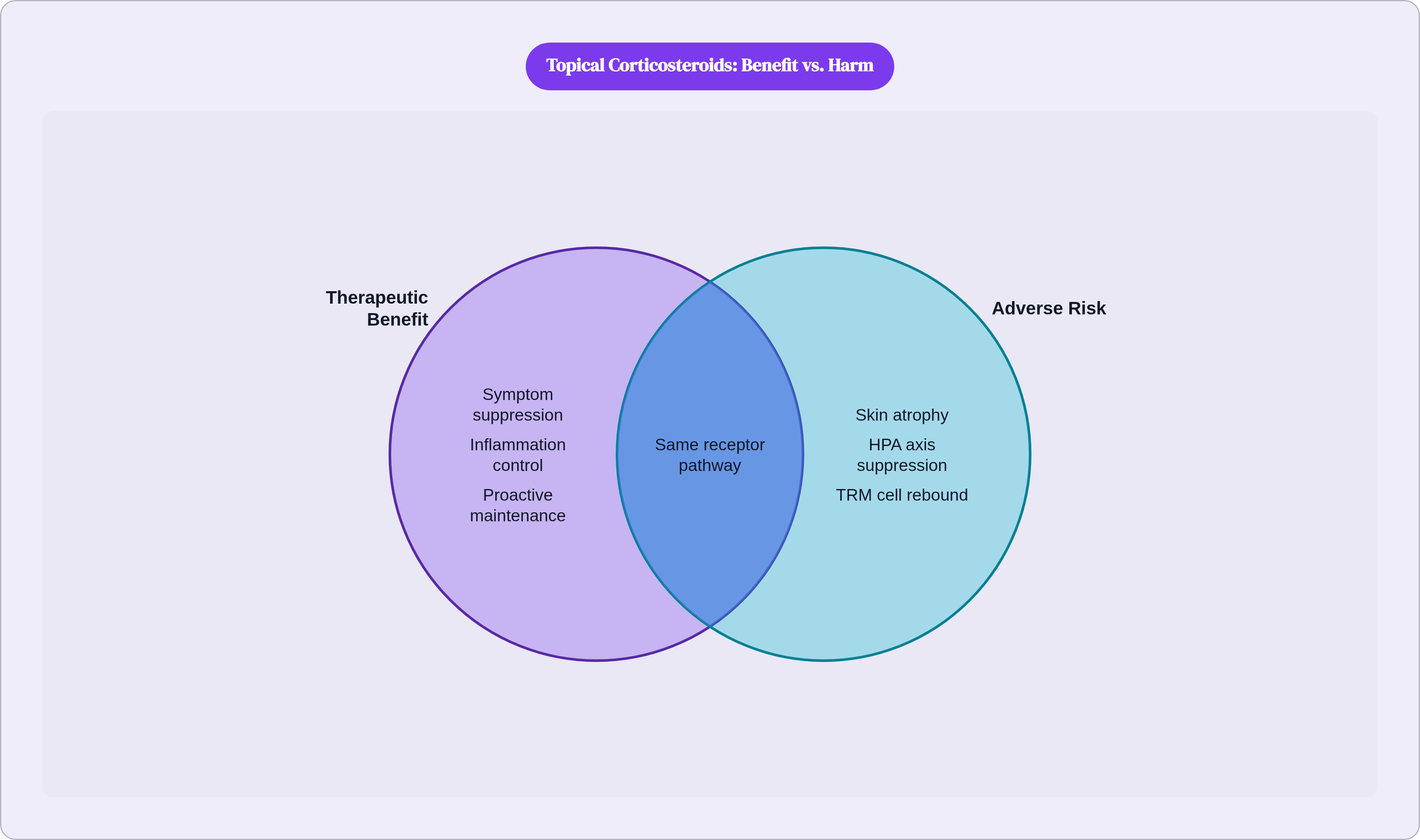
Clinicians who have managed atopic dermatitis for any length of time have seen this pattern without necessarily having a name for it. The Ono et al. findings supply the name. They also clarify something that gets underemphasized in clinical education: the dosing and duration framework is not bureaucratic caution. It is mechanistically motivated. The same receptor-mediated pathways that suppress inflammation also, when driven too hard for too long, produce the adverse events worth understanding. The biology of benefit and the biology of harm are not separate systems you can tune independently. They are the same system, and that fact shapes every clinical decision downstream.
The Seven-Class Potency System and How Vehicle Choice Compounds or Reduces a Drug's Strength
American dermatology classifies topical corticosteroids across seven potency classes. Class I is ultra-high potency. Class VII is lowest, where over-the-counter hydrocortisone lives. Clobetasol propionate 0.05% cream sits at Class I. Betamethasone dipropionate ointment occupies Classes II and III depending on formulation. Triamcinolone acetonide falls around Class IV.
Here is what most patients don't know, and what a surprising number of prescribers treat as a footnote: the vehicle, the cream, ointment, lotion, gel, or foam the drug is suspended in, is not a neutral delivery system. It is a pharmacologically active variable. Ointments are more occlusive than creams. More occlusion means greater penetration, which means effectively higher potency even from the same active ingredient at the same concentration. Apply a cream under an occlusive dressing and you have changed the drug you are using. Apply anything to an intertriginous area, where skin surfaces contact each other, and you have introduced a physiological form of occlusion that amplifies absorption further. No one relabeled the product. The pharmacology changed anyway. That raises an important question: if the vehicle is doing pharmacological work, why does clinical education so often treat it as packaging?
This is why the governing clinical principle is not "use the strongest thing that will work." It is: use the lowest potency that will control the condition. The potency class of a corticosteroid is not a fixed property of the molecule. It becomes a function of how it is delivered, where it is applied, and under what conditions the skin sits.
One practical note: the 2024 UK BNF revision reclassified hydrocortisone butyrate's SmPC potency from potent to moderate. The specific reclassification matters less than what it illustrates. Classification gets updated, and assuming you know a product's current potency tier because you knew it five years ago is a reliable way to get it wrong.
Matching Potency to Body Site, Patient Age, and Skin Condition
These three variables operate simultaneously. Not sequentially.
Body site governs penetration. The face, groin, and axillae have thinner skin with considerably higher absorption capacity than the palms or soles. A potency level appropriate for treating psoriasis on the trunk becomes a meaningful risk on the face. The clinical standard for facial application is lower-potency products, even when the inflammatory condition would warrant something stronger elsewhere. This is not excessive caution; it is physiology.
Patient age compounds everything. Children, particularly infants, have a higher skin-surface-area-to-body-weight ratio than adults, which means more systemic absorption relative to body mass and a meaningfully elevated risk of HPA axis suppression (the body's cortisol-regulation system) and Cushing syndrome at doses that would not concern an adult clinician looking at the same tube. Elderly patients face a different version of the same problem: thinner, more permeable skin increases both local and systemic adverse event risk regardless of potency class.
The condition itself imposes its own specifications. Atopic dermatitis, psoriasis, and allergic contact dermatitis each respond to topical corticosteroids but differ in their chronicity, the degree of skin barrier disruption they produce, and the maintenance patterns that best serve long-term outcomes. The same drug at the same potency applied to the same body site may be entirely appropriate for one diagnosis and poorly matched to another.
Potency class is one input into a multivariable decision. Treating it as the whole decision is where things start going sideways, and it happens more than anyone in clinical practice would comfortably admit.
How Much to Apply, How Often, and for How Long
The fingertip unit is the standard measure for topical corticosteroid dosing, and the majority of patients applying these drugs daily have no idea it exists. One fingertip unit, the amount of cream or ointment squeezed from the tip to the first crease of an adult index finger, is approximately 0.5 grams and covers roughly 2% of adult body surface area. Teachable, concrete, almost never taught at the point of prescription.
Frequency recommendations across the literature converge on once to twice daily. Applying topical corticosteroids more than twice daily does not improve efficacy; it only increases adverse effect risk.
Duration is potency-dependent. Per AAFP guidance, Class I super-high-potency preparations should be used for no more than approximately three weeks. High- and medium-potency preparations are generally appropriate for up to twelve weeks. Low-potency preparations carry no specified time limit, though routine reassessment remains appropriate regardless.
But how does this affect our original promise of controlled, targeted treatment? Data from 2025 indicate that dermatologic patients apply, on average, roughly 35% of their expected individualized dosages. In atopic dermatitis specifically, a substantial proportion of patients have insufficient prescriptions or applications based on FTU calculations. The clinical discourse around topical corticosteroids focuses heavily on the risks of overuse. Underuse is the more common failure mode in actual practice. Both are failures, pointing in opposite directions, and they tend to be driven by different causes.
For patients with frequently relapsing atopic dermatitis, proactive therapy offers an evidence-based path between those two failure modes: applying a lower-potency preparation twice weekly during remission rather than waiting for full flares to redevelop. This reduces relapse frequency and cumulative adverse effects compared to reactive dosing. It requires applying medication to skin that currently looks fine, which is psychologically counterintuitive and, as a result, clinically underutilized.
Local Side Effects That Develop With Prolonged or High-Potency Use
The local side effects of topical corticosteroid misuse are not obscure. Skin atrophy, striae, telangiectasia, hypopigmentation, ecchymoses, hypertrichosis. These are predictable, dose-related consequences of excessive potency or excessive duration applied to skin that cannot sustain that level of glucocorticoid stimulation.
The risk is amplified by higher potency, larger application area, occlusion, and thinner skin sites. Facial misuse specifically produces steroid rosacea and perioral dermatitis. These are not rare idiosyncratic reactions; they are the expected outcome when the vehicle-site-potency framework is ignored across months of use.
None of these effects are inevitable at therapeutic doses and durations. They are the predictable result of misapplication.
This distinction matters enormously, and it tends to get flattened in the way these risks get communicated to patients. Conflating the consequences of misuse with the consequences of appropriate use is precisely how corticophobia acquires its clinical foothold and starts doing its own damage. Some long-term use, even intermittent use, can produce permanent skin changes that outlast the disease being treated. That is a reason to respect the framework governing this drug class. It is not a reason to avoid it.
Systemic Absorption and HPA Axis Suppression: When Topical Treatment Becomes a Whole-Body Concern
Topical does not mean local-only. Applied corticosteroids are absorbed systemically, and that absorption can suppress the hypothalamic-pituitary-adrenal axis, the regulatory loop governing the body's own cortisol production. HPA axis suppression has been documented when high-potency preparations exceed 50 grams per week. Large application area, prolonged use, compromised skin barrier, and occlusion each independently increase systemic exposure.
The serious end of the spectrum includes Cushing's syndrome and avascular necrosis. JCAD reporting from 2025 documented hospitalizations, including sepsis, from significant overuse. These are not common outcomes of appropriately supervised therapy. They exist in the literature as a counterweight to the equally documented, and more prevalent, problem of under-treatment.
HPA axis function typically recovers once the topical corticosteroid is discontinued, though systemic corticosteroids may be required during the recovery period to bridge adrenal insufficiency. Patients on higher-potency preparations warrant periodic monitoring for adrenal suppression. In practice, that monitoring frequently gets skipped. Competing clinical pressures are usually the cause, but the outcome for the patient is identical regardless of why the monitoring didn't happen.
Topical Steroid Withdrawal: What Is Known, What Remains Contested, and Where Research Stands
Topical steroid withdrawal, sometimes called topical steroid addiction, is complicated terrain, and it gets discussed in clinical settings and patient communities with equal confidence pulling in opposite directions.
There is no formally accepted diagnostic definition. The terms are used interchangeably. Characterized by physical dependency and symptom exacerbation upon cessation, it presents with erythema, itching, and burning, along with secondary lesions that appear distinct from underlying eczema. StatPearls describes it as infrequent, arising primarily from chronic misuse, particularly cosmetic use of corticosteroids rather than supervised clinical use. A February 2024 joint statement from UK patient and professional groups described TSW as complex, uncommon, and still under active study, affirming that safe, time-limited use remains important for eczema management.
In March 2025, NIH researchers published provisional diagnostic criteria proposing TSW as a condition distinct from eczema, with potential treatment approaches under investigation. Their stated caveat: larger studies are needed before these proposals should change practice. That caveat matters and should not be footnoted past.
It is also worth considering what the TRM mechanism Ono et al. identified means for how we interpret cessation symptoms. When TRM cells progressively regain proliferative function after corticosteroid discontinuation, the result looks like worsening. It may be worsening. Distinguishing a disease flare driven by TRM reactivation from true withdrawal driven by physiological dependency requires clinical judgment that even experienced practitioners currently lack standardized criteria to apply. We do not yet have the tools to make that distinction reliably.
For anyone reading this as a patient: TSW, as described in the literature, is associated with misuse. It is not the expected consequence of appropriately supervised, appropriately dosed, appropriately timed topical corticosteroid therapy.
Why Fear of Topical Steroids Often Causes More Harm Than the Drugs Themselves
Fear of topical corticosteroids, formalized in the literature as TOPICOP (Topical Corticosteroid Phobia), is well-documented and clinically consequential. A 2024 study in JAAD, using a Danish cohort of 927 patients with chronic hand eczema, found that 75.5% totally or almost totally agreed that topical corticosteroids damage the skin. Nearly half believed topical corticosteroids (TCS) would affect their future health. More than a third reported fear of topical corticosteroids despite being unable to identify specific TCS-associated risks.
That last finding deserves attention. The fear is not principally knowledge-based. It is affect-driven, amplified by online communities, anecdote, and the availability of vivid misuse outcomes described by patients who did, in many cases, misuse these drugs. When misuse is the referent, fear is not irrational. But that same fear, entirely reasonable in a misuse context, gets applied wholesale to appropriate use, and that is a different kind of error with consequences that tend to be invisible precisely because nothing dramatic happens. The disease just doesn't get better.
Corticophobia obstructs adherence. That 35% dosing figure is not purely a technique failure. People who believe a drug is damaging them apply less of it. When applying less means under-treating a chronic inflammatory condition, the disease worsens, which reinforces the conclusion that the drug isn't working, which circles back into more fear and less adherence. Once that pattern is established, it is remarkably hard to interrupt, and it tends to be invisible to prescribers who assume the patient is following instructions. One might argue that the fear, not the drug, has become the primary clinical obstacle in a meaningful proportion of chronic eczema cases.
The appropriate clinical response is not blanket reassurance, which gives patients nothing they can actually use. It is specific education: here is what the actual risk factors are, here is how potency, site, and duration interact, and here is what appropriate use looks like for your condition and your skin specifically.
The Global Misuse Problem and Why Appropriate Prescribing Guidance Still Falls Short in Practice
The misuse of topical corticosteroids extends well beyond individual patients making uninformed choices. Potent corticosteroids are present in skin-lightening creams sold over the counter in markets around the world. Combination products containing a corticosteroid alongside an antifungal and an antibiotic are applied by patients who were sold them as antifungals, with no understanding of what the steroid component is doing to their face over months of daily use. The International League of Dermatological Societies has taken a formal position on this because the clinical fallout is not occasional. It is a public health pattern with a predictable injury profile.
Inappropriate use is not solely a patient phenomenon. A 2025 analysis in the Journal of Young Pharmacists identified gaps in condition-specific prescribing guidelines and insufficient prescription auditing as structural contributors to misuse. When a drug class is assumed to be well understood because it has existed for decades, it tends to receive less rigorous ongoing clinical education than newer, more attention-commanding therapies. The rarer but serious complications become exactly the knowledge most likely to fade across clinician generations, because nobody thinks to keep teaching what everyone assumes is already known.
The under-dosing and over-dosing patterns documented across the literature are not random. They reflect a gap between the prescribing framework that exists and the consistency with which it actually gets implemented. Proposed interventions, condition-specific guidelines, regular prescription audits, structured patient education, are not novel ideas. They are consistently under-resourced relative to the scale of the problem, and that under-resourcing tends to persist precisely because the drug class feels familiar enough that no one flags it as a priority.
How to Use the Potency-Vehicle-Duration Framework to Get the Benefit While Managing the Risk
The central principle is worth stating plainly: the benefit of topical corticosteroids depends on matching potency, vehicle, and duration to the specific condition, site, and patient. That is the framework. Everything else is application.
Start with the lowest effective potency for the condition and site. Choose a vehicle appropriate to that site, recognizing that ointments drive more absorption and that intertriginous areas create physiological occlusion regardless of intent. Apply a duration limit that matches the potency class. Use FTU-based dosing to avoid both under-application and over-application, and make sure the patient actually knows what an FTU is before they leave with the prescription, because assuming they will look it up is how that knowledge gap persists.
For frequently relapsing conditions like atopic dermatitis, proactive maintenance with a lower-potency preparation twice weekly after remission consistently outperforms the oscillation between high-dose reactive treatment and abrupt discontinuation, both for outcomes and for cumulative adverse effect burden.
Face, skin folds, children, and elderly patients are not contraindications to topical corticosteroid therapy. They are specifications for lower-potency, shorter-duration use with closer monitoring. The language of contraindication feeds the fear that drives under-treatment, and under-treatment has its own injury profile, just a less visible one.
For patients on higher-potency preparations, monitoring for systemic effects is part of appropriate use. Patient education on actual risk factors, not generic steroid fear, is what makes adherence possible and is what allows this drug class to do what it has been demonstrably capable of doing since 1952.
The framework exists. The evidence supporting it is robust. What consistently falls short is implementation, and it falls short in both directions simultaneously, which is what makes this drug class more demanding than its long familiarity suggests.