Phototherapy for Inflammatory Skin Diseases
UV light treats these diseases through three distinct mechanisms, not one.

Three distinct mechanisms are at work, and they are not interchangeable. Each maps to a different condition, a different cellular target. Conflating them is how clinicians end up choosing the wrong tool.
The most intuitive one is also the most direct. UV light suppresses DNA replication in rapidly dividing cells. For psoriasis, where keratinocytes are cycling roughly ten times faster than they should, this is not a workaround. It is a direct intervention. At the molecular level, narrowband UVB suppresses Th17 signaling and both type I and type II interferon pathways, the same pathways targeted by some of the most effective biologic drugs currently available. Different delivery route, substantially overlapping biological target. Nearly ninety percent of NB-UVB irradiation is absorbed in the epidermis, and keratinocytes are active participants in the downstream immune response, not simply passive tissue the light passes through.
The second mechanism is subtler. UV alters immune cell function locally within the skin without meaningfully disrupting systemic immunity. For atopic dermatitis, the clinical problem is a chronically overactivated local immune environment, not rapid cellular proliferation, so localized immunomodulation is the operative pathway. The body's broader defenses stay intact while the aberrant local signaling gets quieted. That is a distinct biological event from what's happening in psoriasis, and it matters for treatment selection.
The third runs in the opposite direction entirely. Rather than suppressing cellular activity, UV stimulates it: specifically, it activates melanocyte proliferation and migration. In vitiligo, where T cells have been selectively destroying the skin's pigment-producing cells, this stimulatory effect is the whole point. You are coaxing the very cells the disease has been eliminating to regenerate.
One more phenomenon is worth naming. Repeated sub-sunburn doses, what clinicians call suberythemogenic doses, meaning doses just below the threshold that cause redness, can produce complete disappearance of cutaneous symptoms for weeks or sometimes months. Not marginal improvement. Complete clearance. If you have been managing one of these conditions with topicals for years, that can be disorienting in the best possible way, the first time you see it.
The main forms of phototherapy and what distinguishes them
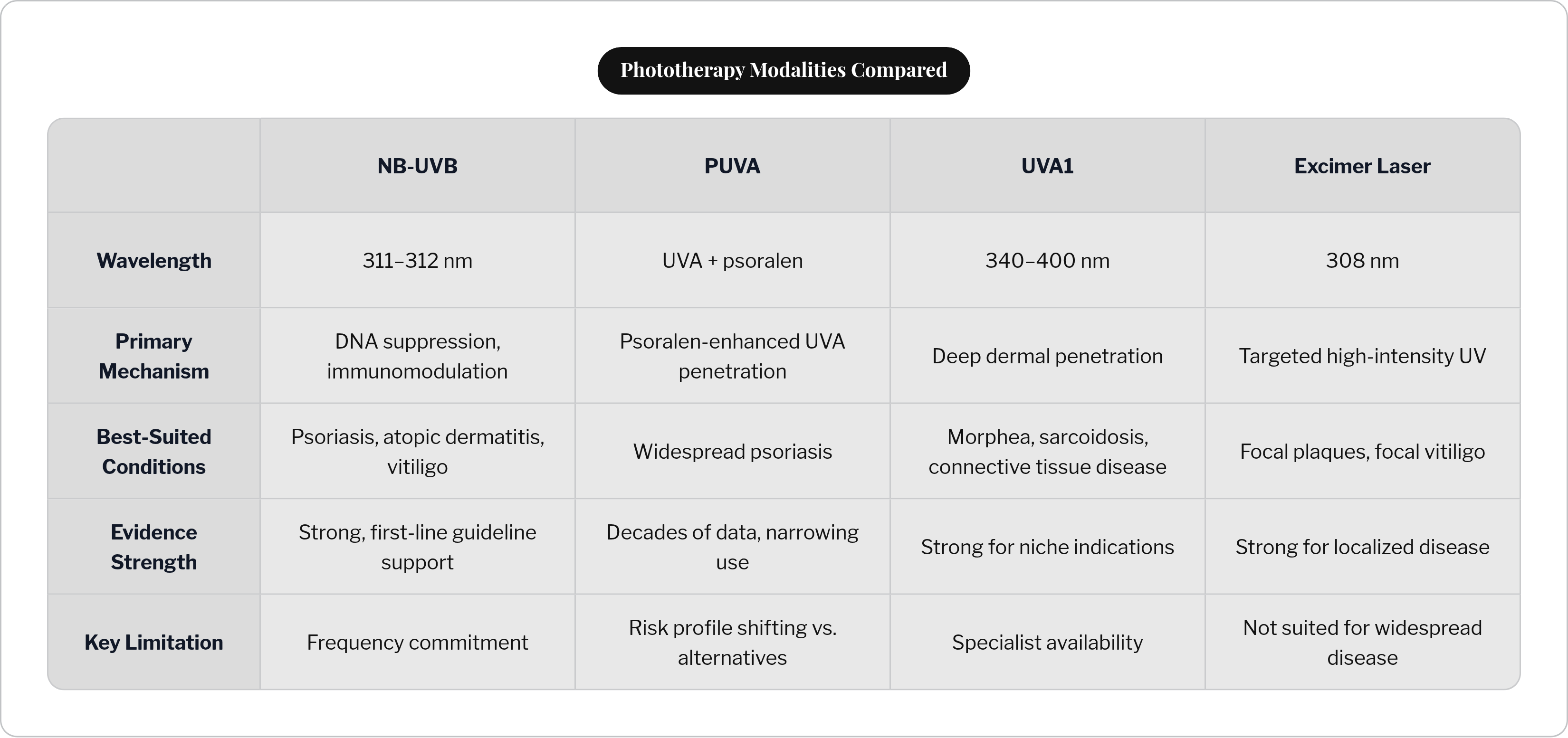
Narrowband UVB, delivered at 311 to 312 nanometers, is the most widely used form in contemporary practice. The "narrowband" label is not marketing; it reflects a real refinement: selecting the wavelength range with the strongest clinical efficacy while removing the broader-spectrum UVB wavelengths most responsible for burning. That selectivity is exactly why NB-UVB sits as an established first-line option for both psoriasis and atopic dermatitis before escalating to systemic therapies.
PUVA (psoralen plus UVA) combines a light-sensitizing compound called psoralen with UVA light. Psoralen sensitizes the skin before exposure, making the combination considerably more potent than UVB alone, and it carries an extensive evidence base accumulated over decades. But its use has been narrowing. The AAD's 2023 guidelines conditionally recommend against PUVA for atopic dermatitis, and global vitiligo guidelines have largely shifted toward UVB. The efficacy has never really been in question; the risk profile relative to newer alternatives has shifted the clinical calculus, particularly for conditions where effective, better-tolerated options now exist.
UVA1, covering 340 to 400 nanometers, penetrates deeper into the dermis than UVB. That depth is what makes it relevant for conditions involving deeper tissue: morphea (a form of localized scleroderma that hardens the skin), certain connective tissue diseases, and cutaneous sarcoidosis. In a real-world study of 740 patients across 26 conditions spanning more than two decades, UVA1 produced marked improvement or complete remission in 85.7 percent of patients with skin sarcoidosis and 50 percent of those with urticaria pigmentosa. Neither of those is an inflammatory skin disease in the conventional sense, which tells you something about how far this therapeutic reach actually extends.
The excimer laser operates at 308 nanometers and delivers targeted, high-intensity UV to specific lesions rather than the whole body. For a patient with a few localized psoriasis plaques or focal areas of vitiligo depigmentation, that precision is clinically significant. Studies show ninety percent clearing of plaques in an average of ten treatments, faster than whole-body phototherapy because the dose concentrates exactly where the disease is.
Blue light via LED is the most nascent modality in this space. Anti-inflammatory and antiproliferative effects have been observed, and it is being actively studied for atopic dermatitis and chronic pruritus; a 2024 clinical trial protocol is evaluating it directly. The evidence base is still early. Worth following.
Which conditions have the strongest evidence for phototherapy
Psoriasis sits at the top of the evidence hierarchy. NB-UVB is a recognized first-line option in clinical guidelines, the excimer laser performs well for localized plaques, and PUVA carries decades of data for widespread disease. The evidence here is mature, not emerging.
Vitiligo is a similarly strong indication, consistently described as a cornerstone of management. NB-UVB has become the preferred approach, largely displacing PUVA, and the excimer laser performs well for focal lesions. The mechanisms are well-understood and the therapeutic rationale is sound.
Atopic dermatitis presents a more complicated picture, and I think it is worth sitting with that complexity rather than papering over it. The AAD's 2023 guidelines give phototherapy a conditional recommendation based on low-certainty evidence, with NB-UVB preferred given its safety profile. The UPDATE trial is currently comparing NB-UVB plus optimal topical therapy against topical therapy alone. An active randomized controlled trial does not mean the treatment is experimental. It means the field is working toward higher-certainty evidence for something it already uses and has reasonable mechanistic grounds for using. Those are different things.
Beyond these three, NB-UVB has demonstrated efficacy across prurigo nodularis (intensely itchy skin nodules), lichen planus, seborrheic dermatitis, pityriasis rubra pilaris, and uremic pruritus (chronic itch linked to kidney disease). Cutaneous T-cell lymphoma, specifically mycosis fungoides, is an established indication, and that last one matters because it signals that phototherapy's utility extends well beyond inflammatory disease in the conventional sense.
You may be wondering about the long-term skin cancer risk, and that question deserves a direct answer rather than reassurance. Across multiple studies, UVB-treated patients show skin cancer rates equivalent to untreated populations. That does not make the concern irrational; it means the current evidence does not support it as a reason to avoid phototherapy when the treatment is otherwise appropriate for the patient in front of you.
Where phototherapy fits when a clinician is weighing treatment options
The standard positioning is as a bridge between topicals and systemic therapies, in the moderate-to-severe range. That framing is accurate but incomplete, because it leaves cost out of the picture, and cost shapes these decisions more than it gets acknowledged in clinical discussions.
Phototherapy is substantially less expensive than biologic therapy. For a patient with moderate psoriasis without psoriatic arthritis, cost-effectiveness frequently favors phototherapy as an intermediate step. For a patient with extensive disease or significant joint involvement, the calculus shifts earlier toward biologics, because systemic disease requires systemic treatment and the clinical burden justifies the expense. Neither answer is universal.
What is emerging now is the possibility that phototherapy complements biologics rather than simply competing with them. A Phase 4 trial is evaluating dupilumab in combination with NB-UVB three times weekly for atopic dermatitis. If combination therapy proves additive, the either-or framing collapses, and treatment sequencing gets more interesting.
The frequency commitment is real and should not be softened. Most phototherapy protocols require multiple sessions per week over weeks to months. For some patients, that is entirely workable. For others, it is the limiting factor regardless of anything else in the clinical picture. That is not a minor logistical note; it is sometimes the whole conversation.
Phototherapy appears in the AAD's 2025 focused update alongside newer agents including tapinarof and roflumilast (topical anti-inflammatory drugs) and lebrikizumab and nemolizumab (injectable biologics). New drugs arriving in a space do not automatically displace older treatments with strong evidence and a distinct risk-benefit profile. It is there because it earns it.
The practical reality of getting phototherapy: office versus home
The logistical burden of office-based phototherapy has been a real barrier, and the numbers make it concrete. Office-based treatment averages around $21,000 per year; home treatment averages around $4,500 per year. One study found patients discontinuing specifically because of travel difficulties, with an average distance of 18.8 miles per session and a round-trip travel cost averaging $168.24 per visit. Multiply that by two or three sessions per week across several months and the financial and logistical weight accumulates fast, independent of the treatment itself.
The LITE trial, published in JAMA Dermatology in 2024, put the two modalities in direct comparison. Across 783 patients at 42 US dermatology practices, home phototherapy was noninferior to office-based treatment for plaque and guttate psoriasis. That finding alone would have been worth publishing. But the trial also found approximately three times higher adherence in the home group, and that is the number that actually changes clinical practice. A treatment patients consistently complete outperforms one they abandon, regardless of what controlled trial data shows under ideal conditions. Adherence is not a footnote; it is frequently the difference between a treatment that works and one that doesn't.
The insurance landscape is also shifting in a meaningful way. Cigna removed restrictions on home phototherapy coverage effective July 15, 2025, following a similar expansion by Elevance Health/Anthem. Together, these changes extend expanded home phototherapy access to more than 66.7 million insured Americans. Over 80 percent of home phototherapy devices from dedicated suppliers are already covered by insurance for vitiligo, psoriasis, eczema, and CTCL. Medicare covers FDA-cleared home units as durable medical equipment when medical necessity is documented.
Noninferior efficacy, substantially better adherence, lower cost, and expanding coverage arriving together is not a minor development. For patients who previously couldn't access consistent treatment because of geography, scheduling, or expense, the home option materially changes what is actually possible for them.
How to think about phototherapy as a patient being offered or considering it
If your dermatologist is recommending phototherapy, the first thing to understand is that this is not a consolation prize. It is a guideline-supported option positioned deliberately between topicals and systemic therapy for many patients, and your clinician is not running out of ideas. They are following the evidence.
The practical questions are the ones worth pressing on. Which modality is being recommended, and why that one for your specific disease and its extent? Is home-based treatment realistic given your schedule and coverage? What does your insurance actually cover, and has anyone verified whether home equipment is accessible to you? How many sessions per week, for how long, and what does a genuine response look like in practice?
Understanding the mechanism helps calibrate expectations, not because it changes what you do, but because it makes the timeline less disorienting. This is not a cure. The goal is suppression of the immune and inflammatory activity driving the disease, and that suppression takes weeks to develop. Maintenance therapy is often part of the picture. If you go in knowing this, you are more likely to stay with it; if you expect rapid resolution, you may abandon a course that would have worked had you held on longer.
The population living with these conditions is large. Approximately 8 million people in the US have psoriasis, more than 16 million have eczema, around 6.5 million have vitiligo. Access to phototherapy has historically been uneven, shaped by cost, geography, and insurance coverage that varied widely and often capriciously. The LITE trial evidence combined with the recent insurance expansions changes that equation for a meaningful number of people who previously had theoretical access to phototherapy but practical access to none.
Teledermatology and asynchronous care models can extend support to patients in areas where dermatologist access is limited. Initiating and monitoring phototherapy does not necessarily require in-person visits at every step, and that flexibility matters in underserved regions.
Before any of this, though: conditions that present like inflammatory skin disease require clinical assessment before treatment begins. Phototherapy works because the mechanism of the treatment maps to the mechanism of the disease. Without the right diagnosis, none of the rest of it lines up.