Generalized Itching With No Visible Rash Causes
Half of chronic itch cases have an invisible systemic disease driving them.
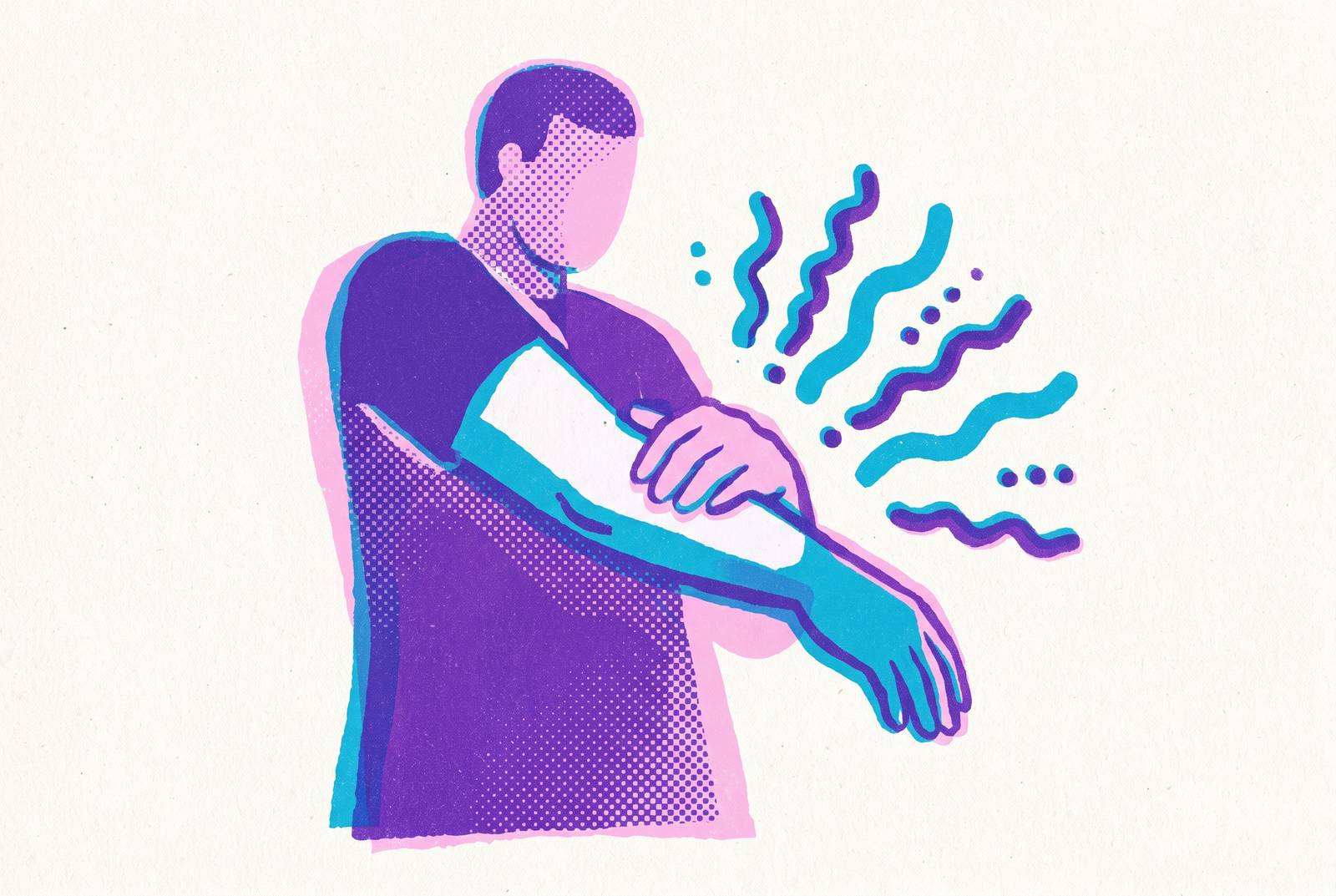
Itching without a rash has a real medical name: pruritus sine materia, meaning itch without visible skin lesions. It appears in roughly half of chronic pruritus presentations (a category doctors label chronic pruritus of unknown origin, or CPUO, once it drags past six weeks). What accounts for the remaining cases? That's where things get interesting, because among patients referred to a dermatologist specifically for this problem, somewhere between 14 and 24 percent turn out to have a systemic disease driving it. That gap between "no rash visible" and "nothing actually wrong" is the whole reason this condition deserves more attention than it gets.
How the itch signal travels without anything wrong on the surface
Itch starts at nerve endings called pruriceptors, a specific class of C-fiber and Aδ fibers sitting in the epidermis. Once triggered, the signal moves from the peripheral nerve into the dorsal horn of the spinal cord, crosses over through the anterior commissure, and climbs the spinothalamic tract to the thalamus on the opposite side of the body, then up into the cortex where it actually registers as "itchy."
Most people assume histamine runs this whole show. It's a fair assumption, since histamine (acting through H1 and H4 receptors, plus sodium channels called Nav1.7 and Nav1.8) does explain hives and a good chunk of allergic itch. But here's where the assumption breaks down: histamine plays a fairly minor role in most chronic itch conditions, especially the generalized kind with no rash. So what's actually driving it?
A wider cast of molecules matters: cytokines like IL-4, IL-13, IL-31, IL-33, and TSLP, along with substance P, nerve growth factor, and endothelin-1. This is precisely why antihistamines fail so often for generalized itch, they're aimed at the wrong target. Keratinocytes, the cells that make up most of the outer skin layer, aren't just passive bricks in a wall either. When the skin barrier gets disrupted, keratinocytes actively release TSLP, IL-33, and NGF, essentially broadcasting the "itch" signal themselves.
Dry skin and skin-barrier breakdown: the most frequent, most underestimated culprit
Xerosis, plain old dry skin, is the single most common reason behind generalized itching without a rash. That sounds almost too simple, but consider how it actually works: the skin's moisture barrier can break down well before any flaking, roughness, or visible dryness appears. The skin can look fine on the surface while the barrier underneath is already compromised. Because keratinocyte-driven itch signals begin at the moment of barrier disruption, not once damage becomes visible, the itch can arrive weeks before the mirror shows anything.
What accelerates this? Low indoor humidity from heating and air conditioning is a major driver. Hot showers strip natural oils faster than most people realize, and harsh soaps throw off the skin's natural pH, weakening the barrier further.
Age adds another layer to this. Oil production slows with age and the skin barrier weakens over time. That combination explains why older adults carry a disproportionate share of this problem, even when their skin looks perfectly normal to the eye.

Systemic diseases that express themselves first through itching
Recall that 14 to 24 percent figure from earlier. That's the slice of patients whose itch traces back to a disease elsewhere in the body, and a few conditions account for most of it.
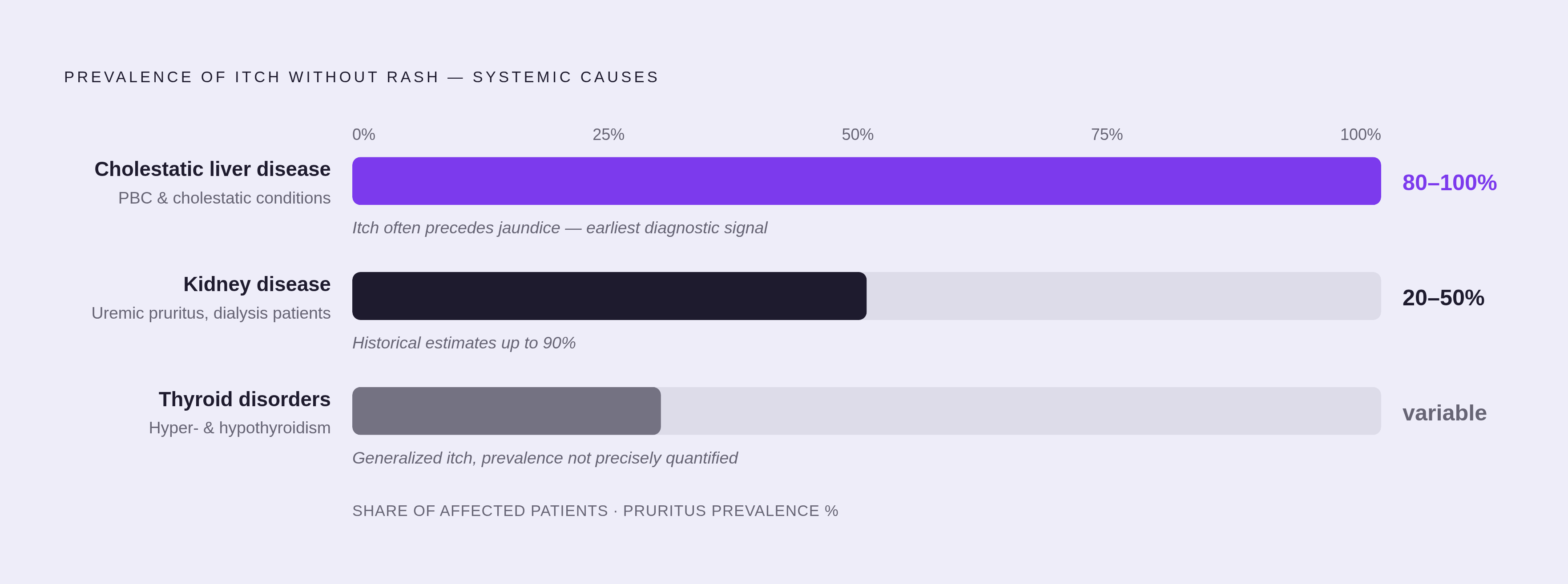
Kidney disease sits at the top of the list. When kidneys fail to clear waste properly, those toxins build up in the bloodstream and irritate nerve endings throughout the skin. Shifts in calcium, phosphorus, and hydration status pile onto the problem. Older medical literature pegged uremic pruritus (the technical term) as affecting up to 90 percent of dialysis patients; current estimates run lower, somewhere between 20 and 50 percent, but that's still a massive burden on a population already managing a serious illness. The pattern tends to worsen at night and can affect wide areas of the body, with no rash present, though scratch marks often develop from repeated clawing at the skin.
Liver disease follows a different mechanism. When bile flow gets obstructed, cholestasis, bile salts build up in the bloodstream and irritate nerve receptors across the whole body. Primary biliary cholangitis and related cholestatic conditions are linked to chronic pruritus in 80 to 100 percent of cases, an extraordinarily high rate. The itch often appears before jaundice or any other visible sign of liver trouble, which makes it diagnostically important. It can be severe and widespread, and its early appearance before jaundice makes it a particularly important diagnostic signal.
Thyroid disorders round out the major systemic causes. Thyroid hormone regulates skin turnover and moisture balance, so both an overactive and an underactive thyroid can trigger generalized itch. Heat intolerance, unexplained weight loss, and tremors alongside itching point toward hyperthyroidism. Fatigue, weight gain, and skin that's gone dry and coarse point the other direction, toward hypothyroidism.
Neurological and medication-related itch, when the signal itself is the problem
Sometimes the itch has nothing to do with the skin or an organ. It's the nerve wiring itself that's misfiring.
Localized itch is the more common signature of neuropathic origin, but generalized versions do happen. Post-herpetic neuralgia is one example: after a shingles rash clears up, the nerve damage it left behind can linger as persistent itch in that same patch of skin, long after any rash is gone. Multiple sclerosis offers another route, where autoimmune damage to nerve insulation leaves itch-signaling neurons less inhibited, producing widespread itch with nothing wrong on the skin. Why does this happen? Because C-fibers carry itch, pain, temperature, and touch signals together, and when those wires get crossed, the brain can register itch without any actual surface irritant to explain it.
Mood chemistry factors in too. Serotonin and dopamine both help regulate how the brain interprets itch signals, so shifts during high-stress stretches of life can genuinely amplify sensitivity.
Medication is a separate, sprawling category. Drugs can trigger itch either by acting directly on nerve fibers or by causing the release of pruritogenic compounds in the body. Common culprits include opioids, certain antibiotics, blood pressure medications, and cholesterol-lowering drugs, among others. Most cases run through an allergic pathway, but opioids and some contrast agents used in imaging can cause itch through a completely non-allergic mechanism. One detail catches people off guard: a person may have been taking a causative drug for some time before itch ever develops, so a longstanding medication shouldn't be automatically ruled out. None of this means stopping a suspected medication on your own. That decision needs a clinician's input, since abruptly quitting some drugs carries its own risks.
Psychogenic itch is a real, recognized clinical category, but it's a diagnosis of exclusion that only gets applied once every other possible cause has been ruled out. And to be clear, this isn't a polite way of saying "it's all in your head." Stress genuinely triggers inflammatory mediators and heightens nerve sensitivity through documented physiological pathways.
Hormonal and life-stage triggers that shift itch sensitivity
Pregnancy reshapes skin physiology through hormonal shifts, increased blood volume, and metabolic changes, and itch is most commonly reported in the third trimester. That's distinct from intrahepatic cholestasis of pregnancy, a separate condition involving impaired bile flow that needs medical evaluation on its own, not something to wait out.
Menopause works through a related but different channel. Declining estrogen reduces skin hydration, weakens collagen, and alters the skin's overall sensitivity. Itch without a rash is a documented symptom of menopause, though it's often written off as ordinary dry skin when the actual driver is hormonal.
Seasonal shifts trigger itch episodes through changes in hormone production and circadian rhythms. Seasonal shifts in temperature and light alter daily routines and indoor environments in ways that can contribute to itch episodes with no obvious cause. Winter heating and summer air conditioning both drop indoor humidity, so the seasonal hormonal shift and the environmental dryness end up compounding each other.
Thyroid function deserves a second mention here. Since thyroid hormone governs skin turnover, anyone noticing fatigue, weight change, or mood shifts alongside itching should think about getting it checked, rather than chalking all three symptoms up to aging or stress separately.
Environmental and product-related triggers that disrupt the skin barrier without producing a visible reaction
Water quality plays a bigger role than most people assume. Hard water leaves behind mineral deposits that irritate skin and throw off its natural pH. Hot showers feel soothing in the moment, but they strip natural oils, and that moisture loss often causes itch hours later, well after the shower's over.
Household products contribute too. Laundry detergents, fabric softeners, and cleaning products leave chemical residue on clothing and surfaces, and that residue can irritate sensitive skin without ever producing visible inflammation. Synthetic fabrics add a mechanical layer of microscopic friction against skin that causes irritation with no inflammatory reaction to point to.
Indoor air matters just as much as anything applied to the skin directly. Heating and cooling systems pull humidity out of indoor air, and that dehydrates skin well before any dryness becomes visible.
Soaps and skincare products round out the list. Harsh chemicals and added fragrances compromise the skin barrier over time, while pH-balanced, fragrance-free alternatives tend to reduce that irritation. Not a guarantee, but a meaningfully lower-risk choice.
Medical evaluation for itch without a rash
A useful marker for readers: itch that persists beyond two weeks without an obvious explanation is worth a visit to a clinician and a basic blood panel. That's a concrete threshold.
Some signs call for faster attention rather than waiting out the two-week mark. Unexplained weight loss, ongoing fatigue, or night sweats alongside the itch point toward something systemic rather than a barrier issue, and that combination is worth bringing to a doctor sooner rather than later.
Sources
- The Spino-Parabrachial Pathway for Itch
- Central neural circuits underlying itch sensation | Nature Reviews Neuroscience
- The neuro-immune insights of itch: peripheral mechanisms and central glial contributions | Cellular & Molecular Biology Letters | Springer Nature Link
- Itch: A Paradigm of Neuroimmune Crosstalk - ScienceDirect
- Basic mechanisms of itch - Journal of Allergy and Clinical Immunology
- ijdvl.com