AI Skin Scan Apps That Track Acne Changes Over Time
These apps can track acne changes, but work best paired with a real clinician.
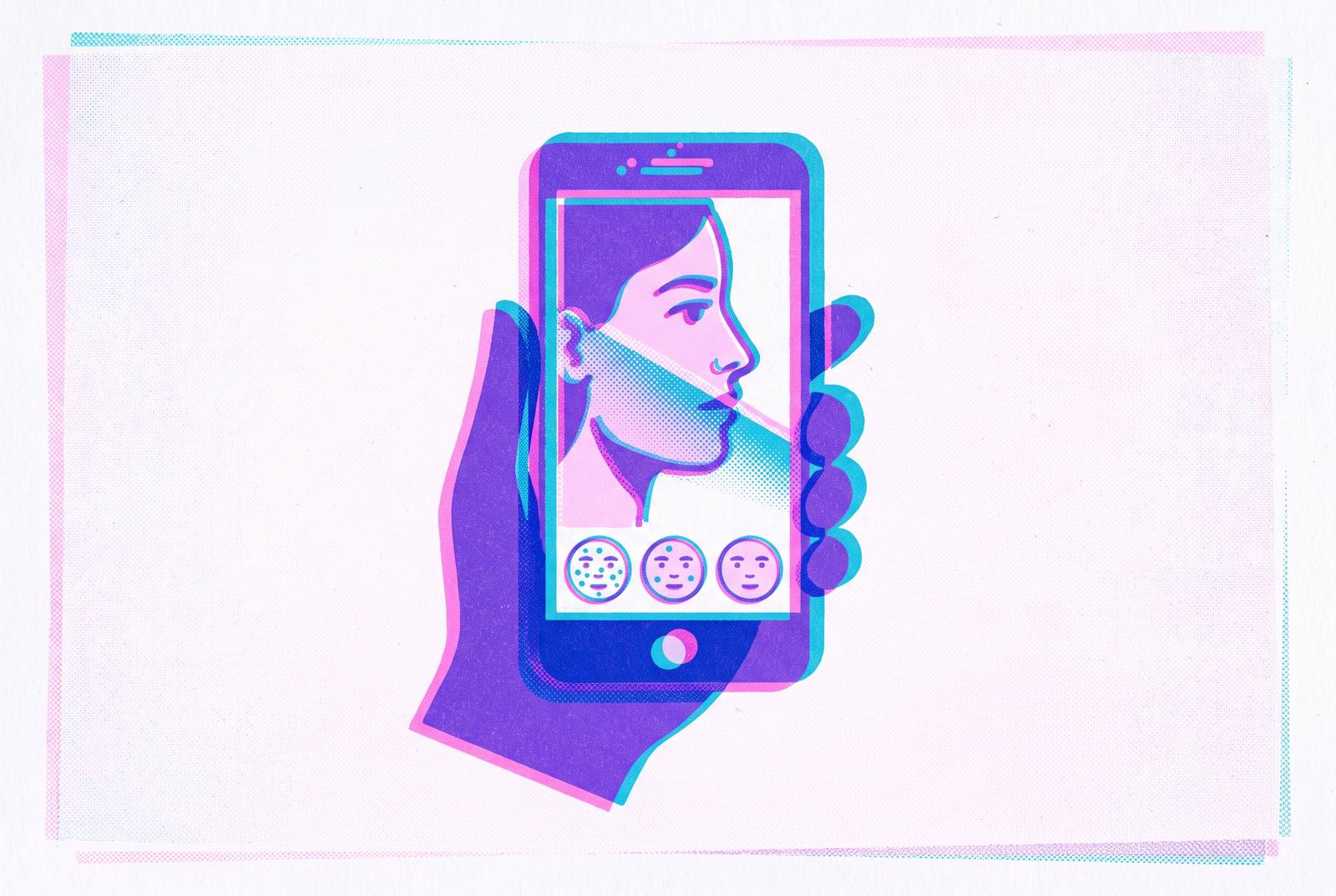
AI acne tracking apps use a phone camera and a trained vision model to score acne severity from a photo, then chart that score over days or weeks so a user can see whether their skin is trending better or worse. The strongest versions of this idea pair photo tracking with review from a licensed clinician, because a severity score alone can't prescribe treatment, and it can't catch what a photo doesn't show. This piece walks through how the technology works, what the evidence says about its accuracy, and how to use it as a complement to your care.
Why acne is unusually well-suited to camera-based tracking
Acne is, at its core, a visible disease. The mechanisms driving a breakout, changes in keratinization, follicular colonization, an inflammatory response, androgen-driven sebum production, all surface as physical lesions you can actually see: comedones, papules, pustules, nodules. That's different from a lot of skin and internal conditions, where the thing causing symptoms isn't the thing a camera can resolve.
Because those lesion types are visually distinct from each other, a computer vision model can be trained to find them in a photo, sort them into categories, and count them. That's a tractable image recognition problem in a way that, say, diagnosing a systemic autoimmune condition from a selfie is not.
Compare that to how acne gets assessed in a typical clinical visit. A clinician does a global severity grading and a manual lesion count, but both happen under time pressure, and the clinician's own judgment call can shift from day to day. That's the exact gap photo tracking claims to close: a more consistent, repeatable way to measure change over time, scan to scan, instead of relying on memory or a single office visit.
The scale of the problem adds to the appeal. Acne is among the most common skin conditions worldwide, and a large share of the people dealing with it don't have regular access to a dermatologist. A tool that only needs a smartphone camera has an obvious opening there, whatever its real accuracy turns out to be.
How an AI acne tracking app works
What differs is what happens inside that loop and how much weight the app asks you to put on the result.
A session usually starts with guided capture: lighting prompts, a face-alignment overlay, instructions to hold the phone a certain distance away. The photo then goes to a computer vision model, which is trained to detect and classify lesion types, or to pull out broader skin metrics. The output lands as a number, often on a 0-100 scale, sometimes broken into sub-metrics like acne severity, redness, pore size, and texture. Stacking enough of those scans together produces a time-series chart showing the trend.
That chart is really the product. Side-by-side photo comparisons and progress charts make change visible in a structured way that a bathroom mirror or a vague memory of "it was worse last month" can't match. Skinive, for instance, adds a real-time scanner mode, so you can move the camera over your skin live, and it keeps a saved skin-check history that covers both acne monitoring and mole or lesion tracking.
The more consequential split is between apps built mainly as documentation tools and apps that try to act as autonomous scorers or treatment advisors. Documentation-first platforms stick to structured photo capture and comparison, and leave the interpreting to the user or a clinician. You see that same logic in AI-assisted telehealth services such as Nolla, where image intake is standardized, but the clinical call still happens downstream of the photo. Scoring-first platforms go further: they generate a severity number and attach recommendations to it. How much weight that number deserves depends entirely on how the underlying model was validated, and most apps don't publish an answer to that question.
Main app types and what they track
"AI skin tracker" is a category label that covers several genuinely different products, and picking the right one means knowing which kind you're actually looking at.
Consumer tracking apps, SkinVerse is one example, are at the accessible end: low barrier to entry, good for building a photo habit, useful for seeing trends. Their limitation is that the recommendations attached to a scan tend to be generalist, built for a broad audience rather than reviewed by a clinician against an individual case.
Medically-registered tracking apps occupy different regulatory ground. Skinive, for example, carries CE marking under the EU Medical Device Regulation and is classified Class I. That registration sets a floor for what claims the app can make and how it has to handle user data, a bar most consumer beauty apps never clear. That marking applies to software that provides information, not software that renders a diagnosis. That's a meaningful signal of regulatory seriousness, not proof that the app can replace a clinical exam.
Specialist acne apps, such as MDacne, trade breadth for depth: they go deeper on acne specifically rather than trying to cover every skin concern at once. If your only skin issue is acne, that's a reasonable trade, but it's less so if you're managing multiple conditions through one tool.
Brand-backed analyzers run a different kind of pipeline, and L'Oréal Paris Skin Genius is a clear case. The analysis exists to generate product recommendations from the brand that built the tool. That's a structural fact about incentives a reader should weigh when deciding how much independent judgment sits behind the output.
Nolla represents a different structural category. It pairs AI trained on over three million labeled clinical cases with mandatory review by a licensed US clinician, so what reaches the patient isn't an autonomous score but a diagnosis, prescription, or guidance issued by a physician after an AI-assisted intake. That design assigns clear responsibility for the call the app's number implies, answering the accountability gap that sits underneath most of the other categories.
Clinical evidence on AI acne tracking accuracy
The consumer market for these apps is already large, but the research behind AI acne tracking is thin, so there's a wide gap between what apps claim about their own accuracy and what's been independently validated.
A meta-analysis spanning 2003 to 2025 found that AI has strong pooled diagnostic performance across dermatology generally. But most of the studies feeding that pooled result cover melanoma detection and lesion classification, not acne specifically. Only a small fraction of the studies screened for that meta-analysis actually met the criteria for acne-specific AI assessment, so the strong topline number doesn't transfer cleanly to the acne-tracking use case.
The closest thing to a direct test of the tracking premise comes from a prospective clinical study published in the Journal of Investigative Dermatology. It compared AI Skincare, built by Perfect Corporation, against a validated computer-based system, VISIA Complexion Analysis, and found both captured measurable pre- and post-treatment changes in redness and pores, measured at baseline and again four to eight weeks into a personalized acne treatment. The study involved a small number of patients, making the finding an early signal.
A separate real-world observational study looked at patient-uploaded photographs, and it found that an AI-derived severity score correlated with clinician assessments. That's an encouraging early sign that these tools can track change over time in a way that lines up with what a dermatologist would see. It's not evidence that the score alone is enough to manage a case remotely without a clinician in the loop.
Then there's a gap between what gets published in research and what gets printed on an app store listing. One app, listed on Google Play, claims 98% accuracy across more than 15 skin problems, a figure with no attached methodology, no population description, and no independent review behind it. Skinive has published its own 2026 accuracy report, not independently peer-reviewed, reporting high sensitivity, specificity, and overall accuracy, with similarly high sensitivity for acne and rosacea specifically. A high accuracy claim tells you almost nothing without knowing what was measured, on what population, under what lighting, and against what clinical baseline, details most apps simply don't publish.
Classification accuracy on a held-out test set, the kind of number most apps report, affects a model's performance on a fixed benchmark, but it doesn't establish clinical utility in tracking a real person's acne over months. A model can score well on a curated dataset and still give a shaky read on a particular face, in a particular bathroom, under a particular lightbulb. The Physician AI Handbook (2025) lands on a measured position here: for psoriasis, acne, and atopic dermatitis, AI severity scores should complement validated clinical instruments rather than replace them, pending prospective studies that directly compare AI-supported monitoring against standard care on real treatment outcomes.
That gap between self-reported accuracy and independently validated performance is part of why clinician oversight matters so much in practice. A licensed dermatologist reviewing an AI-assisted intake can weigh a severity score against a patient's symptoms, medical history, and response to past treatment in a way no standalone algorithm can, which makes that combination a sturdier foundation for actual treatment decisions than a score by itself.
Why skin tone diversity in training data matters
A model validated mostly on one range of skin tones will tend to perform worse on others. It's a documented, well-known failure pattern in computer vision applied to skin, not a hypothetical risk.
The stakes attached to that pattern are higher than they might first appear. Skin cancer is already diagnosed later in people with darker skin, partly because it looks different there than the textbook cases most training data is built from. An AI tool that inherits that same training bias doesn't invent a new problem, it reproduces an existing one, at scale, inside a tool marketed as more accessible.
Researchers and regulators studying digital health tools have flagged this directly: tools built without deliberate attention to bias risk widening the very disparities they claim to close. Algorithmic bias, uneven access to the devices and data plans these apps require, and training sets that skip entire skin tones can all undercut the access story these apps tend to lead with in their marketing.
What should a reader actually ask before trusting one of these scores? Whether the company behind it can show evidence of bias auditing across the Fitzpatrick skin type scale, and whether its training data spans real geographic and demographic diversity. A general claim of accuracy, unattached to that kind of breakdown, isn't a substitute for it. L'Oréal Paris Skin Genius is described as trained on a database spanning a range of ages, ethnicities, and skin types, which is the right direction for the category. Independent verification of how it performs across those subgroups is what would actually confirm the claim, and that verification isn't something a reader can currently check for themselves.
The real risk: using an app score as a substitute for clinical judgment rather than a bridge to it
The sharpest objection to these apps is that a patient might use a good-looking number as a reason to put off care they actually need.
Patients say they feel hesitant toward AI-based skin assessments that don't involve a dermatologist at some point in the process. At the same time, what they say they actually want from these tools is faster triage and quicker access to a real clinician. Put those two findings together: the intended use case is acceleration toward care, not a stand-in for it.
The substitution risk bites hardest on acne that looks mild in a photo but isn't mild underneath it. Hormonal patterns, early scarring, and the psychological weight of a chronic breakout don't appear in a severity number. Current clinical guidelines strongly recommend oral isotretinoin for acne that's severe, causing significant psychosocial burden or scarring, or not responding to standard oral or topical therapy. Not one of those triggers can be read off a photo score. The same guidelines make strong recommendations for benzoyl peroxide, topical retinoids, topical antibiotics, and oral doxycycline. There's a well-established, evidence-based treatment ladder available, one an app cannot prescribe from but a clinician consultation can start.
The access argument genuinely cuts both ways. Teledermatology and AI-assisted triage do lower real barriers to getting seen. That benefit holds only when the tool routes a person toward a clinician. A score that sits in isolation, unreviewed, doesn't do that. A score that feeds into a consultation does.
Using an AI acne tracking app to improve your skin
Everything above points toward one practical conclusion: these tools add the most value as a structured documentation habit that feeds into a clinical decision, not as a stand-in for one.
Set consistent photo conditions before anything else. A lighting change between two scans is the single biggest cause of a false "improvement" or "worsening" reading. Apps that offer guided lighting prompts or face-alignment overlays help cut that noise down. Same time of day, same distance from the camera, same room: those details matter more to the quality of your tracking than which specific app you pick.
Treat the score as a trend signal, not a clinical verdict. If a number moves steadily in one direction across several weeks, it tells you something real. A single scan on a single day doesn't. Skinive states outright that its results are informational and educational rather than a medical diagnosis, a framing that matches what the tracking function can and can't actually do. Watch the direction and the rate of change, and resist anchoring on whatever the absolute number happens to say today.
Bring the photo history to a consultation as a supplement to it. A set of organized serial images is genuinely useful to a clinician: it compresses weeks of gradual change into a review that takes seconds and grounds the conversation in what actually happened to the skin, not just how it looks on the day of the appointment. Skinive builds part of its workflow around that: you can save a skin-check history to organize before talking to a doctor or dermatologist. An asynchronous, message-based consultation, the kind Nolla offers, is a low-cost, low-friction way to get a licensed clinician's eyes on that photo series without booking an in-person visit. If you pair structured self-monitoring with that kind of clinician oversight, it does more for your skin than either one does alone.
Know which symptoms call for a clinician regardless of what the app says. Nodular or cystic lesions, any sign of scarring, acne that persists through several weeks of an evidence-based topical regimen, or acne causing real psychological distress are all reasons to get seen, and a photo score can't detect or rule out a single one of them. For most everyday skin questions, telehealth is a reasonable first step, with the app serving as preparation for that visit.
Check an app's training data claims before leaning on it heavily. Ask whether it publishes anything about how diverse its training data is across skin tones. If it doesn't say, treat whatever score it gives you with more skepticism, not less. CE marking, as with Skinive in the EU, is a real regulatory signal worth factoring in, though it covers software that provides information rather than software that renders a diagnosis, a distinction that should shape how much weight any single scan gets to carry.
Sources
- AI Skin Scanner & Mole Checker - Apps on Google Play
- AI Skin Scanner: Acne Detector - Apps on Google Play
- SkinVerse: AI Skin Scanner - App Store - Apple
- The Evolving Role of Artificial Intelligence in Dermatology: A Meta-Analysis of Diagnostic Performance, Clinical Applications, and Implementation Challenges (2003–2025) - PMC