Moisturizer Ingredients and What They Actually Do
Humectants plump skin temporarily, but the wrong conditions can actually dehydrate it instead.
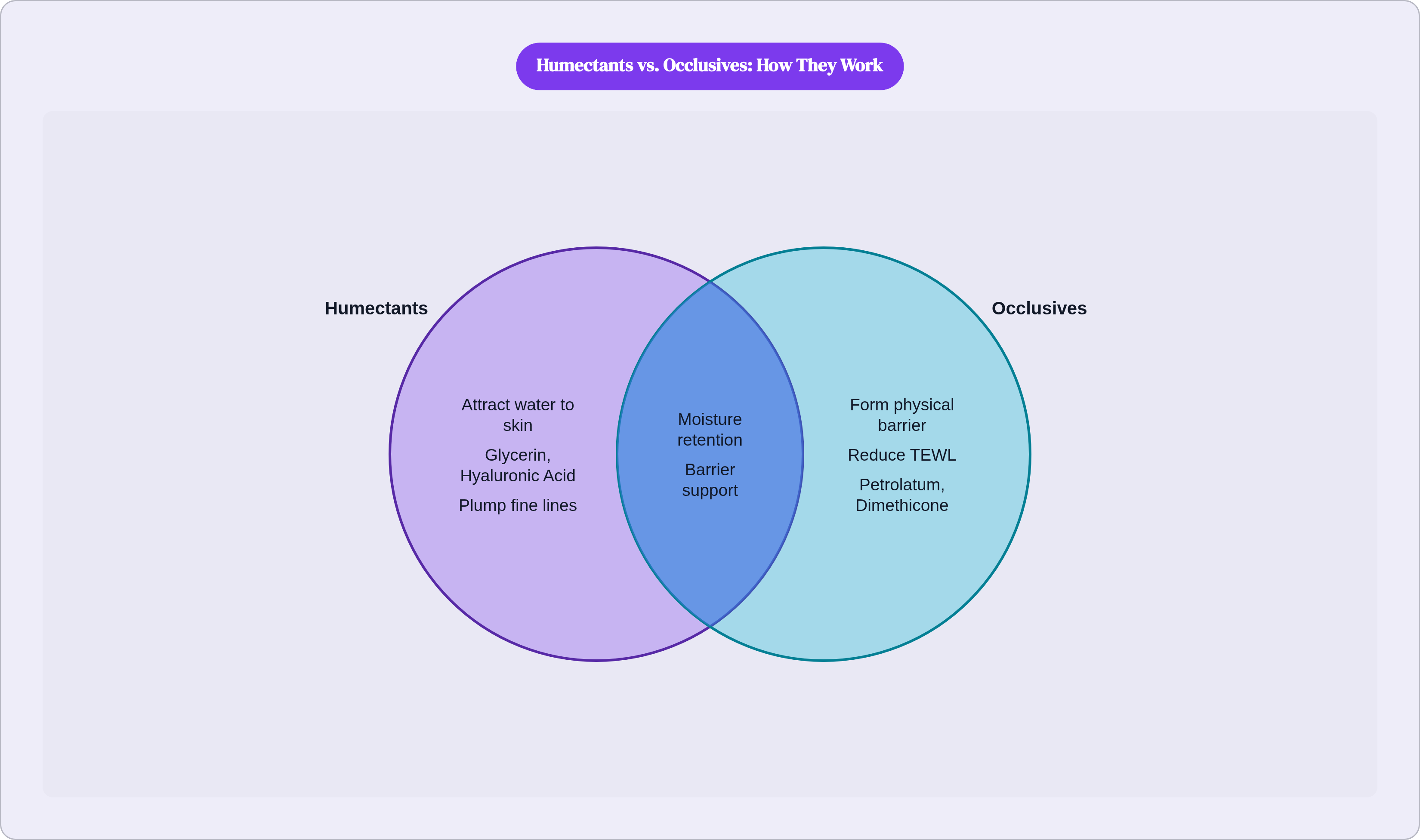
Humectants are hydrophilic molecules, structurally attracted to water. Applied to skin, they pull moisture from two directions: upward from the water-rich dermis below, and inward from surrounding air when humidity cooperates. The surface plumps. Fine lines soften. That effect is real, and it is also temporary. As water content normalizes, the volumizing resolves. Not a failing of the ingredient; just an accurate description of what it actually does.
Glycerin is the benchmark: cheap, stable, present in nearly every moisturizer category. Hyaluronic acid occupies the premium tier. Urea, lactic acid, and aloe fill out the common roster.
Here is the part most people learn the hard way. In low-humidity environments, a humectant applied without an occlusive on top will pull water out of the stratum corneum rather than into it, drawing moisture toward drier air and leaving skin worse than before. This happens routinely in winter, in air-conditioned offices, on airplanes. The humectant is working exactly as intended. The problem is that the only available water source is the skin itself.
Urea is the clearest illustration of how concentration rewrites the story entirely. At one to two percent in a facial moisturizer, it functions as a gentle humectant. At forty percent in a foot peel, the same molecule becomes a chemical exfoliant capable of breaking down keratinized tissue. Same compound, completely different physiological outcome. Dose is not a minor detail.
What hyaluronic acid actually does at different molecular weights
Hyaluronic acid is a glycosaminoglycan that occurs naturally in skin, connective tissue, and the eyes. Its capacity to retain water, reportedly up to a thousand times its own weight, is the foundation of its cosmetic use. Most labels, though, quietly omit the variable that most changes the outcome: molecular weight.
High molecular weight hyaluronic acid does not penetrate the skin. It sits on the surface, forms a film, and retains water at the skin's exterior. Immediate smoothing, surface hydration, temporary effect. Low molecular weight hyaluronic acid penetrates into the epidermal layer and hydrates the stratum corneum more deeply. When a serum calls itself a "hyaluronic acid serum," it is delivering surface hydration, deeper epidermal hydration, or some combination of both, depending on the molecular weight profile of the formulation. Those are not equivalent outcomes, and the label rarely tells you which one you are getting.
Its safety profile is favorable: adverse reactions are rare, and it is considered safe during pregnancy and nursing, which matters if you are navigating ingredient restrictions during a sensitive period. Documented secondary benefits, including support for wound healing and general barrier function, extend beyond the primary hydration effect, which makes it a more useful ingredient than its single-headline marketing usually suggests.
How emollients work on skin texture (and why they are not the same as occlusives)
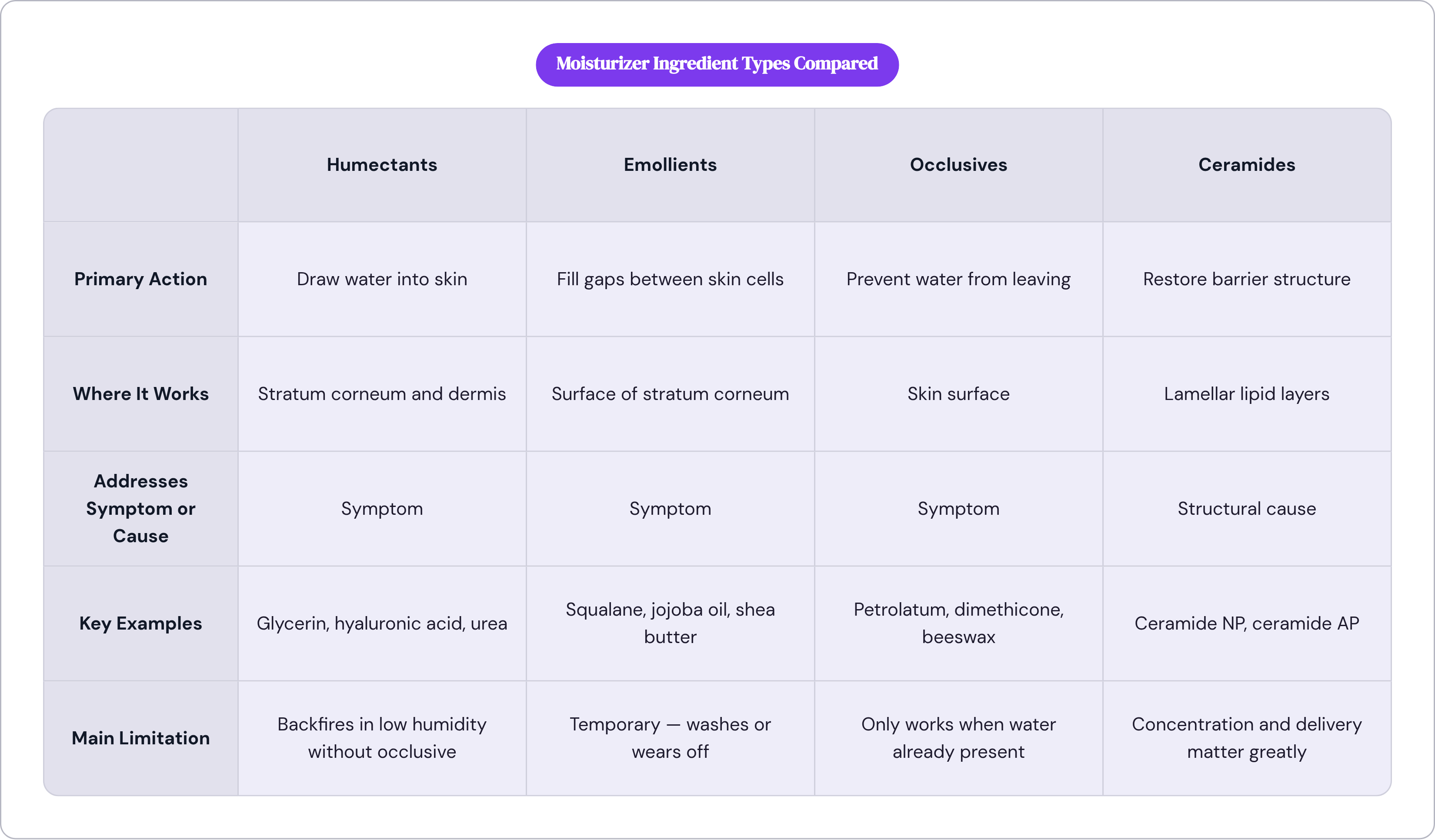
Emollients are oily substances that fill the microscopic gaps between dead skin cells in the stratum corneum. Think of the outer skin layer as a wall where the mortar has partially cracked and dried out; emollients fill those cracks. The effect is textural and structural rather than hydrating in the humectant sense or sealing in the occlusive sense. The surface becomes perceptibly smoother because physical irregularities are temporarily filled, not because water content has changed.
Common emollients include squalane, jojoba oil, meadowfoam seed oil, various esters, and shea butter, which also carries some occlusive properties. The blend of emollients in a formulation is what largely determines how a moisturizer feels: silky, lightweight, richly protective. Tolerability drives adherence, and adherence is the only thing that makes any ingredient work over time. A formulation that performs clinically but feels unpleasant on the skin gets abandoned. That is not a trivial concern.
Panthenol, provitamin B5, is worth considering as a bridge molecule. It functions simultaneously as a humectant and an emollient, drawing water into the stratum corneum while contributing to surface smoothness. One ingredient doing two mechanistic jobs is not unusual in well-constructed formulations, and panthenol is a compact illustration of why real products layer mechanisms rather than betting everything on one.
How occlusives lock in moisture and why petrolatum is still the gold standard
An occlusive's job is to impede water from leaving the skin, not to introduce water from outside. Occlusives are hydrophobic; they form a physical barrier on the skin's surface that reduces transepidermal water loss, referred to clinically as TEWL. Petrolatum reduces epidermal water loss by nearly ninety-nine percent. Nothing else in the consumer market comes close. Dimethicone, mineral oil, and beeswax are effective occlusives, but petrolatum sits at the top of the clinical hierarchy by a margin that deserves more candid discussion than it typically receives.
The barrier to widespread adoption is sensory. Petrolatum is warm, occlusive in feel as well as in function, and carries associations with diaper rash ointment or industrial lubricants. The K-beauty "slugging" trend, applying a thin layer of petrolatum as the final evening step, recontextualized the ingredient for a broader audience. It worked not because the mechanism was new, but because applying it directly made the principle suddenly legible to people who had never approached skincare in mechanistic terms.
The part that surprises most people: occlusives only perform when water is already present in the skin. Applied to a dehydrated surface, an occlusive seals in very little. Timing and sequence are not incidental. They determine whether the ingredient actually functions.
Why ceramides address dry skin differently than humectants or occlusives do
Ceramides are lipids constituting roughly thirty to forty percent of the outer skin layer. Their function is architectural: they maintain the structural integrity of the skin barrier and prevent both moisture loss and pathogen entry. When ceramide levels are low, the barrier becomes permeable, and dehydration follows as a downstream consequence, not as the primary event.
Humectants and occlusives address symptoms. Ceramides address the structural condition generating those symptoms. A 2024 to 2025 clinical study published in Medical Forum Monthly found that a ceramide-enriched moisturizer produced a forty percent reduction in TEWL and a forty percent reduction in SCORAD (a standardized severity measure for dermatitis), compared to a standard glycerin and mineral oil moisturizer. The specific finding worth noting: conventional moisturizers provided symptomatic relief but did not improve the lamellar lipid architecture of the barrier itself. The structure remained compromised even as the surface felt better.
Consumer interest has followed the clinical evidence, with searches for ceramides reaching approximately thirty-two thousand per month as of February 2024, up thirty-eight percent over the prior year. Scaling interest, though, brings dilution. A product containing ceramides at a meaningful concentration in a well-designed delivery system is categorically different from one that lists ceramide NP fourteenth on the ingredient deck.
How niacinamide builds the barrier from the inside rather than patching it from outside
Niacinamide, the biologically active form of vitamin B3, does not fit neatly into the humectant, emollient, or occlusive taxonomy. Its primary contribution to barrier function is upstream: it stimulates the skin's own biosynthesis of ceramides and other stratum corneum lipids rather than delivering those lipids externally. Ceramides in a cream supplement the barrier directly. Niacinamide prompts the skin to build more of its own. That distinction matters more than most labels suggest, because one approach is structural reinforcement and the other is closer to stimulation.
The documented benefits extend beyond lipid synthesis. Niacinamide reduces oxidative stress and erythema, inhibits melanosome transfer to keratinocytes (the mechanism underlying its use in hyperpigmentation), and supports collagen synthesis and extracellular matrix integrity. A 2025 literature review covering published evidence from 1995 through 2024 found consistent clinical improvements in signs of aging at topical concentrations of two to five percent.
The ceramide-and-niacinamide pairing is particularly well-supported because the mechanisms are complementary rather than redundant. Ceramides deliver immediate structural reinforcement of the lamellar lipid layers. Niacinamide scales up the skin's own lipid production over time. A 2024 randomized controlled trial in the Journal of Cosmetic Dermatology confirmed that the combination outperformed a hydrophilic cream alone when used alongside topical anti-acne treatment. Two ingredients working through different pathways within the same functional goal produce effects neither achieves on its own.
Retinol's place in a moisturizing routine (and why it needs barrier support to work well)
Retinol is a vitamin A derivative. Its primary mechanisms are stimulating fibroblasts to produce collagen and suppressing the activity of collagen-degrading enzymes. This is structural tissue remodeling, not hydration in the humectant or occlusive sense. The reason retinol appears in moisturizing contexts is frankly pragmatic: its well-documented irritation profile, dryness, flaking, transient barrier disruption, makes barrier support a practical necessity for consistent use. You cannot get the long-term benefit if the short-term experience drives you to quit.
Formulation has moved in a predictable direction as a result: pairing retinol with ceramides, panthenol, niacinamide, and other barrier-supportive co-ingredients to buffer the disruption. An eight-week IRB-approved clinical study in 2024 evaluated a formulation combining low-dose retinol with a synthetic retinoid ester, a pea peptide, and an antioxidant blend, measuring hydration, TEWL, and elasticity in thirty subjects aged thirty-five to seventy. The design reflects where the field is heading generally: active remodeling ingredients surrounded by protective infrastructure rather than isolated in a delivery vehicle.
What practitioners call "sandwiching" is a practical application of this thinking: a humectant-rich layer before the retinol step, then a ceramide or occlusive-rich moisturizer after. The retinoid works; the barrier survives the night. Emerging alternatives, particularly retinoid-mimicking molecules derived from marine algae, are attracting attention for producing analogous effects with significantly lower irritation potential. Whether they will build a clinical evidence base comparable to retinol's over time is genuinely unclear. Worth following, not yet worth substituting.
How layering order changes what ingredients can actually do
The foundational rule is thinnest to thickest, with occlusives last. An occlusive applied before a humectant forms a seal that prevents the humectant from reaching the stratum corneum; you have sequenced yourself out of an ingredient you paid for. A humectant applied in a dry environment without any subsequent occlusive draws moisture out of the skin rather than in; you have recreated the backfire condition from the first section. Sequence is not a preference. It determines whether an ingredient functions at all.
Ceramide-and-niacinamide combinations often arrive in the same product step, typically a moisturizer, rather than requiring separate application slots. This matters practically: not every mechanistic distinction demands a separate product. Well-formulated moisturizers combine complementary mechanisms deliberately, and layering five distinct products is not necessarily superior to two well-constructed ones. Complexity for its own sake is not optimization.
Retinol sandwiching is a worked example of user-controlled sequencing. Apply your humectant serum first, allow it to absorb, then retinol, then an occlusive or ceramide-rich moisturizer to close. Sequence here is a decision you make at home, not a fixed property of the products themselves, and that is an underappreciated degree of control.
One exception overrides the thickness heuristic entirely: sunscreen goes last regardless of texture. Applying anything over SPF dilutes the UV-absorbing or photon-scattering layer and reduces its efficacy. This is the single most common sequencing error in multi-step routines, and it matters more than most of the other sequence decisions combined.
What "hypoallergenic," "medical grade," and "clinically proven" actually mean on a label
"Hypoallergenic" has no government standard. No regulatory body defines it, certifies it, or requires evidence for it. Any product can carry the term without a single allergy test having been conducted. It is a marketing word, not a technical designation.
"Medical grade skincare" has no legal, scientific, or regulatory definition either. No governing body certifies it. The phrase implies clinical rigor or superior ingredient concentration through association with medicine, but it carries no enforceable meaning whatsoever. It is aspirational branding, not a quality tier.
Hedging language is the mechanism that allows specific-sounding claims to remain legally defensible. "Helps reduce wrinkles" is not a promise of wrinkle reduction. "Supports barrier function" is not evidence of barrier improvement. The verbs, "helps," "supports," "stimulates," "improves the appearance of," create the impression of a claim while making no verifiable commitment. Once you see this pattern, it is difficult to read a label without noticing it everywhere.
What actually carries information: named ingredients at named concentrations, references to peer-reviewed studies you can locate and evaluate, and formulations that combine complementary mechanisms rather than staking everything on a single headline ingredient. A moisturizer listing "hyaluronic acid" without specifying molecular weight, or "ceramides" without indicating concentration, is still doing marketing. If you read it as science, that is a category error, and an expensive one.
One emerging category worth tracking: postbiotics, compounds including peptides, enzymes, and organic acids produced by beneficial bacteria. Board-certified dermatologist Dr. Dara Spearman has described postbiotics as offering measurable benefits without the instability of live probiotics. Whether they will develop a clinical evidence base comparable to ceramides or niacinamide is not yet clear. The humectant, emollient, and occlusive framework is an accurate map of the current terrain. Whether it stays sufficient as the ingredient landscape continues to evolve is an open question without a tidy answer.