Seasonal Patterns in Skin Condition Flares
Understanding the science behind why your skin flares on a seasonal schedule.

Skin flares don't happen at random. Temperature, humidity, UV exposure, and allergen load shift on a predictable calendar, and each shift acts as a biological trigger for the skin conditions people wrestle with year-round. Once you understand the mechanism behind each season's pattern, you can see flares coming instead of chalking them up to bad luck.
Skin is negotiating with its environment hour by hour, adjusting its chemistry to whatever the air outside is doing.
Start with the stratum corneum, the outermost layer of skin and the first thing any seasonal shift hits. It's held together by a lipid matrix made of roughly 50% ceramides, around 25% cholesterol, and approximately 15% free fatty acids. That ratio isn't fixed. Temperature, humidity, and UV exposure all push it around across the year, so the same skin barrier is chemically a little different in January than it is in July.
The measurable signal for how well that barrier holds up is called transepidermal water loss, or TEWL: the rate at which water escapes through skin into the air. Climatic chamber studies show TEWL rises with higher temperature and drops with higher humidity. That single dynamic explains an unreasonable amount of the seasonal symptom swing seen across eczema, psoriasis, and acne.
Here's the part patients get wrong: a disrupted barrier isn't just dry, flaky skin. Once water loss climbs and the lipid matrix thins, irritants and allergens get past the skin's defenses more easily, which flips on inflammation and itch cycles, and can set off immune activation in people already prone to it. Dryness is the symptom you can see. Underneath it sits a gate that's stopped doing its job.
What winter does to skin — cold, dryness, and the compounding triggers patients miss
Winter's damage comes from two things happening at once. Cold outdoor air holds less moisture to begin with, and indoor heating strips out whatever residual moisture is left. Patients end up dry outside and dry inside, with no window of relief in between.
The geography backs this up. States with the highest annual temperatures show 14.8% lower eczema prevalence than the coldest states, and the highest-humidity areas show 17.6% lower prevalence than the driest ones. Season and climate are the same variable, just measured two different ways.
Cold does more than dry the surface. It changes the structure of stratum corneum lipids, slows how fast the barrier recovers once damaged, disrupts the skin's microbiome, and impairs blood vessel function near the surface. Any one of those, on its own, is manageable. Stack all four and you get why winter flares often feel harder to shake than "just use more moisturizer" would explain.
There's a vitamin D angle too, and it's easy to miss. UV-driven vitamin D synthesis declines through autumn and bottoms out from late winter into early spring, which lines up almost exactly with peak psoriasis flare season. Then there's the infection pathway: Group A Streptococcus, the bacteria behind strep throat and tonsillitis, peaks in winter and can trigger or worsen guttate and plaque psoriasis. Most patients never connect a sore throat in January to a skin flare in February. The link is real anyway.
Mood plays a role, and the numbers are striking. A 2025 study found anger correlated with skin symptom severity at R = 0.91, loneliness at R = 0.80, and depression at R = 0.68. Mood disorders themselves peak in winter, so the emotional and physiological triggers land on the same weeks.
Winter flares are rarely one thing going wrong. Cold air, dry heat indoors, low vitamin D, a lingering strep infection, a hard couple of months emotionally: any single one of these could explain a flare on its own, which is exactly why treating just one of them so often feels like it isn't working.
Summer's own set of problems — heat, sweat, UV, and the conditions that worsen in warm months
Warm weather has a reputation for healing skin, and there's some truth to it. But summer runs its own list of aggravations, and for a few conditions, warm months are the harder season, not the easier one.
Acne is the clearest case. Higher temperatures push sebum production up, and higher humidity makes pores more prone to clogging. Sweat mixing with sunscreen or makeup builds an occlusive layer on skin that favors comedone formation, the small plugs that turn into breakouts. A 2024 retrospective study of 298 winter cases and 360 summer cases found acne made up 44.5% of winter diagnoses and 44.04% of summer diagnoses: a dead heat. What actually changes between the two seasons is the type and location of lesions, not whether acne shows up.
Eczema doesn't get a summer pass either. Heat impairs barrier function just as cold does, only by a different route. Sweat carries urea and lactic acid, both of which directly provoke itch on skin that's already sensitized. And air conditioning, ironically, recreates a dry micro-environment indoors, the same dryness eczema patients thought they'd escaped once winter ended.
Psoriasis is the genuinely mixed case. UV exposure helps a meaningful share of patients, and clinical phototherapy, controlled UVB delivered under medical supervision, is the formal evidence that the mechanism is real. But uncontrolled sun exposure runs through a different, less predictable set of effects: heat-driven sweating and skin irritation provoke flares in a real minority of patients, even while that same UV is doing genuine good for someone else in the waiting room.
Air pollution sits on top of all this as a year-round factor that shifts with season and geography both. Each incremental rise in particulate matter or nitrogen dioxide has been linked to a 1 to 3% increase in atopic dermatitis outpatient visits and flare-ups. Where pollution peaks depends on where you live, so two patients with identical eczema can carry completely different seasonal risk just based on zip code.
The transition seasons — why spring and autumn are underestimated as flare windows
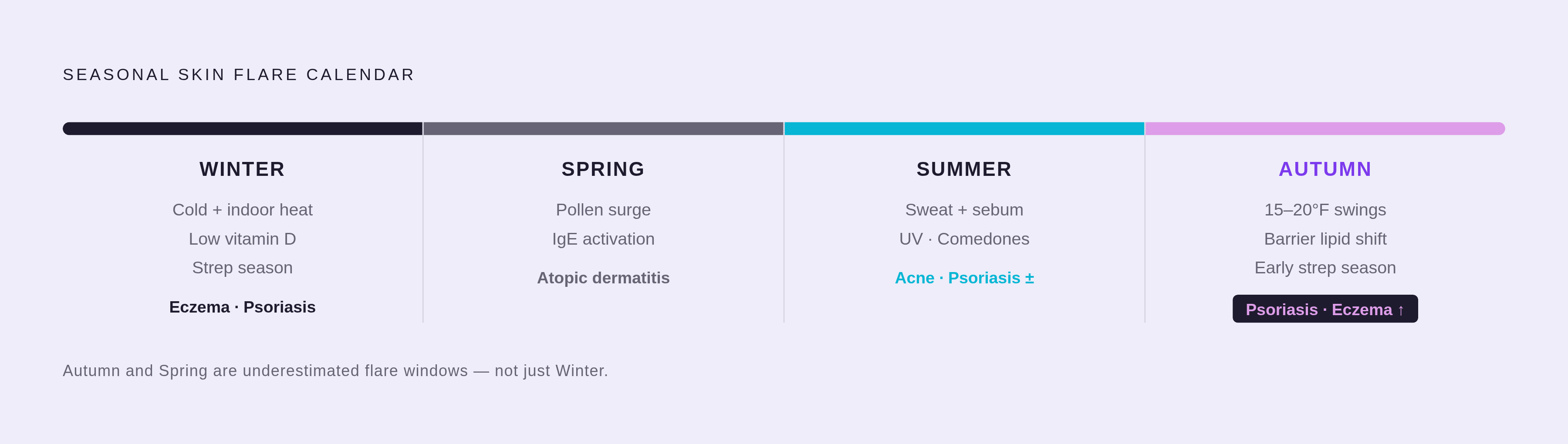
Spring and autumn get filed away as the calm seasons, the buffer between winter's misery and summer's heat. That's backwards. These are periods of the fastest environmental change all year, and change itself stresses reactive skin more than steady-state extremes do.
Spring's defining feature is the allergen surge. Airborne pollen hits atopic skin two ways: direct contact disrupts the barrier and causes itch, and systemic allergic activation worsens existing eczema through IgE-mediated immune pathways. The same immune dysregulation driving atopic dermatitis also drives hay fever, so spring can hit both conditions in the same patient, at the same time, off the same trigger.
Autumn is the early warning window most patients don't clock until it's too late. Temperature starts dropping months before the coldest weather actually arrives, and the barrier lipid changes that come with cold begin well before the air feels wintry. Strep season starts in autumn too, so the psoriasis-infection trigger shows up earlier than most people expect. Indoor heating comes back on and drops indoor humidity immediately, weeks before anyone's thinking about winter skincare.
There's day-to-day volatility on top of all that. When temperature swings 15 to 20 degrees between morning and afternoon, even if the season's average feels mild, skin doesn't get time to settle. It's still adjusting to yesterday's conditions when today's show up.
So the year carries four seasons of risk, not two. Each has its own trigger profile, and each one is readable in advance if you know what to check for.
Building a seasonal management framework — what the evidence actually supports doing differently, quarter by quarter
The principle underneath all of this: adjust before the season turns, not after the flare starts. Reactive skincare is always playing catch-up against a barrier that's already compromised by the time symptoms show up, so the entire framework below runs on a lead, not a response.
Winter calls for barrier repair and occlusion. Ceramide-containing moisturizers replenish the exact lipid components cold weather depletes; given what's happening in the stratum corneum, that's a direct mechanistic match, not a guess. Emollients cut TEWL by sealing the skin surface temporarily, and applying them right after bathing, while skin is still damp, improves absorption. Shorter, cooler showers help, and running a humidifier counters what indoor heating does to the air. Niacinamide, at the evidence-supported 2 to 5% concentration, stimulates ceramide synthesis from within the skin, making it a solid partner to topical barrier repair. Psoriasis patients should raise vitamin D monitoring with a clinician in winter, ahead of the flare, not once it's underway.
Spring is about managing allergen load without overcorrecting. Rinsing skin and hair after time outdoors during high-pollen stretches removes the direct contact trigger before it acts. This is also the wrong season to start aggressive new actives, high-dose retinoids or AHAs: the barrier is already dealing with allergen stress, and layering a new irritant on top of that is asking for trouble.
Summer priorities shift to sebum control, UV protection, and sweat management. Broad-spectrum SPF 30 or higher matters in every season, but in summer it also guards against post-inflammatory hyperpigmentation, which worsens with UV exposure in both acne-prone and eczema-prone skin. Lighter, non-comedogenic formulations should replace the heavier occlusives that worked in winter. Retinoids don't need to pause for summer, but formulation choice and sun protection matter more once UV exposure climbs. For acne patients, the sebum surge is predictable enough that adjusting cleanser frequency before summer starts, rather than after the breakouts show up, is a genuinely useful move.
Autumn is the reinforcement window. Heavier ceramide formulations should go back into the routine before the first cold snap, not after skin has already started cracking. Psoriasis patients should treat autumn as the season for real vigilance around strep and other upper respiratory infections; catching and treating those early may lower the odds of a flare getting triggered at all.
A few things hold steady no matter the season. Sunscreen matters regardless of temperature, since UV damage accumulates whether it's 40 degrees or 90. Stress management matters too: the correlation between emotional state and symptom severity doesn't vanish in summer, it just gets less urgent than winter's mood dip makes it. And known barrier disruptors, sodium lauryl sulfate in cleansers being the common one, raise TEWL in any season. Avoiding them isn't a winter-only habit; it's a year-round one that people only remember in January.
When a pattern that looks seasonal is a signal worth sending to a clinician
Most seasonal flares respond to the adjustments above. But a flare that shows up on the same schedule every single year is carrying clinical information, not just an inconvenience to push through until the weather turns again.
A few signs mean home management has hit its ceiling: flares that keep worsening despite real barrier-repair changes, symptoms spreading to new areas each time the season turns, sleep loss or scarring or a genuine hit to quality of life from itch or pain, or real uncertainty about whether what's happening is eczema, psoriasis, contact dermatitis, or something else entirely. These conditions share triggers, but they don't share treatment. Getting the diagnosis right matters more than the symptom overlap makes it seem.
That raises a practical problem. There are roughly 3.4 dermatologists per 100,000 people, a supply gap that makes a timely in-person appointment genuinely hard to get in a lot of places.
Asynchronous teledermatology, sometimes called store-and-forward, is one real answer to that gap. A patient submits photos and a clinical history, and a clinician reviews the case on their own schedule rather than on a live video call. Remote skin consultations hit diagnostic accuracy in the 80 to 95% range for common conditions like acne and eczema, and patients typically get an assessment back within 24 to 48 hours. Studies comparing teledermatology and in-person visits find the two approaches land on the same answer more often than not for common skin conditions.
What separates a good teledermatology service from a bad one comes down to one question: does a licensed clinician actually review every case, or does software make the call? Technology speeds up triage, but a person has to make the diagnosis. There are real limits worth being upfront about, too: biopsies, hands-on exams, and staging a suspected melanoma all require showing up in person. For the overwhelming majority of everyday skin questions, teledermatology is the right first move; the exceptions are narrower than people assume, but they matter.
If the goal is staying ahead of a seasonal pattern, the best time to use it is right before the bad season hits: autumn for eczema and psoriasis patients, late winter for anyone bracing for a summer acne surge. Walking into the season with a plan already in place beats scrambling for one once the flare's already started. Nolla, an AI-assisted skincare telehealth service where licensed US clinicians review symptoms and issue prescriptions for acne, rosacea, and related conditions in about 10 minutes, is one route to that kind of ahead-of-season assessment.